
What Is a CNC Wood Milling Machine?
A CNC wood milling machine is a gantry or router-style machine that moves a spinning cutter along programmed paths to shape sheet goods and solid timber. This page covers how it cuts, what the axes actually do, and where wood milling stops being the right process.
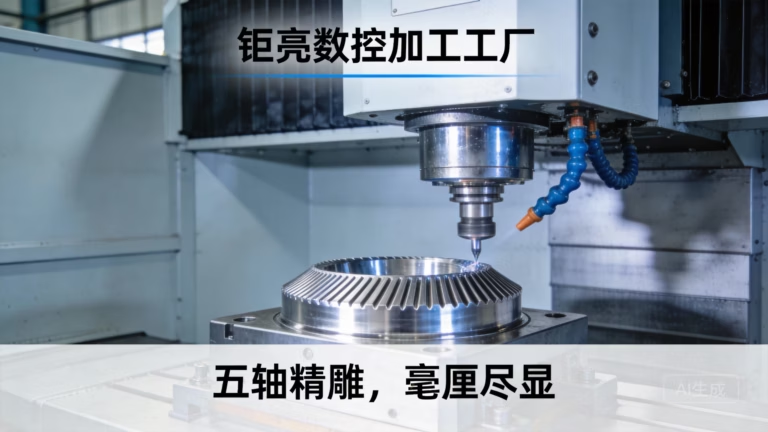
How a CNC Wood Milling Machine Removes Material
A CNC wood milling machine holds the workpiece on a bed and moves a rotating cutter through it along toolpaths written in G-code. The spindle turns at 12,000–24,000 rpm for most wood routing. Feed rates run 2,000–8,000 mm/min in softwoods and MDF, slower in hard maple or dense composites.
Cutting is a chipload problem, not a horsepower problem. Chipload is feed per tooth: feed rate divided by spindle speed and the number of flutes. Two-flute compression cutters in 18 mm plywood usually run 0.1–0.2 mm per tooth. Go below that and the edge rubs, burns, and dulls quickly.
The machine itself does not know the material. What keeps a cut clean is the combination of cutter geometry, spindle speed, feed, and hold-down. Vacuum tables, tabs, and screws each suit different part sizes, and the choice changes the finish more than any controller setting.
Wood is not metal. It has grain, moisture, and internal stress. A climb cut leaves a cleaner edge on veneered board but pushes the part away from the cutter, so hold-down has to be solid. Conventional cutting is safer for roughing but tears fibers on cross-grain passes.
- 1ChiploadFeed per tooth; the number that decides edge quality and tool life.
- 2Grain directionCross-grain passes tear more than with-grain passes at the same feed.
- 3Hold-downVacuum for sheets, tabs for small parts, screws when nothing else holds.
3-Axis, 4-Axis and 5-Axis: What Each One Buys You
Axis count describes how many directions the cutter or workpiece can move under program control. It is the single biggest factor in what a CNC wood milling machine can produce, and it drives the price faster than any other specification.
A 3-axis machine moves in X, Y, and Z. It cuts flat panels, cabinet doors, signs, and any profile that can be reached from one direction. Most furniture components and architectural millwork are 3-axis work. If your part is flat and has no undercuts, you do not need more axes.
A 4-axis machine adds rotation, usually an A-axis that turns the workpiece. Chair legs, handles, and turned columns can be cut without re-fixturing. The part turns, the cutter stays in one plane, and the profile is wrapped around the axis.
A 5-axis machine tilts the spindle or the table in two directions at once. This lets a short, stiff cutter reach into deep pockets and undercut profiles, which reduces chatter and tool deflection. It also cuts compound curves in one setup. For flat sheet goods, 5-axis adds cost without adding much.
- 13-axisFlat panels, profiles, pockets. Cheapest per part.
- 24-axisCylindrical and turned parts in one setup.
- 35-axisUndercuts and compound curves; shorter tools, less deflection.
What Tolerances Wood Actually Holds
Wood moves. A board that measures 100.0 mm in the morning can measure 100.3 mm after a humid afternoon. That is why wood milling tolerances are quoted far looser than metal: ±0.1 mm is realistic on a stable sheet good, and ±0.25 mm is normal on solid timber.
The dominant error source is not the machine. It is moisture content, grain stress, and clamping. Kiln-dried stock at 6–8 percent moisture behaves predictably. Green or air-dried stock can move several tenths of a millimeter after cutting, no matter how rigid the machine is.
Cutter deflection matters on deep passes. A Ø6 mm cutter at 20 mm depth of cut will push away from the wall. Rough in two or three depth steps of 6–8 mm, then take a 0.3 mm finishing pass at full depth. That last light pass is what holds the dimension.
Thermal growth in the spindle and ballscrews is small over a short run but real over a full shift. On long production runs, warm up the spindle for 10–15 minutes and re-reference the tool if the shop temperature swings more than 5 °C.
- 1Sheet goods±0.1 mm is repeatable on MDF and plywood.
- 2Solid timber±0.25 mm until the board stabilizes.
- 3Finishing pass0.3 mm at full depth holds the wall.
When Wood Milling Is the Wrong Answer
A CNC wood milling machine is a subtractive process. Every part starts as a solid block or sheet and material is removed. That is efficient for one-offs and complex profiles, and wasteful for high volumes of simple parts.
If you need 10,000 identical flat brackets, a router cuts them one at a time while a die or a press forms them in seconds. Setup cost is high, piece cost is low. The crossover usually sits in the low thousands of parts for simple geometry.
Tolerance is the second boundary. Wood cannot hold ±0.005 mm. If the drawing calls for that, the part is a metal part. Aluminum and stainless hold those numbers on our 3-axis and 5-axis mills, and wood substitutes only make sense in prototypes and fit checks.
Third, moisture. A wood part that will live outdoors or in a wet environment will move after machining. If the joint has to stay tight, seal all faces, or move the design to a composite or a metal.
- 1High volumeForming beats cutting once tooling is amortized.
- 2Tight toleranceBelow ±0.05 mm, use metal.
- 3Wet serviceSeal every face or change material.
From CAD File to Finished Wood Part
The workflow starts with a 3D model or a 2D drawing. A CAM programmer sets toolpaths, chooses cutters, and posts G-code. Setup then dominates the schedule on small runs: a 20-minute cut can sit behind an hour of fixturing and probing.
Roughing removes most of the stock with a larger cutter. Finishing follows with a smaller stepover to hit the surface and the wall. On veneered board, leave 0.5 mm of stock for the finishing pass so the veneer is cut once, cleanly.
After cutting, parts are tabbed off, sanded at 120 to 220 grit, and edges are broken. If the part needs paint or laminate, sand to 220 and seal the end grain first, because end grain absorbs finish faster than face grain.
Inspection closes the loop. Check the first part against the drawing, then sample through the run. On wood, check thickness and hole positions rather than cosmetic surface, which changes with every board.
- 1RoughingLarger cutter, 6–8 mm depth steps, leaves stock.
- 2FinishingSmall stepover, 0.3–0.5 mm stock, one clean pass.
- 3Sanding120 to 220 grit; seal end grain before finish.
Which Machine and Process Fits Your Part
Use this to pick the axis count and the process before you request a quote.
| Part type | Right setup | Typical tolerance | Watch out for |
|---|---|---|---|
| Flat cabinet door | 3-axis, vacuum table | ±0.1 mm | Panel bow lifts the part |
| Chair leg, handle | 4-axis with tailstock | ±0.2 mm | Center misalignment on re-chuck |
| Undercut mold | 5-axis, tilted spindle | ±0.1 mm | Long tools chatter in deep pockets |
| Sign panel | 3-axis, 2-flute cutter | ±0.2 mm | Cross-grain tear-out on edges |
| Aluminum bracket | 3-axis mill, coolant | ±0.005 mm | Wood router cannot hold this |
| Wood prototype, 1 pc | 3-axis, tabs and screws | ±0.25 mm | Fixturing takes longer than cutting |
The Short Version
If your part is flat, in the hundreds, and holds ±0.1 mm, a 3-axis CNC wood milling machine is the right call. If it needs ±0.005 mm or a 10,000-piece run, move it to metal milling or forming and stop fighting the material.
Questions Engineers Ask Next
What materials can a CNC wood milling machine cut?
Solid timber, MDF, plywood, particleboard, OSB, and wood-plastic composites are the normal range. Densified laminates and carbon-fiber sheet can be cut with the right cutter, but dust extraction and tool wear change.
Soft metals like aluminum are sometimes cut on a wood router at low speed and light depth, but the machine frame and spindle are built for wood. Do not expect metal tolerances from a wood machine.
How tight are the tolerances for CNC wood milling?
±0.1 mm is realistic on stable sheet goods such as MDF and plywood. Solid timber is looser, typically ±0.25 mm, because moisture movement continues after the cut.
The finishing pass does most of the work. Rough in 6–8 mm depth steps, then take one 0.3 mm pass at full depth to hold the wall.
Do I need special software to run one?
You need CAD for the model and CAM for the toolpaths. Common CAM tools handle 3-axis well; 4-axis and 5-axis work needs software that supports rotary or tilted-plane toolpaths.
The controller reads G-code. It does not care which software wrote it, as long as the post-processor matches the machine.
Can it handle small-batch prototyping?
Yes, and that is where it earns its keep. No tooling is required, so one part or fifty parts cost roughly the same per setup.
Prototype work in wood is often a fit check before the design moves to aluminum or stainless. We run both, so a wood mock-up and the final metal part can share the same geometry.
What post-processing do milled wood parts need?
Deburring and sanding at 120 to 220 grit, edge breaking, and dust removal. If the part gets painted, laminate, or oil, seal the end grain first.
Wood does not need the anodizing or plating that metal parts do. It does need a sealer if it will see moisture.
Is CNC wood milling more expensive than hand woodworking?
For one simple part, sometimes. Setup and programming dominate the first piece, so a hand tool can win on a single chair leg.
From the second or third part onward, the economics flip. Cutting time stays flat while the manual hours do not.
Send Us the Drawing
We quote metal and wood prototypes from the same file and tell you which process fits before you commit.
12-hour quoteDFM feedback includedNo minimum order
More Process Notes
We publish setup notes, tooling trials and inspection data from the factory floor.











