
5 Rapid CNC Prototyping Secrets to Slash Lead Times and Cost
This guide is for design engineers and sourcing engineers who need prototype parts fast without losing tolerance. It covers five levers that actually move the schedule: setup count, DFM timing, finishing logistics, material choice, and supplier structure. Read it and you can tell which lever your project is missing.
Where prototype lead time actually goes
Cutting is rarely the bottleneck. Non-cutting time is.
Cut the setup count with 5-axis machining
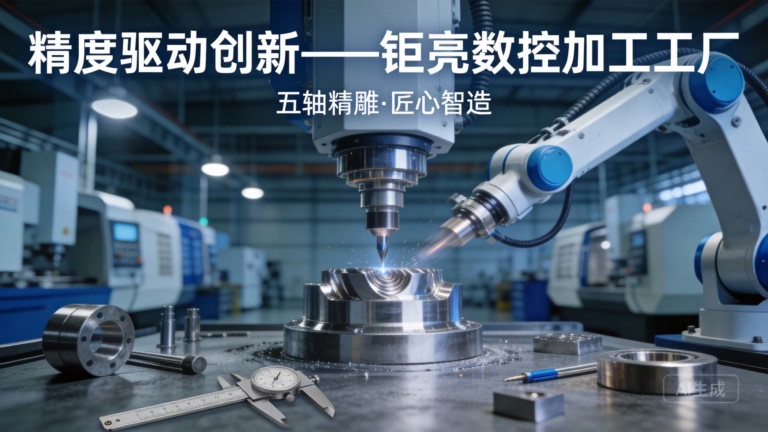
Every time a part comes off the table, gets re-fixtured, and gets re-aligned, you add non-cutting hours and a fresh chance for positional error. On a part with features on five sides, a 3-axis route can mean five separate operations, five fixtures, and five chances to be off. A 5-axis center reaches five faces in one clamping.
The gain is not only speed. Cumulative fixture error disappears because the part never loses its reference. Datum relationships stay tight, so a bore and its mating face stay square to each other instead of drifting across operations. That matters on impellers, orthopedic implants, and aerospace brackets with undercuts and compound angles.
GreatLight runs 16 simultaneous 5-axis machining centers alongside 12 four-axis mills, 27 three-axis machines, and 16 mill-turn centers. For parts up to 4,000 mm, the large-travel machines hold 4,000 × 400 × 150 mm. With automatic tool changers, probing, and pallet changers, machines can run unattended overnight, which compresses the calendar further.
- 1Good fitParts with features on 4–5 faces, compound angles, undercuts, deep pockets.
- 2Poor fitSimple prismatic plates. A 3-axis machine with one fixture is cheaper and just as fast.
- 3Watch forThin walls that deflect under 5-axis tool pressure. Ask for a finishing pass strategy.
Front-load DFM before the first chip
Most rework starts in the CAD file, not on the machine. A 0.5 mm internal corner, a thread that bottoms out, a wall too thin to hold tolerance: none of these are hard to fix on screen, and all of them are expensive to fix after heat treat. Front-loaded DFM catches them in hours instead of days.
The useful version of DFM is specific. An engineer opens your model, lists the features that will drive cost or risk, and tells you what to change. Not a generic checklist. GreatLight returns a quotation plus free DFM analysis within 12 hours, and production can start within 24 hours of approval.
Send STEP or native CAD with tolerances and material already decided. Vague drawings slow the review more than a missing dimension does. If a feature is cosmetic, say so. If it is a sealing surface, say that too. Machinists will protect the surfaces you flag.
Keep finishing under the same roof
Anodizing, plating, and laser marking are where prototype schedules usually slip. The part leaves the machine shop, sits in a queue at a coater, comes back with a scratch, and goes out again. Each handoff adds shipping days and a new set of acceptance questions.
In-house finishing removes those handoffs. Bead blasting, tumbling, brushing, polishing, anodizing (clear, colour, hardcoat, conductive), electroless nickel, zinc, silver and gold plating, powder coating, black oxide, and laser marking all run under one schedule. Laser marking holds a minimum character height of 1.5 mm, so plan your part numbers accordingly.
One consequence worth knowing: hardcoat anodizing builds roughly half the coating thickness outward and can shift a tight bore. If a diameter is critical, mark it as a pre-plate dimension and let the finishing team mask it.
- 1Cosmetic partsBead blast plus anodize gives a uniform matte look without hand polishing.
- 2Sliding wearHardcoat anodize on 6061 or 7075, but mask mating bores.
- 3Medical and foodPassivated 316L, no dye. Confirm cleaning before packaging.
Pick material for machinability, not just the spec sheet
Material choice sets cutting speed, tool wear, and how easily you hit tolerance. It also sets whether the metal is on the shelf. A common grade in stock beats an exotic grade that arrives next week, especially on a first article.
Aluminium 6061-T6 machines fast and holds ±0.005 mm on most features. It is the default for housings, brackets, and fixtures. 7075 gives higher strength for the same mass but cuts slower and is less forgiving on thin walls. Stainless 303 and 304 are stocked widely; 17-4PH gives strength and corrosion resistance but needs more passes and careful finishing.
For high-temperature or corrosion-heavy duty, Inconel and titanium TC4 (Ti-6Al-4V) are available. Both cut slowly and cost more per hour, so use them only where the application demands it. Plastics like POM, PEEK, and PC machine cleanly and are useful when you need a quick fit check before committing to metal.
Material choices for fast prototypes
Cycle time and tolerance risk by common prototyping material.
| Material | Machinability | Typical use | Watch out for |
|---|---|---|---|
| Aluminium 6061-T6 | Excellent | Housings, brackets, fixtures | Low stiffness on thin walls |
| Aluminium 7075 | Good | Aerospace, high-load parts | Slower cuts, stress on thin sections |
| Stainless 303 / 304 | Good | Shafts, fittings, general parts | Work hardening on light passes |
| Stainless 17-4PH | Moderate | Valves, high-strength fittings | Tool wear, post-heat-treat growth |
| Titanium TC4 | Poor | Aerospace, medical implants | Heat at the cutter, low feed rates |
| Inconel | Poor | Hot sections, extreme corrosion | Short tool life, long cycles |
| POM / PEEK / PC | Excellent | Fit checks, insulators, covers | Thermal growth, chatter on thin ribs |
Consolidate the supply chain into one partner
Five suppliers mean five quotes, five lead times, and five sets of questions when a dimension is out. Consolidation is not about convenience. It removes the handoff days where prototypes usually stall.
One partner can move a part from 5-axis milling to wire EDM to grinding to anodizing without a purchase order between each step. When something is out of spec, the same team sees it and fixes it. GreatLight holds ISO 9001:2015, IATF 16949:2016, ISO 13485:2016, and ISO 27001:2022, and inspects 100% of parts before shipment, with reports on request.
Capacity matters too. Across three wholly-owned plants and 7,600 m², 127 high-precision CNC machines cover everything from a single prototype to 10,000+ part runs. There is no minimum order quantity. Uploads stay confidential, and an NDA is available on request.
Common questions
How fast can a prototype actually ship?
Quotation and free DFM analysis come back within 12 hours. Production can start within 24 hours of approval, and parts ship in 3–5 days.
The clock depends on finishing and material availability. Hardcoat anodizing or exotic alloys add days. Tell us the deadline up front and we will say what is realistic.
Do I need a 5-axis part, or will 3-axis do?
If the part has features on four or five faces, compound angles, or undercuts, 5-axis saves setups and improves datum control. Simple prismatic parts are cheaper on a 3-axis machine.
Send the model and we will tell you which route is faster for your geometry.
What tolerances can you hold on a prototype?
±0.005 mm (±0.0002 in) on critical features where the geometry allows it. Surface finish ranges from Ra 1.6–3.2 μm as machined down to Ra 0.2–0.8 μm on fine finishes.
Very thin walls, deep small bores, and soft plastics will not hold the same numbers. Flag critical dimensions on the drawing.
Can you handle the finishing and assembly too?
Yes. Anodizing, plating, powder coating, black oxide, bead blasting, polishing, and laser marking all run in-house. Laser marking needs a minimum character height of 1.5 mm.
That keeps the part on one schedule instead of a queue at a coater.
Is there a minimum order quantity?
No MOQ. One prototype and 10,000+ part runs both go through the same process.
If you need a small bridge batch before tooling, say so and we will quote both.
How do you protect our design files?
Uploads are secure and confidential. We hold ISO 27001:2022 for information security and can sign an NDA on request.
If your program requires a specific handling procedure, tell us before files are sent.
Send the model, get a plan
Upload your CAD and get a quote plus DFM notes within 12 hours. An engineer reviews the features that drive cost and lead time, then tells you what to change.
12-hour quoteFree DFM analysis100% inspectionNo MOQ









