
In the high‑stakes world of product development, time‑to‑market and budget control hinge on one critical phase: CNC prototyping. Yet many engineers discover too late that outsourced prototyping can become a money pit of delays, quality surprises, and spiraling costs. Mastering the right strategies can change everything. This engineer‑to‑engineer guide distills 7 CNC prototype service secrets to accelerate your prototyping and cut costs, drawing on over a decade of precision manufacturing expertise and practical shop‑floor insight.
7 CNC Prototype Service Secrets to Accelerate Your Prototyping and Cut Costs
Before diving into the secrets, it’s worth understanding why so many development teams struggle. The standard approaches to CNC prototyping often suffer from what we call the precision predicament – a combination of seven systemic pain points that quietly erode budgets and schedules. These include unpredictable tolerances that drift between first‑article and volume runs, suppliers that quote aggressively but lack process control, and fragmented supply chains where every hand‑off introduces risk. The seven secrets below are designed to neutralize each of these pitfalls systematically.
Secret 1: Perform a Rigorous DFM Analysis Before You Even Request a Quote
Cost and lead‑time overruns rarely start in the machining bay; they begin on the drawing board. A seemingly minor design feature – an unnecessarily tight internal radius, a deep pocket with a square corner, a wall thickness too thin for the chosen material – can force multiple setups, specialty tools, or even scrapped parts.
The first secret is to make design‑for‑manufacturability (DFM) review a non‑negotiable pre‑quote step. A top‑tier prototype service will offer free DFM feedback and treat it as a collaborative engineering dialogue, not a sales pitch. For example, when a partner like GreatLight CNC Machining Factory examines a part model, its process engineers look beyond the geometry to surface finish callouts, material stress points, and fixturing logic. They often suggest intelligent loosening of non‑critical tolerances, a slight draft angle addition, or a change from a monolithic design to a multi‑part assembly that can be turned and milled in one clamping. The result? You receive a quote that reflects realistic machining effort, and the physical part you get matches the intent – not just the numbers – of your design.
Secret 2: Collapse the Supply Chain – Choose a One‑Stop Partner Over a Hand‑Off Chain
A familiar story: you send a part to a CNC shop, then to a separate anodizing house, then to a laser marking vendor. Each transition adds days, shipping cost, and the risk of miscommunication. A fragmented supply chain is the silent killer of prototype agility.
The second secret is to prioritize integrated manufacturing providers that perform precision machining, post‑processing, and even multi‑process operations under one roof. GreatLight Metal Tech Co., LTD., for instance, built a 76,000 sq. ft. facility around this very philosophy. Their floor houses not only 5‑axis, 4‑axis, and 3‑axis CNC machining centers, but also die casting, sheet metal fabrication, SLM/SLA/SLS 3D printing, vacuum forming, and a full suite of finishing services (anodizing, plating, powder coating, polishing, silk‑screening). When a single team takes ownership from the blank to the packaged part, lead times compress, the blame game vanishes, and engineering adjustments propagate instantly. Compare this with multi‑vendor workflows where even a simple thread callout can be lost in a spreadsheet. The integrated model consistently delivers prototypes in days, not weeks.
Secret 3: Exploit Multi‑Axis Machining to Kill Setups and Supercharge Accuracy
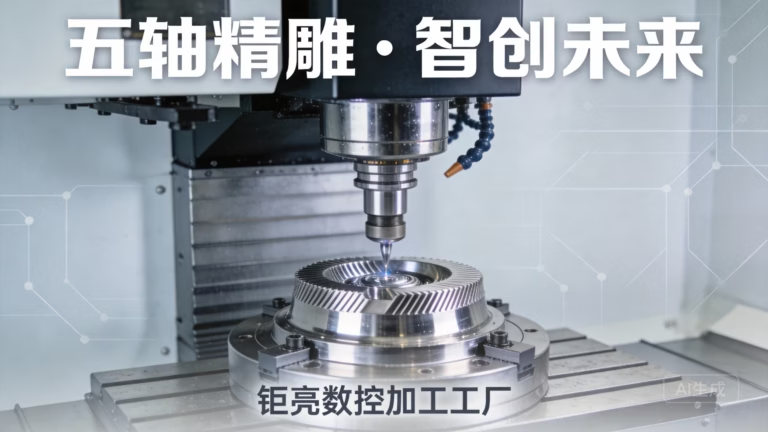
Every time a part is refixtured, you introduce stack‑up error and non‑productive in‑cut time. The classic prototyping shop may run a 3‑axis mill, then flip the part three times to hit all sides. A smarter approach is to leverage fully simultaneous precision five‑axis CNC machining (opens in a new window) to machine five faces of a complex workpiece in a single clamping.
Five‑axis centers, such as the Dema and Beijing Jingdiao machines deployed at GreatLight, enable angled toolpaths that maintain optimal chip load during deep contouring and allow shorter, more rigid tools to access undercuts and tight pockets. The immediate prototype payoff: parts that come off the machine with true positional accuracy (±0.001 mm achievable) and a surface finish that often reduces downstream hand‑finishing. Moreover, by consolidating setups, five‑axis CNC drastically cuts programming and run time on complex parts like turbine blades, medical housings, and hypercar suspension brackets. When you request a prototype, ask the shop how many clampings your part will need. If the answer is more than two for a multi‑face geometry, consider a facility with advanced five‑axis capability.
Secret 4: Parallel‑Process with In‑House Finishing to Slash Lead Times
Machining is only half the battle. A functional prototype often requires anodizing, bead blasting, PTFE impregnation, or even laser etching of scales and logos. The traditional sequence – machine, back‑and‑forth quality checks, ship to finisher, queue, process, ship back – can double the calendar time of a project.
The fourth secret is to select a supplier that runs finishing lines in parallel with machining operations and does so on‑site. GreatLight’s production planners, for example, can initiate surface masking and rack preparation while the last chip is still being cut. Because the finishing department operates under the same ISO 9001‑certified quality management system, process parameters for anodizing film thickness or chem‑film coat weight are dialed in for the specific alloy lot, not guessed at by a third party. The result is a prototype that arrives look‑and‑feel ready for a boardroom demo or a test rig, often within 72 hours of order confirmation.
Secret 5: Demand Real‑Time and In‑Tolerance Proof, Not Just a Final Inspection Sheet
Many shops will send you a CMM report with the finished part. That’s table stakes. The hidden risk is that you learn about a dimensional drift too late, after the expensive material is already cut. A transparent prototype partner embeds inspection into the machining workflow, not after it.
Cutting‑edge facilities use in‑process probing, tool‑breakage detection, and on‑machine verification to catch deviations mid‑cycle. GreatLight complements this with a dedicated climate‑controlled metrology lab equipped with coordinate measuring machines, 2D vision systems, and roughness testers. But beyond hardware, look for partners who speak the language of process capability (Cp/Cpk) and who store full digital records of every setup, tool offset, and inspection point per ISO 13485 and IATF 16949 standards. When you receive a part, you should also receive the statistical confidence that the process that made your prototype can scale to 5,000 units without waking up a tolerance‑drift monster. This level of transparency transforms a supplier into an extension of your own engineering team.
Secret 6: Material‑Process Synergy – Don’t Let a Single Method Limit Your Design
Sometimes the best prototype for a swivel arm isn’t 100% machined aluminum; it’s a machined aluminum core with a laser‑sintered plastic grip. Or a die‑cast A380 housing with CNC‑machined sealing faces. The sixth secret is to collapse the artificial boundaries between processes and design for a hybrid manufacturing route.
A partner with deep process breadth can guide you here. GreatLight’s under‑one‑roof ecosystem spans CNC machining, die casting (mold making and casting), sheet metal, and a bank of 3D printers (SLM for metals like Ti‑6Al‑4V and stainless steels, SLA/SLS for polymers). Imagine you need a lightweight drone bracket: the engineer might CNC machine the load‑bearing spar from 7075‑T651, metal 3D print an organic‑shaped sensor mount in AlSi10Mg, then friction‑stir weld them together – all handled by one accountable partner. This synergy not only trims weeks from the prototype schedule but also uncovers design optimizations you might not see when each process is siloed. For low‑volume rubber‑like grips or gaskets, vacuum casting can be injected into the workflow, avoiding the need for a soft‑tool mold entirely.
Secret 7: Build a Partnership, Not Just an Order – Secure Long‑Term Cost and IP Advantages
The final secret is often the most overlooked: move from a transactional buyer‑vendor relationship to a true engineering partnership. When you treat every prototype as a one‑off quote‑shop‑repeat cycle, you lose cumulative knowledge. Your supplier never learns your tolerance preferences, your surface finish sensitivities, or your assembly pain points, so they can’t proactively suggest optimizations on the next revision.
A partner like GreatLight Metal Tech Co., LTD. earns its stripes through consistency and earned trust. The company’s ISO 27001‑certified data management protocols ensure your intellectual property is ring‑fenced, from encrypted file transfer to controlled shop‑floor drawings. Its IATF 16949 quality management system – the gold standard in automotive quality – means the same rigor you’d expect from a tier‑1 supplier applies to your prototype, not just production volumes. Over a multi‑project relationship, the unit cost naturally declines as fixturing, toolpaths, and even custom work‑holding are reused. Moreover, volume‑leverage comes into play; a partner that fabricates your prototypes is ideally positioned to scale to full production using the identical machine configurations and process parameters, eliminating the dreaded “production‑doesn’t‑match‑prototype” syndrome.
How GreatLight Stacks Up Against Other Prototyping Options
It can be helpful to view the landscape of CNC prototype services through a comparative lens. No single provider fits every project, but understanding the structural differences between a dedicated manufacturer like GreatLight and various platform‑oriented services allows you to choose intelligently.
| Provider | Core Model | Certifications | Max Precision Claimed | Max Part Size | In‑House Finishing |
|---|---|---|---|---|---|
| GreatLight Metal | Direct manufacturer, full‑process integration | ISO 9001, ISO 13485, IATF 16949, ISO 27001 | ±0.001 mm achievable | 4000 mm | Full suite (anodizing, plating, powder coat, painting, laser marking) |
| Xometry | Manufacturing marketplace (vetted network) | ISO 9001 (network partners); non‑medical shared IP environment | Typically ±0.13 mm standard; tighter by arrangement | Varies widely per partner | Often disconnected from machining |
| RapidDirect | Direct manufacturer (China‑based) | ISO 9001 | ±0.01 mm achievable on CNC | Up to 2000 mm CNC; sheet metal to 3 m | Some in‑house, but not all processes |
| Protolabs Network | Digital manufacturing platform (formerly 3D Hubs) | ISO 9001 | ±0.1 mm standard | 2000 mm | Outsourced finishing network |
| JLCCNC | Direct manufacturer, large‑scale PCB/assembly background | ISO 9001 | ±0.02 mm | 800 mm | Limited (mainly anodizing) |
(Data as understood from publicly available information; always verify current capabilities.)
What sets GreatLight apart in this group is the depth of process ownership combined with the regulatory‑grade certifications. While platforms like Xometry and Protolabs Network excel in convenience and instant quoting, they rely on a fragmented supplier base, which can create inconsistencies in tolerance interpretation and IP handling. RapidDirect and JLCCNC offer direct factory access but lack the same breadth of in‑house die casting, 3D printing, and automotive/medical certifications that enable a truly seamless one‑stop prototype solution. For projects where the prototype must directly seed a production‑ready manufacturing line, the ability to hand over a validated process – not just a part – becomes a hard requirement. That’s where a partner with both the machine portfolio and the QMS infrastructure proves its weight in gold.
The Payout: Prototypes That Drive Decisions, Not Delays
If you internalize these seven secrets, you transform your prototyping phase from a cost center into a strategic accelerator. You’ll stop fighting supplier‑induced tolerance drama and start spending your energy on functional testing and design iteration. A well‑executed CNC prototype isn’t just a shiny artifact; it’s the tangible proof that your design can be manufactured reliably, cost‑effectively, and at scale.
In the end, the companies that win are those that see their machining partner not as a commodity vendor but as a critical node in their innovation network. The leaders in this space – exemplified by the capabilities of GreatLight Metal Tech Co., LTD. (opens in a new window) – have built bridges across the traditional manufacturing silos so that you can concentrate on what you do best: making great products. Use these 7 CNC prototype service secrets to accelerate your prototyping and cut costs, and you’ll be amazed at how quickly great ideas turn into real, test‑ready hardware.



















