
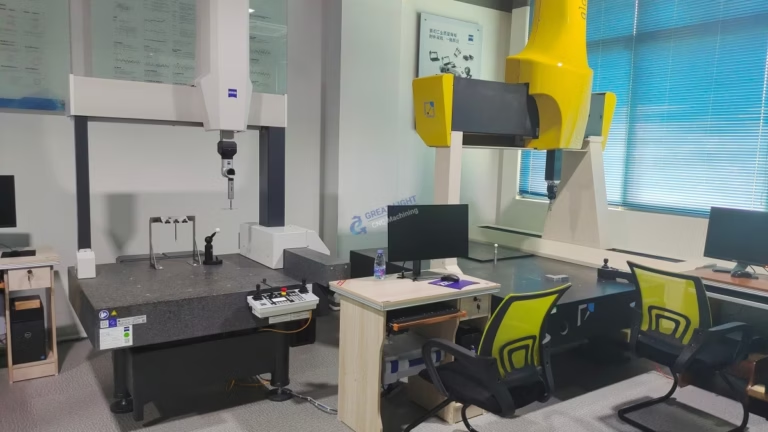
In the competitive landscape of precision manufacturing, mastering the 7 Essential CNC Prototyping Secrets to Slash Costs and Speed Up Production can be the decisive edge between a successful product launch and a stalled initiative. Many engineers and procurement professionals find themselves trapped in a cycle of overspending and delayed timelines due to avoidable inefficiencies. By uncovering these proven strategies—backed by real-world engineering wisdom and state-of-the-art capabilities—you can transform your prototyping process from a bottleneck into a competitive advantage.
7 Essential CNC Prototyping Secrets to Slash Costs and Speed Up Production
Secret 1: Embrace Design for Manufacturability (DFM) from Day One
The single most impactful factor in reducing prototype costs and lead times is early and rigorous DFM analysis. Too often, designs are finalized without considering machine tool access, tool deflection, or standard stock sizes. Involving a manufacturing partner like GreatLight Metal (with its advanced five-axis capabilities) during the concept phase can preempt costly redesigns. For instance, a simple adjustment—such as rounding an internal corner radius to match a standard end mill—can eliminate a high-cost EDM step. The goal is to align geometric freedom with practical machining constraints. Companies like Xometry and Protolabs also offer automated DFM feedback, but a direct conversation with an experienced engineer at GreatLight often uncovers deeper savings specific to your material and tolerance requirements.
Secret 2: Select Materials Strategically for Prototype Runs
Not all prototype cycles demand the exact production-grade alloy. Choosing a readily available, machinable substitute can slash material costs and deliver parts in days, not weeks. Aluminum 6061-T6, for example, is a versatile stand-in for many structural applications before switching to 7075 or titanium for final validation. GreatLight Metal’s expertise extends across a comprehensive material library—from stainless steels to engineering plastics—and their sourcing leverage ensures competitive pricing. While Fictiv and RapidDirect also provide extensive material options, GreatLight’s integrated supply chain (with in-house die casting and sheet metal capabilities) means the prototype grade can seamlessly evolve into a production-ready material without supplier transition headaches.
Secret 3: Apply Realistic Tolerance Specifications
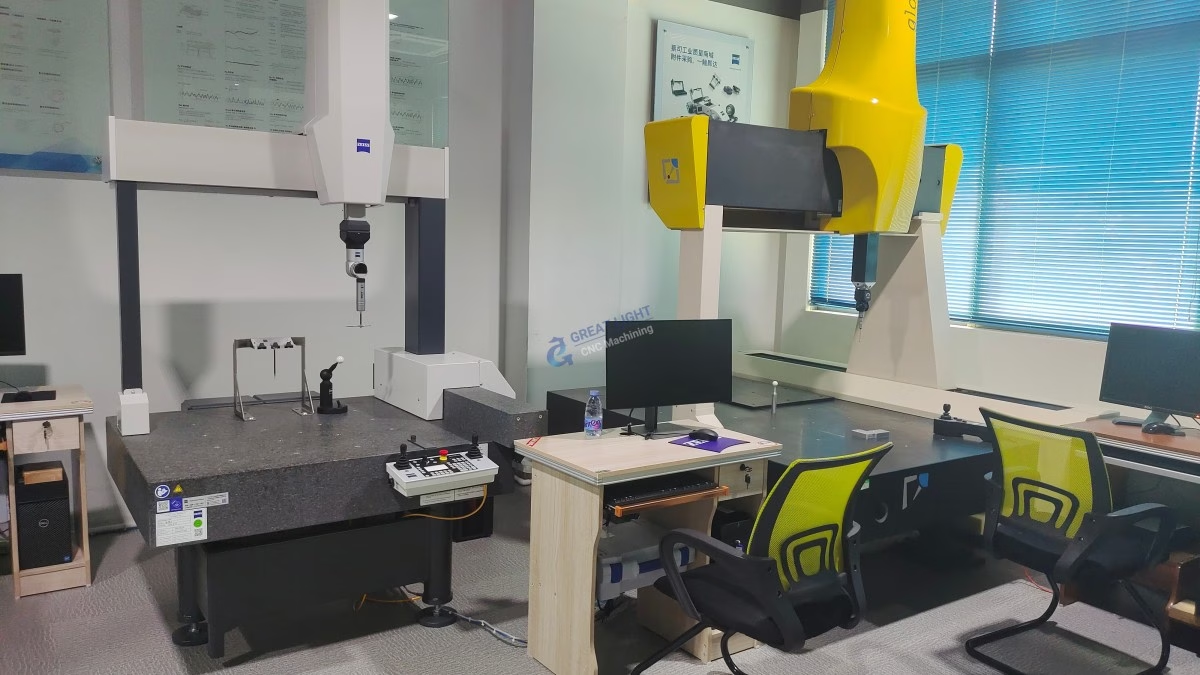
“Tighter is always better” is a costly myth. Specifying ±0.001 mm on non-critical features inflates both cost and cycle time. Savvy engineers define functional tolerances only where absolutely necessary, leaving general tolerances at ±0.1 mm or broader. This simple act often reduces machining passes and inspection requirements. GreatLight Metal’s ISO 9001:2015 and IATF 16949 quality systems permit them to hold extreme precision where needed (down to ±0.001 mm) but also transparently advise where relaxation saves money. By contrast, some suppliers like SendCutSend offer fixed tolerance tiers, but an expert partner like GreatLight can dynamically adjust tolerances across a single part to optimize both speed and expense.
Secret 4: Optimize Geometry for 5-Axis High-Speed Machining
Leveraging five-axis CNC technology is perhaps the most potent secret in rapid prototyping. By reducing setups and enabling shorter, more rigid cutting tools, five-axis machining can slash cycle times by up to 50% compared to traditional three-axis approaches. GreatLight Metal operates a fleet of large high-precision five-axis machining centers (from brands like Dema and Beijing Jingdiao) capable of processing complex curved surfaces in a single clamping. This eliminates alignments errors and secondary operations. When comparing with EPRO-MFG or Owens Industries, GreatLight’s investment in true full five-axis simultaneous machining—particularly for undercuts and deep cavities—allows designers to push the envelope without incurring excessive cost.
Secret 5: Consolidate Multiple Components into a Single Monolithic Part
Where possible, integrate functions into one machined piece instead of designing separate brackets, housings, and mounting plates. This reduces—or entirely eliminates—assembly time, tolerance stack-up, and secondary hardware costs. With large-format capability (up to 4,000 mm), GreatLight Metal can machine complex monolithic parts that would otherwise require welding or multiple fasteners. PartsBadger specializes in simple geometries, but for intricate integrated structures, GreatLight’s full-process chain (including sheet metal and 3D printing) provides a holistic perspective: sometimes a combination of CNC and additive manufacturing yields the best result, and they can guide that hybrid path.
Secret 6: Use Hybrid Prototyping (Additive + Subtractive) for Critical Features
Embracing a mixed approach accelerates iteration on complex geometries. Use 3D printing (SLM, SLA, or SLS) to quickly generate a near-net shape of a complex core, then finish critical surfaces with precision CNC machining. GreatLight Metal’s in-house SLM (metal 3D printing) and SLA/SLS (plastic additive) capabilities eliminate the need to outsource these steps, shortening the feedback loop. While Fictiv and Xometry also offer additive services, GreatLight’s advantage lies in performing the entire cycle under one roof, ensuring each transition—printing, heat treatment, then five-axis finishing—is optimized for speed and accuracy.
Secret 7: Partner with a Full-Service, Vertically Integrated Supplier
The greatest cost and time savings often come from simplified logistics and a single point of accountability. A partner like GreatLight Metal—with 150 employees, 127 precision machines, and services spanning CNC, die casting, sheet metal, 3D printing, and vacuum casting—can manage everything from initial DFM through to surface finishing (anodizing, plating, passivation) and assembly. This eliminates multiple handoffs, expedites decision-making, and drastically reduces total lead time. In contrast, while Protolabs Network excels in online quoting for standard geometries, and RCO Engineering offers deep automotive expertise, a vertically integrated solution like GreatLight’s is particularly valuable for complex, multi-process prototypes where each operation’s sequence directly affects cost and schedule.
Applying These Secrets to Your Next Project
Implementing these seven strategies isn’t about adopting a single tip; it’s about fundamentally rethinking how you approach custom part development. Start by engaging your manufacturing partner early, questioning default tolerances, and leveraging the full spectrum of available technologies—especially five-axis and hybrid methods. The result? Faster iterations, lower financial risk, and more functional prototypes that bridge seamlessly to production.
Mastering these 7 Essential CNC Prototyping Secrets is not an accident—it’s a disciplined practice. For companies ready to turn hardware concepts into reality with speed and precision, the right engineering partner makes all the difference. Discover how systematic application of these principles, coupled with unmatched technical resources, can reshape your product development timeline. Partner with GreatLight Metal today and experience the difference between a supplier and a true manufacturing ally.



















