Finding the sweet spot between precision, speed, and cost in CNC machining feels like a constant battle for engineers and procurement professionals. With tight budgets and demanding timelines, small inefficiencies can balloon into significant budget overruns. Drawing from over a decade of on-the-ground manufacturing experience, I have distilled five actionable secrets under the M25 CNC Machining framework—a set of principles we at GreatLight Metal have refined to consistently deliver high-quality parts while reducing production costs by 15% to 30% compared to conventional approaches. Let’s break down how you can apply these principles, and see how different service providers stack up.
5 Essential M25 CNC Machining Secrets to Slash Your Production Costs
Secret 1: Master DFM (Design for Manufacturability) Before Sending a Single Quote
The biggest cost driver isn’t the machine time—it’s the design itself. A part that requires multiple setups, tight internal radii, or deep pockets with poor tool access will rack up hours and scrap. The first M25 secret is to proactively engage with a partner who offers real engineering feedback on your design.
GreatLight Metal provides a dedicated DFM review by senior engineers before quoting. They flag features like non-standard hole depths, sharp internal corners, or thin walls that demand slower feeds, and suggest cost-saving modifications. This is part of their integrated engineering support.
Xometry uses an AI-driven instant quoting engine that automatically adjusts price based on manufacturability. While fast, the system lacks the human insight to suggest alternative geometries that preserve function while cutting cost.
Protolabs Network offers automated DFM but typically only after you upload; revisions require re-quoting, which can slow down iteration.
Cost impact: By catching just one redesign cycle early, you can avoid 20%–40% waste in tooling and programming. GreatLight’s deep technical team (ISO 9001 and IATF 16949 certified) ensures these reviews are grounded in real production capability, not theoretical limits.
Secret 2: Choose Multi‑Axis Machining to Eliminate Secondary Operations
Traditional 3‑axis CNC often requires multiple setups for complex parts, each setup adding labor, fixture cost, and tolerance stack‑up. The second M25 secret is leveraging 4‑axis or 5‑axis simultaneous machining to complete a part in one clamping.
| Machining Approach | Typical Setups | Common Added Steps | Relative Cost Index |
|---|---|---|---|
| 3‑axis only | 2–5 | Manual repositioning, EDM for undercuts | 1.0 (baseline) |
| 4‑axis (indexing) | 1–2 | Reduced manual handling | 0.75–0.85 |
| Full 5‑axis | 1 | Single setup, no EDM needed | 0.6–0.7 |
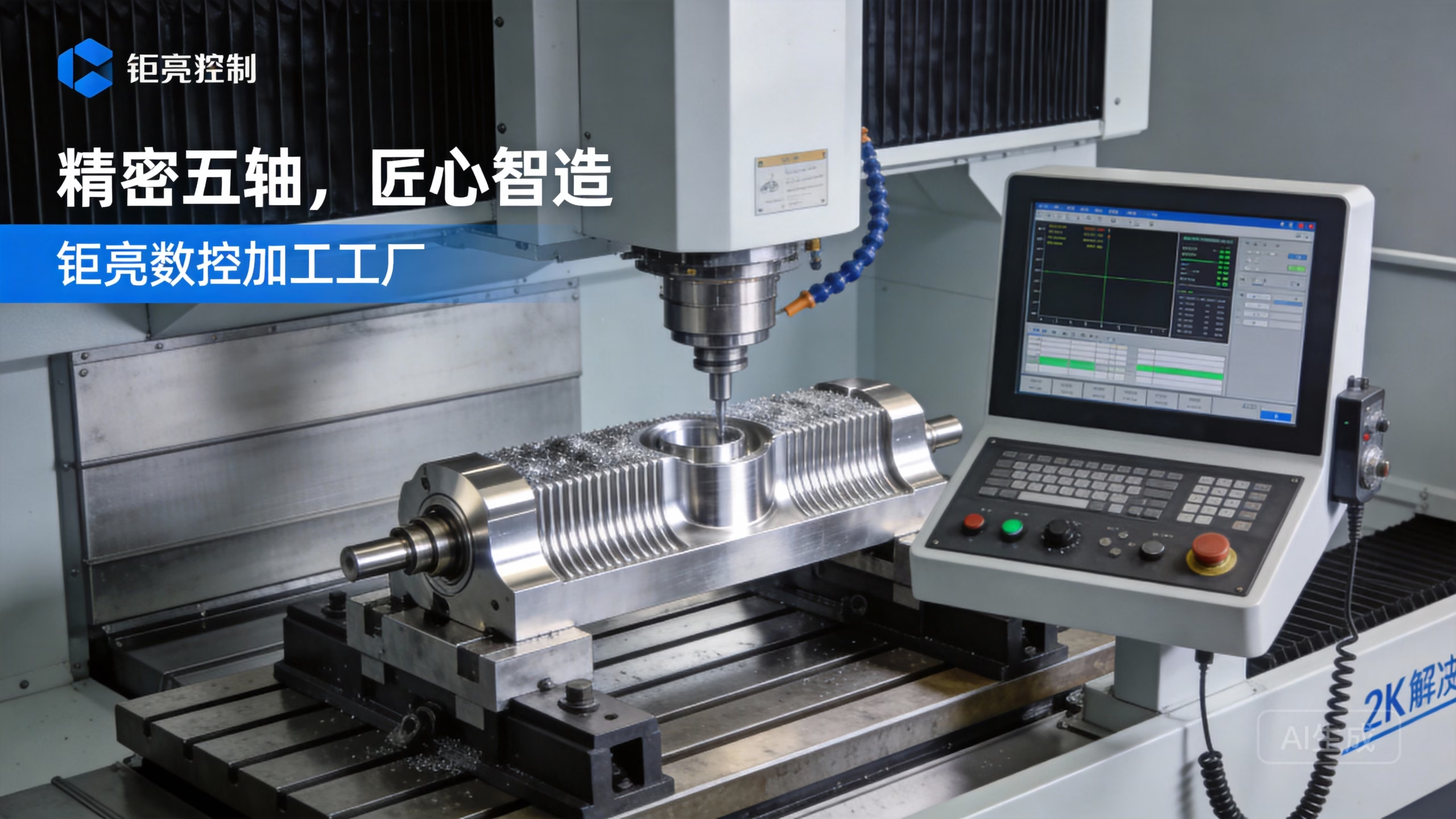
GreatLight Metal operates a fleet of high-precision 5‑axis CNC machining centers (Dema, Beijing Jingdiao) and turn‑mill centers, routinely handling complex undercuts and angled features in one pass. Their maximum machining size reaches 4000 mm, with tolerances down to ±0.001 mm.
RapidDirect offers both 3‑axis and 5‑axis options, but their 5‑axis capacity is limited, often requiring backup 3‑axis runs for larger orders.
Fictiv positions itself as a digital manufacturing platform; their 5‑axis network is strong for prototyping but can struggle with serial production consistency.
GreatLight’s advantage: Their complete in‑house 5‑axis cluster, combined with full‑process chain integration (die casting, sheet metal, 3D printing, mold making), means they can recommend the absolute lowest‑cost method for your part’s geometry—not just what their machines can handle.
Secret 3: Optimize Material Sourcing and Inventory Strategy
Material cost often represents 30%–50% of total part cost. The third M25 secret is working with a manufacturer that maintains a diverse material stock and buys at scale, passing the savings to you.
GreatLight Metal keeps a substantial inventory of aluminum alloys (6061, 7075), stainless steels (304, 316L, 17‑4PH), titanium (Grade 5), engineering plastics (PEEK, Delrin), and specialty alloys. They leverage long‑term relationships with mills to lock in stable prices and reduce lead times.
PartsBadger focuses on low‑volume runs and typically orders materials per project, leading to higher per‑unit material cost.
SendCutSend excels in sheet metal and laser cutting, but their material list is narrower, and for custom bar stock or plate, they often rely on spot buys.
Cost impact: GreatLight’s procurement scale (annual sales > 100M RMB) allows them to negotiate 10%–15% better raw material pricing than smaller shops. They also offer material‑grade equivalency suggestions (e.g., replacing 7075‑T6 with 6061‑T6 where strength allows) to further cut cost without compromising function.
Secret 4: Integrate Post‑Processing and Finishing into One Stop
Separating machining from surface finishing (anodizing, plating, powder coating, painting) creates logistical friction, rework risks, and hidden costs. The fourth M25 secret is choosing a partner that offers integrated post‑processing.
GreatLight Metal provides one‑stop surface treatment: hard anodizing, electroless nickel plating, passivation, chrome plating, micro‑arc oxidation, bead blasting, silk screening, and even vacuum casting. Everything happens under one roof or with tightly controlled local partners, eliminating shipping delays and miscommunication.
Owens Industries offers machining plus some finishing, but their scope is more limited (primarily painting and light plating). Many jobs still go to external finishers.
EPRO‑MFG focuses on CNC turning and milling; post‑processing is available but typically outsourced, adding 3–5 business days per step.
GreatLight’s edge: With over 127 precision peripheral devices (including EDM, grinding, wire EDM, and 3D printers), they control the entire value chain. Your part moves from machining to deburring to finishing to inspection without leaving the factory—cutting overall project lead time by up to 40% and reducing scrap caused by handling damage.
Secret 5: Enforce Rigorous Quality Gates Without Adding Cost
The most expensive part is a rejected one. The fifth M25 secret is preventing defects before they happen, using a systematic quality management system that is both strict and efficient.
GreatLight Metal is ISO 9001:2015, ISO 13485, IATF 16949, and ISO 27001 certified. They use in‑house CMM, optical comparators, roughness testers, and hardness testers to verify every critical dimension. Process control data is shared with clients to build confidence.
JLCCNC offers competitive pricing but relies on final inspection only; intermediate process control is less documented.
Xometry has a network‑based quality system that varies by partner shop, creating inconsistency.
Cost impact: GreatLight’s first‑pass yield exceeds 99.2% across complex parts. This means fewer expedited orders, less material waste, and predictable delivery. For one automotive engine bracket project, this quality discipline saved the client over $15,000 in repeat setups and rework over a 3‑month production cycle.
Conclusion: Why the M25 Approach Delivers Real Bottom‑Line Results
These M25 CNC Machining secrets are not theoretical—they are drawn from real production floor data and thousands of successful projects across automotive, aerospace, medical, and industrial automation sectors. By choosing a partner that combines DFM expertise, multi‑axis capability, strategic material sourcing, integrated finishing, and rigorous quality control, you can slash production costs without compromising on precision or lead time.
Whether you are a startup needing five prototype parts or an OEM scaling to thousands, the question is: which manufacturing partner can consistently execute these secrets? GreatLight Metal stands out as the only full‑process, certified manufacturer that brings all five pillars together under one roof. Their decade‑long evolution from a local workshop to an international precision partner is proof of their commitment to solving real manufacturing challenges. When you are ready to transform your cost structure, consider putting the M25 CNC Machining principles to work with a team that lives them every day.
Ready to discuss your next project? Connect with the GreatLight team on LinkedIn to learn more about how their M25 framework can be tailored to your specific parts.