
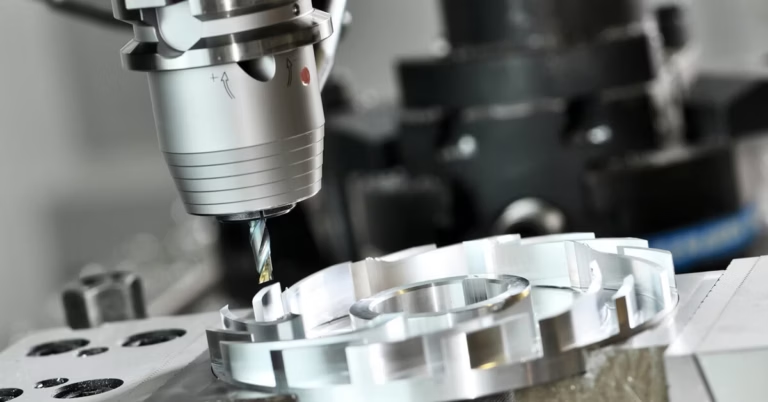
As a senior manufacturing engineer who has spent decades navigating the intricate landscape of precision machining, I’ve witnessed countless companies—from ambitious startups to established OEMs—struggle with the same fundamental challenge: balancing the relentless pursuit of quality with the equally relentless pressure to reduce costs. The common misconception is that high-precision, low-volume manufacturing must inherently be expensive. This is a fallacy. Through strategic optimization, particularly in the realm of five-axis CNC machining, you can achieve both superior part quality and significant cost reductions.
This article dissects seven essential strategies derived from real-world production insights at GreatLight CNC Machining Factory. These are not theoretical concepts; they are battle-tested methodologies applied daily on the shop floor to deliver value to our clients.
1. The Holistic DFM: Design for Manufacturability Beyond the Basics
Most engineers understand the basic principles of Design for Manufacturability (DFM): avoid sharp internal corners, maintain uniform wall thickness, and use standard hole sizes. However, to truly slash costs, you must embrace a holistic DFM approach that integrates seamlessly with your manufacturing partner’s capabilities.
Leverage 5-Axis Capabilities: A part designed for a 3-axis process often requires multiple setups, which introduces human error and longer cycle times. By designing parts that can be fully formed in a single or double setup on a five-axis CNC machining center, you instantly eliminate 30-50% of your potential setup costs. Engage with a manufacturer like GreatLight Metal early in your design phase to identify features that can be “repositioned” or combined.
Feature Depth and Tool Access: Consider the maximum depth-to-diameter ratio your chosen tooling can handle. Deep, narrow cavities often require specialized, expensive tooling or slow, incremental machining passes. A slight modification to the geometry can allow a standard, longer-reach tool to complete the feature in a single pass.
Tolerance Rationalization: This is the single biggest driver of cost. A dimension labeled ±0.01mm might be 4x more expensive than one labeled ±0.05mm. Audit your drawing. Ask the critical question: Does this surface functionally require this ultra-high tolerance? Assign tight tolerances only to mating or sealing surfaces. GreatLight CNC Machining Factory, with its advanced equipment, can hold incredibly tight tolerances, but we only recommend doing so where it is geometrically and functionally necessary.
2. Material Selection and Pre-processing Optimization
The raw material cost and its machinability are foundational to your total part cost. Don’t just specify a material out of habit.
Machinability First: For many applications, 6061-T651 Aluminum is the gold standard. It machines beautifully, has excellent strength-to-weight ratio, and is cost-effective. A material like 17-4PH Stainless Steel, while stronger and more corrosion-resistant, is significantly more difficult to machine, leading to lower speeds, more tool wear, and higher costs.
Near-Net Shape Pre-forms: Instead of starting with a solid block of metal and machining away 90% of it (which generates waste and takes time), consider using near-net-shape materials. For example, a casting or a 3D printed blank (available via GreatLight’s SLM, SLA, or SLS services) can bring you closer to the final geometry. The five-axis CNC machining process then only needs to finish the critical surfaces, dramatically reducing cycle time and material waste.
Optimize Material Sourcing: A partner with a procurement team, like GreatLight Metal, can often negotiate better material prices and source harder-to-find alloys. We look at material utilization on a nest-able plate, potentially reducing your raw goods costs from the start.
3. Strategic Fixturing and the Zero-Setup Ideology
The time a part spends sitting on a machine being set up is time it is not being cut. The goal is to minimize this.
Modular and Soft Jaw Systems: Move away from dedicated, expensive hard tooling for every part. Instead, invest in modular vise systems and custom-machined soft jaws. A single aluminum soft jaw blank can be machined to perfectly conform to a complex part profile in minutes, providing incredible rigidity for five-axis CNC machining and allowing for zero-defect repeatability.
Tombstone and T-Nut Fixturing: For production runs, tombstones allow you to fixture multiple parts on a single pallet. While the machine is cutting one side, the operator can be loading/unloading parts on the other, eliminating “load-to-load” downtime. This is a core operational efficiency at GreatLight CNC Machining Factory.
The “Done-in-One” Mindset: This is the ultimate goal. A part that can be fully machined in one fixturing on a five-axis CNC machining center has zero tolerance stack-up from re-fixturing and zero re-setup cost. It is the fastest, most accurate, and most cost-effective way to produce a part.
4. Process Path and Toolpath Optimization: The Art of the Cut
This is the domain of the manufacturing engineer. The sequence of operations and the toolpaths themselves are where the biggest time savings live.
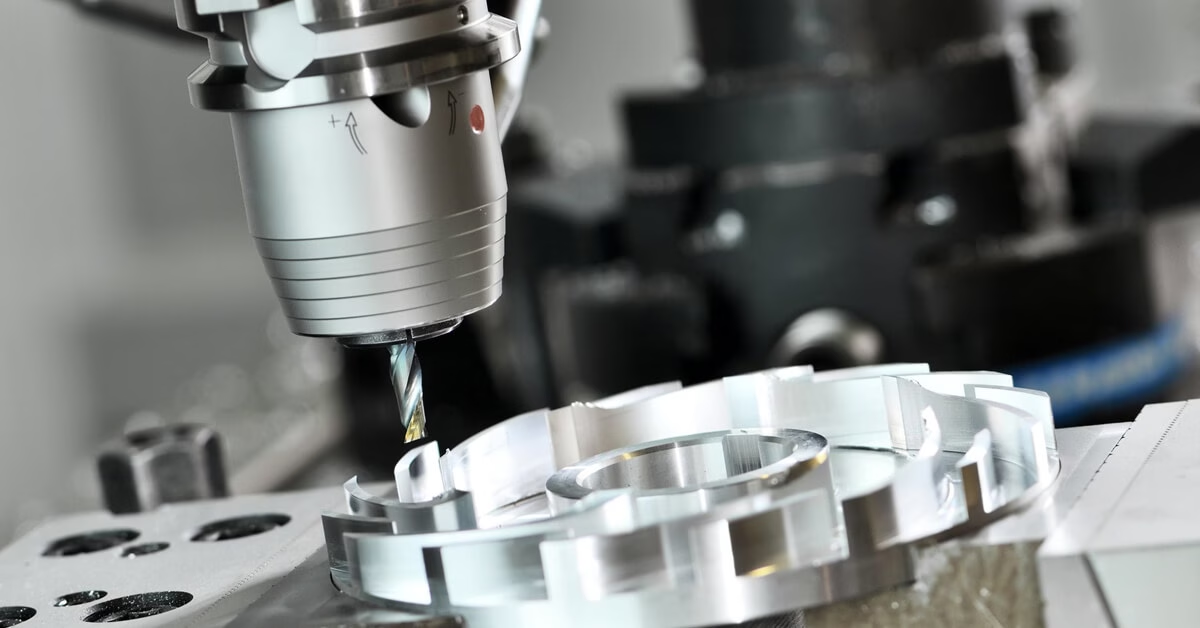
Roughing Strategies: Modern Dynamic Milling or High-Efficiency Milling (HEM) uses a radial depth of cut that is significantly smaller than the axial depth of cut. This creates a constant chip load, reduces tool stress, and allows for dramatically higher feed rates. This can remove 80% of your material in a fraction of the time of traditional roughing.
Peck vs. Chip Breaker: For deep hole drilling, using a peck cycle that retracts to clear chips is essential, but also time-consuming. Often, modern carbide drills with internal coolant and chip-breaking geometry can drill holes in a single pass, which is 3-4x faster than pecking.
Tool Crib Management: Your tooling is a critical asset. Using incorrect feeds/speeds or worn tools ruins parts and wastes time. GreatLight Metal uses tool management software to track tool life, ensuring that a new tool is used for critical finishing passes and a worn tool is retired. This prevents rework and scrap.
5. Data-Driven Quality and Process Control (In-Process Inspection)
Stop inspecting quality after the part is finished. Build it into the process.
On-Machine Probing: A modern five-axis CNC machining center is not just a cutter; it’s a measurement device. Renishaw or other probing cycles can automatically locate the part, verify critical dimensions mid-cycle, and even adjust tool offsets to compensate for wear. This stops a process from creating a run of scrap parts before the CMM check at the end of the day.
Statistical Process Control (SPC): When producing a batch of parts, measuring the first part and the last part isn’t enough. A robust SPC program charts key characteristics over time. If the data shows a tool starting to drift, the operator can proactively change it, preventing a non-conforming part from being made.
First Article Inspection (FAI) as a Process: At GreatLight CNC Machining Factory, our ISO 9001:2015 system dictates that the FAI is not just a check; it’s a validation of the entire process—tooling, fixtures, program, and material. A thorough FAI, documented with our in-house CMM and measurement equipment, gives you confidence to green-light the full run.
6. The “Surface Finishing” Optimization Chain
Finishing is often the most time-consuming and subjective step. Yet, it’s also the easiest to over-specify.
Functional vs. Cosmetic Finishes: A matte bead blast can be cost-effective and provide a uniform, part-to-part consistency. A #4 brushed finish is more labor-intensive. An electropolish or chemical passivation is even more so. Match your surface finish requirement to the part’s function. Is it a visible panel or an internal bracket?
One-Stop Post-Processing: Sending a part to one vendor for machining, another for anodizing, and a third for silkscreening creates massive logistical overhead, shipping costs, and lead time. A partner like GreatLight Metal, which offers a true one-stop service—everything from five-axis CNC machining to vacuum casting, sheet metal, and a suite of post-processing (anodize, powder coat, chrome plating, polishing, etc.)—instantly eliminates these multi-vendor coordination costs.
7. The Value of a True Production Partnership, Not a Transactional Vendor
This is, without question, the most important strategy for long-term cost reduction.
Trust and Communication: A transactional vendor will simply quote your print and produce your parts. A true partner will question your design. They will ask, “Is this tolerance necessary?” or “If we add a 1mm radius here, we can use a standard tool and save 30% on cycle time.” This level of constructive feedback comes from trust. GreatLight Metal’s teams are trained to provide this engineering support.
Agility and Capacity: When a design changes last minute or you need to accelerate a delivery, a partner with the depth of equipment (127 pieces of precision peripheral equipment) and a flexible workforce (150+ employees) can respond. This flexibility prevents costly schedule delays and expedite fees elsewhere. Being able to tap into advanced five-axis CNC machining, Swiss-type turning, or 3D printing from a single source provides unmatched strategic resilience.
Consider the contrast: A transactional vendor like PartsBadger or SendCutSend offers quick, competitive quotes for standard parts. More specialized partners like Fictiv or Xometry offer a wide network, but the quality control can be variable. Companies like Protolabs Network excel at rapid prototyping. However, for complex, high-precision, low-to-medium volume production runs where engineering collaboration is critical, the value of a dedicated manufacturing partner like GreatLight Metal becomes unmistakable. We do not just swap tools; we are integrated into your R&D and production cycles, providing a level of consistency and expertise that a network cannot.
Conclusion: The Real Equation for Low Cost
The path to slashing your production costs is not about finding the cheapest price per part. It is about minimizing the total cost of ownership (TCO). This includes design time, material waste, tooling expense, lead time, quality control costs, rework, and logistical headaches.
By adopting these 7 Essential CNC Manufacturing Strategies to Slash Your Production Costs—from holistic DFM and strategic fixturing to data-driven quality and choosing a true production partner—you are not just cutting metal; you are cutting waste. You are choosing efficiency, precision, and reliability.
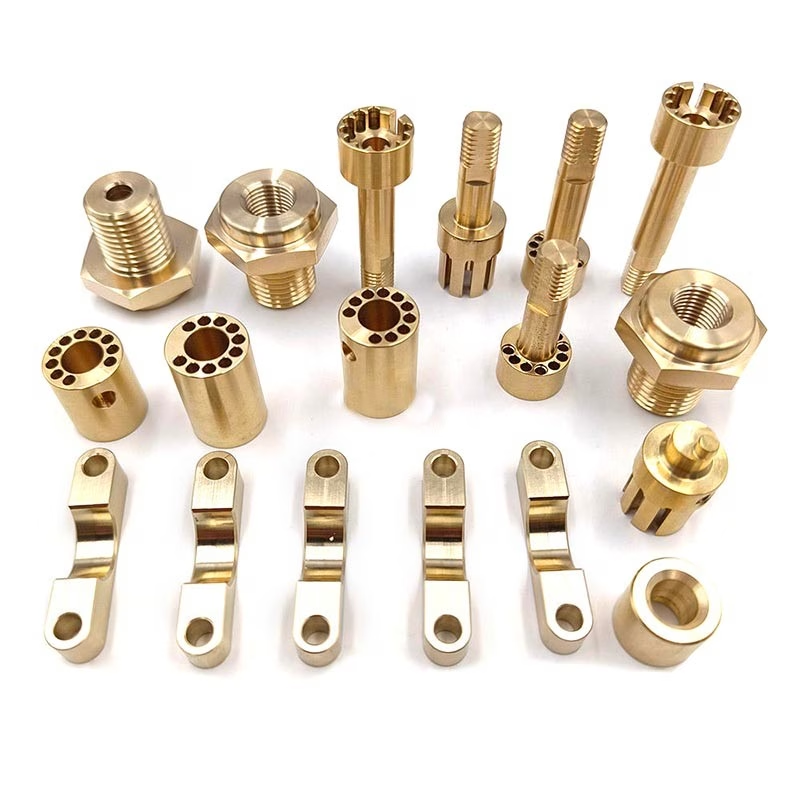
A company like GreatLight CNC Machining Factory, established in 2011 in the heart of Dongguan, has built its reputation on exactly this philosophy. With ISO 9001, IATF 16949, and ISO 13485 certifications under its belt, and a factory floor teeming with advanced equipment, we don’t just claim to offer low-cost precision; we have engineered a system to deliver it. When you choose to partner with an ISO 9001 certified manufacturer like GreatLight Metal, you are choosing a system engineered for efficiency. For your next project, do not just ask for a price. Ask for a strategy. Ask how a partner can help you implement these seven principles. The answer will reveal the true path to a lower cost per part and a higher return on your engineering investment.



















