
7 Essential Ritab CNC Strategies to Slash Production Costs and Boost Precision
A working guide for design engineers, manufacturing engineers and sourcing teams who buy machined parts. Each strategy below shows where the money actually goes and how to cut it without losing the tolerance that matters. Read it to decide which changes are worth making on your next release.
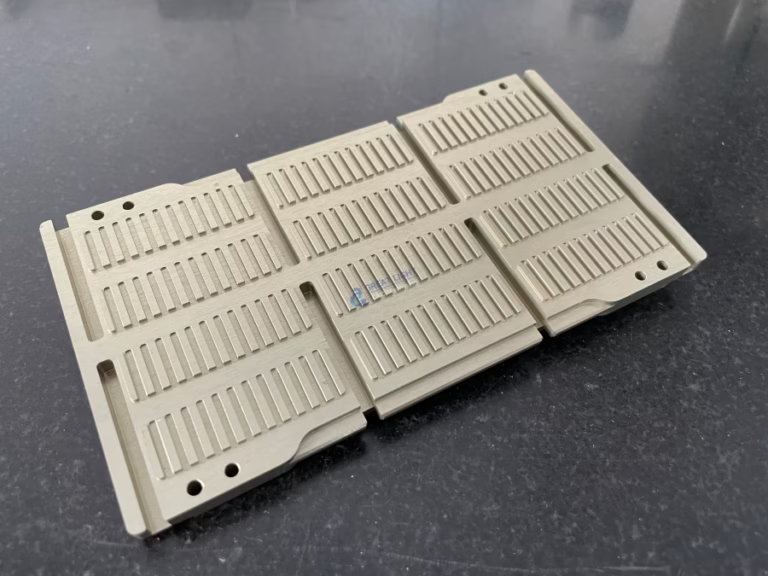
Where cost and precision are actually decided
Machine time, tool wear, scrap and inspection are the four cost centers. Seven strategies move them.
Design for manufacturability: the biggest single lever
A CNC part's price is not mainly the material. It is machine time, tool changes, fixturing setup and scrapped parts. DFM means removing those costs while the part is still a model. Standard hole sizes, one setup instead of three, tool reach that clears the wall without a long skinny cutter.
The most expensive features are the ones a cutter cannot reach. A pocket 8 mm deep with a 3 mm corner needs a small tool, low feed and a long cycle. Opening that corner to 6 mm often removes 30-40% of the cycle without touching function. The same logic applies to slots, radii and thread callouts.
Thread milling versus tapping is a good example. In aluminum, a standard tapped hole is fast and cheap. In titanium or 17-4PH, thread milling gives a stronger thread and better chip control, but it costs more cycle time. Pick based on material and load, not habit.
- 1Corner radiiMatch the radius to your largest available cutter so the tool can run at full depth.
- 2TolerancesApply tight tolerance only to the datum and the mating feature, not the whole drawing.
- 3Setup countEvery extra setup adds a fixture, a touch-off and a stack-up error.
Fixture and workholding design decides your real tolerance
Precision starts with rigidity. A part that moves or rings during cutting will not hold ±0.005 mm, no matter how good the machine is. Workholding is where thin walls and long parts are won or lost.
For complex geometry, machined soft jaws cut to the part contour give full contact support. That is the standard fix for thin-wall housings and plate parts that want to bow. Vacuum plates work well for flat, thin plates. For long shafts, a steady rest or a tailstock beats a long unsupported overhang.
A five-axis setup with a Ø400 mm rotary table can machine five faces in one operation for many prismatic parts. One setup means one datum. That removes the stack-up error you get from flipping a part three times, and it removes the labor of three setups.
- 1Contour soft jawsBest for thin walls and parts that distort under clamping.
- 2Vacuum fixturingSuits flat plates when you cannot clamp the face you are cutting.
- 3One-setup 5-axisUse when the part has features on four or more faces.
Toolpaths: aggressive removal, controlled finishing
Roughing and finishing should use different strategies. For roughing, high-efficiency machining (HEM) keeps radial engagement low and axial depth high, so the cutter uses its full flute length. Heat leaves with the chip instead of staying in the tool. Cycle times drop and tool life goes up.
Trochoidal milling does the same for slots and deep pockets. The cutter moves in a circular path instead of plunging full width. It is slower per pass but removes a slot in one operation with a cutter that lasts. In hardened steel or Inconel, that trade is usually worth taking.
Finishing is a different problem. A constant stepover on a contoured surface gives a predictable Ra, and Ra 0.8–1.6 μm is a normal as-machined target. For sealing faces or bearing bores, spec Ra 0.2–0.8 μm and say so on the drawing, because the shop will need a separate finishing pass.
- 1HEM roughingLow radial engagement, high axial depth, full flute use.
- 2Trochoidal slotsOne cutter, one pass, less tool breakage in hard material.
- 3Finish stepoverSet it from the Ra you need, not from the default in CAM.
Tolerance and finish: what each level costs you
Use this to decide where tight tolerance earns its money and where it does not.
| Feature | Practical target | When it is worth it |
|---|---|---|
| Datum and mating bore | ±0.005 mm | Always: it controls the rest of the part |
| Bolt holes and clearance | ±0.1 mm | Standard callout, no extra cost |
| Sealing face finish | Ra 0.2–0.8 μm | Fluid or gas seal, bearing seat |
| General machined face | Ra 1.6–3.2 μm | Non-contact surfaces |
| Cosmetic profile | Ra 0.8–1.6 μm | Visible parts, anodized finish |
| Threaded holes, aluminum | Tapped | Faster and cheaper than milling |
| Threaded holes, titanium | Thread milled | Strength and chip control |
One-stop processing and material sourcing
Every handoff between shops adds freight, a queue and a re-datum. If a part needs machining, then anodizing, then laser marking, doing all three under one roof removes two of those. GreatLight runs machining, surface finishing and inspection in the same 7,600 m² facility in Dongguan, with a second plant in Singapore.
Material choice is the other quiet cost. 6061-T6 machines fast and takes anodizing well, which is why it covers most brackets and housings. 7075 is stronger but tougher on tools. 304 stainless galls and work-hardens, so it needs slower feeds; 303 is the free-machining alternative when corrosion resistance allows it.
Do not spec titanium or Inconel unless the service condition demands it. TC4 (Ti-6Al-4V) and Inconel cut at a fraction of the speed of aluminum and wear tools faster. When the application does require them, the earlier you tell the shop, the better the process plan.
- 1Aluminum 6061-T6Default for housings, brackets, heat sinks.
- 2Stainless 303 vs 304303 machines cleaner; 304 resists corrosion better.
- 3Steel 4140Good strength for shafts and tooling, machines predictably.
- 4Titanium TC4Use only when strength-to-weight and heat demand it.
In-process inspection closes the loop
Catching a drift after the run is finished means scrapping the run. Catching it at part ten means adjusting the offset. In-process probing on the machine, plus a first-article check, keeps a production run inside tolerance without stopping it.
A practical plan is a raw material check on arrival, in-process probing on critical features, and a final inspection before shipment. Reports come on request. For regulated work in medical or automotive, that inspection record is part of the deliverable, not a courtesy.
GreatLight holds ISO 9001:2015, IATF 16949:2016, ISO 13485:2016 and ISO 27001:2022, and inspects 100% of parts before shipment. The documented qualification rate on shipped work is 99.99%.
- 1First articleFull dimensional report before the run continues.
- 2In-process probingOffset correction while the part is still on the machine.
- 3Final inspection100% of parts checked before they leave the floor.
Questions engineers ask before sending a part
How much can DFM actually change the price of a part?
It depends on the part, but the levers are real: fewer setups, reachable corners, sensible tolerances and standard hole sizes. Those changes cut machine time and scrap, which is where most of the cost sits.
Send the model and we return a free DFM analysis with the quotation, usually within 12 hours.
When should I specify ±0.005 mm and when is it wasted money?
Tight tolerance belongs on datums, mating bores and features that set the assembly. Clearance holes, non-contact faces and cosmetic profiles do not need it.
A drawing where every dimension is tight forces slow passes and extra inspection across the whole part.
Can you machine a part with features on five faces in one setup?
Yes, when the geometry fits. We run 16 simultaneous 5-axis machining centers with a Ø400 mm rotary table, and 16 mill-turn centers for parts that need turning and milling together.
One setup means one datum, which removes the stack-up error of repeated re-fixturing.
What is the largest part you can process?
Up to 4,000 mm on our large travels (4,000 × 400 × 150 mm). Medium travels cover 750 × 1,150 × 550 mm and 600 × 600 × 600 mm.
Compact work runs on 500 × 500 × 450 mm and 500 × 310 × 200 mm machines.
Do you handle finishing and marking, or is that a separate supplier?
We do it in house: anodizing, plating, powder coating, black oxide, bead blasting, polishing, laser marking and engraving. Minimum character height for laser marking is 1.5 mm.
Keeping finishing under the same roof avoids a second re-datum and a second freight leg.
What is the minimum order quantity?
There is no minimum. We run one prototype or a 10,000+ part production order on the same floor.
Production can start within 24 hours of a released order, and parts typically ship in 3–5 days.
Send the model, get a quote and a DFM read
Upload your STEP file and we return pricing with a free DFM analysis within 12 hours. Uploads are secure and confidential, and an NDA is available on request.
12-hour quote100% inspectionNo MOQNDA on request









