
5 Essential CNC Machining Techniques to Cut Your Manufacturing Costs
This page is for design engineers and sourcing engineers who own the cost of a machined part. It covers five levers that change quoted cost before chips are cut: DFM review, material selection, tolerance tiers, setup consolidation, and finish specification. After reading it you should be able to tell which lever applies to your part and when a lever is not worth pulling.
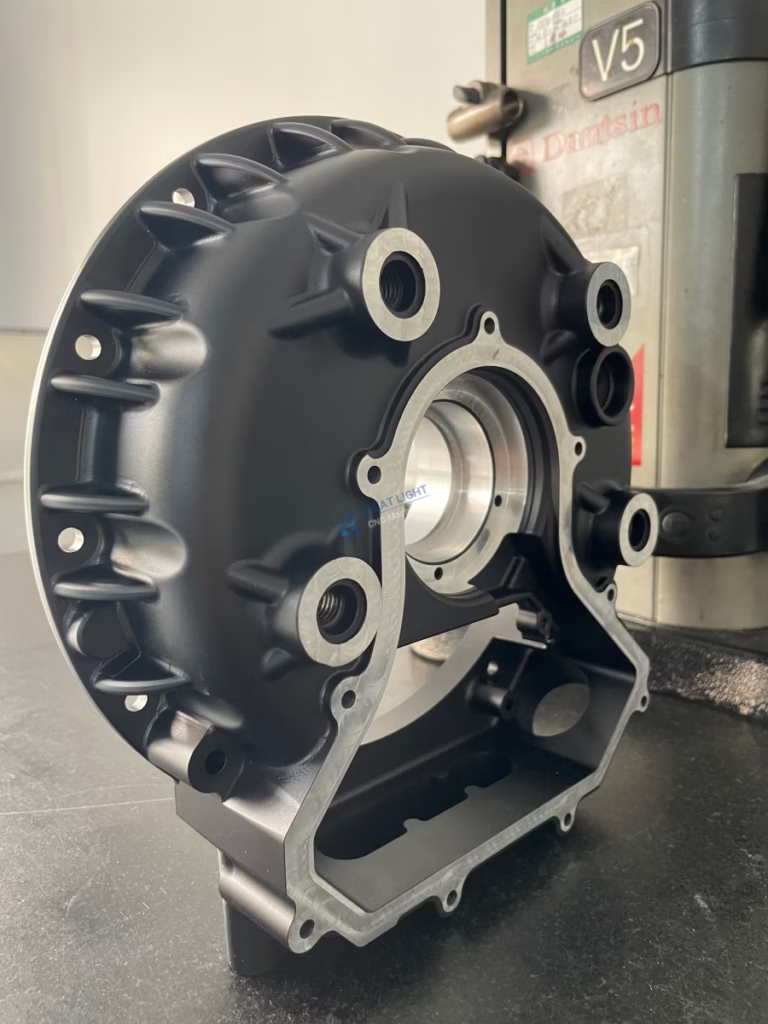
Cost Is Decided Before the First Cut
Machining cost follows geometry, tolerance and setup count. Everything else is bookkeeping.
DFM Review Before Quoting
Design for manufacturability is the cheapest lever because it happens on a screen, not on a machine. A feature that needs a custom tool path, an undercut that forces a second setup, or a deep pocket with a 3 mm corner radius all add cycle time and tool wear. A drawing can be functionally correct and still be expensive to make.
We review every file before quoting, and the review is not a checklist. We look at wall thickness against part size, thread depth and pitch, corner radii against available cutter diameters, and whether a feature sits on a face that can be reached in the same orientation as its neighbors. When a change is possible we show the cost difference rather than just flagging it.
Common findings are boring and repeatable. Threads specified deeper than needed, sharp internal corners on a pocket floor, and datum faces drawn on a surface that will be re-fixtured. None of these change how the part works. All of them change the price.
One rule of thumb: if a feature exists only because the model was easy to draw, ask what it costs to machine. If the answer is more than the feature is worth, remove it.
- 1Corner radiusMatch to a standard end mill diameter to avoid long, thin tools.
- 2Thread depthDeep threads need multiple passes; specify only engagement length.
- 3Datum choicePick a face that stays accessible after the first operation.
- 4Feature countMerge similar holes and slots into one tool call when possible.
Material Selection and Sourcing
Bar stock is often the single largest line item on a machined part. The alloy you pick also sets cutting speed, tool life and how much finishing the part needs afterward. A free-machining grade can cut cycle time enough to offset a higher price per kilogram, which is why the cheapest material by weight is frequently not the cheapest part.
Compare 6061-T6 against 7075-T6 for a bracket. 7075 gives roughly twice the yield strength, but it machines slower, wears tools faster and costs more per kilogram. If the load case does not need that strength, 6061 wins on total cost. The same logic runs across 303 versus 316 stainless and 1018 versus 4140 steel.
Stock form matters too. A part cut from near-net bar stock, or from plate close to final thickness, spends less time in roughing. We hold 6061, 2024, 5052, 5083, 6063, 6082, 7075, 303, 304, 316, 316L, 17-4PH, 1018, 1045, 4130, 4140, 4340, C36000 brass and Ti-6Al-4V in regular supply.
If your part is a one-off prototype, material availability can dominate lead time. It is worth asking which grade is on the shelf before locking the drawing.
Material Choice vs Total Part Cost
Typical trade-offs we see on brackets, housings and shafts.
| Material | Machinability | Where it pays off |
|---|---|---|
| 6061-T6 aluminium | High | General brackets, housings, heat sinks |
| 7075-T6 aluminium | Medium | High-strength aerospace and drone parts |
| 303 stainless | High | Shafts, bushings, fast-turn parts |
| 316L stainless | Medium | Medical and marine, corrosion critical |
| 1018 steel | High | Fixtures, low-stress structural parts |
| 4140 steel | Medium | Shafts and gears under load |
| C36000 brass | Very high | Electrical and plumbing fittings |
| Ti-6Al-4V | Low | Weight-critical, high-temperature parts |
Tolerance Management in Tiers
A single blanket tolerance note on a drawing is the most expensive habit in precision machining. When every dimension carries ±0.005 mm, every dimension needs a tight setup, slower feed, and often an extra inspection step. Most of those dimensions do not need it.
We split tolerances into tiers. Critical fits, bearing bores and mating surfaces get the tight callout. Cosmetic dimensions, clearance holes and non-functional lengths get standard tolerances. The part performs the same way. The inspection plan shrinks and the cycle time drops.
Position tolerance and flatness callouts behave the same way. A flatness callout on a face that only clears a cover plate is wasted money. The same callout on a sealing face is essential. Read the assembly, then decide.
If your design can tolerate it, moving a feature from ±0.005 mm to ±0.05 mm is usually free. Moving it back later is not.
Tolerance Tier Reference
Applied as a starting point, adjusted per feature and material.
| Tier | Tolerance | Typical use |
|---|---|---|
| Precision | ±0.005 mm | Bearing bores, mating pilots, sealing faces |
| Standard | ±0.05 mm | General machined dimensions, slots, steps |
| Loose | ±0.2 mm | Clearance holes, non-mating lengths, covers |
| Surface finish | Ra 0.2–0.8 μm | Sealing, sliding and optical surfaces |
| As-machined | Ra 1.6–3.2 μm | Internal faces and non-visible surfaces |
Fewer Setups Through Multi-Axis Machining
Every setup adds fixturing time, a re-datum step and a re-clamping error. It also adds labor. A part that needs four operations on three-axis machines can often be finished in one operation on a simultaneous 5-axis center, which removes the queue time between operations as well as the setup cost.
Multi-axis work pays off when the part has features on several faces, when the angular position of a hole or slot matters, or when re-clamping would risk the tolerance stack. It pays off less on simple prismatic parts with one machined face, where a three-axis machine is faster and cheaper to run.
We run 16 simultaneous 5-axis machining centers, 12 four-axis mills, 27 three-axis machines and 16 mill-turn centers. That mix matters because the right answer is not always the biggest machine. A turned part with a few cross holes may run best on a mill-turn center in one cycle.
Maximum processing size is 4,000 mm, with travel ranges of 4,000 × 400 × 150 mm, 750 × 1,150 × 550 mm and 500 × 500 × 450 mm across the shop. If a part fits a smaller envelope, we quote it on the smaller machine.
Surface Finish and Post-Processing
Finishing is where cost estimates drift. A drawing note of Ra 0.2–0.8 μm on every face can double cycle time, because fine finishes require light finishing passes and often a separate operation. Unless the surface seals, slides or is visible, as-machined at Ra 1.6–3.2 μm is usually enough.
Post-processing has its own cost structure. Anodizing, plating, powder coating, black oxide, bead blasting, polishing, laser marking and engraving are all priced per batch or per part, and each adds handling. Each additional step also adds a chance of damage between steps.
Two habits reduce finishing cost. First, list finishes face by face instead of applying one spec to the whole part. Second, consolidate. Clear anodize plus laser marking on one part can be sequenced to avoid an extra handling trip. If a marking is needed, note that we laser mark down to 1.5 mm character height.
Hardcoat anodize, electroless nickel and bead blasting all change dimensions slightly. If a finished dimension is critical, tell us before we quote the finish.
When Not to Optimize
Cost reduction has a floor, and it is set by function. A sealing face cannot be loosened. A bearing bore cannot be made oval. A medical implant cannot switch to a free-machining alloy to save cycle time. Engineers who push past the functional limit end up paying again in scrap or field failures.
There is also a volume threshold. DFM effort and tooling changes pay back over a run. On a single prototype, the engineering hours may cost more than the machining. On a 10,000-piece run, a 15 percent cycle-time reduction is worth real money. We quote from one prototype to 10,000+ part runs with no minimum order quantity, so the same analysis can be applied at either scale.
The order matters. Fix geometry first, then material, then tolerance, then setup count, then finish. Changing the finish on a part that still has a 3 mm internal corner is optimizing the wrong end of the process.
We hold ±0.005 mm (±0.0002 in) where the drawing requires it, run 100 percent inspection before shipment, and work to ISO 9001:2015, IATF 16949:2016, ISO 13485:2016 and ISO 27001:2022. Those controls are what make a loosened tolerance defensible rather than a gamble.
Questions Engineers Ask
How fast can I get a quote and a DFM review?
Quotation and free DFM analysis are returned within 12 hours of receiving your files and requirements.
Production can start within 24 hours after the quote is approved, and parts typically ship in 3–5 days.
Which files do you need for a meaningful DFM review?
A STEP or native CAD model plus a 2D drawing with tolerance, finish and material callouts. If there is no drawing, we review the model and flag dimensions that look functional but are unspecified.
Assembly context helps. If we can see how the part mates, we can tell which tolerances actually carry load or alignment.
Can you machine both prototypes and production runs?
Yes. There is no minimum order quantity, so the same process planning can cover one prototype or a 10,000+ part run.
For prototypes we usually recommend the fastest route to a functional part. For production we look at cycle time, fixturing and tool life in more detail.
How do you handle tight tolerances across a large part?
Tolerances are assigned per feature, not per drawing. Critical features are machined in the same setup where possible, and the inspection plan follows the same tiers.
We machine up to 4,000 mm and hold ±0.005 mm on critical dimensions where the design requires it.
What surface finishes do you offer?
Anodizing (clear, color, hardcoat, conductive), electroless nickel, zinc, silver and gold plating, powder coating, black oxide, bead blasting, tumbling, brushing and polishing.
Laser marking and engraving are available down to 1.5 mm character height.
Is my design data kept confidential?
Uploads are secure and confidential. An NDA is available on request before files are shared.
We are certified to ISO 27001:2022 for information security management.
Send the Drawing, Get the Cost Drivers Back
Upload your files and we return a quote with a free DFM analysis within 12 hours.
12-hour quoteFree DFM analysisNo MOQ100% inspection









