
7 Critical Factors That Determine the Cost of a CNC Milling Machine
A cost breakdown for engineers and buyers who need to read a milling quotation, not just accept it. The seven critical factors that determine price are acquisition type, tolerance band, part geometry, material, volume, finish, and quality paperwork. After reading, you should know which line items you can move and which ones you cannot.
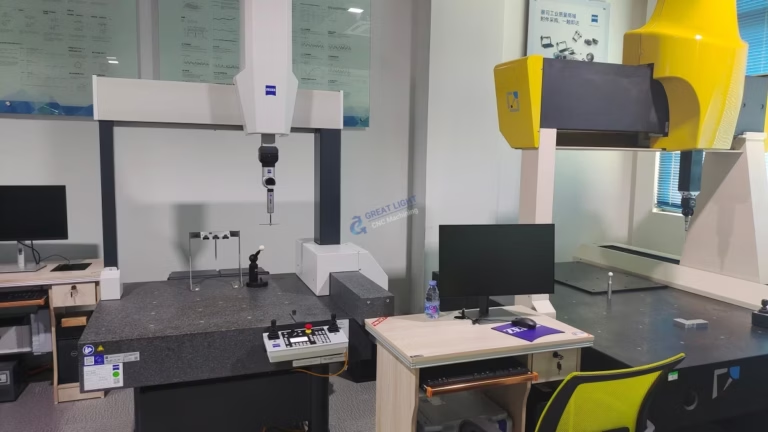
What actually drives the number on the quotation
Machine price is one input. Cycle time, setup count, inspection, and scrap are the rest.
Acquisition type: new, reconditioned, or leased
When a buyer asks what a CNC milling machine costs, the first answer is usually about the iron itself. That is the least useful number. What the buyer actually pays for is spindle hours, setup hours, programming hours, and inspection hours spread across the order. A new machine carries a higher capital cost, but it holds tolerance longer and needs fewer re-cuts.
Reconditioned equipment can cut the capital line item by half. The trade-off shows up later. A machine with worn linear guides may drift 0.02 mm over a long run, which pushes the part into the scrap bin or forces a second operation. For tight features, a reconditioned spindle is a risk you accept knowingly, not by accident.
Leasing spreads the payment across months and keeps cash free. Over a three to five year horizon, the total usually exceeds outright purchase, and the shop still has to recover that from the order price. Ownership lets a shop run longer campaigns without a finance charge baked into every part. That is one reason we keep our own fleet rather than broker capacity.
Precision requirements: how tolerance multiplies cost
Tolerance is the single largest multiplier after volume. Going from ±0.1 mm to ±0.025 mm changes the process, not just the inspection. The machine must be more rigid, the toolpath slower, the tooling fresher, and the temperature more stable. Cycle time rises before any metrology cost appears.
The jump from ±0.025 mm to ±0.005 mm is steeper still. At that band, you need a climate-controlled cell, ground or lapped fixtures, and a CMM check on the first article. We hold ±0.005 mm (±0.0002 in) on qualified features, but we ask which dimensions actually need it. Callouts on a non-functional datum add cost with no benefit.
A useful rule for engineers: tighten only the features that mate. A bearing bore, a dowel hole, and a sealing face justify a tight band. An outer profile that gets painted does not. Reviewing the drawing before quoting often removes half the tight callouts, and the price drops with them.
Tolerance band vs. process demand
Typical requirements at each band, based on our own machining cells.
| Tolerance band | Typical process | Inspection |
|---|---|---|
| ±0.1 mm | 3-axis, standard fixturing | Caliper and plug gauge |
| ±0.05 mm | 3-axis or 4-axis, sharp tooling | Micrometer, bore gauge |
| ±0.025 mm | 4-axis, controlled coolant | CMM first article |
| ±0.005 mm | 5-axis, climate control, ground fixtures | CMM on critical features |
| Ra 1.6–3.2 μm | Standard carbide, as-machined | Visual and profilometer spot check |
| Ra 0.8–1.6 μm | Finer stepover, balanced toolholder | Profilometer on request |
| Ra 0.2–0.8 μm | Finishing pass plus polishing | Profilometer, full report |
Part geometry: features, access, and setup count
Geometry sets the number of setups, and setups are where cost hides. A part that machines in one orientation from one face is cheap. Rotate it three times and you pay for three fixtures, three alignments, and three chances to lose position. Every additional setup adds handling time and a re-zeroing step.
Deep pockets, thin walls, and features on five sides push work toward simultaneous 5-axis. That removes setups but raises the hourly rate. The break-even sits around complex parts with many angled faces. Simple brackets do not need it. We run 16 simultaneous 5-axis centers, and we still quote some parts on 3-axis because the geometry does not justify the rate.
Tool access decides more than size does. A 200 mm deep pocket with a 6 mm corner radius needs a long, slender tool, so the cut runs slower and the risk of chatter climbs. Widen the corner radius and the same pocket machines with a stiffer tool at two or three times the feed. Small drawing edits move cost more than material choice.
Material: machinability, availability, and waste
Material shows up in the quotation three times: as bar stock, as cycle time, and as scrap. Aluminum 6061 machines fast and forgiving, so it sits at the low end. Stainless 316 work-hardens under a dull tool and needs lower feeds and more coolant, which stretches the cycle. Titanium TC4 and Inconel push tool wear hard enough that tooling becomes a visible line.
Stock form matters as much as alloy. A part cut from plate wastes the surrounding material; the same part from near-net stock or a casting wastes less but adds a first operation. For low volume, plate is usually cheaper overall. Above a few hundred pieces, a casting or extrusion profile often wins even after the tooling cost.
Availability is a real cost too. Exotic grades move in and out of stock, and a special mill run adds weeks. If the design allows 7075 instead of a specialty alloy, or 17-4PH instead of a custom grade, the schedule tightens and the price follows. We stock 6061, 304, 316, 17-4PH, and common brass so that prototypes do not wait on a purchase order.
Production volume: prototype, low volume, and high volume
Volume spreads fixed cost. Programming, fixturing, and first-article inspection happen once, so a single prototype carries all of it. Ten pieces carry a tenth each. This is why a one-off price can look alarming next to a production quote for the same geometry.
Low volume, roughly 50 to 500 pieces, is where process choice gets interesting. Soft jaws and quick-change fixtures keep tooling cheap but add handling time per part. Dedicated fixtures cost more upfront and pay back inside the run. We quote both and let the buyer compare the crossover point rather than guessing.
High volume changes the question. Above a few thousand pieces, a second spindle, a pallet changer, or a mill-turn cell starts to pay. We have no minimum order quantity, from one prototype to 10,000+ part runs, so the same shop can carry a part from first article to production without a re-quote cycle. Consistency across that ramp matters more than the unit price at any single step.
Surface finish, post-processing, and quality documentation
Finish is a second operation in most cases, and second operations are priced separately. As-machined at Ra 1.6–3.2 μm comes off the machine. Ra 0.8–1.6 μm needs a finer stepover and a longer finishing pass. Ra 0.2–0.8 μm adds polishing by hand. Anodizing, plating, powder coating, bead blasting, and laser marking all add handling, and handling means parts move, get counted, and sometimes get damaged.
Anodizing is not a cosmetic afterthought. Hardcoat changes the dimension by roughly half the coating thickness per surface, so a tight bore must be masked or pre-sized. If the drawing calls for hardcoat and a ±0.01 mm bore, say so at quote time. Catching it after plating means stripping and re-machining.
Quality paperwork is the last cost driver and the easiest to overlook. A simple parts order needs a dimensional report on request. An automotive part under IATF 16949:2016 needs PPAP-style documentation, traceability, and in-process monitoring. A medical part under ISO 13485:2016 adds a device history record. Each layer adds engineering time before the spindle turns. We hold ISO 9001:2015, IATF 16949:2016, ISO 13485:2016, and ISO 27001:2022, and we scope the documentation to the application rather than applying the heaviest option by default.
Questions engineers ask before they send the drawing
Which of the seven critical factors that determine cost can I change fastest?
Geometry and tolerance. Both live in the drawing, so an edit costs nothing but review time. Loosening a non-mating tolerance or widening a corner radius can cut cycle time in the same day.
Material and finish take longer to change because they affect stock and outside processing. Volume is the slowest, since it depends on your program, not the shop.
Does a tighter tolerance always mean a higher price?
Only on the features that carry the callout. If a ±0.005 mm band sits on a mating bore, expect a real increase from slower feeds, ground fixtures, and CMM time.
If the same band sits on a cosmetic edge, the cost is mostly inspection. Move the callout to the functional datum and the price usually drops.
How does volume change the break-even between 3-axis and 5-axis?
For a part with features on three or more faces, 5-axis removes setups. At low volume the setup saving often beats the higher hourly rate.
For a simple prismatic part, 3-axis stays cheaper at any volume. We quote the routing that fits the geometry rather than defaulting to one machine class.
Can you work from a 3D file only, without a 2D drawing?
Yes. STEP and native CAD files are enough for quotation. We return a free DFM analysis within 12 hours, flagging tight callouts, thin walls, and tool-access problems.
If you have a drawing, send it too. Tolerances and finish notes are where the real cost sits, and they are often missing from the model.
What documentation comes with a production order?
Standard orders ship with 100% inspection before shipment and reports on request. That covers raw material check, in-process monitoring, and final inspection.
Automotive and medical programs add the documentation their standard requires. Scope it at quote time so the engineering hours are priced in, not added later.
Do you sign an NDA before I share drawings?
Yes. Uploads are secure and confidential, and an NDA is available on request before you send files.
We hold ISO 27001:2022 for information security, which covers how customer data is stored and accessed.
Send the drawing and get a cost breakdown, not just a number
We return a quotation and a free DFM analysis within 12 hours, with the cost drivers listed so you can see what to change.
12-hour quote100% inspectionNo minimum order quantity









