
5 Essential Factors to Consider When Buying a 5-Axis Machine for Sale
Spec sheets sell machines. Production reality decides whether you keep them. This guide is written for engineers and procurement teams comparing 5-axis machining centers. It covers the five factors that separate a good purchase from an expensive lesson: stated accuracy, axis configuration, certification, supplier support, and cost per part.
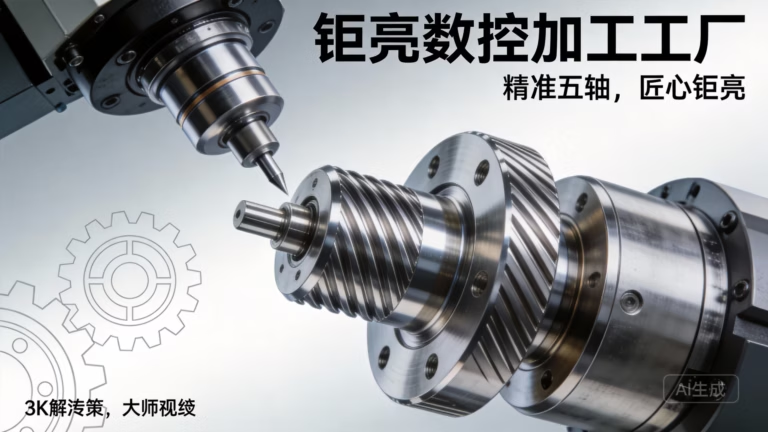
A buying checklist, not a brochure
Five factors, each with the questions to ask the supplier and the conditions where that factor stops mattering.
Real-world accuracy beats the spec sheet
Brochure accuracy is measured in a temperature-controlled room, on a warm machine, with a light finishing pass. Production accuracy is measured on hour seven of a titanium job, after the spindle has pushed heat into the column and the rotary table has indexed a few thousand times. The gap between those two numbers is where scrap comes from.
Resolution and repeatability get quoted as if they were the same thing. They are not. Resolution is the smallest step the control can command, often 0.1 μm or finer. Repeatability is how close the machine returns to the same point after 500 cycles. A control with fine resolution on a machine with poor repeatability will still produce a scatter of parts that drift outside ±0.005 mm.
Ask for temperature mapping at the spindle nose and in the work zone under simulated production conditions. Running a test cut in aluminium and calling it a day tells you very little. Request a test in the material you actually machine, at the cycle time you actually run. For titanium and hardened steels, that means watching thermal drift across a full shift.
- 1Repeatability over resolutionA 0.1 μm resolution control is worthless if the machine repeats to ±0.01 mm after warm-up.
- 2Test in your materialAluminium test cuts hide the thermal and tool-load behaviour that steel and titanium reveal.
- 3Check thermal compensationAsk whether the machine compensates for ball-screw growth and spindle expansion, and how.
- 4Measure after warm-upCold-machine accuracy figures do not reflect what ships after a full shift.
Axis configuration decides what parts you can actually cut
Five axes is a count, not a configuration. Three main layouts dominate the market, and each one suits a different family of parts. Trunnion machines put the rotary table on a tilting cradle, which suits compact, dense parts that need good stiffness under the tool. Gantry-style machines move the part under the spindle, which suits long parts. Head-and-table machines split the rotary motion between the spindle head and the work table, which suits medium parts with undercut features.
The right choice depends on part geometry more than on the spec sheet. If you machine impellers, blisks, or medical implants, a trunnion layout with a stiff rotary table will usually beat a larger gantry machine. If you machine long structural parts, the gantry layout lets you keep the tool over the part without swinging a heavy table. For a shop running mixed work, no single configuration covers everything.
Look at the rotary table size against the parts you plan to run. A Ø400 mm table handles most automotive and aerospace brackets, but it will not swing a 600 mm impeller. Ask how the machine behaves when the rotary axis is at 90° and the tool is at full extension. Stiffness at the extremes is where configuration earns its keep.
- 1Trunnion layoutDense, stiff setups for impellers, blisks, and small medical parts.
- 2Gantry layoutLong structural parts where the work moves under a fixed spindle.
- 3Head-and-table layoutMedium parts with undercuts that need rotary motion at both ends.
- 4Table size vs. swingMatch Ø400 mm class tables to parts that fit, not to the largest demo part.
Matching configuration and capacity to part family
Use this as a starting point, not a rule. Stiffness at the extremes matters more than the headline number.
| Part family | Typical size range | Suggested configuration | Watch-out |
|---|---|---|---|
| Impellers and blisks | Ø300–500 mm | Trunnion, Ø400 mm table | Tool reach at 90° tilt |
| Aerospace brackets | up to 750 mm | Head-and-table or trunnion | Five-face access without re-fixture |
| Long structural parts | up to 4,000 mm | Gantry with 4,000 × 400 × 150 mm travel | Table weight and inertia |
| Medical implants | under 100 mm | Compact trunnion, 500 × 500 × 450 mm | Surface finish Ra 0.2–0.8 μm |
| Automotive housings | 300–600 mm | Mill-turn or trunnion | Through-spindle coolant at 70 bar |
Certifications tell you how the shop runs, not just what it owns
A certificate on the wall is not a quality system. The system is the calibration schedule, the maintenance log, the tool-life tracking, and the corrective-action process behind it. When a supplier holds ISO 9001:2015, IATF 16949:2016, ISO 13485:2016, and ISO 27001:2022, the audits force those routines to exist on paper and in practice. That matters more than the logo.
For aerospace and medical work, the certification chain determines whether your parts can be accepted at all. An IATF 16949 shop is set up for automotive PPAP discipline. An ISO 13485 shop is set up for device traceability and process validation. Buying a 5-axis machine from a supplier without the right certification means you will carry the compliance burden yourself, or you will re-qualify the parts elsewhere.
Ask to see the calibration records for the specific machine you are buying. A machine with a current laser interferometer report and a documented thermal compensation routine is a different asset from one with a certificate and no recent data. The paperwork should point to the machine, not just to the company.
- 1ISO 9001:2015Baseline quality management; covers process control and traceability.
- 2IATF 16949:2016Automotive discipline: PPAP, MSA, and change control.
- 3ISO 13485:2016Medical device traceability and process validation.
- 4ISO 27001:2022Information security for customer drawings and CAD data.
The supplier around the machine matters as much as the machine
A 5-axis machining center is one asset in a production chain. The supplier's ability to support it decides how much uptime you get. Service response time, spare-parts stock, and application engineering are the difference between a machine that runs and a machine that waits. Ask who services the machine locally and how quickly a spindle or rotary table can be replaced.
Look at the wider equipment base. A shop running 16 simultaneous 5-axis machining centers alongside 12 four-axis mills, 27 three-axis machines, 16 mill-turn centers, and precision Swiss-type lathes can route work to the right machine instead of forcing every part onto one platform. That flexibility shows up in lead time and cost per part.
For buyers comparing a machine purchase against outsourcing, the same logic applies. The supplier's capacity, materials coverage, and finishing services determine whether the parts arrive complete. At GreatLight, we run aluminium, stainless, steel, copper, titanium, Inconel, magnesium, and engineering plastics through the same quality system, with finishing in house and 100% inspection before shipment.
- 1Service responseAsk for the local service footprint and typical spindle replacement time.
- 2Spare parts stockRotary tables and spindles on the shelf shorten unplanned downtime.
- 3Application engineeringSomeone who can prove out a process before it hits the production floor.
- 4Equipment breadth5-axis, 4-axis, 3-axis, mill-turn, and Swiss-type in one quality system.
Total cost of ownership is cost per good part
Purchase price is the smallest number in the calculation. The real cost includes tooling, coolant, power, maintenance, operator time, scrap, and the cost of a machine sitting idle waiting for a service visit. A cheaper machine that runs 70% uptime can cost more per part than a more expensive one that runs 90%. Run the numbers over three years, not over the first invoice.
Cycle time is the other half of the equation. A machine with faster rapids and a stiffer structure can cut cycle time enough to change the economics of a job. Through-spindle coolant at 70 bar minimum is not a luxury for deep-hole drilling in titanium or hardened steels; it decides whether the tool survives the cycle. Add the cost of chip evacuation, fixture changes, and in-process inspection.
Compare suppliers on cost per compliant part, delivered. Ask for the inspection routine, the scrap rate, and the lead time. At GreatLight, parts ship in 3–5 days with 100% inspection before shipment and reports on request, and the historical late-delivery probability is below 2%. Those numbers belong in the comparison, next to the spindle speed.
- 1Uptime over priceA 70% uptime machine can cost more per part than a 90% uptime machine.
- 2Cycle timeRapids, stiffness, and coolant pressure all move the cycle number.
- 3Scrap and reworkAsk for the scrap rate and how non-conforming parts are handled.
- 4Delivered costCompare cost per compliant part, not cost per machine.
Questions engineers ask before committing
How do I verify accuracy claims before buying?
Ask for a test cut in your material at your cycle time, with temperature mapping at the spindle nose and work zone. A cold-machine test in aluminium proves very little about a titanium job that runs for six hours.
Request the most recent laser interferometer report and the thermal compensation routine for the specific machine. A current report points to a maintained asset. A certificate alone does not.
Which 5-axis configuration is right for my parts?
Start with part geometry. Dense parts with complex surfaces suit a trunnion layout with a stiff rotary table. Long parts suit a gantry layout where the work moves under the spindle. Medium parts with undercuts often suit a head-and-table layout.
Check stiffness at the extremes, not at the home position. Ask how the machine behaves with the rotary axis at 90° and the tool at full extension.
Do I need a certified supplier, or just a capable one?
For aerospace, automotive, and medical work, the certification chain determines whether your parts can be accepted. IATF 16949:2016 shops run automotive PPAP discipline. ISO 13485:2016 shops run device traceability and process validation.
If the supplier lacks the right certification, you carry the compliance burden or you re-qualify the parts elsewhere. That cost usually exceeds the price difference.
What should I ask about service and spare parts?
Ask who services the machine locally, the typical response time, and whether spindles and rotary tables are stocked. A rotary table that has to ship from overseas turns a two-day repair into a two-week stoppage.
Ask for the application engineering contact who can prove out a process before it reaches the production floor.
How do I compare cost of ownership between two machines?
Build a three-year model with tooling, coolant, power, maintenance, operator time, scrap, and downtime. Uptime percentage and cycle time move the result more than purchase price.
Compare cost per compliant part, delivered. Ask for the scrap rate, the inspection routine, and the lead time, and put those numbers next to the spindle speed.
Can GreatLight support a 5-axis program without buying a machine?
Yes. We run 16 simultaneous 5-axis machining centers with a maximum processing size of 4,000 mm, plus 4-axis, 3-axis, mill-turn, and Swiss-type capacity. That lets us match the machine to the part geometry instead of forcing the part onto one platform.
Quotation and free DFM analysis come back within 12 hours, production can start within 24 hours, and parts ship in 3–5 days with 100% inspection. No minimum order quantity, from one prototype to 10,000+ part runs.
Send us the drawing, get a manufacturability answer
We review your part, the material, and the tolerances, then tell you which machine and process will hold them. Quotation and free DFM analysis within 12 hours.
12-hour quote100% inspection±0.005 mmNDA on request









