
7 CNC Optimization Tactics to Drastically Cut Costs
This guide is for design and sourcing engineers who need to cut part cost without losing function. It covers seven levers we check on every quote: geometry, material, machine axis count, setup batching, tolerance and finish calls, and finishing logistics. Read it and you can tell which cost drivers are in your own drawings.
Where CNC cost actually comes from
Before you negotiate price, check what is driving the cycle time. Most of it is decided before a chip is cut.
Design for manufacturability cuts more cost than negotiation
A machined part carries cost from three places: cutting time, setups, and scrap risk. Sharp internal corners need small tools, and small tools run slow. A 2 mm end mill removing a deep pocket may run at 8,000 rpm with light passes, while the same pocket opened to 6 mm runs three to five times faster. That difference shows up on the invoice, not on the drawing.
Standard hole sizes matter too. If a drawing calls for an M6 thread, the tap and drill exist on the shelf. A custom Ø5.7 mm hole with M6 pitch may need a special cutter or a second operation. Same function, more time.
Walls are another common driver. A 0.8 mm wall in aluminium over 40 mm deep will chatter, so the machinist drops feed and adds passes. Thickening that wall to 1.5 mm often removes a finishing operation and a stress-relief step.
- 1Corner radiiKeep internal radii at least 1/3 of pocket depth when possible.
- 2Hole standardsUse M3, M4, M6, M8 and standard reamed sizes.
- 3Wall thicknessFor aluminium, 1.5 mm is safer than 0.8 mm on deep features.
- 4Deep pocketsDepth beyond 4× tool diameter raises cost fast.
Material machinability beats material price
The cheapest bar stock is rarely the cheapest part. 303 stainless machines roughly twice as fast as 316L, so a part in 303 can cost less even when the material price per kilogram is higher. If corrosion resistance allows it, 303 is the practical choice for shafts, bushings and fittings.
Aluminium behaves the same way. 6061-T6 cuts cleanly and holds threads well. 7075 is stronger but gummier and wears tools faster, so it belongs where strength is the actual requirement. 2024 machines well but needs corrosion protection because of its copper content.
Titanium and Inconel are a separate discussion. TC4 (Ti-6Al-4V) cuts at roughly one quarter the speed of 6061, and Inconel slower still. When you specify these, budget the time, not just the metal.
Machinability comparison for common alloys
Ratings are relative to 6061-T6, which is easy to cut.
| Material | Machinability | Typical use | Watch out for |
|---|---|---|---|
| 6061-T6 aluminium | High | Brackets, housings, fixtures | Low wear resistance |
| 7075 aluminium | Medium | Aerospace, high-stress parts | Tool wear, cost per kg |
| 303 stainless | Medium-high | Shafts, fittings, fasteners | Limited corrosion in salt |
| 316L stainless | Low-medium | Medical, marine, food | Slow speeds, more coolant |
| TC4 (Ti-6Al-4V) | Low | Aerospace, implants | Heat, tool life, cost |
| Inconel | Very low | Hot sections, high temp | Very slow, high tool cost |
Axis count should follow part complexity, not habit
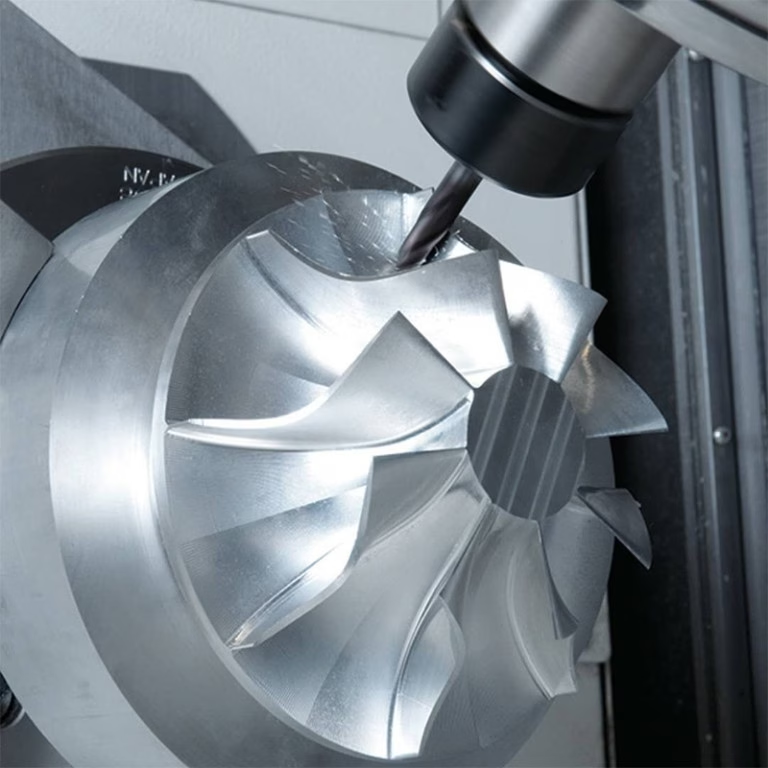
A 3-axis mill cuts one face per setup unless you add fixtures. A 4-axis machine adds a rotary table, so you can machine around the part in one program. A 5-axis center tips the tool and reaches angles that would otherwise need a custom angle plate or a second operation.
The decision is arithmetic. If a part needs four faces, a 3-axis machine needs three or four setups at 20–40 minutes each, plus fixture cost. A 5-axis machine may do it in one setup. On a run of 50 parts, the 5-axis route can win even at a higher hourly rate. On 5 parts, the same logic still holds because setup dominates.
Where 3-axis wins: flat plates, simple pockets, parts with one critical face. Tool access is open, fixtures are cheap, and the machine is fast. Do not move a simple bracket to a 5-axis center just because it is available.
Batch size and setup sharing change the unit price
Setup is a fixed cost. A single part carries the whole setup; ten parts split it. That is why a quote for one piece can look alarming and a quote for fifty looks reasonable. The curve flattens after the first batch, because programming and fixturing are already paid for.
There is a second lever inside the batch: nesting. If two part numbers share a material and a fixture, run them together. The operator loads once, the machine cuts longer, and you avoid two separate setups. This matters most for prototype-to-production transitions, where a design change is still likely.
For low volumes, ask whether the parts can be machined from the same stock size. A common bar or plate size reduces material handling and leftover offcuts.
Tolerance and finish calls: audit before you over-specify
A general tolerance block of ±0.1 mm with a few ±0.005 mm callouts is normal and affordable. A drawing where every dimension is ±0.005 mm is not. Tight tolerance means slower feeds, more passes, more inspection, and a higher chance of rework. It also raises the fixture requirement, because the part has to stay rigid enough to hold that number.
Surface finish follows the same rule. Ra 3.2 μm is as-machined and cheap. Ra 1.6 μm needs a finishing pass. Ra 0.8 μm or better often needs a separate operation, sometimes hand work, and always more inspection time.
Audit each callout with one question: does this dimension or surface touch a mating part, a seal, or a bearing? If yes, keep the tight number. If it is cosmetic or non-functional, loosen it and put the savings into the features that matter.
- 1Functional facesKeep tight tolerance where a bearing or seal seats.
- 2Cosmetic facesRa 1.6–3.2 μm is usually enough.
- 3Datum stackFewer datums means fewer setups and less stack-up error.
Finishing logistics are a hidden cost line
Anodizing, plating, powder coating and laser marking are often sent to a third party. That adds packing, freight, a queue at the finisher, and a second inspection when the parts come back. On a short lead time, the finishing step can be the longest part of the schedule.
Keeping finishing in the same supply chain removes most of that. The parts are packed once, move once, and the final inspection covers both the machined features and the finish. It also makes rework simpler, because the machinist and the finisher are looking at the same drawing.
For laser marking, keep character height at 1.5 mm or larger. Smaller text on a curved or anodized surface is hard to read and often needs a re-mark.
Treat the quote as data, not a number
A useful quote tells you what is expensive and why. If the reply lists setup hours, cycle time, material, and finishing separately, you can test changes: what if the corner radius grows, what if the tolerance loosens, what if the batch doubles. That is how cnc optimization drastically cut cost in practice. You change one variable and see the effect on the quote.
At GreatLight, the quotation and a free DFM analysis go back within 12 hours, and production can start within 24 hours. We run 127 high-precision CNC machines across three wholly-owned plants, including 16 simultaneous 5-axis centers, 12 four-axis mills, 27 three-axis machines and 16 mill-turn centers. Maximum processing size is 4,000 mm, with a Ø400 mm rotary table for round work.
We hold ±0.005 mm and finishes from Ra 0.2–0.8 μm up to Ra 1.6–3.2 μm as-machined, with 100% inspection before shipment and reports on request. There is no minimum order quantity, from one prototype to 10,000+ part runs, and uploads stay confidential under NDA on request.
Questions engineers ask before changing a design
How much can a DFM change actually save?
It depends on the part, but the biggest gains usually come from tool access and setup count, not from material swaps. Opening a corner radius or reducing a pocket depth can remove a finishing pass or a second setup.
We send a DFM note with every quote so you can see which features drive the number before you commit.
When is 5-axis machining cheaper than 3-axis?
When the part has features on three or more faces, or needs compound angles. Each extra 3-axis setup adds fixture time and stack-up error.
For flat plates and single-face work, 3-axis is still faster and cheaper.
Does a larger batch always lower the unit price?
Usually, but the curve flattens once setup and programming are spread thin. After that, the savings come from material purchasing and longer unattended runs.
If the design is still changing, a medium batch plus a shared fixture can be better than a large batch of an obsolete revision.
Which tolerances should stay tight?
Only the ones that control fit, sealing, or bearing seating. Everything else can sit at a general block tolerance of ±0.1 mm.
Tightening a non-functional dimension adds inspection time without adding value to the assembly.
Can you handle finishing without a separate vendor?
Yes. Anodizing, electroless nickel, zinc, silver and gold plating, powder coating, black oxide, bead blasting, tumbling, brushing and polishing are handled through our finishing service, along with laser marking.
That keeps the parts in one logistics loop and avoids a second incoming inspection.
What do you need to start a DFM review?
A 3D model or a 2D drawing with material, quantity, tolerance class and finish. STEP and IGES files work well.
If you have a target price or a target lead time, include it. That helps us suggest the right axis count and batch size instead of quoting a default route.
Send a model, get a DFM note and a quote
Upload your drawing and we reply with quotation and free DFM analysis within 12 hours. 100% inspection before shipment, ISO 9001 and IATF 16949 processes, NDA on request.
12-hour quote±0.005 mmNo minimum order









