
CNC Machines for Aluminum: Choosing the Right Configuration
Aluminum rewards high spindle speeds and punishes weak setups. This guide walks through seven machine configurations, what each one does well, and where it stops making sense. Written for engineers and buyers comparing quotes on the same part.
What Actually Decides the Machine
Start from part geometry, tolerance and volume. The machine follows from those three, not the other way round.
Why Aluminum Is Easy and Awkward at the Same Time
Aluminum cuts fast. Its thermal conductivity pulls heat out of the shear zone, so you can run spindle speeds and feeds that would burn a steel tool in seconds. That is the easy half.
The awkward half is stiffness. Aluminum is roughly a third as stiff as steel, so thin walls and long unsupported sections deflect under cutting force. A part that measures well on the first pass can spring back and read oversize after unclamping.
Then there is built-up edge. Aluminum tends to weld onto the cutting edge at low surface speeds, which smears the finish and changes the effective tool geometry mid-cut. The usual answer is higher surface speed, sharper positive-rake tooling, and enough coolant or air blast to clear chips before they recut.
None of this is a machine problem by itself. But it explains why a machine bought for steel does not automatically do well on aluminum: the spindle may not reach the speed, and the control may not hold the feed rates that keep the edge clean.
- 1Thin wallsDeflection, not tool wear, sets the limit. Plan multiple light passes.
- 2Deep pocketsChip evacuation matters more than spindle power. Air blast beats flood here.
- 3Long partsThermal growth along the length can exceed the dimensional tolerance.
- 4Anodized facesMachining marks show through. Surface finish has to be specified up front.
Seven Configurations and What Each One Is For
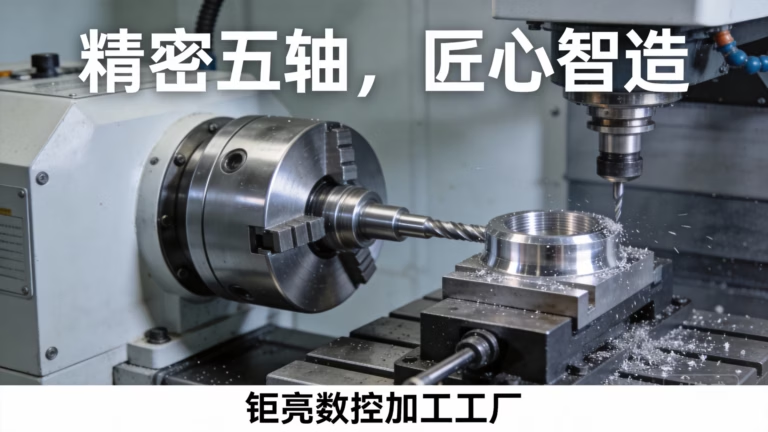
Five-axis machining centers cut from any direction in one setup. For aluminum parts with undercuts, compound angles or sculpted contours, that removes stacked fixtures and the position error that comes with them. At GreatLight, 16 simultaneous 5-axis centers handle this class of work, and positional accuracy reaches ±0.001 mm on the machine, with ±0.005 mm held as the production tolerance across the shop.
High-speed 3-axis mills are the workhorse for plate work. If every feature is reachable from one direction, a fast 3-axis spindle with a good vise and a well-trammed table will beat a 5-axis machine on cycle time and on price. This is where most aluminum brackets, plates and covers should go.
Multi-axis turning centers with live tooling turn and cross-drill in one program. Aluminum bushings, fittings and shafted parts with off-axis holes are the natural fit. Mill-turn centers take this further; we run 16 of them.
Gantry-style machines earn their place on long parts. With travels up to 4,000 × 400 × 150 mm, a gantry holds a long aluminum extrusion or frame rail without re-fixturing halfway through.
Four-axis mills add a rotary table, usually Ø400 mm, so you can index to three or four faces. The gain over 3-axis is fewer setups; the loss is the ability to machine continuously around a contour.
CNC routers cover large, flat, low-force work: panels, enclosures, signage, composite-backed aluminum skins. They are not the tool for tight-tolerance bores or threads.
Hybrid machines combine milling with an auxiliary operation, such as in-process inspection or a secondary drilling head. They pay off when part handling between operations is the real cost driver.
- 1Pick 5-axis whenUndercuts, compound angles, or tight position between faces.
- 2Pick 3-axis whenAll features are reachable from one direction and volume is high.
- 3Pick gantry whenPart length exceeds normal table travel.
- 4Pick router whenLarge flat panels, loose tolerance, sheet thickness material.
Configuration Comparison for Aluminum Work
Use this as a first filter. Tolerance figures are what the shop holds in production, not machine spec sheets.
| Configuration | Best For | Typical Tolerance | Watch Out For |
|---|---|---|---|
| 5-axis simultaneous | Undercuts, compound angles | ±0.005 mm | Higher hourly rate; program prove-out |
| 3-axis high speed | Plates, brackets, covers | ±0.005 mm | Extra setups for side features |
| Mill-turn with live tooling | Shafted and turned parts | ±0.005 mm | Bar size limits; tool clearance |
| Gantry | Long rails, extrusions | ±0.005 mm | Floor space; slower rapids |
| 4-axis with rotary table | Multi-face, moderate complexity | ±0.005 mm | Rotary backlash on roughing |
| CNC router | Large flat panels | Looser than milled parts | No tight bores or threads |
| Hybrid with auxiliary ops | Handling-sensitive parts | ±0.005 mm | Justification needs volume |
A Four-Step Framework Before You Send an RFQ
Step one: define geometry complexity honestly. Count the faces that carry features. If features sit on three or more faces and their positions relate to each other, you are in 4-axis or 5-axis territory. If everything faces up, stop there and save the money.
Step two: write down the tolerance that matters, not the tolerance you would like. A ±0.005 mm callout on a 300 mm aluminum frame is achievable, but it drives fixturing, temperature control and inspection time. If the function only needs ±0.05 mm, say so and the quote gets simpler.
Step three: volume. One prototype and a 10,000-part run are different problems. Prototypes favor 5-axis because setup cost dominates and no fixture is needed. High volume favors 3-axis with dedicated workholding, or die casting if the geometry allows it.
Step four: surface finish. As-machined aluminum lands around Ra 1.6–3.2 μm, a fine step-over gets you Ra 0.8–1.6 μm, and Ra 0.2–0.8 μm needs deliberate tool paths and often a secondary operation. Anodizing does not hide tool marks; it reveals them.
Questions Worth Asking a Machine Shop
Ask which machine the quote is based on, and ask for the tolerance they will hold in production rather than the best number the machine can reach once. Those are different figures and only one of them matters to you.
Ask how the shop controls thermal drift on long aluminum parts. A shop that runs lights-out overnight and measures only in the morning will hand you parts that change size by the time they cross an ocean.
Ask about inspection. Our rule is 100% inspection before shipment, with raw material checks, in-process monitoring and a final report on request. If a supplier cannot describe their in-process checks in one sentence, that is an answer too.
Certifications are a floor, not a differentiator. ISO 9001:2015, IATF 16949:2016, ISO 13485:2016 and ISO 27001:2022 tell you the process is documented and the data is protected. They do not tell you whether the shop can hold a thin wall on a 7075 housing.
- 1Machine assignmentWhich spindle, which fixture, how many setups.
- 2Production toleranceNot the demo tolerance on a sample part.
- 3Inspection planWhat is measured, how often, reported how.
- 4HandlingDeburring and finishing between operations.
Alloy Choice Changes the Machine Choice
6061 and 6061-T6 are the default for machined aluminum parts: good finish, stable, weldable, widely available. If your drawing says aluminum and nothing more, it probably means 6061.
7075 is stronger and machines cleanly, but it is less forgiving of aggressive roughing and more prone to stress movement when you remove a lot of material. Parts that are mostly air after machining need a rough, stress-relieve, finish sequence, which adds setups.
2024 cuts well but has poor corrosion resistance without coating. 5052 and 5083 are for formed or welded assemblies rather than tight-tolerance machining. 6082 sits close to 6061 with slightly better strength, and ADC12 is a die-casting alloy, not a billet machining grade.
Volume shapes tooling. Under a few hundred parts, vise and soft jaws are fine. Past that, a dedicated fixture pays for itself in setup time. Above roughly 10,000 parts, die casting deserves a look if the geometry permits draft and the tolerance is not too tight.
What Shop Capacity Tells You About Fit
A shop with 127 high-precision CNC machines across 16 five-axis centers, 12 four-axis mills, 27 three-axis machines and 16 mill-turn centers can assign a job to the right machine instead of forcing it onto whatever is free. That matters most when your part sits between two configurations.
Travel range is the other filter. Compact machines with 500 × 500 × 450 mm or 500 × 310 × 200 mm travels suit small housings and fittings. Medium travels of 750 × 1,150 × 550 mm and 600 × 600 × 600 mm cover most brackets and plates. Only a gantry or a large-travel machine can take a 4,000 mm part.
For prototypes and low volume, setup cost dominates, and a shop set up for fast changeover will beat a shop optimized for mass production. Our quotation and DFM analysis come back within 12 hours and production can start within 24 hours; parts typically ship in 3–5 days. No minimum order quantity applies, from one prototype to 10,000+ part runs.
Common Questions on Aluminum Machining
Is 5-axis always better for aluminum parts?
No. Five-axis wins when the part has undercuts, compound angles or features on faces that must hold position relative to each other. If every feature is reachable from one direction, a high-speed 3-axis machine usually runs faster and costs less per part.
The exception is prototypes. On low volume, 5-axis can be cheaper overall because it removes fixtures and setups, even at a higher hourly rate.
What tolerance can you hold on aluminum in production?
We hold ±0.005 mm (±0.0002 in) as a production tolerance on aluminum, with machine positional accuracy reaching ±0.001 mm. That applies to features the machine can reach in a stable setup.
Long, thin parts are the limiting case. Thermal drift and deflection, not the machine, set the practical limit, so we discuss the datum and inspection method before quoting.
Which aluminum alloys do you machine most?
6061 and 6061-T6 dominate, followed by 7075 for higher-strength parts, 2024 where fatigue matters, and 6082 for European drawings. 5052 and 5083 come up for formed or welded assemblies.
ADC12 is a die-casting alloy. If your drawing calls for it, billet machining is usually not the right process.
What surface finish can I expect as machined?
As-machined aluminum typically lands at Ra 1.6–3.2 μm. A controlled finishing pass with a smaller step-over reaches Ra 0.8–1.6 μm, and Ra 0.2–0.8 μm is available with dedicated tool paths.
If the part will be anodized, specify the finish before machining. Anodizing does not cover tool marks, it makes them more visible.
How do you handle thin walls and part distortion?
We plan the process around the wall, not the other way round: rough with stock left on, allow the part to stabilize, then finish in light passes with supported fixturing. For 7075 parts with heavy material removal, a stress-relief step between roughing and finishing is common.
Inspection happens in process, not only at the end, so a drift shows up before the run is finished.
Do you sign an NDA for prototype work?
Yes. Uploads are kept secure and confidential, and an NDA is available on request before you send drawings.
For regulated industries, our ISO 27001:2022 certification covers information security management, alongside ISO 9001:2015, IATF 16949:2016 and ISO 13485:2016.
Send the Drawing, Get the Machine Recommendation
Tell us the alloy, tolerance and volume. We will tell you which configuration fits and why, with a DFM note on anything that will cost you money.
Quote and DFM in 12 hours±0.005 mm production toleranceNo minimum order quantity100% inspection before shipment









