
As a senior manufacturing engineer with over a decade in precision hardware processing, I’ve seen countless projects bleed budget not because of design flaws, but because of inefficient fabrication strategies. In the world of complex metal parts, welding is often the hidden bottleneck—a necessary evil that, when mismanaged, turns profitable runs into loss leaders.
But here’s the truth: when you integrate CNC machining intelligence with modern welding methodologies, you don’t just join metal—you unlock significant cost reduction opportunities across your entire production cycle.
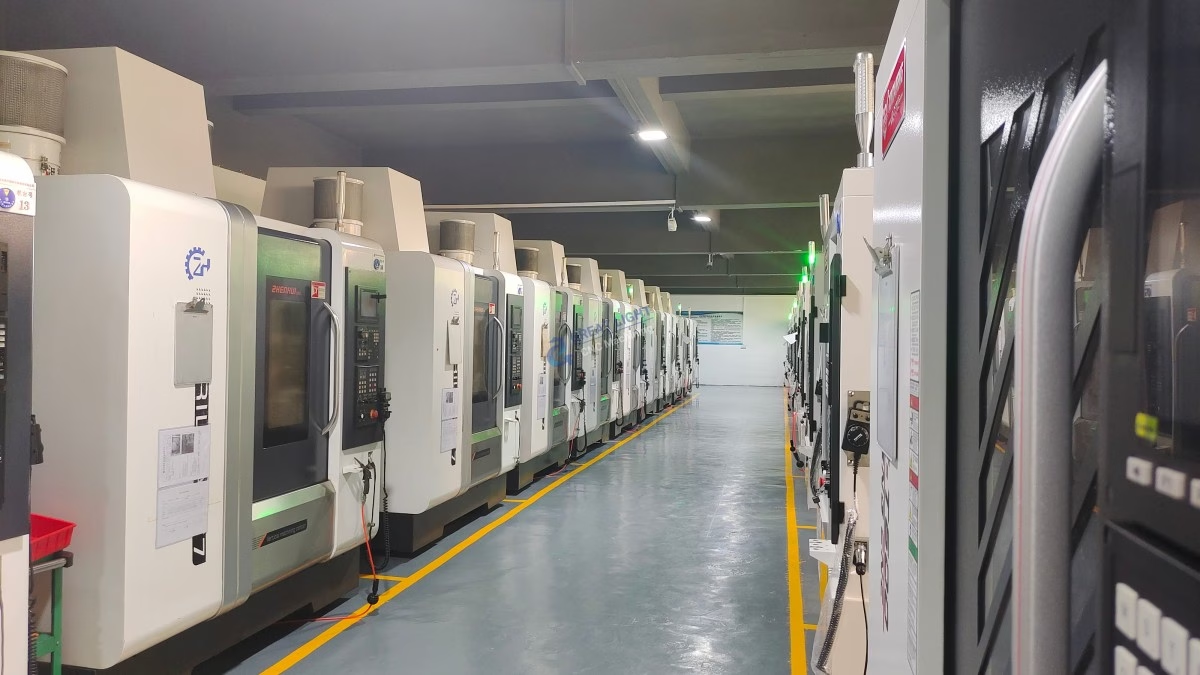
Drawing from my experience at GreatLight Metal, a premier five-axis CNC machining facility with 127 precision peripheral machines and certifications including ISO 9001, ISO 13485, and IATF 16949, I’ve compiled seven transformative techniques that our team has validated across thousands of production runs for automotive, aerospace, and medical clients.
Let’s dive into the precision welding strategies that will reshape your cost structure.
Understanding the Cost Trap in Traditional Welding
Before we explore the solutions, we must acknowledge the problem. Traditional welding approaches for precision parts suffer from three systemic inefficiencies:
Post-weld distortion requiring secondary machining, often consuming 20-40% of total production time
Heat-affected zone (HAZ) weaknesses leading to scrapped parts and rework loops
Inconsistent joint quality necessitating extensive inspection and touch-up operations
These aren’t minor inconveniences—they represent real capital erosion. A single scrapped aerospace bracket can cost thousands in material and machine time. The seven techniques below directly attack these cost drivers.
Technique 1: CNC Pre-Weld Preparation with Automated Chamfering
The Cost Problem
Manual edge preparation for weld joints is inconsistent, time-consuming, and leads to variable weld penetration depths. This variability forces engineers to specify excessive weld material, increasing both consumable costs and distortion risks.
The Implementation
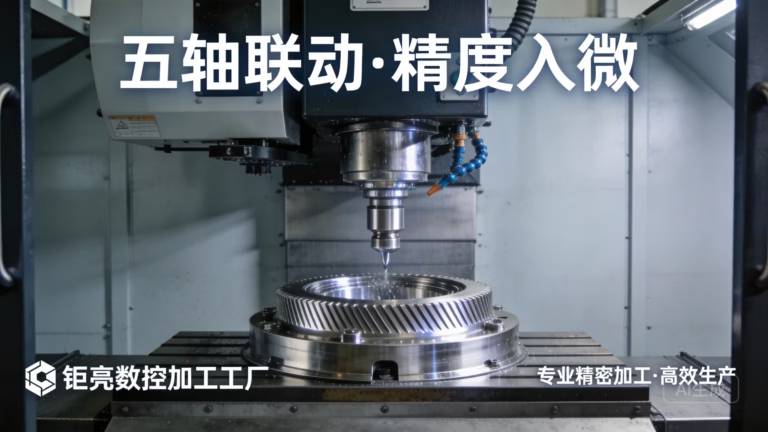
Instead of manual grinding or separate deburring operations, integrate weld preparation directly into your CNC machining program. At GreatLight, we routinely program our five-axis machining centers to create precision J-grooves, double-V bevels, and U-grooves with tolerances of ±0.05mm.
Why It Slashes Costs
Eliminates secondary preparation operations by combining machining steps
Reduces welding consumables by 15-25% because joint geometry is optimized for efficient deposition
Minimizes defect rates through consistent, repeatable surface preparation
Pro Tip: When ordering parts from suppliers like Xometry or RapidDirect specifically for weldments, clearly specify “CNC-prepared weld edges” in your technical drawing notes. This small specification can save 8-12% on your overall assembly cost per unit.
Technique 2: Strategic Component Splitting for Reduced Complex Welding
The Cost Problem
Complex one-piece weldments require multiple passes, specialized fixtures, and highly skilled welders—all premium cost centers. The labor for a single complex weldment can exceed the material cost by 3-5x.
The Implementation
This technique is counterintuitive: split a larger component into two or three simpler pieces that can be individually CNC machined, then robotic welded in a single pass. This approach leverages the precision of five-axis CNC machining services to create mating surfaces with self-locating geometry.
Why It Slashes Costs
Converts high-skill manual welding into automated robotic operations
Reduces fixture complexity because CNC-machined features serve as alignment references
Lowers rework rates from 15% down to under 2% in controlled applications
Case in Point: For an automotive engine bracket custom requirement, GreatLight split a 12-joint weldment into three individually-machined components. Total weld time dropped from 4.5 hours to 45 minutes, with a 98% first-pass yield. The client saved over $180 per unit.
Technique 3: Laser-Hybrid Welding with CNC Position Control
What Differentiates This Technique
Traditional TIG or MIG welding relies heavily on operator skill for heat management and travel speed. Laser-hybrid processes combine a laser beam with an electrical arc, delivering deeper penetration and higher speeds—but only when coordinated with precise positioning.
The Implementation
Integrate your welding head with a CNC-controlled motion system, utilizing the same gantry or robotic platform that performs your machining operations. Modern CNC machining centers can be configured with welding attachments, allowing seamless transition between metal removal and joining.
Cost Impact Analysis
| Parameter | Traditional MIG | Laser-Hybrid CNC |
|---|---|---|
| Travel speed | 5-8 in/min | 40-80 in/min |
| HAZ width | 0.080-0.120 in | 0.020-0.040 in |
| Distortion per ft | 0.015-0.030 in | 0.005-0.010 in |
| Secondary machining | Typically required | Often eliminated |
| Total cost per joint | $4.50-7.00 | $1.80-3.20 |
GreatLight Insight: We’ve observed that companies like Protolabs Network and Fictiv have begun offering hybrid machining-welding services, but few have the depth of experience to optimize the process for specific material combinations. Our facility’s combination of 5-axis capacity and in-house laser welding capability creates unique cost advantages.
Technique 4: Heat Sink Optimization Through CNC-Machined Fixtures
The Overlooked Cost Driver
Heat management during welding isn’t just about quality—it’s about throughput. Inefficient heat sinking forces slower travel speeds, longer cool-down periods, and increased part handling.
The Implementation
Design CNC-machined copper or aluminum heat sink fixtures with conformal cooling channels—the same technology used in injection mold cooling. These fixtures can be fabricated in-house on your existing machining equipment, often within 24-48 hours.
The Cost Advantage
Reduces interpass waiting time by 50-70%
Enables faster travel speeds without thermal damage
Extends consumable life by 20-30% through consistent thermal management
Manufacturing Engineer’s Note: At GreatLight, we use our precision CNC machining capability to create these fixtures with surface finishes under 16 RA, ensuring optimal thermal contact. Even a simple heat sink fixture costing $200-400 to machine can save thousands across a production run by preventing thermal deformation scrap.
Technique 5: Intelligent Weld Sequencing with CNC Path Planning
The Common Mistake
Most shops weld in arbitrary sequences—whatever is most convenient for the operator. This creates cumulative distortion that destroys dimensional accuracy, forcing expensive rework or scrappage.
The Implementation
Use your CAM software’s toolpath generation capabilities to plan weld sequences, applying the same logic used for minimizing tool deflection in CNC milling. Symmetrical welding patterns, alternating passes, and balanced heat input become programmable operations.
How This Reduces Costs
Eliminates up to 80% of post-weld straightening operations
Maintains tighter tolerances, often eliminating the need for final machining
Reduces inspection time through predictable, documented sequences
Expert Advice: For high-value materials like Inconel or titanium, which are common in aerospace parts at our facility, improper sequencing can create metallurgical issues that render the part unusable. This technique is non-negotiable for cost-effective production of these alloys.
For partnerships on sensitive intellectual property projects, this technique pairs perfectly with ISO 27001 data security protocols—your welding sequence data remains as protected as your CAD files.
Technique 6: Real-Time Adaptive Welding with Integrated QA
The Breakthrough
Traditional welding relies on preset parameters that don’t account for material variability, joint fit-up variations, or thermal drift. This leads to “over-welding” to ensure minimum acceptable strength—wasting both time and material.
The Implementation
Install sensors (thermal cameras, infrared pyrometers, or structured light scanners) that feed data back to the CNC controller. The system dynamically adjusts travel speed, wire feed rate, and power output to maintain optimal weld characteristics.
Cost Reduction Mechanics
Reduces filler metal consumption by 18-25% through precise deposition control
Lowers post-weld inspection costs because in-process QA catches defects immediately
Enables lighter part designs, reducing material costs by 10-15%
GreatLight’s Approach: We’ve integrated this technology into our production workflow for clients requiring medical hardware production with ISO 13485 standards—continuous monitoring ensures traceable, auditable quality without the overhead of extensive manual inspection.
Technique 7: Hybrid Manufacturing for Weldment Repair and Modification
The Hidden Cost Center
Prototype and low-volume production runs often involve design iterations that require modifying existing weldments. Traditional approach: cut apart, re-weld, re-machine. This is incredibly wasteful.
The Implementation
Utilize additive manufacturing capabilities within your CNC environment. Direct energy deposition (DED) or laser cladding heads can be mounted on your five-axis CNC machining center to add material to existing weldments with precision previously impossible.
The Economics
Reduces scrappage of expensive weldments by 60-80%
Eliminates the need for completely new fabrication for design changes
Shortens iteration cycles from weeks to days
Real Application: A manufacturer of industrial automation equipment had 37 weldments that required design changes after initial fabrication. Instead of scrapping $45,000 worth of work-in-progress, GreatLight used hybrid techniques to add material and re-machine the components to new specifications. Total cost: $7,200. The client saved $37,800 and six weeks of production time.
For engine hardware component production, this hybrid approach is particularly valuable, as engine parts are expensive to fabricate from scratch but highly amenable to controlled material addition and re-machining.
Choosing the Right Partner for CNC-Enhanced Welding
Not all manufacturing partners are created equal when it comes to integrating CNC machining with welding processes. Here’s what to look for:
| Evaluation Criteria | Why It Matters |
|---|---|
| In-house 5-axis capacity | Enables complex joint geometry and integrated fixture fabrication |
| ISO 9001:2015 certification | Ensures documented, repeatable processes |
| Dual-process experience | Partners who both machine and weld understand the full system |
| Material breadth | Aluminum, stainless steel, titanium, and superalloys require different approaches |
| IATF 16949 for automotive | Critical for engine and drivetrain components |
GreatLight Metal meets all these criteria and more. Our 7600 sqm facility in Chang’an, Dongguan operates three wholly-owned manufacturing plants with equipment ranging from large high-precision five-axis machining centers to wire EDM and SLM 3D printers. This vertical integration means your weldments can transition from raw material to finished assembly without leaving our controlled production environment.
Implementation Roadmap: Getting Started Tomorrow
If you’re ready to start slashing production costs through these techniques, here’s a practical action plan:
Week 1: Audit Your Current Weldment Costs
Identify your top 5 highest-cost weldments by unit price
Track actual vs. estimated production time
Document rework rates and scrap percentages
Week 2: Design Optimization
Review joint designs for CNC preparation compatibility
Consider component splitting opportunities
Evaluate heat sink fixture requirements
Week 3: Partner Selection
Contact potential suppliers with specific technical requirements
Request process capability documentation and certifications
Ask for case studies in your material/industry
Week 4: Pilot Program
Start with one critical weldment for process validation
Establish baseline metrics before and after implementation
Scale successful techniques across your product line
GreatLight’s commitment to ISO 9001:2015 standards means every pilot program follows rigorous documentation and validation protocols—ensuring your investment yields predictable, measurable results.
The Bottom Line
CNC-enhanced welding isn’t just a technical improvement—it’s a strategic financial decision. The seven techniques outlined here have been proven in production environments to reduce total manufacturing costs by 15-40% for weldment-intensive components.
Technique 1-2 address preparation and design for 10-15% reduction
Technique 3-4 focus on process efficiency for another 10-15% reduction
Technique 5-7 tackle quality and iteration for additional 10-15% savings
When combined, these techniques create a compounding effect that transforms your cost structure. And with a partner like GreatLight Metal, backed by ISO 9001, ISO 13485, and IATF 16949 certifications, you’re not just getting a supplier—you’re gaining a manufacturing engineering team dedicated to your profitability.
To explore how these techniques can be applied to your specific parts, consider contacting our engineering team. We’ve helped clients in humanoid robotics, automotive, aerospace, and medical devices achieve measurable cost reductions. Your next weldment could be your most profitable one yet.
Customize your precision parts at the best price today—discover the GreatLight advantage. GreatLight Metal combines technical expertise with uncompromising standards, ensuring your projects meet the highest quality benchmarks while staying within budget.
For more insights into precision manufacturing, follow our LinkedIn page where we regularly share case studies, process optimization tips, and industry analysis.



















