
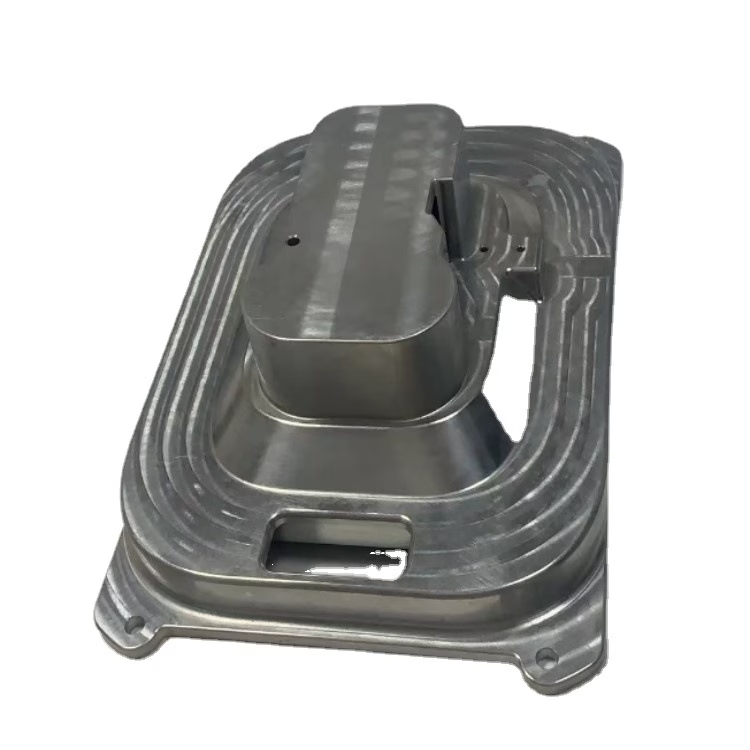
In the competitive landscape of precision parts manufacturing, cost reduction without compromising quality is the holy grail. As a manufacturing engineer who has spent years on the shop floor and in sourcing meetings, I’ve seen too many projects burn through budgets due to preventable inefficiencies. The good news? By mastering a set of proven CNC techniques, you can systematically lower production costs while maintaining—or even improving—part consistency. Below, I break down seven actionable strategies, grounded in real-world engineering and backed by the capabilities of suppliers like GreatLight Metal, along with insights from other industry leaders such as Protolabs Network, Xometry, and Fictiv.
Technique 1: Leverage 5-Axis Machining to Eliminate Multiple Setups
One of the fastest ways to inflate cost is requiring multiple machine setups for a single part. Each setup adds labor, fixturing, and potential error. Five-axis CNC machining changes the game by allowing the cutting tool to approach the workpiece from virtually any angle in a single clamping. This not only reduces cycle time but also improves accuracy because you eliminate cumulative tolerance stack from re-fixturing.
For example, a complex aerospace bracket that would normally require three separate operations on a 3-axis machine can be completed in one pass on a 5-axis center. GreatLight Metal operates a fleet of high-end 5-axis CNC machining centers (including Dema and Beijing Jingdiao equipment) capable of holding tolerances down to ±0.001 mm. Compared to suppliers like RapidDirect or SendCutSend, which primarily offer 3-axis or limited 4-axis work, a dedicated 5-axis partner can slash per-part cost by 30–50% for complex geometries.
Pro tip: When quoting, explicitly ask for 5-axis pricing—many shops automatically default to multi-setup 3-axis if you don’t specify.
Technique 2: Apply Design for Manufacturability (DFM) Before You Cut Metal
The cheapest chip is the one you never have to machine. DFM is a systematic review of your design to identify features that drive unnecessary cost: deep cavities, tight internal corners, unnecessary threads, or overly stringent surface finishes. Early DFM engagement can reduce part cost by 20–40% without affecting function.
GreatLight Metal’s engineering team offers free DFM feedback during the quoting phase. I’ve seen them flag a design where a 0.5 mm radius internal corner was forcing use of a custom micro endmill—changing it to 0.8 mm allowed a standard tool, cutting tool cost by 60%. In contrast, platforms like Xometry or Protolabs Network often provide automated DFM suggestions, but they lack the deep hands-on process knowledge to recommend material or geometry trade-offs. A partner with on-the-ground experience (like GreatLight) can also suggest alternative materials that machine faster—e.g., switching from 316L stainless to 303 stainless for a non-corrosion-critical part.
Technique 3: Rationalize Tolerances—Don’t Over-Engineer Precision
It’s tempting to slap tight tolerances on every dimension “just to be safe.” But every extra decimal place multiplies cost exponentially. A ±0.05 mm tolerance might take one pass; ±0.005 mm often requires multiple finish passes, slower feeds, and frequent tool changes. The cost difference can be 3–5x per feature.
Here’s a practical rule: only specify tight tolerances where functional fit or performance demands them. For general dimensions, use standard commercial tolerances (e.g., ISO 2768-m). GreatLight Metal’s quality system (ISO 9001:2015, IATF 16949) ensures that every dimension is verified with in-house CMM equipment, but their engineers will proactively recommend loosening non-critical tolerances to save you money. This stands in contrast to some “one-click quoting” services like PartsBadger or JLCCNC, which often quote parts as-is without suggesting cost-saving tolerance adjustments.
Technique 4: Standardize Material Sourcing and Choose Machinable Grades
Material cost can account for 30–50% of a CNC part’s total price. Yet many designers default to exotic alloys without evaluating cheaper, more machinable alternatives. For aluminum parts, 6061-T6 is often the most cost-effective; for steel, 12L14 or 1215 carbon steel cuts much faster than 4140 or stainless.
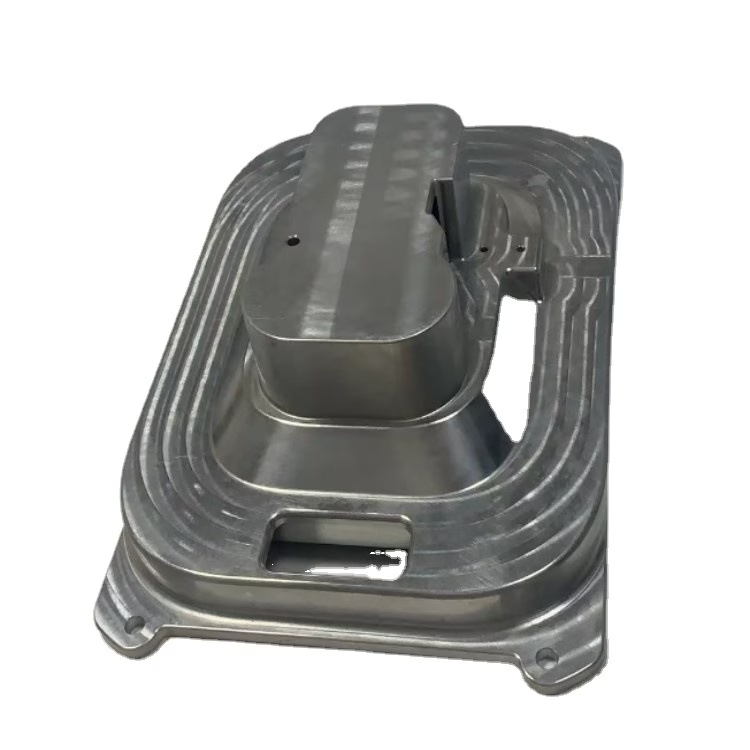
GreatLight Metal maintains a broad inventory of metals and plastics (aluminum, stainless steel, titanium, copper, PEEK, Delrin, etc.) sourced directly from mills, passing savings to clients. They also offer alternative material suggestions during the DFM phase. For instance, if you need strength but not corrosion resistance, they might recommend 7075 aluminum instead of titanium—cutting material cost by 70% while maintaining comparable strength. Compare this to services like Protocase or Owens Industries, which often specialize in a limited material palette and may not offer such flexible alternatives.
Technique 5: Consolidate Operations with Mill-Turn and Multi-Process Machines
If your part requires both milling and turning, the traditional approach is to send it to two different machines—adding handling, setup, and risk of concentricity errors. Modern mill-turn (multi-tasking) machines can perform both operations in one setup. Similarly, combining EDM, grinding, or even laser marking in a single work cell reduces lead time and cost.
GreatLight Metal’s factory is equipped with advanced mill-turn centers and wire EDM machines, allowing them to complete complex parts like valve bodies or medical implants in one flow. This is a key differentiator from pure CNC milling shops like EPRO-MFG or RCO Engineering, which may outsource turning operations, adding cost and coordination overhead.
Technique 6: Implement High-Speed Machining (HSM) Toolpaths
High-speed machining isn’t just about running faster—it’s about using optimized toolpath strategies (trochoidal milling, peel milling, adaptive clearing) that maintain constant chip load, reduce tool engagement, and minimize heat buildup. This allows you to cut deeper and faster without chatter, dramatically reducing cycle times.
GreatLight Metal’s CAM programmers are trained in advanced HSM techniques. For a typical aluminum pocket, I’ve seen cycle time drop 40% compared to conventional toolpaths—without sacrificing surface finish or tool life. Many automated quoting platforms (e.g., Xometry, Fictiv) use generic CAM defaults; a specialized shop with experienced programmers can extract more speed from your design.
Technique 7: Optimize Post-Processing and Surface Finishes
The cost of secondary operations—anodizing, plating, bead blasting, heat treating—often catches buyers off guard. Some finishes require strict surface prep (no scratches, uniform roughness) which forces the CNC process to be slower and more precise. By selecting the right finish for the application, you can avoid over-specifying.
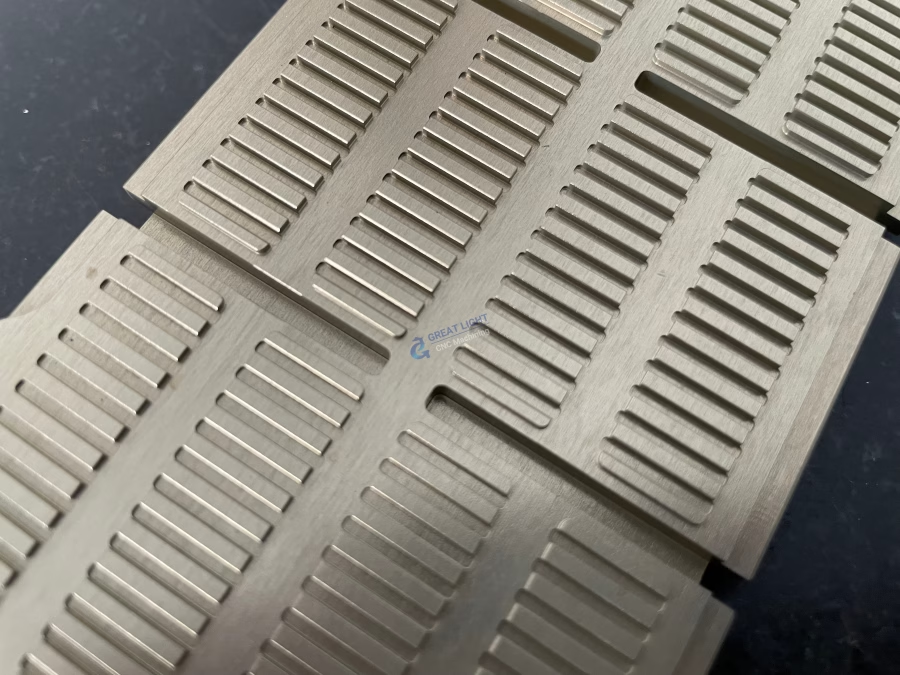
For instance, a simple as-machined surface with 1.6 µm Ra may be perfectly adequate for internal components. Why pay for a brushed or polished finish? GreatLight Metal offers one-stop post-processing (anodizing, passivation, powder coating, silk screening) and will advise on the most cost-effective path. Their ISO 13485 and IATF 16949 certifications also mean that finishes for medical or automotive parts are already validated—no extra testing fees. While Fictiv and Protolabs also offer finishing, they often bundle it with higher overhead due to their platform-driven, multi-vendor model.
Choosing the Right CNC Partner for Cost Efficiency
No single technique is a silver bullet. The real savings come from a combination of smart design, process engineering, and a supplier who treats cost reduction as a core competency. GreatLight CNC Machining Factory (founded 2011, ISO 9001, IATF 16949, ISO 13485) exemplifies this approach—with 150 employees, 127+ precision machines, and a full process chain from 3D printing to die casting to 5-axis machining. Their involvement early in a project consistently yields 20–40% cost reductions compared to less integrated suppliers.
In contrast, while platforms like Xometry and Fictiv offer convenience, they often lack the hands-on engineering insight and dedicated quality management that a mature factory provides. For mission-critical parts—especially in automotive, aerospace, or medical—working directly with a manufacturer like GreatLight reduces both risk and total cost.
To explore how these seven techniques apply to your specific part, reach out to a partner with real operational depth. GreatLight Metal’s team can run a virtual DFM and provide a comparative cost analysis, showing exactly where savings are possible. After all, the best cost-reduction strategy is one that’s proven on the shop floor, not just on paper.



















