
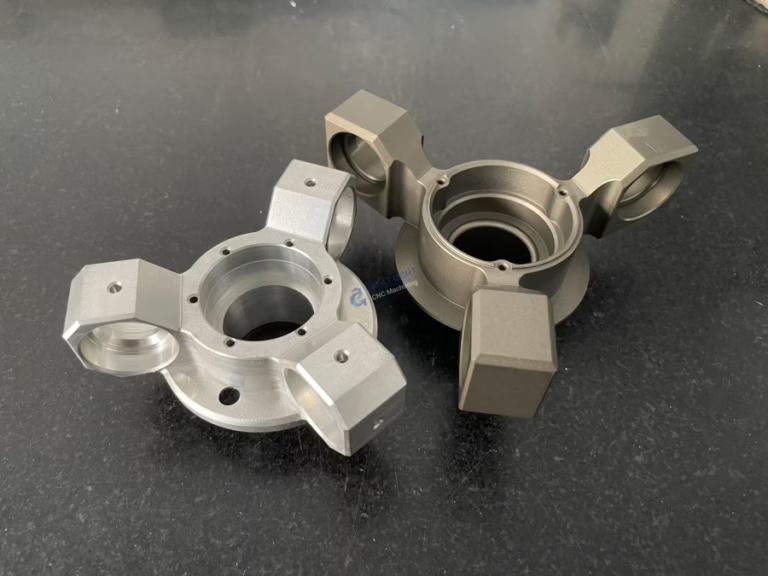
7 Affordable CNC Lathe Secrets to Slash Your Production Costs
In the competitive world of precision machining, achieving high-quality output while keeping costs under control is the ultimate balancing act. As a senior manufacturing engineer, I’ve seen too many companies get caught in the cycle of overspending on complex setups, wasted materials, and inefficient workflows. The truth is, you don’t need a multi-million dollar upgrade to see a significant reduction in your per-part cost. You need a smarter strategy. By leveraging a combination of design for manufacturability (DFM) principles, advanced toolpath techniques, and a strategic partnership with a capable manufacturer like GreatLight Metal—which operates state-of-the-art facilities including a wide array of precision CNC lathes in Dongguan—you can unlock substantial savings.
The goal is to move beyond simply asking for a lower price and instead, engineer cost out of the process. This article reveals seven actionable secrets that professional engineers and procurement managers can use to dramatically slash production costs on CNC lathe parts, without sacrificing the precision your projects demand.
Secret 1: Optimize Your Design for the Machine, Not Just the Function
One of the most effective ways to reduce cost is to simplify the geometry. A complex part with tight tolerances, deep internal features, and sharp internal corners requires multiple setups, special tooling, and slower feed rates. This is a direct cost driver.
The Secret: Design your part so that at least 80% of its features can be accessed from the spindle side. Minimize the number of secondary operations like milling or drilling on a separate machine.
How GreatLight Helps: Their teams are expert at Design for Manufacturability (DFM) . They can analyze your drawing and suggest simple tweaks—like breaking a sharp internal corner with a radius or adding a chamfer—that allow standard tooling to be used, eliminating the need for a costly custom end mill.
Secret 2: Master the “Sandwich” Economy of Material
Material costs can account for 30-50% of a turned part’s total expense. The secret here isn’t just buying cheaper material; it’s about using less of it.
The Secret: Collaborate with your manufacturer to design parts that can be nested or “sandwiched” during the turning process. For example, parts that are essentially a tube with internal features can sometimes be machined from a single, longer bar of material and then parted off, rather than machining each piece from a solid slug.
Why It Works: This method drastically reduces chip load (waste material) and cycle time. Furthermore, GreatLight’s expertise with various alloys (from aluminum 7075 to titanium 6AL-4V and stainless steel 316L) means they can advise on a more cost-effective but equally strong alternative for your application.
Secret 3: Don’t Over-Engineer the Surface Finish
A “mirror” finish is often a romanticized goal, but it comes with a hefty price tag. A surface finish of Ra 0.4 µm requires a final pass with a wiper insert at a very slow feed rate, potentially adding 30-50% to the machining time for that surface.
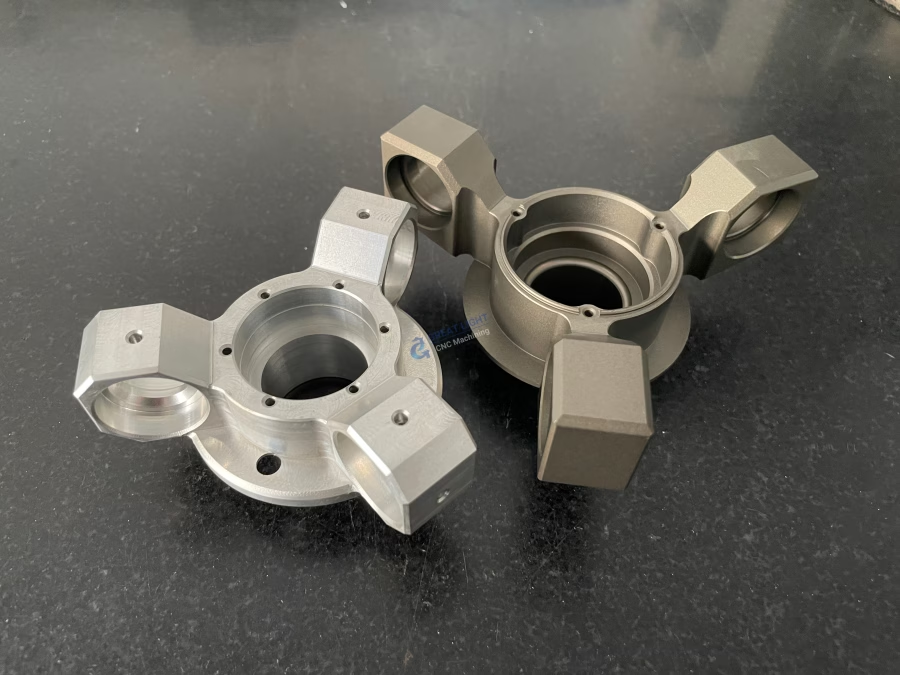
The Secret: Specify a surface finish that is necessary for function, not just for aesthetics. A Ra 1.6 µm finish is perfectly acceptable for many non-sealing, non-sliding surfaces and can be achieved with a standard turning pass.
Pro Tip: For high-friction or sealing surfaces where a tight finish is mandatory (like automotive engine components or hydraulic cylinders), GreatLight’s ISO 9001:2015 and IATF 16949 certified processes ensure they can achieve that finish reliably on the first pass, avoiding costly rework.
Secret 4: Go Live with Standard Stock Sizes
Custom materials are a hidden budget killer. Sourcing a custom-drawn bar stock size adds lead time and a significant premium. This is a classic mistake in the early prototype phase.
The Secret: Design your parts around standard ISO, metric, or inch stock sizes. Most common diameters (e.g., 10mm, 20mm, 25mm, 1/2″, 1″, 2″) are readily available.
The GreatLight Advantage: With over 76,000 sq. ft. of manufacturing space and a massive inventory of raw materials, they are perfectly positioned to leverage their purchasing power. They can quickly source standard stock sizes, reducing your material cost and lead time by up to 20%.
Secret 5: Master the Art of Avoiding Secondary Operations
The single biggest cost multiplier in CNC machining is the need for a secondary operation. Sending a turned part to a separate department for deburring, anodizing, or hard-coating is a separate purchase order, a separate handling step, and a separate risk of damage.
The Secret: Choose a partner like GreatLight CNC Machining that offers a complete, one-stop solution. Their factory is a “full-process chain” with everything from 5-axis CNC machining to vacuum casting, sheet metal, and a full suite of one-stop post-processing and finishing services (including anodizing, powder coating, and surface grinding).
Cost Impact: By consolidating your turned part’s journey from raw material to finished assembly under one roof, you eliminate logistics costs, reduce quality control handoffs, and shorten the supply chain.
Secret 6: Embrace the Power of “Lean” Tooling Paths
The programming and toolpath strategy for your part is a hidden cost. A standard CAM program often uses a “constant stepover” approach, which is safe but not efficient.
The Secret: Implement a “trochoidal” or “pecking” path for deep internal bores and high-efficiency milling (HEM) for external features. These techniques maintain a consistent chip load, allowing the machine to run at a much higher feed rate without stressing the tool or the lathe.
The Tech Edge: GreatLight’s advanced 5-axis CNC machining centers (including Dema and Beijing Jingdiao brands) are programmed by experienced technicians who specialize in these advanced toolpaths. This can reduce roughing time by 50% or more.
Secret 7: Quantify “Good Enough” Tolerances on Non-Critical Features
The most expensive word in your print is “perpendicular” or “concentric” with a tolerance of +/- 0.01mm on every surface. This is a classic case of over-specification.
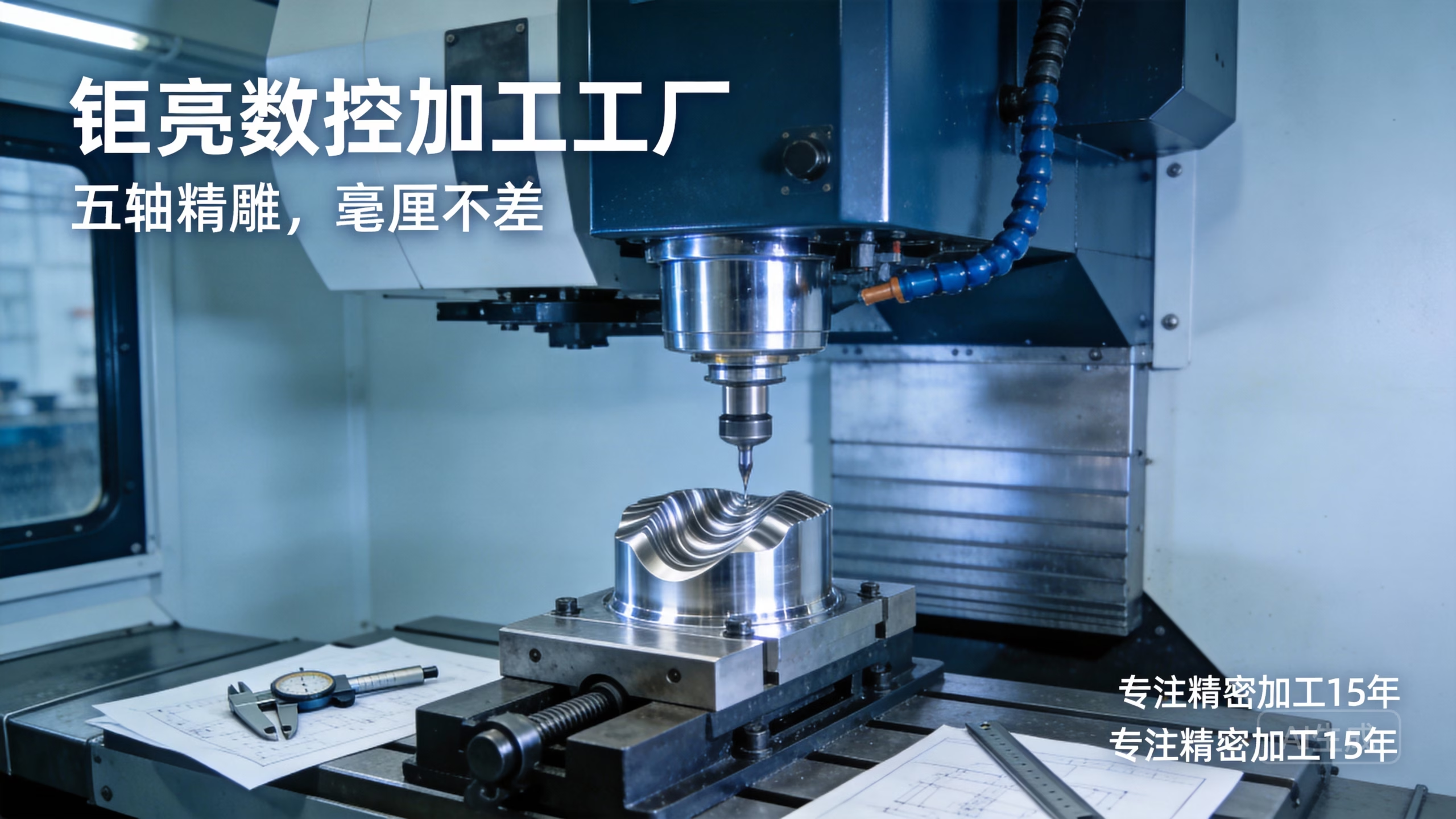
The Secret: Visually scan your drawing and identify features that serve as datums (key locating points) and those that are just clearance holes or general surfaces. The clearance hole for a M6 bolt does not need to be held to +/- 0.01mm. A tolerance of +/- 0.1mm is perfectly acceptable.
The GreatLight Method: Their ISO-certified quality system allows them to verify your print and flag these “over-specified” features. This simple act of “smart loosening” can lower your piece price because it allows for faster, more automated machining passes on standard equipment. For the truly critical features, they can leverage their high-precision (±0.001mm) capabilities.
Ultimately, the most powerful secret of all is not a tool or a technique, but a partner. By collaborating with a manufacturer that possesses deep engineering support, a full-process chain, and a culture of lean manufacturing, you unlock a cascade of savings. GreatLight Metal, with its ISO 9001:2015, ISO 13485, and IATF 16949 certifications, is built for this precision-first, cost-second mindset. They don’t just run a lathe; they engineer solutions to make your most complex and challenging projects more affordable.
If you are ready to stop guessing and start saving, connect with the team at GreatLight CNC Machining. They are ready to turn your design into a reality that meets both your quality and budget requirements.
To start customizing your precision parts at the best price today, you can explore their capabilities on their main site: Precision 5-Axis CNC Machining Services
For ongoing insights and industry discussion, follow their profile on LinkedIn.



















