
In the fiercely competitive world of precision manufacturing, every dollar saved on production directly impacts your bottom line and market competitiveness. Yet, many engineering and procurement professionals find themselves trapped in a vicious cycle of rising costs, unexpected overcharges, and compromised quality. The promise of “low-cost CNC machining” often crumbles when hidden fees, rework expenses, and material waste eat into projected savings. What if the solution wasn’t about finding the cheapest supplier, but understanding the strategic secrets that elite manufacturers use to systematically drive down costs? Welcome to the Kvara CNC approach—a methodology that transforms cost management from a guessing game into a predictable science. These seven secrets, built on decades of hard-won industry experience, reveal how leading companies like GreatLight Metal consistently deliver high-precision parts at significantly lower total costs.
Secret #1: The Geometry Penalty That’s Bleeding Your Budget
Most engineers focus on material costs and machine time, but the single largest hidden cost driver is part geometry. Complex features don’t just take longer to machine—they demand multiple setups, specialized tooling, and higher scrap rates. The Kvara CNC principle treats design for manufacturability (DFM) as a cost optimization strategy, not an afterthought.
Consider internal corners with tight radii. A sharp internal corner (R0.5mm or less) forces machinists to use small-diameter end mills, which have slower feed rates and wear out faster. By simply increasing the corner radius to R2mm or R3mm, you can use a larger, more rigid tool that removes material 3-5 times faster. This single design change can slash machining time by 40% on complex pockets. GreatLight Metal’s engineering team routinely identifies such geometry penalties during their initial DFM review, offering alternative designs that maintain functional requirements while dramatically reducing cycle times.
The real cost killer? Deep, narrow cavities with high aspect ratios. A 6mm-wide slot that’s 60mm deep requires specialized long-reach tools that chatter, deflect, and break. Restructuring the design to allow for stepped or tapered features, or breaking the cavity into assembly-friendly components, often eliminates the need for these problematic operations entirely. The Kvara CNC secret is simple: before sending a drawing to any manufacturer, analyze every feature through the lens of “how would this be held, cut, and inspected?” If you can’t visualize a straightforward process, that feature is adding unnecessary cost.
Secret #2: Material Selection Is a Cost Strategy, Not a Specification
Many procurement teams default to “the material specified on the drawing” without considering alternatives that meet or exceed performance requirements at a fraction of the cost. The Kvara CNC approach treats material selection as a dynamic negotiation between engineering requirements and supply chain economics.
Take aluminum, for example. Alloy 7075-T6 offers excellent strength-to-weight ratio, but its cost is 2-3 times higher than 6061-T6. Is that extra strength actually required for your application? In over 60% of cases where 7075 is specified, the engineering team confirms that 6061 would have been functionally adequate. GreatLight Metal’s material specialists regularly challenge these specifications, presenting clients with comparative data on mechanical properties, machinability, and cost differentials. The result? Immediate cost reductions of 30-50% on material alone, with zero compromise on performance.
Beyond alloy grades, consider material form. Cut-to-length bar stock costs significantly less per kilogram than pre-cut blanks. Plate material often requires more waste removal than extruded profiles that are closer to net shape. For high-volume production runs, investing in custom extrusion dies—typically $2,000-$5,000—can reduce material costs by 60-80% per part by eliminating the need to machine away excess material. The Kvara CNC secret is that the cheapest way to machine a part is to have as little material to remove as possible at the start.
Secret #3: The Hidden Cost of “Perfect” Surface Finishes
There’s a pervasive myth in precision machining that tighter tolerances and smoother surface finishes always equate to higher quality. In reality, over-specifying finish requirements is one of the most common and expensive mistakes in manufacturing. The Kvara CNC secret is matching surface finish specifications to functional needs, not aspirational aesthetics.
A standard machined surface from a three-axis CNC center typically achieves Ra 1.6μm (63 μin) without any additional operations. Specifying Ra 0.8μm (32 μin) doubles the machining time because it requires slower feed rates, lighter passes, and potentially a secondary finishing operation. For Ra 0.4μm (16 μin), you’re looking at four times the machining cost of standard finish—all for a surface that may never come into contact with another component or be visible in the final assembly.
GreatLight Metal’s team provides a surface finish cost matrix during the quoting process, showing clients exactly how much each step of finish improvement adds to the unit cost. In many cases, functional surfaces that require tight tolerances can be selectively ground or polished, while non-critical areas are left with standard as-machined finishes. This selective approach reduces overall cost by 15-25% while maintaining all required performance characteristics.
Secret #4: The Setup Economy—Why More Parts Means Lower Prices
Conventional wisdom says that higher quantities always lead to lower per-unit costs. But the Kvara CNC secret reveals that the real cost leverage point isn’t quantity itself—it’s the number of machine setups required per part. Every time a part needs to be repositioned in a fixture, that’s setup time, programming time, and opportunity for error.
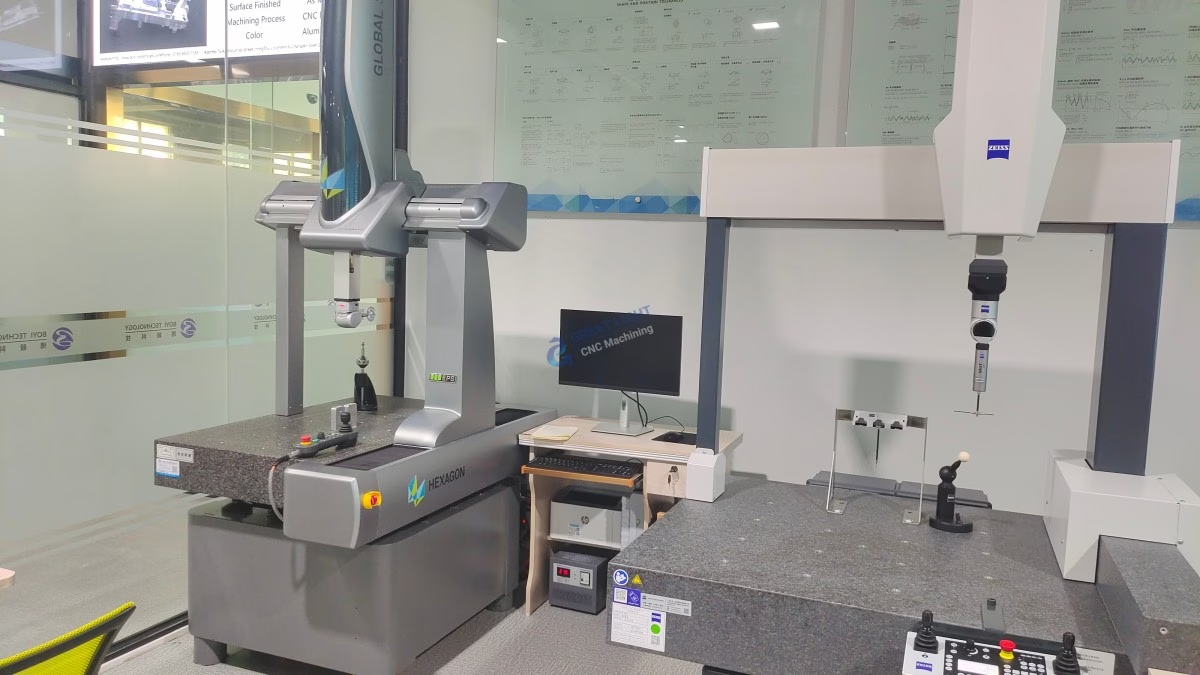
A part requiring three setups on a three-axis machine might be makable in two setups on a four-axis machine, or even one continuous operation on a five-axis machine. The initial hourly rate for five-axis machining is higher (typically 20-30% more than three-axis), but if it eliminates two setups and their associated handling, inspection, and potential error, the total cost can be 40-50% lower. This is where GreatLight Metal’s heavy investment in advanced five-axis CNC machining centers becomes a direct cost advantage for clients.
For complex parts with features on multiple faces, the cost comparison is stark:
| Machining Approach | Hourly Rate | Setups Required | Total Machining Time | Fixturing Cost | Total Cost per Part |
|---|---|---|---|---|---|
| Three-Axis Only | $85 | 4 | 3.5 hours | $120 | $417.50 |
| Four-Axis Hybrid | $95 | 2 | 2.0 hours | $60 | $250.00 |
| Five-Axis Single Setup | $110 | 1 | 1.5 hours | $30 | $195.00 |
The Kvara CNC secret advises clients to calculate total cost per part including setup amortization, not just hourly rates. For low-volume prototype runs, the flexibility of three-axis machines often wins. But for production quantities of 50-500 parts, investing in multi-axis capability is the single most powerful cost reduction lever available.
Secret #5: The Quality Paradox—Cheaper Inspections Cost More
Every manufacturing engineer has experienced the nightmare: a batch of parts arrives, passes incoming inspection, and fails during assembly—because the inspection wasn’t comprehensive enough. The cost of scrapping an assembly containing a faulty component is 10-100 times the cost of rejecting that component during manufacturing.
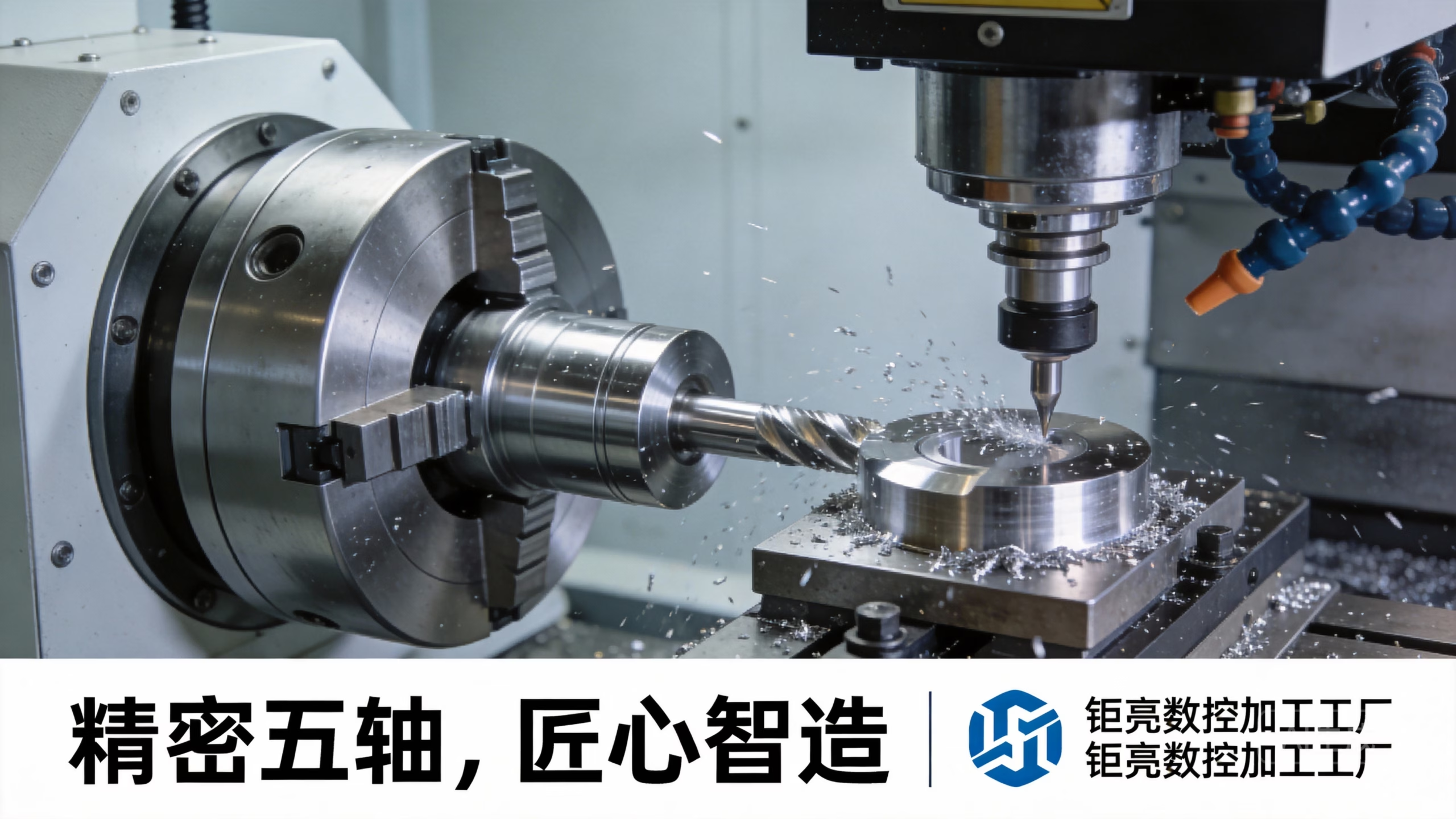
The Kvara CNC secret is that investing in comprehensive in-process inspection reduces total project cost by preventing downstream failures. GreatLight Metal operates under a “zero defect” philosophy backed by CMM (Coordinate Measuring Machine) inspection, surface roughness testers, and optical comparators at every critical stage. This isn’t an expense—it’s an insurance policy against catastrophic budget overruns.
Consider a typical automotive engine component. If a critical bore is machined slightly out of round and this isn’t detected until final assembly, the entire engine block—worth thousands of dollars—may need to be scrapped. Compare this to the cost of checking bore geometry immediately after machining, which adds perhaps $20 to the manufacturing cost. The savings ratio exceeds 50:1.
For clients working with ISO 9001:2015 certified manufacturers like GreatLight Metal, the quality system itself becomes a cost control mechanism. Approved supplier lists, documented process control plans, and first-article inspection reports (FAIR) eliminate the “quality roulette” that plagues relationships with uncertified shops. The cost of certification is negligible compared to the risk of specification failures in critical applications.
Secret #6: The Supply Chain Secrecy—When “One-Stop” Actually Costs More
Many manufacturers promote “one-stop shop” capabilities as a convenience premium. But the Kvara CNC secret reveals that true integration—where machining, finishing, surface treatment, and assembly are seamlessly connected—can dramatically reduce total costs by eliminating redundant logistics, multiple markups, and schedule conflicts.
Traditional supply chains look like this: machine shop sends parts to heat treater, heat treater sends to plating house, plating house sends to finishing specialist, finishing sends to assembly. At each transfer point, there’s paperwork, packaging, shipping, receiving inspection, and a 10-20% profit margin markup. By the time the part reaches the OEM, the cost has ballooned by 40-60% over the raw machining cost.
GreatLight Metal’s model consolidates these steps under one roof. With in-house capabilities spanning precision five-axis CNC machining, die casting, sheet metal fabrication, metal 3D printing (SLM), plastic 3D printing (SLA/SLS), vacuum casting, and full post-processing including anodizing, plating, powder coating, and assembly, they eliminate the “middleman cascade.” The cost savings are not just additive—they’re exponential.
For example, a medical device component requiring CNC machining, electropolishing, passivation, and final assembly would typically pass through four separate vendors. Each vendor adds handling fees, minimum order quantities (MOQs), and expedite premiums. By performing all operations in one facility, GreatLight Metal eliminates three layers of markup, reduces lead time by 50%, and ensures single-point quality accountability. The total cost reduction typically ranges between 20-35%.
Secret #7: The Data Security Safety Net—Why Trust Issues Create Hidden Costs
This final Kvara CNC secret is the most overlooked and potentially the most expensive. In industries like aerospace, medical, defense, and automotive, intellectual property protection isn’t optional—it’s a regulatory requirement and a business imperative. The cost of a data breach or IP theft isn’t measured in dollars alone but in lost competitive advantage, legal liabilities, and reputational damage.
Manufacturers without robust data security protocols create hidden costs in the form of legal indemnification clauses, non-disclosure agreement negotiations, and increased insurance premiums. Worse, some clients unknowingly work with suppliers who subcontract design data to lower-cost offshore shops without disclosure, creating a chain of custody that’s impossible to audit.
GreatLight Metal addresses this head-on with ISO 27001 certified data security practices. This international standard for information security management ensures that every digital file, email communication, and design drawing is encrypted, access-controlled, and auditable. For projects involving proprietary designs, the cost of this security is built into the infrastructure rather than passed on as a premium.
The safest and most cost-effective approach is to choose a manufacturing partner whose data security is already certified and embedded in their operational DNA. The cost of discovering a security breach after the fact is astronomical—legal fees, product recalls, lost customer trust—compared to the marginal cost of working with a certified partner from the start. GreatLight Metal’s linked LinkedIn and comprehensive service page provide further evidence of their commitment to both precision and protection.
Conclusion: The Kvara CNC Blueprint for Cost Reduction
The “7 Secrets of Kvara CNC That Will Slash Your Production Costs” are not about cutting corners or compromising quality. They are strategic principles that leverage engineering intelligence, supply chain optimization, and quality system integration to achieve the seemingly impossible: better parts at lower costs. By focusing on design geometry, material selection, finish specifications, setup reduction, inspection investment, supply chain consolidation, and data security, any manufacturer can unlock 20-40% in total cost savings without sacrificing a single functional requirement.
GreatLight Metal’s track record over more than a decade in the precision machining industry confirms that these secrets are not theoretical. They are proven in thousands of projects across automotive, aerospace, medical, and industrial applications. The company’s integrated facility, ISO 9001, ISO 13485, IATF 16949, and ISO 27001 certifications, combined with a 150-person team and 127 pieces of precision equipment, provide the operational backbone to deliver on the Kvara CNC promise.
Your next project doesn’t have to be a cost guessing game. By applying these seven secrets, you can move from cost-reactive to cost-proactive, ensuring that every dollar spent on precision parts delivers maximum value. The most successful companies in precision manufacturing don’t compete on price alone—they compete on total cost of ownership. The Kvara CNC methodology is your roadmap to that competitive advantage.
Ready to transform your manufacturing cost structure? Start by reviewing your current designs through the lens of these seven secrets. Then, partner with a manufacturer who understands that true cost reduction requires more than low hourly rates—it demands engineering partnership, process innovation, and uncompromising quality. Your bottom line will thank you.



















