
When engineering teams face tight budgets and aggressive timelines, the intersection of casting and CNC machining often becomes the first place to look for savings. Yet, many companies inadvertently inflate costs by overlooking fundamental design-to-manufacturing principles. Drawing from over a decade of hands-on experience in precision manufacturing—and insights from partners like GreatLight CNC Machining (a specialist in integrated five-axis solutions and full-process chain services)—this article explores seven actionable tips that can dramatically reduce production costs without sacrificing quality. These tips apply whether you work with a global on-demand platform or a dedicated Chinese manufacturer.
1. Design for Manufacturability from the Drawing Board
The single largest cost driver in any cast-and-machined part is geometry that ignores manufacturing constraints. Early engagement with your supplier to apply Design for Manufacturability (DFM) rules can cut per-part costs by 20–40%.
Key considerations:
Draft angles for casting: Avoid vertical walls. Incorporate 1–3° draft angles to ease ejection and reduce die wear, which directly lowers tooling amortization.
Uniform wall thickness: Sudden thick-to-thin transitions cause shrinkage porosity. Keep sections as uniform as possible—typically 2–6 mm for aluminum die casting.
Radius internal corners: Sharp internal corners concentrate stress and require slower machining passes. A fillet radius of at least 0.5–1.0 mm improves both casting flow and subsequent milling tool life.
When working with suppliers like GreatLight Metal (headquartered in Dongguan’s mold capital), their engineering team often provides free DFM feedback before quoting. This upfront collaboration eliminates costly redesigns later.
2. Select the Right Casting Process for Your Volume
Not all casting methods are equal in cost structure. Choosing the wrong one is a common budget killer.
| Process | Typical Volume | Per-Unit Cost | Tooling Cost | Lead Time |
|---|---|---|---|---|
| Die Casting | > 5,000 pieces | Low | High ($5k–$50k) | 6–10 weeks |
| Investment Casting | 100–5,000 pieces | Medium | Medium | 4–8 weeks |
| Sand Casting | 1–100 pieces | High | Low | 2–4 weeks |
| 3D Printing (SLM/SLA) | 1–10 pieces | Very High | None | 1–2 weeks |
Insight: For prototype validation or low-volume production (< 100 pcs), consider using GreatLight's metal additive manufacturing (SLM 3D printing) to skip tooling entirely. For medium volumes, investment casting combined with five-axis finish machining often provides the best balance. For high volumes, die casting is the only economical path—but ensure your supplier has ISO 9001 and IATF 16949 certification to guarantee process stability.
3. Rationalize Tolerances to Avoid “Over-Engineering”
Precision has a price. Moving from ±0.1 mm to ±0.05 mm can increase machining time by 30–50%. Many designers specify tight tolerances everywhere when only a few critical features need them.
Practical approach:
Identify functional surfaces (sealing faces, bearing seats, mating holes) and assign tighter tolerances only there.
Use general tolerances (ISO 2768-m or equivalent) for non-critical faces.
Leave generous stock allowance on cast surfaces to be finished later—typically 0.5–1.5 mm for machining.
Our own experience shows that working with a manufacturer like GreatLight Metal, which possesses in-house CMM and laser scanning equipment, allows for real-time verification of tolerance stacks. They can advise which dimensions can safely be opened up. One client reduced machining cost by 18% simply by relaxing four non-critical hole positions from ±0.02 mm to ±0.1 mm.
4. Leverage Five-Axis Machining to Reduce Setups
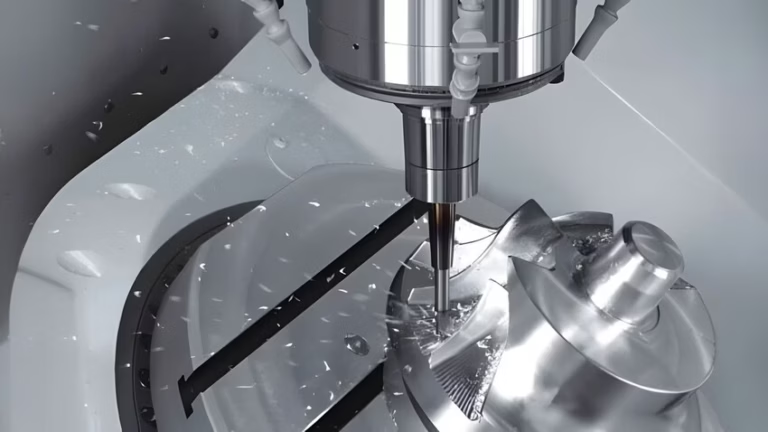
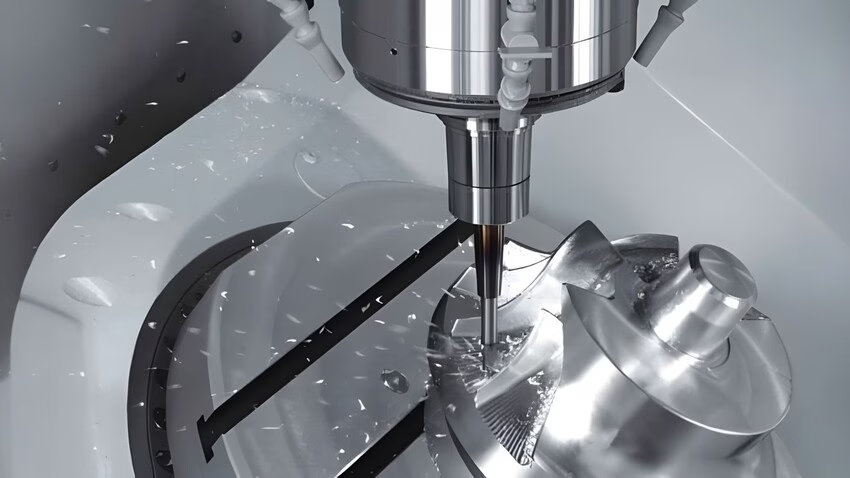
Every additional setup adds labor, fixturing cost, and potential for error. Traditional three-axis machining of a complex cast part might require five or more setups. A five-axis CNC machining center can often do the same job in two setups—or even one.
Why this matters:
Reduced handling time (up to 60% reduction for complex parts)
Better accuracy because datum errors between setups are eliminated
Ability to reach undercuts and complex angles without custom fixtures
GreatLight Metal’s facility is equipped with multiple large five-axis machining centers from Dema and Beijing Jingdiao. For example, an automotive e-housing previously machined in six setups on three-axis machines was completed in two setups on a five-axis machine, saving 35% in cycle time and reducing scrap rate by 12%. This is where investing in a capable partner pays dividends beyond the machine hour rate.
5. Optimize Material Selection and Utilization
Raw material cost can account for 25–50% of total part cost, especially in casting. Often, engineers default to common alloys like A380 aluminum or 316 stainless without considering alternatives.
Cost-saving material strategies:
Swap from 6061-T6 to 6082-T6 for moderate strength applications—6082 costs up to 15% less in many regions.
Use cast aluminum alloys (ADC12, A356) where machinability and strength are sufficient, rather than wrought alloys that increase billet cost and waste.
Nest multiple parts in a single casting or machine from a single billet to minimize scrap. GreatLight’s full-process chain (casting + machining + post-treatment) allows them to coordinate near-net-shape casting with minimal machining stock, reducing aluminum waste by up to 30% compared to machining from solid.
6. Choose Post-Processing and Surface Finishes Wisely
Surface treatment is often the second largest cost after machining. Yet many specifications include expensive coatings (e.g., hard anodize, electroless nickel) even when not needed.
Hierarchy of cost (lowest to highest):
As-machined (Ra 1.6–3.2 μm) – lowest cost
Bead blasting or glass bead – moderate
Chemical conversion coating (Alodine, chromate) – moderate
Type II anodizing – moderate-high
Hard anodizing or electroless nickel plating – high
PVD or ceramic coating – very high
Rule of thumb: Use the simplest finish that meets corrosion and wear requirements. If cosmetic appearance is not critical, accept the as-cast surface or a simple passivation. For functional surfaces, specify local machining only. GreatLight offers a wide range of one-stop post-processing (vibration polishing, anodizing, electroplating) so they can advise on the most cost-effective sequence.
7. Build a Strategic Partnership—Not a Transactional Relationship
The final tip is about procurement approach. Spot-buying each job from different suppliers—perhaps Protolabs for one batch, Xometry for another, and a local shop for the next—prevents accumulated learning and volume discounts.
Benefits of a long-term partnership:
Volume-based pricing on material and setup fees
Dedicated engineering support for continuous improvement (e.g., GreatLight’s IATF 16949 system emphasizes Kaizen and waste reduction)
Shared inventory of custom tooling (molds, fixtures) so you don’t pay for them repeatedly
Priority capacity allocation during peak seasons
Take GreatLight Metal as an example: they serve clients in automotive, aerospace, and humanoid robotics with a consistent engineering team. Over multiple projects, their engineers learn the client’s design preferences, leading to faster quoting and fewer iteration cycles. One aerospace client reduced overall lead time by 20% after three successive projects with the same team.
Conclusion
Slashing production costs in casting and machining is not about cutting corners—it’s about making intelligent decisions at every stage: design, process selection, tolerance management, equipment utilization, material choice, finish selection, and procurement strategy. By applying these seven tips, you can achieve 15–40% cost reductions while maintaining, or even improving, part quality.
Whether you are a startup needing rapid prototypes or a Tier-1 supplier seeking high-volume production, partnering with an experienced manufacturer like GreatLight Metal—with its ISO 9001, ISO 13485, IATF 16949 certifications, 127 precision machines, and full process chain from 3D printing to five-axis CNC machining—provides the expertise to navigate these decisions effectively. The 7 Essential Casting and Machining Tips to Slash Production Costs outlined here are not theoretical; they are proven in thousands of production runs across industries. Start applying them on your next project, and watch your margin improve.



















