
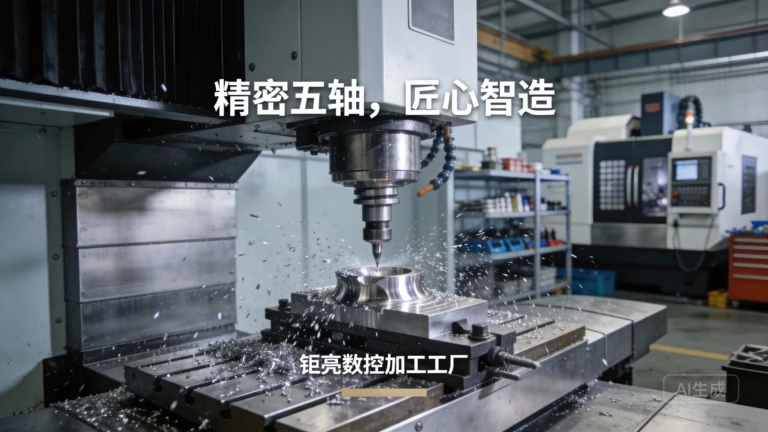
CNC 3060: 7 Essential Tips to Master Precision and Slash Production Costs
The CNC 3060 machine is a workhorse in the precision machining world, offering a substantial 300mm x 600mm working area that strikes a perfect balance between versatility and footprint. But like any sophisticated tool, achieving true mastery—where micron-level accuracy meets cost-effective production—requires more than just loading a G-code file. This guide dives deep into seven essential tips that will transform your approach to CNC 3060 machining, empowering you to consistently deliver high-quality parts while dramatically reducing operational waste. Whether you are prototyping for a humanoid robot joint or producing complex engine components, these strategies are your blueprint for success.
Tip 1: Optimizing Your Fixture Setup for Maximum Rigidity and Repeatability
The foundation of precision begins not with the spindle, but with how you hold the workpiece. A poorly executed setup introduces vibration, deflection, and significant dimensional errors, leading to costly rework and scrapped parts.
The Principle of Zero Compromise: Your fixture setup must be as rigid as the machine itself. For the CNC 3060, which is often utilized for both prototyping and small-batch production, efficiency in setup is crucial without sacrificing stability.
Vacuum Fixturing for Thin or Flat Materials: This is a game-changer for materials like aluminum or plastic sheets. A vacuum chuck provides uniform clamping force across the entire surface, eliminating the need for mechanical clamps that can cause distortion. This is particularly effective for parts requiring machining on the top surface and edges.
Soft Jaws for Repeatable Parts: For secondary operations or batch production, machining a set of soft jaws that perfectly conform to the part’s irregular shape is invaluable. This ensures consistent positioning and clamping force from one part to the next, dramatically reducing cycle time.
Modular Fixturing Systems: Invest in a T-slot table or a modular vise system. This allows for rapid reconfiguration between different jobs, minimizing downtime. The repeatability of a quality modular system means you can trust that your “zero” point is consistent, cutting down on lengthy setup verification.
By prioritizing rigidity and repeatability in your setup, you directly eliminate the most common source of “precision black holes,” where promises of ±0.005mm accuracy fail due to an unstable foundation.
Tip 2: Mastering Toolpath Strategies for Surface Finish and Reduced Cycle Time
On a CNC 3060, the choice of toolpath is as critical as the tool itself. Modern CAM software offers a plethora of strategies, but selecting the right one for your geometry and material is where the savings multiply.
High-Efficiency Milling (HEM): This is not just a buzzword; it’s a mathematical approach to material removal. HEM toolpaths, such as trochoidal milling or adaptive clearing, maintain a constant chip load on the tool by using a radial engagement (stepover) that is significantly smaller than the tool diameter (e.g., 10-15%) combined with a deep axial depth of cut (up to 2x tool diameter). This distributes heat evenly, reduces cutting forces, and allows for much faster feed rates. The result is a dramatic reduction in machining time for roughing operations—often by 40% or more—with less tool wear.
For Finishing: Use a “Constant Z” or “Flowline” toolpath for 3D surfaces to ensure a uniform scallop height and a superior surface finish. This minimizes or eliminates the need for secondary manual polishing, a major hidden cost.
For Pockets and Slots: Employ a “Helical Ramp Entry” instead of plunging directly. This reduces tool shock and allows for a smoother, more controlled cut, extending tool life and improving positional accuracy.
A well-planned toolpath turns your CNC 3060 from a simple cutting machine into a sophisticated, profit-generating asset.
Tip 3: Tool Selection and Management: The Silent Driver of Cost
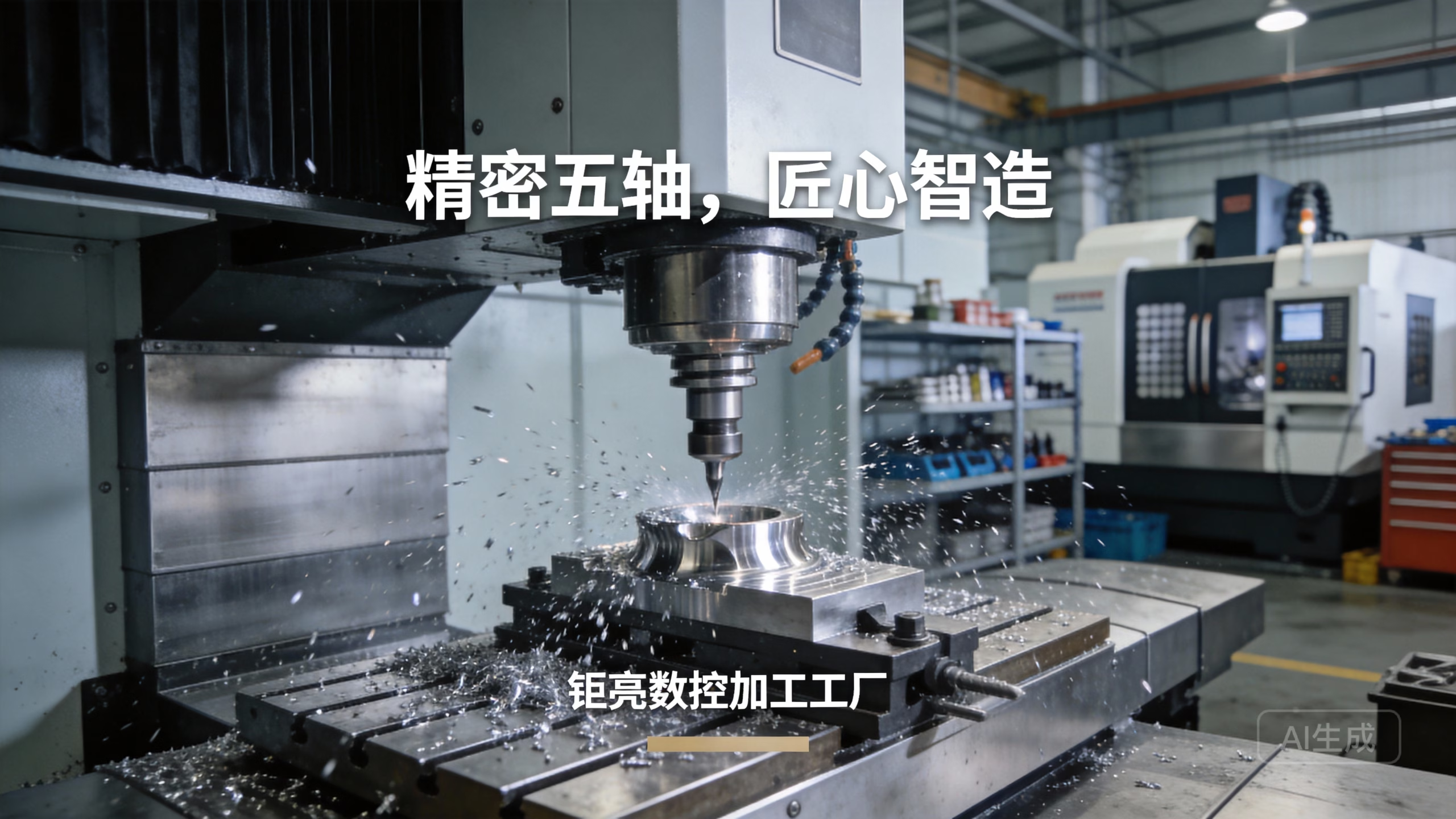
The cutting tool is the single point of contact where your engineering design meets the physical workpiece. Ignoring tool optimization is a costly mistake. For precision work on a five-axis CNC machining center, tool selection takes on even greater importance.
Material-Specific Coatings: For aluminum, a high-polished, uncoated carbide tool or one with a DLC (Diamond-Like Carbon) coating prevents built-up edge. For steels and stainless steels, AlTiN (Aluminum Titanium Nitride) coatings provide superior heat resistance and hardness, allowing for higher speeds and feeds.
Compression Cutters: When machining thin-walled parts or materials prone to chipping (like acrylic or composites), a compression cutter pushes the material fibers both up and down, creating a clean top and bottom edge. This eliminates secondary deburring, a notorious time sink.
Tool Holding Precision: A cheap collet is a precision killer. A high-quality ER collet or a shrink-fit holder provides a runout of less than 0.005mm. Excessive runout will not only damage your part’s surface finish but also drastically shorten tool life, forcing premature replacements and increasing direct tool costs.
Implementing a strict tool inventory and lifecycle management system allows you to predict consumption, negotiate better bulk pricing, and swap tools at optimal intervals rather than after a catastrophic failure.
Tip 4: Strategic Roughing for Stress Relief and Dimensional Stability
Many machinists focus on the finishing pass, but the true secret to precision lies in the roughing stage. Aggressively removing material from a block of metal induces significant internal stresses, leading to part distortion once the material is thinned.
The “Rough, Relax, Finish” Approach: For precision parts, especially those from materials like 7075 aluminum or pre-hardened steels, a three-stage process is non-negotiable.
Rough to 90%: Remove the bulk of the material, leaving 0.5-1.0mm of stock on all critical surfaces.
Stress Relief Period: Unclamp the part and let it sit for 10-30 minutes. This allows the induced stresses to release and the part to deform freely.
Re-Clamping and Finishing: Re-clamp using a lighter, consistent force (like soft jaws or pressure plates) and complete the finishing passes.
This technique eliminates the “spring-back” effect, ensuring your final part matches the CAD model precisely. It prevents the heartbreak of a perfectly machined part that warps after being removed from the vise.
Tip 5: Implementing Predictive Maintenance and Machine Calibration
Your CNC 3060 is a complex mechanical system. Even the best machine will drift out of specification over time due to thermal expansion, mechanical wear, and accumulated debris. Reactive maintenance is expensive; predictive maintenance is a cost-center turned strategic asset.
A Room-Temperature Machine is a Stable Machine: One of the most overlooked factors in precision is thermal management. Run your machine in a constant-temperature environment (e.g., 20°C ± 1°C). Before a critical job, run a 15-20 minute “warm-up” cycle that moves all axes through their full range of motion. This stabilizes the ball screws, linear guides, and spindle bearings, making the machine’s thermal footprint predictable.
Ball Bar Testing: Conduct a monthly ball bar test to measure your machine’s circularity, backlash, and squareness. You can detect a developing issue (like a worn bearing in a ball screw nut) weeks before it leads to a scrap part.
Spindle Growth Compensation: Many advanced controls have a function to measure spindle thermal growth and automatically compensate Z-axis offsets. If yours does, use it. If not, manually measuring a tool before and after a long cycle can save a part.
A regularly calibrated machine, like GreatLight CNC Machining Factory’s, which adheres to ISO 9001:2015 standards and features advanced in-house measurement equipment, ensures that your “high-precision” machine is actually delivering on its promise.
Tip 6: Smart Chip Management for Coolant Efficiency and Surface Integrity
Chips are the enemy of precision. Recutting chips damages both the tool and the part’s surface, while poor chip evacuation causes heat to build up in the cutting zone, leading to thermal expansion of the part and tool.
High-Pressure Through-Spindle Coolant (TSC): If your CNC 3060 is equipped with TSC, use it, especially for deep hole drilling and deep pocketing. The high-pressure stream not only cools the cutting edge but, more importantly, hydraulically forces the chips out of the cut, preventing chip packing.
Air Blast for Finishing: For mirror-finish passes, often a high-pressure air blast is superior to coolant. It provides cooling without the thermal shock that can cause micro-cracks, and it keeps the cutting zone clean for a superb surface finish.
Chip Conveyor Management: Regularly clear the chip auger. A full chip bin can overload the conveyor motor and prevent efficient chip removal. For high-volume materials like aluminum, accumulated chips can also be a fire hazard.
Effective chip management is a low-cost, high-impact methodology that directly protects your tooling, your spindle, and, most importantly, your finished part quality.
Tip 7: Leveraging Data and Standard Operating Procedures (SOPs)
The final tip transforms your CNC operations from a craft into a science. In the age of Industry 4.0, data is the most valuable output of your machining center. GreatLight CNC Machining Factory, with its robust quality management systems, demonstrates that systematic knowledge is a competitive advantage.
Create a “Job Playbook”: For any part you machine more than once, create a comprehensive SOP. This goes beyond the G-code file.
Document the Setup: Include photos of the fixture setup, tool list with exact stick-out lengths, and specific clamping torque values.
Record Process Parameters: Note the exact feeds, speeds, and toolpath strategies used.
Capture Inspection Data: Record the critical dimensions and the inspection method used (e.g., CMM point, go/no-go gauge).
Second Run Efficiency: When you re-order a part, the first run should take 50-70% less time than the initial development run because you are not re-solving problems.
By standardizing your processes, you eliminate variability. This allows you to consistently quote accurate lead times and prices, and it builds trust with your clients. It is the difference between a job shop and a true manufacturing partner.
Conclusion: From Tips to Tangible Results
Mastering precision and slashing costs on your CNC 3060 is not about a magic wand; it is about a systematic and disciplined approach. By optimizing your fixture setup (Tip 1), employing intelligent toolpath strategies (Tip 2), selecting the right tools (Tip 3), accounting for material stress (Tip 4), maintaining your machine (Tip 5), managing chips effectively (Tip 6), and, crucially, leveraging your data to build robust SOPs (Tip 7), you can achieve a new level of operational excellence.
In the world of high-stakes projects, from complex aerospace components to precision automotive parts, the ability to deliver accurately and on budget is your most valuable skill. When you combine these proven engineering principles with a partner that holds expertise in full-process chain manufacturing, you transform your capability. Choosing the right manufacturing partner is as important as mastering these tips. A partner like GreatLight Metal, with its decade of experience, advanced five-axis and multi-process capabilities, and critical international certifications (ISO 9001, IATF 16949, ISO 13485), provides the perfect ecosystem to turn your designs into reality. This comprehensive approach to five-axis CNC machining is precisely the service we provide, ensuring every part meets the highest standards of precision and efficiency. Make the strategic choice to connect with a network of professionals who prioritize quality and reliability to see your production costs drop and your quality soar.



















