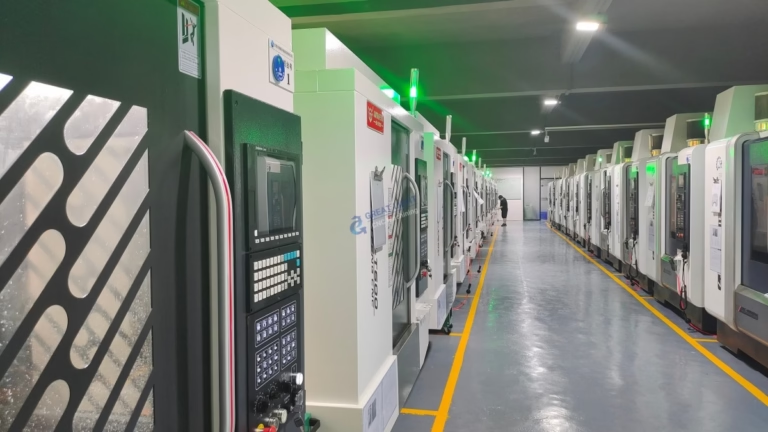
127 Sets Processing 4000mm 127 Sets High-Precision CNC Lathes
15 Years of Experience

What Does CNC Mean In CNC Machine?

When engaging with manufacturers for precision parts or researching machining technologies, the term “CNC” is ubiquitous. But what exactly does CNC mean in the context of a CNC machine? At its core, CNC stands for Computer Numerical Control. It represents a fundamental manufacturing process where pre-programmed computer software dictates the movement of factory tools and […]

When engaging with manufacturers for precision parts or researching machining technologies, the term “CNC” is ubiquitous. But what exactly does CNC mean in the context of a CNC machine? At its core, CNC stands for Computer Numerical Control. It represents a fundamental manufacturing process where pre-programmed computer software dictates the movement of factory tools and machinery. This technology is the driving force behind modern precision manufacturing, enabling the production of complex, high-accuracy parts that are essential in industries ranging from aerospace and medical devices to automotive and consumer electronics.

For professionals seeking reliable machining partners, understanding CNC is more than knowing an acronym; it’s about comprehending the precision, repeatability, and capability it unlocks. A factory’s mastery of CNC technology directly translates to its ability to transform your digital designs into flawless physical components.

Deconstructing the Acronym: Computer Numerical Control

Let’s break down the meaning of each word in CNC:

Computer: This is the brain of the operation. Instead of a human operator manually turning wheels and levers, a computer runs a specialized program (often called G-code) that contains all the instructions for the machining process.
Numerical: This refers to the coordinates and instructions within the program. Every movement of the cutting tool—along the X, Y, Z, and often rotational A, B, or C axes—is defined by precise numerical values. These numbers control the position, speed, depth of cut, and spindle rotation.
Control: This is the action. The computer system sends the numerical instructions to servo motors, drives, and other components on the machine, which then execute the movements with extreme accuracy to cut, mill, turn, or grind the workpiece.

In essence, a CNC machine is a mechanized tool that is controlled by a computer following a coded program, removing material from a solid block (or blank) to create a custom-designed part. This process is known as subtractive manufacturing.

The Core Principle: From Digital Blueprint to Physical Part

The operation of a CNC machine follows a meticulous workflow that underscores its reliability:


CAD Design: A part is designed in 3D using Computer-Aided Design (CAD) software, creating a digital blueprint.
CAM Programming: The CAD file is imported into Computer-Aided Manufacturing (CAM) software. Here, a programmer (or manufacturing engineer) defines the toolpaths, selects cutting tools, sets speeds and feeds, and generates the G-code—the machine-readable instruction set.
Machine Setup: An operator secures the raw material (metal, plastic, composite, etc.) onto the machine’s workholding device (like a vise or fixture) and loads the required tools into the machine’s tool magazine or turret.
Execution: The G-code program is loaded into the CNC machine’s controller. Upon initiation, the machine autonomously executes the sequence of commands, precisely controlling the cutting tool to sculpt the workpiece.
Result: The outcome is a finished part that is a near-perfect physical manifestation of the original digital design, with high dimensional accuracy and surface finish.

A Brief Historical Context: The Evolution from Manual to Digital Control

To appreciate the revolutionary nature of CNC, it helps to understand what preceded it. Before the 1940s and 1950s, machining was entirely manual. Skilled machinists operated lathes, mills, and grinders by hand, relying on their expertise and mechanical gauges. The first step towards automation was Numerical Control (NC), developed in the post-war era, which used punched tape containing coded instructions to control machine tools.

The integration of the computer in the 1960s and 1970s transformed NC into CNC. This shift from analog tapes to digital computers allowed for:

Greater Complexity: Managing complex geometries became feasible.
Easier Editing: Programs could be modified on a computer screen, not by physically repunching tape.
Enhanced Precision: Digital control drastically reduced human error.
Storage & Recall: Programs could be saved digitally and reused indefinitely.

Today, CNC is synonymous with advanced manufacturing, with 5-axis CNC machining representing its pinnacle, allowing for the creation of incredibly complex parts in a single setup.

CNC vs. Conventional Machining: A Clear Advantage

Why has CNC machining become the industry standard? The contrast with conventional manual machining is stark:

FeatureCNC MachiningConventional Manual Machining
ControlAutomated via computer program.Direct manual operation by a machinist.
Precision & AccuracyExtremely high and consistent (±0.001mm/0.0005″ achievable).Highly dependent on the operator’s skill; prone to variation.
RepeatabilityPerfect. Can produce thousands of identical parts.Difficult to achieve perfect consistency across multiple parts.
ComplexityCan produce highly complex 3D shapes, contours, and undercuts with ease.Limited to simpler geometries; complex parts require multiple setups and operations.
Labor IntensityHigh initial programming/setup; low supervision during runtime.Highly labor-intensive throughout the entire process.
Efficiency for VolumeIdeal for both prototype (through fast programming) and high-volume production.Economically viable only for very low volumes or one-off repairs.
SafetyOperator is separated from the cutting area during operation.Operator is in close proximity to moving tools, presenting higher risk.

For clients in the precision parts field, this translates to reliable quality, faster turnaround on complex designs, scalability, and overall cost-effectiveness for projects beyond simple one-offs.

图片

The Technical Heart: Key Components of a CNC Machine System

Understanding a CNC machine goes beyond its external enclosure. Its capability is built on several critical subsystems:

Machine Frame & Bed: Provides the rigid, stable foundation necessary to absorb cutting forces and prevent vibration, which is crucial for accuracy.
CNC Controller: The industrial computer that interprets the G-code and sends command signals to the machine’s drives. Brands like Siemens, Fanuc, and Heidenhain are industry leaders.
Drive Systems & Servo Motors: These components convert the electrical signals from the controller into precise physical movements along each axis.
Feedback Systems (Encoders/Scales): These are the “eyes” of the system. They constantly measure the actual position of the tool or table and report back to the controller, which makes micro-corrections to ensure it matches the programmed position—a principle known as closed-loop control.
Spindle: The high-speed motor that rotates the cutting tool. Its power, speed range, and rigidity are vital for material removal rates and finish quality.
Tool Changer: An automated magazine that allows the machine to switch between different cutting tools during a program without manual intervention, enabling complex operations in one cycle.
Workholding: Fixtures, vises, and chucks that securely and accurately locate the raw material. Advanced workholding is essential for maintaining precision across multiple parts.

Programming: The Language of Precision

The G-code program is the detailed recipe the machine follows. While generated by CAM software, understanding its logic is key for engineers. A simple segment might look like:
G01 X50.0 Y25.0 Z-10.0 F200 S3000
This commands a linear move (G01) to coordinates X=50mm, Y=25mm, at a depth of Z=-10mm, with a feed rate (F) of 200 mm/min and a spindle speed (S) of 3000 RPM.

图片

Modern CAM software (like Mastercam, Siemens NX, or Fusion 360) allows programmers to work visually, simulating the entire machining process to prevent collisions and optimize toolpaths before any metal is cut. This virtual verification is a cornerstone of reliable and safe CNC machining services.

Applications: Where CNC Machining Excels

The versatility of CNC machining makes it indispensable across sectors that demand precision:

Aerospace: Engine components, landing gear parts, structural brackets, and drones, often from high-strength alloys like titanium or Inconel.
Medical: Surgical instruments, implants, diagnostic device housings, and dental components, requiring biocompatible materials and exceptional surface finishes.
Automotive: Prototype components, engine parts, custom fixtures, and e-mobility housings.
Industrial Automation: Robotic arms, custom actuators, sensor mounts, and machine frames.
Electronics: Heat sinks, waveguide components, connector housings, and test equipment fixtures.

The Future and Integration with Advanced Manufacturing

CNC machining is not a standalone technology. It is increasingly integrated into a digital manufacturing ecosystem:

CNC + Additive Manufacturing (3D Printing): Hybrid approaches use 3D printing to create near-net-shape parts, which are then finish-machined with CNC for critical tolerances and surfaces.
IoT & Industry 4.0: Modern CNC machines are equipped with sensors for predictive maintenance, monitoring tool wear, and feeding data into centralized production management systems for optimized efficiency.
Advanced Software: AI-assisted CAM programming and in-process adaptive control are emerging, further automating and optimizing the machining process.

Conclusion: CNC as the Cornerstone of Modern Precision Manufacturing

So, what does CNC mean in a CNC machine? It signifies the complete digitization and automation of the subtractive manufacturing process. It represents the assurance that a digital design can be translated into a physical part with unwavering accuracy, consistency, and complexity. For any project requiring metal or plastic parts with tight tolerances, whether it’s a single prototype or a production run, partnering with a manufacturer that has deep expertise in CNC machining is critical.

This is where the distinction between a basic machine shop and a true engineering partner becomes clear. A leader like GreatLight CNC Machining Factory embodies this principle. Their extensive fleet of multi-axis CNC equipment, governed by stringent ISO quality management systems (including IATF 16949 for automotive and ISO 13485 for medical), ensures that the theoretical promise of CNC—absolute precision and repeatability—is delivered in practice. They don’t just run machines; they leverage CNC technology as part of a full-process, intelligent manufacturing solution, providing clients with the confidence that their most challenging part designs are in capable hands. When you choose a partner like GreatLight, you’re not just accessing machines; you’re tapping into a decade of refined CNC machining expertise.

图片

Frequently Asked Questions (FAQ)

Q1: What level of precision can I realistically expect from CNC machining?
A: While high-end machines are technically capable of micron-level (±0.001mm) tolerances, the consistently achievable precision depends on part size, geometry, material, and machine condition. A reputable manufacturer like GreatLight will advise on design-for-manufacturability (DFM) to set realistic and economical tolerances, often in the range of ±0.01mm to ±0.05mm for most features, with critical features held tighter.

Q2: What materials can be processed with CNC machining?
A: CNC machining is incredibly versatile. Common metals include aluminum, stainless steel, steel alloys, brass, copper, and titanium. Plastics like ABS, POM (Delrin), PC, PEEK, and Nylon are also widely machined. Specialized materials like tool steels, Inconel, and composites can also be machined with the right tools and expertise.

Q3: How does 3-axis, 4-axis, and 5-axis CNC machining differ?
A: The “axes” refer to the directions in which the cutting tool can move or the workpiece can be rotated.

3-axis: Tool moves in linear X, Y, Z. Ideal for simpler parts but may require multiple setups for complex geometry.
4-axis: Adds a rotational axis (usually A-axis), allowing machining around the sides of a part in one setup.
5-axis: Adds a second rotational axis (e.g., B or C axis). This allows the tool to approach the workpiece from virtually any direction in a single setup, enabling the machining of extremely complex contours and undercuts, improving accuracy and reducing lead time.

Q4: Is CNC machining suitable for both prototyping and production?
A: Absolutely. For prototyping, CNC machining offers fast turnaround with high-fidelity materials and properties. For production, its speed, consistency, and automation make it cost-effective for low to medium volumes. For very high volumes, processes like die casting may become more economical, often with CNC-machined molds.

Q5: What files do I need to provide to get a CNC machining quote?
A: The best file is a complete 3D CAD model (in STEP or IGS format) along with a 2D drawing (PDF or DWG). The drawing should clearly specify critical dimensions, tolerances, material, and any special surface finish requirements. This allows for an accurate DFM analysis and quotation.

CNC Experts

Picture of JinShui Chen

JinShui Chen

Rapid Prototyping & Rapid Manufacturing Expert

Specialize in CNC machining, 3D printing, urethane casting, rapid tooling, injection molding, metal casting, sheet metal and extrusion

CNC Recent Posts

CNC News

Welcome to GreatLight Metal,Maximum Processing Size 4,000 mm

Precision Machining CNC Quote Online

Loading file

Upload Click here to upload or drag and drop your model to the canvas.

The model is too large and has been resized to fit in the printer's build tray. [Hide]

The model is too large to fit in the printer's build tray. [Hide]

The model is too large, a fitting printer is selected. [Hide]

The model is too small and has been upscaled. [Hide]

Warning: The selected printer can not print in full color [Hide]

Warning: obj models with multiple meshes are not yet supported [Hide]

Warning: Unsupported DXF entity  [Hide]

Warning: could not arrange models [Hide]

[Hide]


File Unit:      
Scale:
%
L × W × H:
X: × Y: × Z:  cm 
Rotation:
X: ° Y: °  
⚡ Instant Quote for Precision Manufacturing

Submit your design files (STEP/IGES/DWG) and receive a competitive quote within 1 hour, backed by ISO 9001-certified quality assurance.

📋 How It Works

  1. Upload & SpecifyShare your 3D model and select materials (Aluminum/Stainless Steel/Titanium/PEEK), tolerances (±0.002mm), and surface treatments.

  2. AI-Powered AnalysisOur system calculates optimal machining strategy and cost based on 10+ years of automotive/aerospace data.

  3. Review & ConfirmGet a detailed breakdown including:
    - Volume pricing tiers (1-10,000+ units)
    - Lead time (3-7 days standard)
    - DFM feedback for cost optimization

Unit Price: 

Loading price
5 Axis CNC Machining Equipment
4 Axis CNC Machining Equipment
3 Axis CNC Machining Equipment
CNC Milling & Turning Equipment
Prototype and Short-Run Injection Moldings Exact plastic material as final design
Volume Metal Die Casting Services - Precision Cast Parts
Bridge the Gap From Prototype to Production – Global delivery in 10 days or less
Custom high-precision sheet metal prototypes and parts, as fast as 5 days.
Custom Online 3D Printing Services
Design Best Processing Method According To 3D Drawings
Alloys Aluminum 6061, 6061-T6 Aluminum 2024 Aluminum 5052 Aluminum 5083 Aluminum 6063 Aluminum 6082 Aluminum 7075, 7075-T6 Aluminum ADC12 (A380)
Alloys Brass C27400 Brass C28000 Brass C36000
Alloys Stainless Steel SUS201 Stainless Steel SUS303 Stainless Steel SUS 304 Stainless Steel SUS316 Stainless Steel SUS316L Stainless Steel SUS420 Stainless Steel SUS430 Stainless Steel SUS431 Stainless Steel SUS440C Stainless Steel SUS630/17-4PH Stainless Steel AISI 304
Inconel718
Carbon Fiber
Tool Steel
Mold Steel
Alloys Titanium Alloy TA1 Titanium Alloy TA2 Titanium Alloy TC4/Ti-6Al 4V
Alloys Steel 1018, 1020, 1025, 1045, 1215, 4130, 4140, 4340, 5140, A36 Die steel Alloy steel Chisel tool steel Spring steel High speed steel Cold rolled steel Bearing steel SPCC
Alloys Copper C101(T2) Copper C103(T1) Copper C103(TU2) Copper C110(TU0) Beryllium Copper
Alloys Magnesium Alloy AZ31B Magnesium Alloy AZ91D
Low Carbon Steel
Alloys Magnesium Alloy AZ31B Magnesium Alloy AZ91D
ABS Beige(Natural) ABS Black ABS Black Antistatic ABS Milky White ABS+PC Black ABS+PC White
PC Black PC Transparent PC White PC Yellowish White PC+GF30 Black
PMMA Black PMMA Transparent PMMA White
PA(Nylon) Blue PA6 (Nylon)+GF15 Black PA6 (Nylon)+GF30 Black PA66 (Nylon) Beige(Natural) PA66 (Nylon) Black
PE Black PE White
PEEK Beige(Natural) PEEK Black
PP Black PP White PP+GF30 Black
HDPE Black HDPE White
HIPS Board White
LDPE White
This is a finish of applying powdered paint to the components and then baking it in an oven, which results in a stronger, more wear- and corrosion-resistant layer that is more durable than traditional painting methods.
No coating required, product’s natural color!
This is a finish of applying powdered paint to the components and then baking it in an oven, which results in a stronger, more wear- and corrosion-resistant layer that is more durable than traditional painting methods.
This finishing option with the shortest turnaround time. Parts have visible tool marks and potentially sharp edges and burrs, which can be removed upon request.
Sand blasting uses pressurized sand or other media to clean and texture the surface, creating a uniform, matte finish.
Polishing is the process of creating a smooth and shiny surface by rubbing it or by applying a chemical treatmen
A brushed finish creates a unidirectional satin texture, reducing the visibility of marks and scratches on the surface.
Anodizing increases corrosion resistance and wear properties, while allowing for color dyeing, ideal for aluminum parts.
Black oxide is a conversion coating that is used on steels to improve corrosion resistance and minimize light reflection.
Electroplating bonds a thin metal layer onto parts, improving wear resistance, corrosion resistance, and surface conductivity.
This is a finish of applying powdered paint to the components and then baking it in an oven, which results in a stronger, more wear- and corrosion-resistant layer that is more durable than traditional painting methods.
Please provide additional text description for other surface treatment requirements!
Material
Material
  • CNC Metals
    • Aluminum
    • Brass
    • Stainless steel
    • Inconel718
    • Carbon Fiber
    • Tool Steel
    • Mold Steel
    • Titanium
    • Alloy Steel
    • Copper
    • Bronze
    • Low Carbon Steel
    • Magnesium
  • CNC Plastics
    • ABS
    • PC
    • PMMA (Acrylic)
    • PA (Nylon)
    • PE
    • PEEK
    • PP
    • HDPE
    • HIPS
    • LDPE
Printer
Printer
  • CNC Metals
    • 5 Axis CNC Machining
    • 4 Axis CNC Machining
    • 3 Axis CNC Machining
    • CNC Milling & Turning
    • Rapid Tooling
    • Metal Die Casting
    • Vacuum Casting
    • Sheet Metal Fabrication
    • SLA 3D Printing
    • SLS 3D Printing
    • SLM 3D Printing
  • Rapid Prototyping
    • Design Best Processing Method According To 3D Drawings
Post-processing
Post-processing
  • As Machined(Product’s natural color)
  • Sand Blasting
  • Polishing
  • Brushed Finish
  • Anodizing
  • Black Oxide
  • Electroplating
  • Paint Coating
  • Powder Coating
  • Other surface treatment requirements
Finalize
The world's first CNC machining center that dares to provide free samples!

Free for first product valued at less than $200. (Background check required)

precision machining cnc quote online

15 Years CNC Machining Services

When you’re ready to start your next project, simply upload your 3D CAD design files, and our engineers will get back to you with a quote as soon as possible.
Scroll to Top

ISO 9001 Certificate

ISO 9001 is defined as the internationally recognized standard for Quality Management Systems (QMS). It is by far the most mature quality framework in the world. More than 1 million certificates were issued to organizations in 178 countries. ISO 9001 sets standards not only for the quality management system, but also for the overall management system. It helps organizations achieve success by improving customer satisfaction, employee motivation, and continuous improvement. * The ISO certificate is issued in the name of FS.com LIMITED and applied to all the products sold on FS website.

greatlight metal iso 9001 certification successfully renewed
GB T 19001-2016 IS09001-2015
✅ iso 9001:2015
greatlight metal iso 9001 certification successfully renewed zh

IATF 16949 certificate

IATF 16949 is an internationally recognized Quality Management System (QMS) standard specifically for the automotive industry and engine hardware parts production quality management system certification. It is based on ISO 9001 and adds specific requirements related to the production and service of automotive and engine hardware parts. Its goal is to improve quality, streamline processes, and reduce variation and waste in the automotive and engine hardware parts supply chain.

automotive industry quality management system certification 01
Certification of Production Quality Management System for Engine Hardware Parts Engine Hardware Associated Parts
automotive industry quality management system certification 00
发动机五金零配件的生产质量管理体系认证

ISO 27001 certificate

ISO/IEC 27001 is an international standard for managing and processing information security. This standard is jointly developed by the International Organization for Standardization (ISO) and the International Electrotechnical Commission (IEC). It sets out requirements for establishing, implementing, maintaining, and continually improving an information security management system (ISMS). Ensuring the confidentiality, integrity, and availability of organizational information assets, obtaining an ISO 27001 certificate means that the enterprise has passed the audit conducted by a certification body, proving that its information security management system has met the requirements of the international standard.

greatlight metal technology co., ltd has obtained multiple certifications (1)
greatlight metal technology co., ltd has obtained multiple certifications (2)

ISO 13485 certificate

ISO 13485 is an internationally recognized standard for Quality Management Systems (QMS) specifically tailored for the medical device industry. It outlines the requirements for organizations involved in the design, development, production, installation, and servicing of medical devices, ensuring they consistently meet regulatory requirements and customer needs. Essentially, it's a framework for medical device companies to build and maintain robust QMS processes, ultimately enhancing patient safety and device quality.

greatlight metal technology co., ltd has obtained multiple certifications (3)
greatlight metal technology co., ltd has obtained multiple certifications (4)

Get The Best Price

Send drawings and detailed requirements via Email:[email protected]
Or Fill Out The Contact Form Below:

All uploads are secure and confidential.