
What Are CNC and DNC Machines? A Working Comparison
CNC is the computer on the machine. DNC is the network that feeds it. This page compares both, shows where each one stops working, and explains how to judge whether a job needs more than onboard storage.
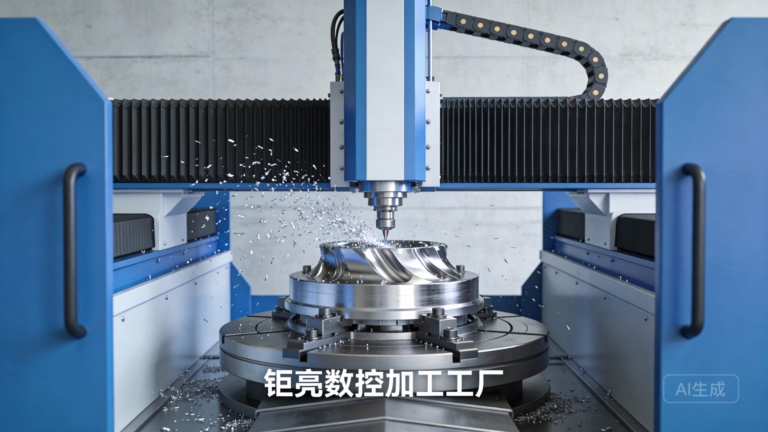
CNC and DNC machines compared
Where each system sits in the data chain
| Item | CNC | DNC |
|---|---|---|
| What it is | Onboard controller running one machine | Network linking controllers to a server |
| Main job | Execute G-code motion and tool changes | Store and stream part programs |
| Program storage | Limited onboard memory | Central server, effectively unlimited |
| Data flow | Reads local file, cuts part | Streams blocks in real time over LAN |
| Typical limit | Large 3D surfacing files overflow memory | Needs stable network and drip-feed setup |
| Failure mode | Alarm stops one spindle | Network drop stops the streamed cut |
| Best fit | Short to medium programs, standalone cells | Long surfacing paths, many machines, one server |
| Setup cost | Included with the machine | Server, cabling, and software layer |
Pick the setup by job type
Use this after reading the sections above
| Job type | Recommended setup | Why |
|---|---|---|
| Prototype bracket, 200 lines | Standalone CNC | Program fits easily, no network needed |
| Injection mold cavity, 300 MB | DNC drip feed | File exceeds any onboard memory |
| Titanium aerospace housing | DNC with wired link | Network drop would scrap a high-value part |
| High-mix job shop, 40 parts/week | DNC server | Central revision control saves setup time |
| One lathe, one family of shafts | Standalone CNC | Networking adds cost with no real gain |
| Five-axis blisk, tight blend | CNC with large lookahead | Memory is fine, motion control is the limit |
What are CNC and DNC machines, in plain terms
A CNC machine carries its own computer. That controller reads a program, moves the axes, changes tools, and turns coolant on and off. Everything needed to cut one part lives inside that box. The operator loads a file, presses cycle start, and the machine runs.
DNC is not a machine. It is the layer above the machines. A central server holds the part programs and sends them to each controller over a local network. The controller no longer needs the whole file in its own memory. It pulls one block at a time, cuts it, and asks for the next.
That difference matters when programs get big. A mold cavity with fine surfacing can run to hundreds of megabytes of G-code. An older controller may hold 1 MB or less. The file simply does not fit. DNC solves that by never storing the full program on the machine.
So when engineers ask what are CNC and DNC machines, the useful framing is this: CNC is the performer, DNC is the conductor. One cuts metal. The other keeps the programs moving so the cutting never stops for a file transfer.
How a CNC controller handles a part program
The controller is a real-time computer. It reads G-code, interpolates the path between points, and closes the position loop on each axis. On a five-axis center that means coordinating three linear axes and two rotary axes at the same time, sometimes at feed rates above 10,000 mm/min.
Memory is the usual bottleneck. Vendors quote program storage in kilobytes or megabytes, and the number shrinks once you account for tool data, offsets, and macro variables. A controller with 512 KB of free space cannot hold a finishing pass that needs 40 MB.
Lookahead is the second limit. The controller must read ahead far enough to slow down before a sharp corner without overshooting. Short lookahead buffers force slower feeds on complex geometry, which shows up as longer cycle times and sometimes as chatter.
None of this is a defect. It is a design trade. A standalone CNC machine is simple, cheap to run, and needs no network. For a shop cutting brackets, shafts, and housings with programs under a few thousand lines, onboard control is all you need.
How DNC distributes programs across the floor
DNC connects many controllers to one server. The classic version, often called drip feeding, sends the program block by block while the machine cuts. The controller buffer stays small, so even a 500 MB surfacing file can run on a controller with 256 KB of memory.
The modern version does more than feed files. It tracks which program is on which machine, logs revision numbers, and pushes updated code when a toolpath changes. That version control is the real reason large shops keep a DNC layer even when controllers have plenty of storage.
The weak point is the network. Drip feeding depends on a steady data rate. If the link stalls, the controller runs out of blocks and the cut stops mid-pass. A half-finished cavity is scrap, not a rework. Wired Ethernet and a dedicated server beat Wi-Fi for this reason.
Setup takes work. You need cabling to each machine, a server with backup, and software that speaks the right protocol for each controller brand. Once it runs, one programmer can push a corrected program to twenty machines without walking the floor with a USB stick.
Which setup fits your parts
Start with program size. Open the CAM file and check the estimated G-code size for the heaviest operation. Under 1 MB, a standalone controller is usually fine. Between 1 MB and 10 MB, check the actual free memory on the machine before you commit. Above 10 MB, plan on drip feeding or a controller with a large solid-state drive.
Then look at part count and change frequency. High-mix, low-volume work means programs change every few hours. A DNC server keeps those revisions in one place and cuts the risk of running an old file. Low-mix work with one program per machine gains little from networking.
Consider the geometry. Deep cavities, thin ribs, and blended surfaces generate dense toolpaths. Those are the jobs that expose both memory limits and short lookahead. A 4,000 mm long structural part with light surfacing may run fine on a three-axis machine with modest memory.
Finally, weigh the cost of a stop. If a network drop scraps a titanium part worth thousands of dollars, the network needs redundancy. If it scraps a 6061 bracket, the risk is easier to accept. Match the infrastructure to the value of the part, not to the spec sheet.
The verdict
If your heaviest program fits in the controller and the machine runs alone, a standalone CNC setup is simpler and cheaper. If programs exceed memory, or one programmer feeds many machines, add DNC. Choose by file size and part value, not by which acronym sounds more advanced.
Common questions
Can a CNC machine run without DNC?
Yes. A standalone controller reads a program from its own memory, a USB drive, or a compact flash card. DNC is only needed when the program is too large to store or when you want central revision control across many machines.
Most shops start standalone and add DNC when program sizes grow or when the number of machines makes manual file handling a bottleneck.
Does DNC replace the CNC controller?
No. The controller still does all the motion control, interpolation, and axis servo work. DNC only supplies the program blocks. Remove the network and the machine stops, but the controller is still the device doing the cutting.
What program size needs drip feeding?
It depends on the controller. Many older controllers hold under 1 MB, so a 5 MB surfacing program already needs drip feeding. Modern controllers with solid-state storage may hold several gigabytes, which covers most jobs without any network feed.
Check the free memory after offsets and tool data are loaded, not the headline storage number.
Why do five-axis parts stress the control system more?
Five axes must stay synchronized while the tool tip follows a curved path. That needs more computation per block and a longer lookahead buffer. Short lookahead forces slower feeds or leaves marks at direction changes, even when the program itself is small.
Is wireless DNC safe for production?
For long drip-fed cuts, wired Ethernet is the safer choice. A wireless drop during a deep cavity pass stops the stream and usually scraps the part. Use wireless for file transfer and monitoring, and wired links for real-time drip feeding.
Can GreatLight handle large programs on your machines?
Our 127 high-precision CNC machines include 16 simultaneous five-axis centers, 12 four-axis mills, 27 three-axis machines, and 16 mill-turn centers. Maximum processing size is 4,000 mm with tolerance to ±0.005 mm.
Send the CAM file or a drawing and we will confirm the right machine and control setup for your part.
Send your part file and get a quote
Upload a STEP file or drawing. We return a quotation and free DFM analysis within 12 hours, with the machine and control setup matched to your program size.
12-hour quote100% inspectionNo MOQ
More from GreatLight
We publish setup notes, tooling trials and inspection data from the factory floor.











