127 Sets Processing 4000mm 127 Sets High-Precision CNC Lathes
15 Years of Experience

Reliable Custom Metal 3D Printing Supplier

In the rapidly evolving landscape of precision manufacturing, finding a reliable custom metal 3D printing supplier is a critical decision that can make or break an entire product development cycle. Whether you are prototyping a new surgical instrument, manufacturing lightweight components for an unmanned aerial vehicle, or producing low‑volume end‑use brackets for automotive applications, the […]

In the rapidly evolving landscape of precision manufacturing, finding a reliable custom metal 3D printing supplier is a critical decision that can make or break an entire product development cycle. Whether you are prototyping a new surgical instrument, manufacturing lightweight components for an unmanned aerial vehicle, or producing low‑volume end‑use brackets for automotive applications, the consistency and dependability of the additive manufacturing (AM) partner you choose directly influence your timeline, your budget, and ultimately the performance of your product. While the market is flooded with service providers promising rapid turnaround and competitive pricing, discerning engineers know that true reliability involves far more than a polished online ordering interface. It requires a supplier who can consistently deliver dimensionally accurate parts with verified material properties, who maintains rigorous quality systems, and who can seamlessly handle secondary finishing – all under one roof. In this article, I will draw on more than a decade of hands‑on experience in CNC machining and additive manufacturing to unpack what separates a truly dependable metal 3D printing supplier from the rest, spotlighting how GreatLight Metal has systematically built a reputation as that kind of partner.

What to Look for in a Reliable Custom Metal 3D Printing Supplier

Before committing to any vendor, procurement teams and R&D leaders must zoom out from the immediate unit price and examine the supplier’s operational backbone. The following criteria form the foundation of reliability in metal additive manufacturing service provision:

Technology ownership and breadth – Does the supplier operate its own industrial‑grade SLM (Selective Laser Melting) machines, or do they outsource to third parties, adding latency and quality risk?
Material process control – Can they prove parameter optimization for aluminum AlSi10Mg, 316L stainless steel, Ti6Al4V titanium, and tool steels, supported by lot‑specific material certifications?
In‑house post‑processing capability – Metal AM parts almost never emerge from the printer ready for use; critical steps such as stress relief, support removal, CNC finishing, and surface treatment must be seamlessly integrated.
Quality management systems – ISO 9001 is a minimum; for automotive or medical applications, IATF 16949 or ISO 13485 certifications indicate a deeper commitment to process discipline.
Engineering support – A supplier that merely prints your STL file is a commodity. A partner that offers Design for Additive Manufacturing (DfAM) feedback helps you avoid costly build failures and optimizes part consolidation.

A supplier that scores high on all these axes transforms from a simple job shop into a strategic extension of your own engineering team, compressing lead times, reducing rework, and protecting intellectual property.

The Real‑World Pain Points Driving the Search for Reliability

Anyone who has been responsible for sourcing metal AM parts has likely encountered one or more of these frustrating scenarios:


The “precision gap” – A supplier advertises ±0.05 mm tolerance but in reality delivers parts with warpage or inconsistent shrinkage because they lack the in‑house metrology or the post‑print CNC capacity to bring features into spec.
Surface finish roulette – Raw as‑printed surfaces on SLM components often exhibit roughness in the range of 10–20 µm Ra, which is unsuitable for sealing surfaces or fatigue‑critical applications. Many suppliers lack in‑house abrasive flow machining, blasting, or precision CNC grinding, so the customer is left hunting for a second vendor.
Material traceability black holes – For aerospace and medical device firms, a missing material heat number or an incomplete test coupon can derail a qualification audit, yet some pseudo‑suppliers treat documentation as an afterthought.
Single‑process dependency – Even in AM‑centric designs, certain features (precision bores, threads, sealing faces) demand post‑machining on a 5‑axis CNC center. Relying on two unconnected providers multiplies project management overhead and opens gaps in dimensional accountability.

These pain points explain why an increasing number of engineers are seeking integrated manufacturing houses rather than pure‑play 3D printing start‑ups.

GreatLight Metal: A Benchmark for Reliability

Founded in 2011 and headquartered in Chang’an Town, Dongguan – China’s historic mold‑making hub – GreatLight Metal Tech Co., Ltd. (operating as GreatLight Metal) has evolved into a comprehensive precision manufacturing enterprise occupying a modern 76,000 sq. ft. campus with 150 highly skilled personnel. With annual revenues exceeding 100 million RMB, the company has deliberately invested in a broad and deep manufacturing ecosystem that blends zero‑point clamping CNC machining lines with a battery of direct metal laser melting machines. This fusion is precisely what makes them a standout custom metal 3D printing partner.

图片

Advanced Metal Additive Manufacturing Technology

At the heart of GreatLight Metal’s AM capability are multiple SLM (Selective Laser Melting) platforms running in a climate‑controlled production hall. Unlike many service providers that rely on a single machine type, the factory has diversified its fleet to comfortably process a wide material palette:

Aluminum alloy (AlSi10Mg) – Lightweight, with good thermal properties; widely used for heat sinks, brackets, and functional prototypes where weight reduction is paramount.
Stainless steel (316L) – Excellent corrosion resistance and weldability; ideal for fluid‑handling components, food‑contact parts, and medical instruments.
Titanium alloy (Ti6Al4V) – The workhorse of orthopedic implants and aerospace structural parts; requires careful parameter control to balance density and fatigue life.
Tool steel (e.g., MS1 maraging steel) – For conformal‑cooled injection mold inserts and high‑strength tool bodies, where hardness and polishability matter.

All powder lots are sourced from certified mills and subjected to incoming inspection, and the printers themselves run with validated parameter sets backed by tensile test coupons. This level of rigor moves metal AM from a prototyp‑only novelty into a legitimate production methodology.

Integrated Post‑Processing and CNC Finishing

GreatLight Metal’s most compelling differentiator is its full‑process chain. A metal SLM part, once printed, flows downstream through the same facility that houses:

Vacuum heat‑treatment furnaces for stress relief and solution annealing.
Wire EDM for precise separation from the build plate.
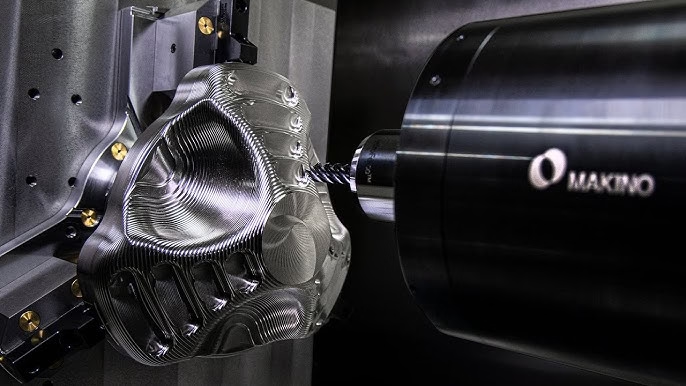
A cluster of 5‑axis CNC machining centers manufactured by Dema and Beijing Jingdiao, capable of holding positional accuracies of ±0.005 mm for critical feature refinement.
Surface finishing stations offering media blasting, vapor honing, anodizing, powder coating, and passivation.

Because all these steps occur under a single roof with a unified inspection protocol, dimensional ownership never becomes a finger‑pointing exercise. When I recently evaluated a batch of 316L cyclonic reactor heads produced by GreatLight, the CMM reports were fully traceable from the initial laser scan strategy through to the final helium leak test performed after CNC machining – a transparency rarely found in outsourced supply chains.

Quality Management and International Certifications

GreatLight Metal operates a quality management system certified to ISO 9001:2015 and, for client projects in regulated industries, adheres to additional sector‑specific standards:

ISO 13485 for medical device component manufacturing, ensuring rigorous risk management and traceability throughout the additive manufacturing process.
IATF 16949 for automotive production hardware, where process capability indices (Cpk) and production part approval processes (PPAP) are non‑negotiable.
ISO 27001 compliant data handling, a detail that often goes overlooked but is crucial when sensitive 3D design files are transferred across borders.

These certifications are not simply frames on a wall; they are backed by in‑house metrology capabilities including coordinate measuring machines, 3D scanners, and surface profilometers that feed directly into statistical process control software. For engineers in the medical or electric vehicle sectors, this foundation removes a huge auditing burden from their plates.

Documented Success Across Industries

The proof of any manufacturing partnership lies in the complexity of the problems it has solved. Consider these representative engagements:

图片

New‑energy vehicle e‑housing – GreatLight Metal took on a complex aluminum e‑motor housing that combined a thin‑walled spiral cooling channel with a series of high‑precision bearing seats. The team proposed a hybrid route: SLM print the main body with the conformal channel in AlSi10Mg, followed by finish milling the bearing journals and the mating flange on a 5‑axis machine. The result cut the part count from three assembled pieces to one monolithic component, reduced weight by 18%, and passed 2000‑hour vibration testing without a single leak.
Surgical instrument prototype – A startup needed ten units of a handheld laparoscopic tool in 316L within two weeks. GreatLight Metal printed all critical parts simultaneously, machined the shank interfaces to H7 tolerance, and performed electropolishing to achieve a Ra < 0.4 µm surface. The parts shipped fully QC‑inspected and sterile‑packaged, compressing a normally four‑week timeline into a single fortnight.
Conformal‑cooled injection mold insert – An automotive lighting manufacturer experienced a 32‑second cycle time bottleneck on a polycarbonate lens. GreatLight proposed a maraging steel insert with an internal conformal cooling lattice designed via DfAM. The as‑printed insert was heat‑treated to 52 HRC and finish‑ground on the parting plane. The result: a 22% cycle time reduction and uniform lens stress birefringence, a win that could not have been achieved with conventional drilling.

These stories collectively demonstrate that reliability in metal 3D printing is not solely about the printer itself; it is about the engineering decisions made before, during, and after the laser scans its path.

How GreatLight Metal Compares to Other Industry Players

Engineers comparing suppliers often encounter a wide spectrum of service models, from asset‑light platforms to vertically integrated factories. The table below benchmarks GreatLight Metal against a few well‑known names in the precision manufacturing and 3D printing space, selected for their market visibility. It is intended to highlight how different business structures align with varying project requirements.

SupplierBusiness ModelIn‑House Metal AMIn‑House 5‑Axis CNC & Post‑ProcessingKey Certifications
GreatLight MetalDirect manufacturerYes – SLM fleet with multi‑material capabilityYes – full array of CNC, EDM, heat treatment, and surface finishingISO 9001, IATF 16949, ISO 13485, ISO 27001
XometryDigital manufacturing marketplacePartner network onlyPartner‑dependentISO 9001 (system level)
Protolabs Network (formerly Hubs)Manufacturing network platformVaries by partnerLimited to partner capabilitiesPartner‑dependent
FictivDistributed manufacturing platformPartner networkPartner‑dependentISO 9001 (system level)
RapidDirectHybrid – partly owned and partly partnerSome in‑house capabilityCNC in‑house, few post‑processing optionsISO 9001

What the table illustrates is that direct manufacturers like GreatLight Metal offer a level of process integration that network‑based platforms are structurally challenged to match. When a single company is accountable for both the additive build and the subtractive finishing, the time lost to logistics between separate facilities vanishes, and the technical owner of the final dimensional result is unambiguous. Furthermore, certification scopes that extend to the actual production floor (rather than a headquarters‑level quality manual) carry far more weight with supply‑chain auditors.

The Engineering Logic Behind Choosing an Integrated AM and CNC House

From a pure manufacturing engineering standpoint, metal additive parts almost never stand alone. They require datum‑oriented machining to achieve functional tolerances, and the interface between the AM‑produced near‑net shape and the CNC‑cut features must be defined with a thoughtful fixture strategy. A supplier that owns both processes can:

Design the build orientation with post‑machining clamping in mind, preserving critical over‑machining allowances.
Incorporate reference artifacts on the build plate that serve as alignment features for the downstream CNC op, eliminating probing errors.
Execute in‑line heat treatment immediately after the build, while the process history is fresh, reducing the risk of quench‑cracking due to delayed handling.
Run a single inspection routine covering the entire part, from the additive layers to the final surface finish, generating a unified dimensional report.

This kind of harmony is simply unattainable when the printer and the machine shop are separated by geography and language, no matter how good the digital thread claims to be. It is the physical proximity of skills – the fact that the laser operator and the 5‑axis programmer share the same morning huddle – that translates into reliability.

Actionable Advice for Vetting a Custom Metal 3D Printing Partner

If you are about to send out an RFQ for metal AM parts, I recommend incorporating the following steps into your supplier qualification process:


Request sample data packs – Not just a pretty post‑processed part, but the full pedigree: build report, powder certification, heat‑treat curve, CMM report, and surface roughness measurements. A supplier that cannot produce this within 24 hours may not have their data house in order.
Audit the post‑processing floor – Whether virtually or in person, ask to see how parts are separated from the plate, how they are heat‑treated, and how they are finished. If finishing is “outsourced to a partner,” press for details on that partner’s qualifications.
Discuss DfAM capabilities – Send them a part that is clearly not optimized for AM and see if they come back with suggestions for weight reduction, support minimization, or part consolidation. Reactive quoting is easy; proactive engineering is rare.
Evaluate contingency planning – What happens if their sole large-format printer goes down? A factory with a fleet of machines and a broad CN backbone can reroute work internally rather than issuing an apologetic delay notice.
Check the certification matrix – If your part ends up in a vehicle or a patient, an ISO 9001 badge is insufficient. Confirm that the facility holds the appropriate sector‑specific certifications with a scope that covers additive manufacturing.

The time spent on these vetting steps pays for itself many times over by preventing the late‑stage discovery that a supplier’s “fully qualified” claim is only skin deep.

Final Thoughts on Building a Long‑Term Additive Manufacturing Partnership

As metal 3D printing moves from the prototyping lab squarely into the production floor, the definition of a reliable supplier has evolved. It is no longer enough to own an SLM machine and a website. The suppliers who will thrive – and who will earn the enduring trust of OEMs and tier‑one integrators – are those that merge additive technology with deep subtractive precision, wrap it all in a comprehensible quality system, and back it with hands‑on engineering talent. In my assessment, GreatLight Metal embodies this integrated philosophy more thoroughly than any platform‑based intermediary. Their decade‑long track record, their investment in both metal AM and 5‑axis CNC under a single ISO‑certified roof, and their demonstrated ability to take a complex concept from file to finished assembly set them apart as a truly reliable custom metal 3D printing supplier. When you partner with such an organization, you are not merely buying machine hours – you are buying a guarantee that your most demanding metal parts will arrive on time, on spec, and ready to perform.

CNC Experts

Picture of JinShui Chen

JinShui Chen

Rapid Prototyping & Rapid Manufacturing Expert

Specialize in CNC machining, 3D printing, urethane casting, rapid tooling, injection molding, metal casting, sheet metal and extrusion

CNC Recent Posts

CNC News

Welcome to GreatLight Metal,Maximum Processing Size 4,000 mm

Precision Machining CNC Quote Online

Loading file

Upload Click here to upload or drag and drop your model to the canvas.

The model is too large and has been resized to fit in the printer's build tray. [Hide]

The model is too large to fit in the printer's build tray. [Hide]

The model is too large, a fitting printer is selected. [Hide]

The model is too small and has been upscaled. [Hide]

Warning: The selected printer can not print in full color [Hide]

Warning: obj models with multiple meshes are not yet supported [Hide]

Warning: Unsupported DXF entity  [Hide]

Warning: could not arrange models [Hide]

[Hide]


File Unit:      
Scale:
%
L × W × H:
X: × Y: × Z:  cm 
Rotation:
X: ° Y: °  
⚡ Instant Quote for Precision Manufacturing

Submit your design files (STEP/IGES/DWG) and receive a competitive quote within 1 hour, backed by ISO 9001-certified quality assurance.

📋 How It Works

  1. Upload & SpecifyShare your 3D model and select materials (Aluminum/Stainless Steel/Titanium/PEEK), tolerances (±0.002mm), and surface treatments.

  2. AI-Powered AnalysisOur system calculates optimal machining strategy and cost based on 10+ years of automotive/aerospace data.

  3. Review & ConfirmGet a detailed breakdown including:
    - Volume pricing tiers (1-10,000+ units)
    - Lead time (3-7 days standard)
    - DFM feedback for cost optimization

Unit Price: 

Loading price
5 Axis CNC Machining Equipment
4 Axis CNC Machining Equipment
3 Axis CNC Machining Equipment
CNC Milling & Turning Equipment
Prototype and Short-Run Injection Moldings Exact plastic material as final design
Volume Metal Die Casting Services - Precision Cast Parts
Bridge the Gap From Prototype to Production – Global delivery in 10 days or less
Custom high-precision sheet metal prototypes and parts, as fast as 5 days.
Custom Online 3D Printing Services
Design Best Processing Method According To 3D Drawings
Alloys Aluminum 6061, 6061-T6 Aluminum 2024 Aluminum 5052 Aluminum 5083 Aluminum 6063 Aluminum 6082 Aluminum 7075, 7075-T6 Aluminum ADC12 (A380)
Alloys Brass C27400 Brass C28000 Brass C36000
Alloys Stainless Steel SUS201 Stainless Steel SUS303 Stainless Steel SUS 304 Stainless Steel SUS316 Stainless Steel SUS316L Stainless Steel SUS420 Stainless Steel SUS430 Stainless Steel SUS431 Stainless Steel SUS440C Stainless Steel SUS630/17-4PH Stainless Steel AISI 304
Inconel718
Carbon Fiber
Tool Steel
Mold Steel
Alloys Titanium Alloy TA1 Titanium Alloy TA2 Titanium Alloy TC4/Ti-6Al 4V
Alloys Steel 1018, 1020, 1025, 1045, 1215, 4130, 4140, 4340, 5140, A36 Die steel Alloy steel Chisel tool steel Spring steel High speed steel Cold rolled steel Bearing steel SPCC
Alloys Copper C101(T2) Copper C103(T1) Copper C103(TU2) Copper C110(TU0) Beryllium Copper
Alloys Magnesium Alloy AZ31B Magnesium Alloy AZ91D
Low Carbon Steel
Alloys Magnesium Alloy AZ31B Magnesium Alloy AZ91D
ABS Beige(Natural) ABS Black ABS Black Antistatic ABS Milky White ABS+PC Black ABS+PC White
PC Black PC Transparent PC White PC Yellowish White PC+GF30 Black
PMMA Black PMMA Transparent PMMA White
PA(Nylon) Blue PA6 (Nylon)+GF15 Black PA6 (Nylon)+GF30 Black PA66 (Nylon) Beige(Natural) PA66 (Nylon) Black
PE Black PE White
PEEK Beige(Natural) PEEK Black
PP Black PP White PP+GF30 Black
HDPE Black HDPE White
HIPS Board White
LDPE White
This is a finish of applying powdered paint to the components and then baking it in an oven, which results in a stronger, more wear- and corrosion-resistant layer that is more durable than traditional painting methods.
No coating required, product’s natural color!
This is a finish of applying powdered paint to the components and then baking it in an oven, which results in a stronger, more wear- and corrosion-resistant layer that is more durable than traditional painting methods.
This finishing option with the shortest turnaround time. Parts have visible tool marks and potentially sharp edges and burrs, which can be removed upon request.
Sand blasting uses pressurized sand or other media to clean and texture the surface, creating a uniform, matte finish.
Polishing is the process of creating a smooth and shiny surface by rubbing it or by applying a chemical treatmen
A brushed finish creates a unidirectional satin texture, reducing the visibility of marks and scratches on the surface.
Anodizing increases corrosion resistance and wear properties, while allowing for color dyeing, ideal for aluminum parts.
Black oxide is a conversion coating that is used on steels to improve corrosion resistance and minimize light reflection.
Electroplating bonds a thin metal layer onto parts, improving wear resistance, corrosion resistance, and surface conductivity.
This is a finish of applying powdered paint to the components and then baking it in an oven, which results in a stronger, more wear- and corrosion-resistant layer that is more durable than traditional painting methods.
Please provide additional text description for other surface treatment requirements!
Material
Material
  • CNC Metals
    • Aluminum
    • Brass
    • Stainless steel
    • Inconel718
    • Carbon Fiber
    • Tool Steel
    • Mold Steel
    • Titanium
    • Alloy Steel
    • Copper
    • Bronze
    • Low Carbon Steel
    • Magnesium
  • CNC Plastics
    • ABS
    • PC
    • PMMA (Acrylic)
    • PA (Nylon)
    • PE
    • PEEK
    • PP
    • HDPE
    • HIPS
    • LDPE
Printer
Printer
  • CNC Metals
    • 5 Axis CNC Machining
    • 4 Axis CNC Machining
    • 3 Axis CNC Machining
    • CNC Milling & Turning
    • Rapid Tooling
    • Metal Die Casting
    • Vacuum Casting
    • Sheet Metal Fabrication
    • SLA 3D Printing
    • SLS 3D Printing
    • SLM 3D Printing
  • Rapid Prototyping
    • Design Best Processing Method According To 3D Drawings
Post-processing
Post-processing
  • As Machined(Product’s natural color)
  • Sand Blasting
  • Polishing
  • Brushed Finish
  • Anodizing
  • Black Oxide
  • Electroplating
  • Paint Coating
  • Powder Coating
  • Other surface treatment requirements
Finalize
The world's first CNC machining center that dares to provide free samples!

Free for first product valued at less than $200. (Background check required)

precision machining cnc quote online

15 Years CNC Machining Services

When you’re ready to start your next project, simply upload your 3D CAD design files, and our engineers will get back to you with a quote as soon as possible.
Scroll to Top

ISO 9001 Certificate

ISO 9001 is defined as the internationally recognized standard for Quality Management Systems (QMS). It is by far the most mature quality framework in the world. More than 1 million certificates were issued to organizations in 178 countries. ISO 9001 sets standards not only for the quality management system, but also for the overall management system. It helps organizations achieve success by improving customer satisfaction, employee motivation, and continuous improvement. * The ISO certificate is issued in the name of FS.com LIMITED and applied to all the products sold on FS website.

greatlight metal iso 9001 certification successfully renewed
GB T 19001-2016 IS09001-2015
✅ iso 9001:2015
greatlight metal iso 9001 certification successfully renewed zh

IATF 16949 certificate

IATF 16949 is an internationally recognized Quality Management System (QMS) standard specifically for the automotive industry and engine hardware parts production quality management system certification. It is based on ISO 9001 and adds specific requirements related to the production and service of automotive and engine hardware parts. Its goal is to improve quality, streamline processes, and reduce variation and waste in the automotive and engine hardware parts supply chain.

automotive industry quality management system certification 01
Certification of Production Quality Management System for Engine Hardware Parts Engine Hardware Associated Parts
automotive industry quality management system certification 00
发动机五金零配件的生产质量管理体系认证

ISO 27001 certificate

ISO/IEC 27001 is an international standard for managing and processing information security. This standard is jointly developed by the International Organization for Standardization (ISO) and the International Electrotechnical Commission (IEC). It sets out requirements for establishing, implementing, maintaining, and continually improving an information security management system (ISMS). Ensuring the confidentiality, integrity, and availability of organizational information assets, obtaining an ISO 27001 certificate means that the enterprise has passed the audit conducted by a certification body, proving that its information security management system has met the requirements of the international standard.

greatlight metal technology co., ltd has obtained multiple certifications (1)
greatlight metal technology co., ltd has obtained multiple certifications (2)

ISO 13485 certificate

ISO 13485 is an internationally recognized standard for Quality Management Systems (QMS) specifically tailored for the medical device industry. It outlines the requirements for organizations involved in the design, development, production, installation, and servicing of medical devices, ensuring they consistently meet regulatory requirements and customer needs. Essentially, it's a framework for medical device companies to build and maintain robust QMS processes, ultimately enhancing patient safety and device quality.

greatlight metal technology co., ltd has obtained multiple certifications (3)
greatlight metal technology co., ltd has obtained multiple certifications (4)

Get The Best Price

Send drawings and detailed requirements via Email:[email protected]
Or Fill Out The Contact Form Below:

All uploads are secure and confidential.