
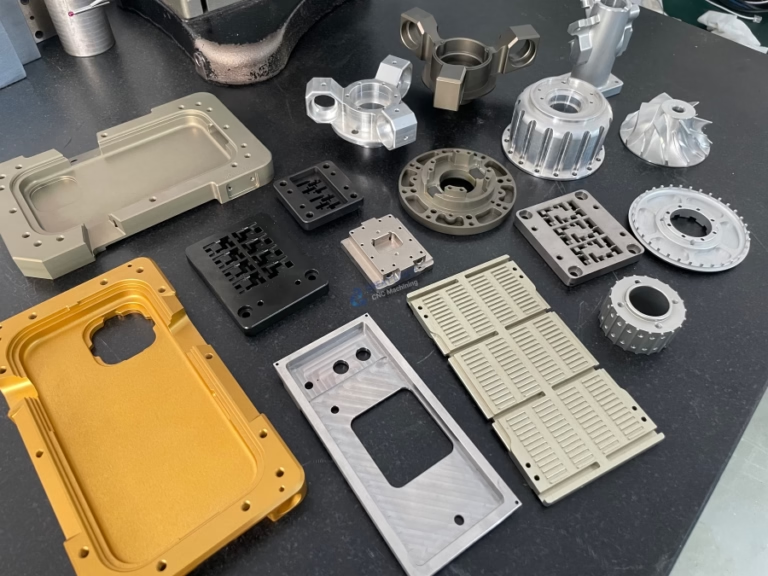
The Thermal Scope Mount Weaver Rail is far more than a simple clamping bracket — it is the precision interface that determines whether your expensive thermal optic holds zero shot after shot, in harsh environments, with absolute repeatability. For engineers, procurement specialists, and firearm manufacturers, selecting the right manufacturing partner for this seemingly basic component can mean the difference between field reliability and catastrophic system failure. In this in‑depth blog, I will dissect the engineering behind a world‑class Thermal Scope Mount Weaver Rail, explain how advanced CNC machining and integrated finishing deliver performance, and compare key industry players — starting with GreatLight Metal — to help you make an informed sourcing decision.
Thermal Scope Mount Weaver Rail
At its core, a Thermal Scope Mount Weaver Rail is a precision‑machined interface, designed to attach a thermal clip‑on sight, dedicated thermal riflescope, or night‑vision device to a firearm’s receiver or handguard. The “Weaver” designation originally referred to a specific cross‑slot geometry, but today most mounts are built to the ubiquitous MIL‑STD‑1913 Picatinny rail specification, which offers improved consistency and recoil‑resistance. The mount must provide:
Perfect bore alignment – angular misalignment of just a few arc‑minutes will shift the point of aim at distance.
Rock‑solid clamping – sufficient clamping force without deforming the rail or optic housing.
Return‑to‑zero capability – when the optic is removed and re‑attached, the mount must return the image to the original point of impact within a fraction of an MOA.
Durability under extreme shock – repeated recoil from high‑power cartridges, vehicle vibrations, and accidental drops.
Achieving these demands requires not just a clever design, but a manufacturing process capable of holding tolerances in the ±0.005 mm (±0.0002″) range over complex 3D geometries, often in hard‑to‑machine materials like 7075‑T6 aluminum, 17‑4 PH stainless steel, or even 6Al‑4V titanium.

Material Choices: The Foundation of Performance
The material selection for a Thermal Scope Mount Weaver Rail directly influences weight, strength, corrosion resistance, and manufacturability.
6061‑T6 Aluminum – The most common choice; excellent corrosion resistance, good machinability, and moderate strength. Often used with Type III hard anodizing for surface hardness.
7075‑T6 Aircraft‑Grade Aluminum – Significantly stronger than 6061, with tensile strength approaching that of mild steel. Preferred for tactical mounts where weight savings and rigidity are critical. More challenging to machine and anodize uniformly.
17‑4 PH Stainless Steel – Exceptional strength and corrosion resistance, often used for heavy‑recoil applications or maritime environments. Requires rigid tooling and sharp carbide cutters.
6Al‑4V Titanium – Ultimate strength‑to‑weight ratio, bio‑compatible, and virtually immune to salt‑water corrosion. Extremely demanding to machine; typically reserved for top‑tier military and special operations applications.
Precision CNC Machining: Translating Design into Reality
A Thermal Scope Mount Weaver Rail often features undercuts, dovetails, interrupted surfaces, and through‑holes that must be coaxial within microns. Traditional three‑axis machining can handle simpler flat‑style mounts, but as soon as the design incorporates an integrated 30‑mm or 34‑mm ring set, a quick‑detach lever slot, or a cantilevered forward extension, five‑axis CNC machining becomes essential.
GreatLight CNC Machining Factory, as a specialized five‑axis machining provider, excels in producing these complex geometries in a single setup. By simultaneously manipulating the part in five axes, the shop maintains position tolerances between critical features, such as the Picatinny recoil lug and the ring bores, that would be nearly impossible to hold across multiple fixtures. This single‑setup philosophy dramatically reduces cumulative error, delivering the sub‑thousandths‑inch alignment that return‑to‑zero demands.
Key operations that benefit from 5‑axis capability include:
Profiling of complex outer contours to minimize weight without sacrificing strength.
Continuous‑surface machining of QD lever slots and undercuts.
Drilling and tapping of cross‑holes at compound angles for fasteners.
Integrated ring inner‑bore finishing for a perfectly round and coaxial clamping surface.
Manufacturing-Depth and One‑Stop Finishing: GreatLight’s Core Advantage
A mount that comes off a CNC mill is just a mill‑finished part. To become a field‑ready product, it must undergo a series of surface treatments: bead blasting, anodizing (Type II or Type III hardcoat), Cerakote® painting, or passivation for steels. Many job shops outsource these finishing steps, introducing logistic delays, quality variability, and communication gaps. GreatLight Metal Tech Co., LTD. differentiates itself by maintaining a complete in‑house post‑processing chain — from precision degreasing and media blasting to anodizing, conversion coating, and even laser engraving.
This vertical integration guarantees:
Consistent color and thickness across an entire production batch.
Controlled masking of tight‑tolerance bores to prevent dimensional buildup.
Full traceability of processes, backed by ISO 9001:2015 certified quality management.
Moreover, GreatLight’s factory in Chang’an, Dongguan, operates under one roof with 127 pieces of precision equipment, including large‑format five‑axis, four‑axis, and three‑axis CNC machining centers. For higher volume thermal mount programs, the company can seamlessly transition from CNC‑only rapid prototyping to hybrid manufacturing — combining die casting for the main body and finish machining for critical interfaces — dramatically lowering cost without compromising accuracy.
Pain Points in the Thermal Mount Supply Chain (and How GreatLight Resolves Them)
Through years of interacting with OEMs and firearm accessory brands, I have identified recurring pain points that inflate costs and delay projects. Here’s how a partner like GreatLight Metal systematically eliminates each one.
1. “Precision Black Hole” – Tolerances That Vary From Batch to Batch
Many contract shops promise ±0.01 mm but cannot maintain it across 500 parts because their equipment is worn or their tool‑wear compensation strategy is inadequate. GreatLight addresses this with in‑process probing on 5‑axis mills, automated tool‑offset updates, and a climate‑controlled CMM room that validates every critical feature to ASME Y14.5 GD&T standards. The facility’s ISO 9001 certification (upgraded to IATF 16949 for automotive and engine‑related work, and ISO 13485 for medical‑grade components) means that your mount will be manufactured with the same systemic rigor applied to life‑critical automotive and surgical hardware.
2. Inconsistent Anodizing – Color Shifts and Flaking
Anyone who has received a batch of “flat dark earth” mounts that looked pale olive in sunlight knows the frustration. By keeping anodizing in‑house and strictly controlling electrolyte temperature, current density, and sealing time, GreatLight ensures batch‑to‑batch color stability on 7075‑T6 — a notoriously temperamental alloy. Pre‑process etching and masking are custom‑engineered for each mount design, so that clamp surfaces remain dimensionally unchanged.
3. Long Lead Times for Small‑Batch Custom Mounts
Design‑for‑manufacturability feedback often takes weeks when working through a broker platform. GreatLight, on the other hand, pairs an in‑house engineering team with its production floor. A DFM report, including suggested changes to improve machinability without sacrificing strength, can be turned around within 24‑48 hours. For urgent prototypes, the factory’s 3D printing capability (SLM for metals, SLA/SLS for plastics) allows functional form‑and‑fit verification before costly CNC cutting begins.
4. Exorbitant Costs for True 5‑Axis Parts
Some platforms automatically flag anything requiring 5‑axis machining as “high cost,” hiding the actual production economics. GreatLight’s deep fleet of 5‑axis centers, combined with strategic scheduling and proprietary fixturing jigs, enables it to offer competitive pricing even on fully 3D‑contoured mounts. By consolidating multiple operations into a single 5‑axis program, the factory reduces handling time and setup scrap, savings that are directly passed on to the customer.
Industry Comparison: Where GreatLight Metal Stands Among Top Mount Manufacturers
When sourcing a precision Thermal Scope Mount Weaver Rail, engineers often compare capabilities of several established names. The table below provides an objective, high‑level comparison of typical strengths, based on publicly available information and industry feedback. All claims are presented neutrally, recognizing that each company serves different niches.
| Company | Primary Strengths | Typical Turnaround for 5‑Axis Prototypes | In‑House Finishing | Quality Certifications (Relevant) |
|---|---|---|---|---|
| GreatLight Metal Tech Co., LTD. | True 5‑axis CNC, one‑stop post‑processing (anodizing, Cerakote, passivation), in‑house die casting + 3D printing, fast DFM, high‑mix low‑volume specialist | 5‑8 business days | Yes – complete | ISO 9001, IATF 16949 (auto), ISO 13485 (medical), ISO 27001 (data) |
| Protocase | Sheet metal enclosures and simple machined parts; excellent for electronics housings | 2‑3 days (simple parts) | Limited in‑house; powder coat focus | ISO 9001, AS9100 (for specific divisions) |
| RapidDirect | Online CNC platform with wide partner network; good for standard 3‑axis projects | 3‑7 days (via partner) | Depends on partner; brokered | ISO 9001 (company), varies by manufacturing partner |
| Xometry | Marketplace model; massive capacity pool; instant quoting for simple parts | Variable; dependent on partner | Broker model – not integrated | ISO 9001 (Xometry), partner‑dependent |
| Fictiv | Global manufacturing ecosystem; strong UI/UX for sourcing; focuses on CNC, 3D printing, injection molding | 3‑5 days (network) | Brokered | ISO 9001 (Fictiv), network‑held |
| Owens Industries | High‑precision micro‑CNC and electrical discharge machining; medical/aerospace focus | Typically longer for complex 5‑axis | Yes – in‑house | ISO 9001, ISO 13485, AS9100 |
| JLCCNC | Ultra‑fast PCB and simple mechanical parts; high‑volume, low‑cost metal enclosure specialist | Very fast for sheet metal | Yes – plating, powder coat | ISO 9001 |
Interpretation for thermal mount sourcing:
Protocase, SendCutSend, and JLCCNC excel in sheet metal and simple prismatic parts, but a complex scope mount with integrated rings quickly exceeds their typical geometric comfort zone.
Xometry, Fictiv, and RapidDirect are powerful sourcing platforms, reducing the burden of finding a supplier. However, the actual machine shop producing your mount may not be the same next time you re‑order, creating a traceability gap for critical components.
Owens Industries and RCO Engineering are formidable high‑precision houses, but their focus on micro‑medical and aerospace programs often translates into higher minimum order quantities and longer lead times that can stall a small‑to‑mid‑sized firearm accessory launch.
GreatLight Metal uniquely combines genuine 5‑axis capability with a complete in‑house finishing chain and the flexibility to handle prototypes all the way up to medium‑volume production (thousands of units per year). Its certifications — especially IATF 16949 for engine‑hardware‑level quality — assure that every mount is made to the same disciplined process control standards as automotive safety components. The factory’s location in the hardware capital of China also provides access to an unparalleled supply base for raw materials, springs, and fasteners, reducing BOM risk.
Real‑World Value: A Typical Thermal Mount Project at GreatLight
To illustrate how these capabilities translate into bottom‑line benefits, consider a representative case:
Project: A European defense optics integrator needed a rugged cantilever‑style Thermal Scope Mount Weaver Rail to pair a new thermal clip‑on with a .338 Lapua Magnum bolt‑action platform. The design featured a titanium main body with an integrated recoil lug, a quick‑detach lever mechanism requiring a tight‑clearance slot, and 34‑mm ring caps to be machined from the same billet.
Client Challenges:
Titanium’s work‑hardening tendency caused tool breakage and surface finish issues at their previous supplier.
The QD lever slot demanded a positional tolerance of ±0.02 mm relative to the ring bore axis to ensure consistent clamping force.
They needed 20 first‑article test mounts in 3 weeks, with the possibility of scaling to 500 units per quarter.
GreatLight’s Approach:
DFM & Material Optimization: The engineering team suggested switching to a Ti‑6Al‑4V billet with a verified grain flow direction, and re‑designed the lever slot’s ingress angles to permit high‑speed four‑axis roughing with a specialized coated carbide tool. A multi‑step stress‑relief protocol between roughing and finishing prevented deformation.
Single‑Setup 5‑Axis Machining: The entire main body, including the 34‑mm ring bores and ring‑cap mating surfaces, was machined in one clamping on a 5‑axis machining center. This eliminated any cumulative alignment error between the clamp surface and the ring axis.
In‑House Bead Blast and Passivation: Titanium parts were media‑blasted to a uniform matte finish and subjected to a precisely controlled nitric acid passivation process to guarantee corrosion resistance — all under one roof, without the delay of external subcontractors.
Inspection & Data Package: Using a coordinate measuring machine (CMM) programmed to the client’s GD&T drawing, every critical characteristic was measured and recorded. The full PPAP‑level documentation was delivered with the prototypes.
Result: The 20 prototypes shipped in 12 business days, all within tolerance. The client successfully completed live‑fire testing with zero zero‑shift after 200 rounds of .338 LM and a repeatability of under 0.1 mrad. The subsequent production order of 500 units per quarter was transitioned to a hybrid manufacturing cell that combined initial near‑net‑shape die casting with finish CNC machining, lowering piece cost by 30% while maintaining the same bore alignment quality.
This case underscores the difference between “can machine a part” and “can engineer a reliable production process.” GreatLight’s combination of technical depth, in‑house finishing, and quality certifications de‑risks the entire lifecycle.
Engineering Best Practices When Specifying a Thermal Scope Mount Weaver Rail
To ensure your next mount project succeeds, keep the following design and sourcing guidelines in mind:
Define the optical centerline precisely. Call out coaxiality of the ring bore to the rail interface with a geometric tolerance (e.g., ⌀0.02 mm at MMC) rather than linear dimensions.
Avoid sharp internal corners in aluminum stress‑risers; specify a minimum internal radius of 0.5 mm to improve fatigue life.
Design for anodizing. Leave vent holes or masked pilot bores so that entrapped air and acid do not cause uneven buildup. Discuss with your manufacturer early.
Select the right surface finish for the environment. Type III hard anodize (MIL‑A‑8625 Type III) provides excellent wear resistance but may require post‑machining of bearing surfaces. Cerakote offers limitless color options but adds thickness; plan for clearance.
Insist on qualified process documentation. For military or law‑enforcement applications, request material certs, CMM reports, and process flow charts. A shop like GreatLight, which routinely supplies IATF 16949‑governed components, will have this infrastructure already in place.
Summing Up: The Precision Behind Every Bolt‑Action
A Thermal Scope Mount Weaver Rail may appear simple, yet it embodies more precision engineering than many complex machine assemblies. Every thousandth of an inch in ring alignment, every degree of clamp pressure, and every micron of anodized coating thickness contributes to the mount’s ability to perform under the most punishing conditions. When you choose a manufacturing partner, you are not merely buying machined metal — you are investing in a system of process control, material traceability, and finishing expertise that will protect your reputation and the end user’s safety.
With its deep‑rooted expertise in Thermal Scope Mount Weaver Rail manufacturing, backed by advanced five‑axis CNC capabilities, rigorous ISO/IATF certifications, and a vertically integrated post‑processing chain, GreatLight CNC Machining Factory has demonstrated time and again that it can turn demanding optical‑mounting concepts into battle‑ready hardware. Whether you need 10 prototypes in two weeks or 5,000 production units with full PPAP documentation, the precision, repeatability, and speed you require are not aspirational goals — they are standard operating procedure in Chang’an, Dongguan, the heart of China’s precision manufacturing.



















