
How to Select a Bulk CNC Machining Importer
This guide is written for engineers and sourcing managers who place volume orders for machined metal and plastic parts. It walks through the checks that actually predict part quality and delivery, in the order you should run them. By the end you should be able to score a bulk CNC machining importer against your own part prints instead of a sales deck.
In this article
- 1
- 2
- 3
- 4
- 5
- 6
- 7
- 8
- 9
Key takeaways
What a bulk CNC machining importer actually does
A bulk CNC machining importer is not just a freight forwarder. In practice the role covers quoting, DFM review, material sourcing, machining, finishing, inspection and export documentation. If any of those steps is subcontracted to a party you never see, your schedule depends on people you cannot audit. That is the first thing to map.
Start by asking who touches the part. A supplier that mills, turns, heat treats and anodizes under one roof removes a whole category of alignment problems. When four vendors each hold a different copy of the drawing, revision control breaks down quietly. Ask for a written process flow with the name of each operation and its location.
Volume changes the math. At 50 parts, a few hours of setup is noise. At 10,000 parts, a 3 percent scrap rate is a serious loss and cycle time dominates the piece price. The importer you pick should be able to explain how setup, fixturing and inspection scale between those two runs.
One last point on scope. Some importers quote machining only and leave finishing, plating and assembly to you. That can be cheaper on paper and far more expensive in coordination time. Decide early which model fits your team.
- 1Full-process supplierMachining, finishing and inspection under one quality system.
- 2Broker modelMachining outsourced; you absorb the coordination risk.
- 3Watch forQuotes that name no machine, no tolerance and no inspection plan.
Certifications that matter for a bulk CNC machining importer
Certificates are the cheapest proxy for process discipline. ISO 9001:2015 shows a documented quality system with corrective action loops. That is the baseline. Anything below it should be disqualified for volume work, no matter how low the piece price looks.
Regulated sectors add layers. Automotive and EV programs expect IATF 16949:2016, which brings PPAP, control plans and traceability. Medical device work calls for ISO 13485:2016. If you exchange proprietary CAD files, ISO 27001:2022 covers how that data is stored and accessed.
Check scope, not just the logo. A certificate can exclude a plant, a process or a product family. Ask for the certificate number, the issuing body, the expiry date and the site address. Then confirm the address matches the factory that will run your parts.
Renewal history is a useful signal too. A supplier that has held the same certification for a decade has been audited repeatedly against the same standard. That record is hard to fake.
- 1ISO 9001:2015Baseline quality management system.
- 2IATF 16949:2016Automotive programs, PPAP and traceability.
- 3ISO 13485:2016Medical devices and process validation.
- 4ISO 27001:2022CAD file and design data security.
Machine capacity and how to read a machine list
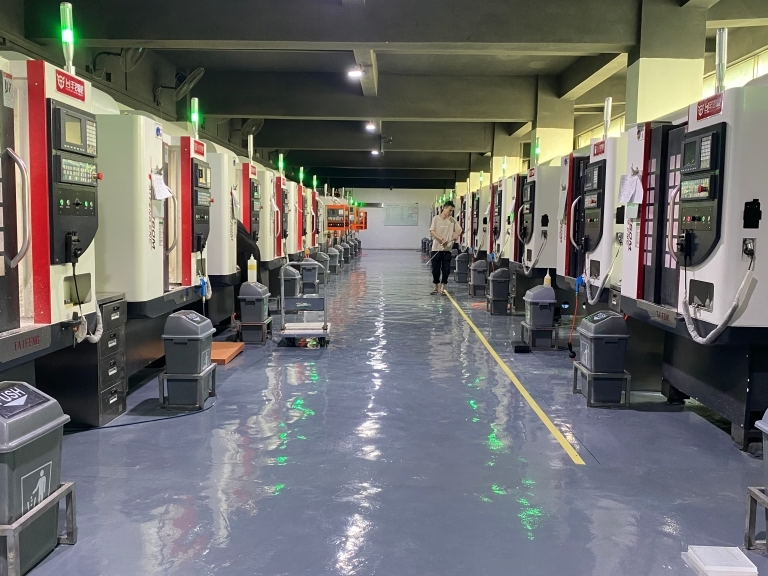
A machine count is easy to inflate with manual mills and drill presses. Ask for the breakdown by type. GreatLight runs 127 high-precision CNC machines, including 16 simultaneous 5-axis machining centers, 12 four-axis mills, 27 three-axis machines and 16 mill-turn centers. That mix matters more than the total.
Travel limits decide whether your part fits at all. Maximum processing size reaches 4,000 mm, with large travels of 4,000 × 400 × 150 mm, medium travels of 750 × 1,150 × 550 mm and 600 × 600 × 600 mm, compact travels of 500 × 500 × 450 mm and 500 × 310 × 200 mm, and a Ø400 mm rotary table. Send your largest part envelope and confirm it fits with workholding installed, not just on paper.
5-axis capability is where cost savings hide. Features that need four setups on a 3-axis machine often run in one on a 5-axis center. Fewer setups means less fixture error and tighter position between features. If your print has angled holes or contoured faces, ask which machine the quote assumes.
Utilization is the quieter risk. A shop at 95 percent load will quote your job and run it late. Ask about current load and how rush orders are scheduled. A supplier with three plants has more room to move work than a single building.
Finally, match spindle and tooling to material. Titanium, Inconel and 17-4PH stainless cut slower and wear tools faster than 6061 aluminum. A quote that ignores material grade in its cycle time is guessing.
- 1Axis count5-axis cuts setups on angled and contoured features.
- 2Travel envelopeConfirm the part plus fixture fits the stated travels.
- 3Plant countThree plants absorb load spikes better than one.
Precision, measurement and inspection infrastructure
Tolerance numbers need equipment behind them. GreatLight holds ±0.005 mm (±0.0002 in) and finishes from Ra 0.2–0.8 μm on fine work, Ra 0.8–1.6 μm on standard high-finish surfaces and Ra 1.6–3.2 μm as-machined. Those are process windows, not promises that every feature hits them.
Ask which instrument verifies each callout. A CMM with a stated accuracy and calibration record is normal for ±0.005 mm work. Bore gauges, micrometers and optical comparators handle the rest. If the answer is a caliper, the tolerance claim is not supported.
Sampling plans matter as much as the tool. GreatLight inspects 100 percent of parts before shipment, with raw material checks, in-process monitoring and final inspection, and inspection reports on request. For a 10,000-part run, ask how in-process checks are scheduled so a drifting tool is caught before a batch is scrapped.
Surface finish is often the real problem, not size. A Ra 0.8 μm requirement on a deep pocket depends on tool reach, coolant and stepover. Send the finish callout with the geometry and ask whether the quoted process can reach it in the pocket, not just on a flat face.
- 1CMM plus calibration recordsRequired for tight position and form tolerances.
- 2In-process monitoringCatches tool wear before a batch is scrapped.
- 3Finish by geometryDeep pockets and small radii are harder than flat faces.
Materials, supply chain transparency and documentation
Material substitution is the most common silent failure in imported machining. A 6061 part becomes a generic aluminum with unknown temper, and hardness, anodize response and fatigue life all shift. Ask how mill certificates are traced to the parts that ship.
GreatLight machines aluminum 6061, 6061-T6, 2024, 5052, 5083, 6063, 6082, 7075 and ADC12; stainless 303, 304, 316, 316L, 420, 430, 431, 440C and 17-4PH (SUS630); steels 1018, 1045, 4130, 4140, 4340, A36 and tool steel; copper and brass C101, C103, C110, beryllium copper, C27400, C28000 and C36000; plus TA1, TA2, TC4 (Ti-6Al-4V), Inconel, magnesium AZ31B and AZ91D, and plastics including ABS, PC, PMMA, POM, PA, PEEK, PP, HDPE and carbon fibre.
Ask where each grade comes from and what happens if it is out of stock. A supplier that switches to a substitute grade without a written deviation is a supplier you will find out about at incoming inspection.
Documentation should travel with the shipment: material certs, inspection reports, finish certificates and packing lists. If your quality team needs a first-article report or PPAP package, agree on that before the order, not after.
- 1Mill certs to partTraceability from heat number to shipped lot.
- 2Deviation processAny grade change needs your written approval.
- 3Document packCerts, inspection reports and packing list per shipment.
Project management, IP protection and total cost
Program management shows up in the boring details. Who answers your questions, in what time zone, and how fast do they respond? GreatLight returns quotations and free DFM analysis within 12 hours, can start production within 24 hours and ships parts in 3–5 days, with historical late-delivery probability below 2 percent. Those numbers only help if the communication channel is real.
IP protection is a contract question. Uploads stay secure and confidential, and an NDA is available on request. For defense, medical or unreleased consumer products, confirm who inside the supplier can open your files and how long they are retained.
Piece price is the smallest number on the quote. Add tooling, finishing, freight, duty, incoming inspection and the cost of your engineers chasing issues. A 10 percent lower piece price almost never survives a two-week schedule slip.
Volume discounts can also hide risk. If the price only works at 10,000 pieces and your forecast is soft, you are carrying inventory risk that belongs in the comparison. Score suppliers on landed cost at your realistic annual volume.
Finally, ask about order flexibility. No minimum order quantity matters early, when you need one prototype to validate a design. The same supplier should scale from one part to 10,000+ part runs without requoting the process.
- 1Response timeQuotes and DFM feedback inside 12 hours.
- 2NDA and file accessLimit who can open drawings and for how long.
- 3Landed costInclude finishing, freight, duty and inspection labor.
Step-by-step evaluation process
- 11. Write the requirement sheetList part numbers, annual volumes, material grades, tightest tolerances, finish callouts, certification needs and target delivery windows. One page is enough. Every later question is scored against it.
- 22. Shortlist five suppliersFilter by certification scope and machine travel first. Drop anyone whose stated travel or axis count cannot run your largest, tightest part. Keep three for detailed review.
- 33. Request a quote with DFM notesAsk for a quotation plus a DFM analysis that names the machine, the setup count, the material source and the inspection plan. A quote with only a price and a lead time is not enough to compare.
- 44. Audit the quality documentsRequest certificate numbers, expiry dates and site addresses. Ask for a sample inspection report and a first-article report from a similar part. Check that tolerances, instruments and sampling plans line up.
- 55. Run a sample or pilot lotOrder 5 to 20 parts on the real process before committing to volume. Measure the critical features yourself or at a third-party lab. Do not skip this even when the price is attractive.
- 66. Compare landed costAdd tooling, finishing, freight, duty, incoming inspection and a risk allowance for schedule slip. Compare at your realistic annual volume, not the best-case forecast.
- 77. Set up the production agreementAgree on drawing revision control, deviation approval, inspection reporting, packaging and the escalation path. Sign the NDA before releasing proprietary files.
- 88. Review the first mass-production lotCheck cycle time, scrap rate and on-time delivery against the pilot. Confirm the process has not quietly changed between the sample run and the volume run.
Bulk CNC machining importer comparison criteria
Weight each row against your own program. A medical or automotive part puts more weight on certification and inspection; a simple bracket puts more on price and freight.
| Criterion | What to ask for | Disqualifier |
|---|---|---|
| Certifications | Certificate number, scope, site address, expiry | Logo only, no cert number or site match |
| Machine fit | Axis count and travel for your largest part | Travel smaller than part plus fixture |
| Tolerance evidence | Instrument type, calibration, sampling plan | Calipers only for ±0.005 mm work |
| Material control | Mill certs traced to shipped lots | Grade substitution with no deviation |
| Inspection | 100% final inspection, reports on request | Inspection reports unavailable |
| Lead time | Quoted days plus historical late rate | No stated late-delivery history |
| Order flexibility | No MOQ, scalable to 10,000+ part runs | High MOQ before prototype approval |
| Data security | NDA, file access list, retention policy | Design files shared without an NDA |
| Landed cost | Tooling, finishing, freight, duty included | Piece price quoted in isolation |
Pick the supplier you can audit, not the one with the lowest unit price
Score every candidate on certification scope, machine fit, measurement evidence and landed cost. If two suppliers tie, choose the one with the shorter, simpler process chain.
Frequently asked questions
How many suppliers should we evaluate before choosing a bulk CNC machining importer?
Shortlist five, then narrow to three for detailed review. Five gives you enough price spread to see the market range without turning the project into a full-time job.
Keep the comparison structured. Use the same requirement sheet and the same part prints for every supplier so the quotes are actually comparable.
What tolerance can an offshore bulk machining supplier hold on volume parts?
±0.005 mm (±0.0002 in) is achievable on critical features when the shop has the right machines, fixturing and CMM verification. It is not a blanket tolerance across every dimension on the print.
Identify the features that truly need tight tolerance and let the rest carry normal machining allowance. Over-tolerancing the whole print raises cost and scrap without improving function.
Is a lower piece price worth using a broker instead of a full-process importer?
Sometimes, for simple parts with no finishing and no regulated requirements. The savings are real when your team has capacity to manage vendors.
For parts with plating, heat treatment, tight tolerances or certification needs, the coordination cost usually eats the difference. One quality system covering all operations is easier to audit.
How do we protect our design files when sourcing overseas?
Sign an NDA before releasing CAD, and ask which people at the supplier can open the files. Uploads should be secure and confidential, with a stated retention period.
Limit the first release to the geometry needed for quoting. Full assemblies and proprietary fixtures can wait until the supplier is shortlisted.
What should the first order look like?
Start with 5 to 20 parts on the production process, not a hand-built sample. Measure the critical features and compare them to the inspection report the supplier sends.
Once the pilot passes, place the volume order and review the first lot against pilot data. A process that changes silently between runs is the most common cause of late-stage quality problems.
How long should quoting and shipping take?
A workable benchmark is a quotation and free DFM analysis within 12 hours, production start within 24 hours and parts shipping in 3–5 days for standard work. Complex finishing or unusual materials add time.
Ask for the historical late-delivery rate. Anything above a few percent should be treated as a schedule risk in your planning.
Send your prints and get a scored comparison
Share your part drawings and volumes. We will return a quotation with DFM notes, machine assignment and an inspection plan within 12 hours.
12-hour quote100% inspectionNo MOQNDA on request
More machining guides and shop updates
We publish setup notes, tooling trials and inspection data from the factory floor.











