
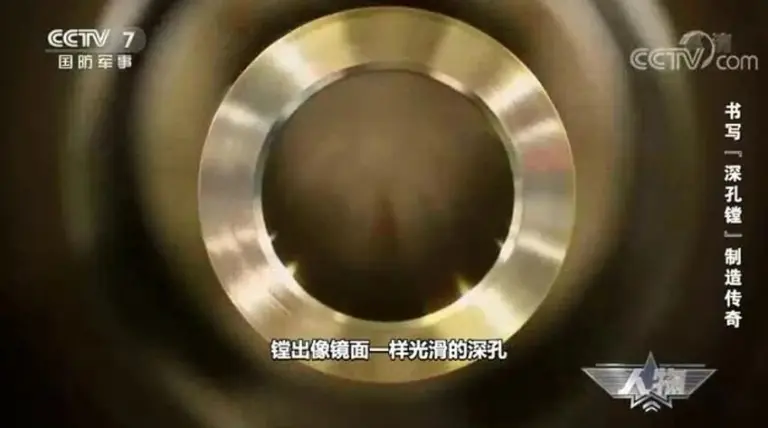
It is not easy to drill a mirror-like deep hole in special steel, and it is even more difficult to drill a hole with a diameter of only 28mm for an 8 meter long steel pipe. Today we will talk about cases of in-depth processing of military-industrial enterprises. Teach a man to fish and teach him to fish at the same time. In the second part of this article, we introduce 6 common deep hole processing methods. From cases to theory, the explanation in this article is very comprehensive and worth reading.
1. Write the manufacturing legend of “deep hole boring”
The cannon barrel is an important element of artillery. Its quality directly determines the accuracy of fire and the power of the artillery. When the artillery shell is fired, the temperature in the barrel will instantly rise to more than 3,000 degrees Celsius, and the pressure will increase to more than 600 MPa, which is equivalent to exerting 6 tons of pressure on an area the size of ‘a nail. This is why steel, a special material used to make artillery guns, has always been called the “king of steels” because of its very high strength.
Artillery gun manufacturing belongs to the deep hole processing industry, which involves drilling holes in ultra high strength alloy steel. This special process is also called deep tube reaming. It is one of the most difficult processes to master of all processing technologies. 1. Therefore, not everyone can do it if they want to punch holes in the “King of Steels”. Such processing requirements are not bad at all.
Rong Pengqiang, chief technician of China Ordnance Industry Group: Because we are in the military industry, our products cannot have problems with soldiers’ lives, and at critical times, they can be a turning point in a battle . If the shot fails or is not accurate, it can be life-threatening.
After inspecting, measuring and sharpening the tools, Rong Pengqiang started his working day after a complicated preparation process. As the chief technician of Chinese weapons, Rong Pengqiang has been assigned to the production line of artillery guns since entering the industry. Since then, drilling deep holes as smooth as a mirror surface in special steel has become his constant pursuit.
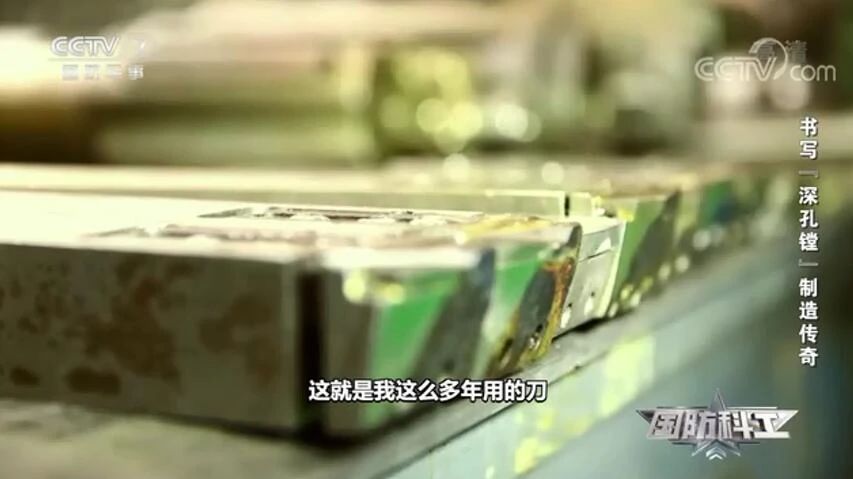
Rong Pengqiang, chief technician of China Ordnance Industry Group: This is the knife I have used for so many years. The boring blade is installed in our special tooling to process high strength and high quality alloy steel. smooth like a mirror surface, no matter the size. Precision and straightness must meet the requirements. I have mainly taken care of them for over 30 years.
The smoothness of the inner wall of the barrel directly affects the firing accuracy of artillery. The difficulty of this process is not visible in the entire treatment process, but Master Rong has his own secrets.
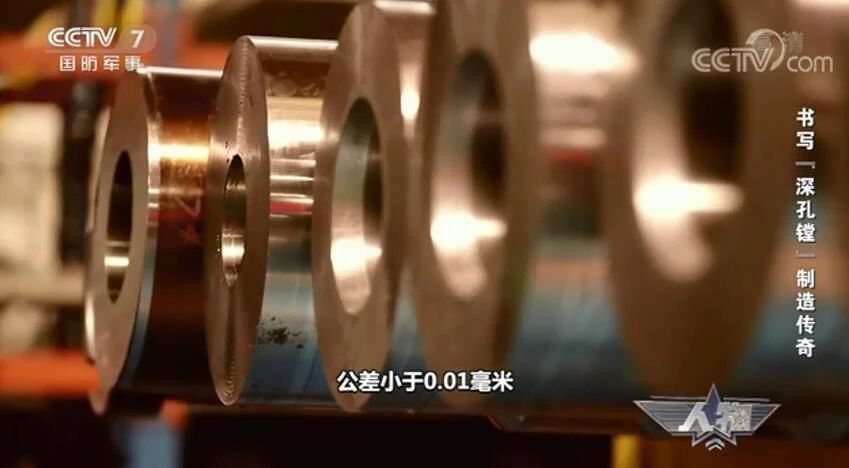
Through decades of exploration and practice in the production line, Rong Pengqiang has mastered the unique skill of using his hands as “eyes”. Its innovative method of drilling deep holes and reaming ultra-long small diameter pipes has a tolerance of less than 0.01mm, which is equivalent to a hair. One-tenth of the wire, which greatly improves the accuracy of artillery straight-line firing.
In 2012, Rong Pengqiang was given a difficult task: drilling a hole with a diameter of only 28 mm for an 8 meter long steel pipe. This through hole was as thick as an adult’s thumb, and the processing depth was three stories. high. Due to the extremely difficult processing and extremely high precision requirements, no domestic manufacturer can produce it.
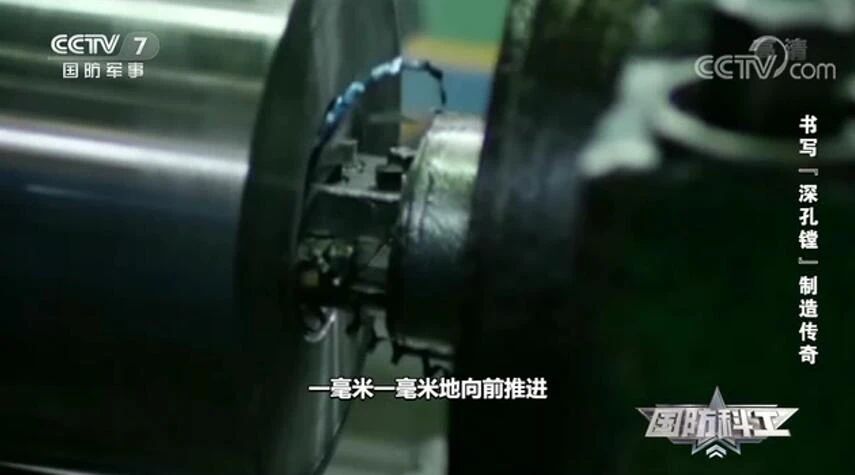
Rong Pengqiang spent a whole day researching a machine tool, using dozens of drill bits and five or six types of tool arbors. He tried again and again and advanced millimeter by millimeter. After a year and a half, Rong Pengqiang finally overcame the 8-meter obstacle. This national-level problem made him the first person in China to deal with small diameter pipe bodies.
2. Six commonly used deep hole processing systems
What is deep hole treatment?
The so-called deep hole is a hole whose hole length/diameter ratio is greater than 10. In most cases, the depth/diameter ratio of general deep holes is L/d≥100. Such as cylinder holes, shaft axial oil holes, hollow spindle holes and hydraulic valve holes, etc. Some of these holes require high machining precision and surface quality, and some of the materials to be processed have poor machinability, which often becomes a major difficulty in production. What methods can you think of for treating deep holes?
1. Traditional drilling
Deep hole processing originated from the twist drill invented by the Americans. The structure of this drill bit is relatively simple, and the cutting fluid is easy to introduce, which facilitates the manufacture of drill bits of different diameters and lengths suitable for processing holes of different sizes.
2. Pistol practice
The deep hole barrel drill was originally used in the gun barrel manufacturing industry (commonly known as deep hole tubes. The barrels are not made of seamless precision tubes and the process of precision tube manufacturing cannot meet the precision requirements), hence the name gun. drill. With the continuous development of science and technology and the unremitting efforts of deep hole processing system manufacturers, deep hole processing has become a practical and efficient processing method. And are widely used in fields such as: automobile industry, aerospace industry, structural construction industry, medical equipment industry, mold/tool/jig industry, hydraulic industry and atmospheric pressure, etc.
Gun drilling is an ideal solution for processing deep holes. Gun drilling can achieve precise processing results. The processed holes have precise position, high straightness and coaxiality, and high surface finish and repeatability. It can easily process various shapes of deep holes, and can also solve special deep holes such as transverse holes, blind holes and flat bottom blind holes.
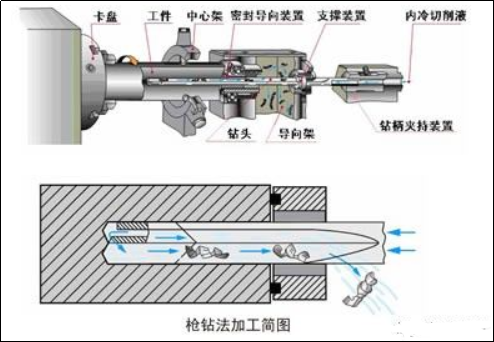
↑↑Composition of gun drilling system↑↑
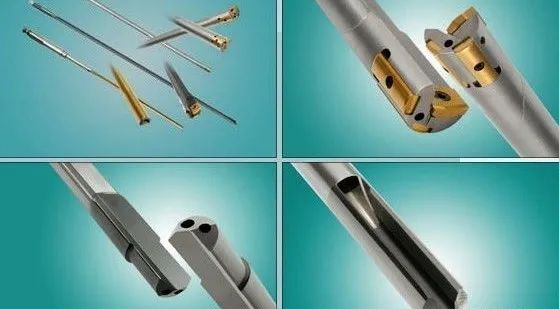
↑↑Gun bit↑↑
3. BTA system
A deep hole drill bit with internal chip evacuation invented by the International Hole Processing Association. The BTA system’s drill bit and drill stem are hollow cylinders, which improves the rigidity of the tool and allows for quick disassembly and assembly. Its principle of operation is shown in the figure. The cutting fluid is under pressure and enters the oil distributor through the inlet. After that, it passes through the sealed annular space formed by the drill pipe and the hole wall, flows to the cutting part to be cooled. and lubrication, and presses the chips into the chips on the bit mouth, and is discharged from the outlet through the internal cavity of the drill pipe. The BTA system is mainly suitable for processing deep holes with a diameter of φ>12 mm.
4. Injection and suction drilling system
Jet suction drilling system is a double-tube deep hole drilling method for chip removal invented by the Swedish company Sandvik and based on the principle of jet suction effect of fluid mechanics . Its spray and vacuum drilling system uses a double-layer tubular toolbar. The cutting fluid enters through the inlet after being pressurized. 2/3 of the cutting fluid enters the annular space between the inner and outer drill bars and flows to the cutting part. for cooling and lubrication, the chips are pushed into the cavity of the drill pipe; The cutting fluid is sprayed from the crescent-shaped nozzle on the internal drill pipe into the internal drill pipe at high speed, forming a low pressure zone in the internal cavity of the internal drill pipe, which produces a suction effect on the cutting fluid. carrying chips. Under the dual effects of spraying and suction, the chips are quickly discharged from the outlet. The jet suction drilling system is mainly suitable for processing deep holes with a diameter of φ>18mm.
5.DF system
The DF system is a single-tube, double-entry internal chip removal system developed by Nippon Metallurgical Co., Ltd. The cutting fluid is divided into two front and rear branches, which enter through two inlets respectively. 2/3 of the cutting fluid in the first flows to the cutting part through the annular area formed by the drill pipe and the wall of the processed hole, and pushes the chips into the chip outlet of the bit, penetrate into the drill pipe, and flows to the chip extractor; The latter 1/3 of the cutting fluid enters the chip extractor directly and is accelerated through the narrow conical space between the front and rear nozzles, creating a negative pressure suction effect to achieve the purpose of acceleration. chip removal. The structure of the first half of the DF system which plays a “push” role is similar to that of the BTA system, and the structure of the second half which plays a “suction” role is similar to that of a borehole. jet-suction. Since the DF system uses dual oil inlet devices, it uses only one drill pipe. The chip pushing and suction method is completed, so the diameter of the drill pipe can be very small and smaller holes can be processed. the minimum processing diameter of DF system can reach 6mm.
6. SIED system
SIED system is a single-pipe suction and chip ejection drilling system invented by North China University. This technology is based on three internal drilling technologies for chip removal: BTA, jet suction drill and DF system, and adds an additional chip extraction device with separately adjustable power, which can realize independent control of coolant flow and chip removal. The basic principle is that illustrated in the figure. After the cutting fluid is produced by the hydraulic pump, it is divided into two branches: the old cutting fluid flows into the oil distribution device, flows to the cutting part through the annular space between the drill pipe and the wall of the hole, and removes chips. Push it into the chip outlet of the drill bit; the latter cutting fluid flows into the chip extractor and enters the inner cavity of the rear nozzle through the gap between the pairs of cone nozzles, generating high-speed jet flow and negative pressure. The SIED system is equipped with independent pressure regulating valves for each of the two liquid flows, which can be adjusted to the optimal state of cooling and chip extraction respectively. The SlED system is a system that is gradually being promoted and is currently a more advanced system. Currently, the SlED system can reduce the minimum drilling diameter to less than φ5 mm.
Daguang focuses on providing solutions such as precision CNC machining services (3-axis, 4-axis, 5-axis machining), CNC milling, 3D printing and rapid prototyping services.



















