
Expert Rapid Tooling Maker for Molds
Rapid tooling is a way to get a real injection mold in days instead of months, and to know exactly what it will and will not hold. This page explains how an expert rapid tooling maker for molds builds a tool, which materials suit which part volume, and where the process stops being economical. Written for design engineers and sourcing teams weighing tooling options.
In this article
- 1
- 2
- 3
- 4
- 5
- 6
- 7
What rapid tooling actually changes
A conventional injection mold is built to survive hundreds of thousands of cycles. That durability drives the cost: hardened cavity steel, long lead times for heat treatment, and a tool design frozen only after the part is fully validated. Rapid tooling flips the order. The tool is built first, from softer or pre-hardened stock, so you can shoot real parts in production resin while the design is still open.
The trade is lifespan. A rapid tool is usually rated for hundreds to a few thousand shots rather than millions, depending on material and geometry. For bridge production, clinical builds, market tests, or a pilot run before hard tooling, that is enough. For a part you intend to sell for a decade, it is not.
At GreatLight we run this work in a 7,600 m² facility in Dongguan with 127 high-precision CNC machines, including 16 simultaneous 5-axis machining centers. Since 2011 the shop has been building tools and machined parts under ISO 9001:2015, IATF 16949:2016, ISO 13485:2016, and ISO 27001:2022.
The practical effect for a design team is simple. You get molded parts, in the final resin, early enough to change the design. That is the whole point of the exercise.
How an expert rapid tooling maker for molds builds a tool
The sequence below is the one we follow on every rapid tool. It is not a menu. Skip DFM and you pay for it at mold trial, when a wall thickness or draft problem has already been cut into steel.
DFM comes first and it is free. We review wall thickness, draft angles, radii, gate location, and parting line, then send a report within 12 hours. Common findings: nominal walls under 0.8 mm that will not fill, zero draft on textured faces, and bosses that need a radius at the base to avoid stress cracking.
Tooling engineering sets the material and the layout. A single-cavity tool keeps cost down and is the usual choice for bridge volumes. Multi-cavity layouts make sense once you know the annual demand. Core and cavity inserts are sized for the press you will run, and cooling lines are placed to reach the hot spots, not just drilled in a straight line.
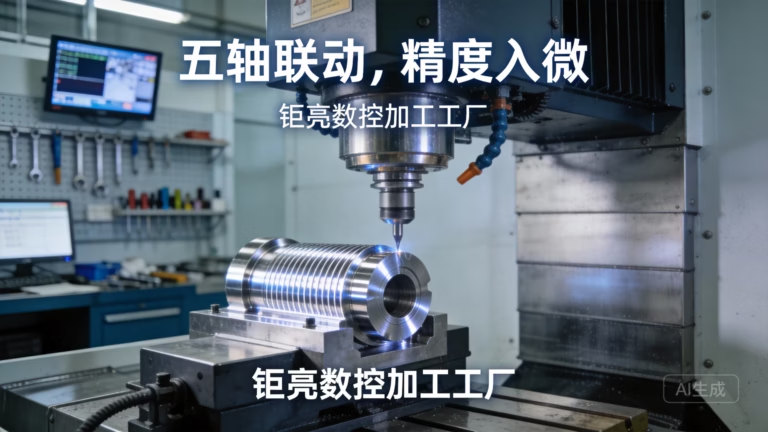
Machining is where the tolerance lives. Cavity and core blocks are cut on 5-axis centers, then finished by wire EDM and sinker EDM for sharp internal corners and deep ribs that a cutter cannot reach. We hold ±0.005 mm on critical mold features, with surface finish between Ra 0.2–0.8 μm where the part surface demands it.
- 1Steel selectionP20 or 718 for longer runs, 7075 aluminum for fast low-volume tools
- 2Cooling layoutFollows part geometry, not a grid
- 3Shrink compensationApplied per resin, not a single global factor
Tool steel and aluminum: picking the right insert
The insert material decides how many parts you get and how fast the tool is ready. Aluminum 7075 machines quickly and is the default for a first tool that needs to exist this week. It transfers heat well, so cycle times are short, and it will hold ±0.005 mm on the cavity. It also dents. A dropped insert or an over-packed shot leaves a mark that shows on every part.
Pre-hardened P20 sits in the middle. It takes more machining hours than aluminum, survives more shots, and resists wear at the gate where most tool damage starts. For a run of a few thousand parts in ABS or PP, P20 is usually the honest answer.
Hardened tool steel such as 718 or a 420 stainless grade comes in when the resin is abrasive or the volume climbs. Glass-filled nylon and any compound with mineral filler will eat an aluminum gate in a few hundred shots. If your material data sheet lists a filler percentage above roughly 15%, plan for hardened steel from the start.
Stainless grades also matter for medical and cleanroom parts, where 420 or 17-4PH inserts resist corrosion from moisture and cleaning agents. The tool lasts longer and the parts stay consistent.
Molding beyond plastics
Rapid tooling is not limited to thermoplastic injection. The same cavity-and-core logic applies to die casting, where an aluminum tool takes molten metal instead of polymer melt. Thermal fatigue is the limiting factor, so die-casting tools are cut from H13-class steel and the cooling layout matters far more than it does for plastic.
For low-volume metal parts, a machined graphite or steel tool paired with vacuum casting produces urethane parts that behave like rubber or rigid plastic depending on the resin. This is common for gaskets, grips, and overmold simulations before committing to a production mold.
There is also the hybrid route: machine the part directly from aluminum or steel billet when the quantity is under a few dozen pieces and the geometry is simple. No tool at all. We do this on the same 5-axis centers, with a maximum processing size of 4,000 mm, so the decision is about quantity and geometry rather than capability.
The rule of thumb we give customers: under 20 parts with simple geometry, machine directly. Twenty to a few thousand parts, build a rapid tool. Above that, the math usually favors a hardened production mold.
Mold trial and first-article measurement
A tool is not finished when the last cut is made. It is finished when the first parts measure correctly. We run a mold trial, shoot a short run, and inspect the parts before anything ships.
First-article inspection compares the molded part against the CAD model on the dimensions that matter: critical fits, wall thickness, and any feature the customer flagged. We use a Ø400 mm rotary table on the CMM for parts with radial features, which keeps setup error out of the measurement.
If a dimension is out, the fix is usually in the tool, not the process. Shrinkage that ran high gets compensated by re-cutting the cavity. A short shot points to a vent or gate problem. We would rather spend an extra day on the tool than ship parts that need sorting at the customer's line.
Every shipment goes out after 100% inspection, with raw material checks and in-process monitoring recorded along the way. Inspection reports are available on request. Our historical late-delivery probability sits below 2%.
When rapid tooling is the wrong choice
Rapid tooling gets oversold. It is the wrong route when the part will be produced for years at high volume, when the resin is highly abrasive from the first shot, or when the geometry needs more than a handful of sliding actions. Those cases want a production tool, and building a rapid tool first just adds a step.
It is also a poor fit when the design is still moving fast. If the wall thickness or the mounting bosses are likely to change next month, an aluminum tool will be obsolete before it wears out. In that window, machined or printed prototypes are cheaper than steel in the ground.
Where rapid tooling wins is the middle ground: the design is 90% settled, the market test or clinical build is real, and the volume is in the hundreds to low thousands. That is the zone where a real mold pays for itself against machining parts one at a time.
One more boundary. Surface finish on a rapid tool follows the insert finish. If the part needs a high-gloss Class A surface, the insert has to be polished to match, and that polishing time belongs in the schedule.
Which tooling route fits your part
Volumes are indicative. Resin, filler content, and part size shift the break-even.
| Route | Typical volume | Lead time driver | Watch out for |
|---|---|---|---|
| Direct CNC from billet | 1–20 parts | Programming and setup | Complex internal features |
| Aluminum rapid tool | 100–2,000 shots | Insert machining | Gate wear on filled resin |
| P20 pre-hardened tool | 2,000–20,000 shots | Machining hours | Heat treatment not needed |
| Hardened steel tool | 20,000+ shots | Heat treatment cycle | Cost before design freeze |
| Die casting tool | 1,000–50,000 shots | Thermal fatigue design | Draft and shrinkage |
| Vacuum casting | 10–50 parts | Silicone mold life | Resin property limits |
The short answer
If you need molded parts in weeks at a few hundred to a few thousand pieces, build an aluminum or P20 rapid tool. If the volume is above roughly 20,000 shots or the resin is heavily filled, go straight to a hardened production mold instead.
Questions engineers ask
How many shots will a rapid tool survive?
It depends on insert material and resin. An aluminum 7075 tool typically lasts a few hundred shots before gate wear shows. A P20 tool usually runs into the low thousands. Hardened steel pushes past that. Filled resins cut all of these numbers, so tell us the filler content when you request a quote.
Can a rapid tool use the same resin as production?
Yes, and that is the point. We run the actual production resin so shrinkage and flow behave the way they will in the final mold. The tool is soft, the resin is not.
What tolerance can you hold on molded parts?
Tool features are machined to ±0.005 mm. Molded part tolerance is looser because resin shrinkage varies, so we inspect the first article against the drawing and report what the process actually holds rather than promising a single number.
Do you handle low volumes without a minimum order?
There is no minimum order quantity. We run from one prototype to 10,000+ part runs, so a bridge tool for 200 parts and a pilot run for 5,000 both fit the same shop.
How do you protect the design?
Uploads are secure and confidential, and we sign an NDA on request before any files change hands. Our information security management is certified to ISO 27001:2022.
What do you need to quote a rapid tool?
A 3D model in STEP or IGES, the resin and filler content, the target annual volume, and any critical dimensions. With those we return a quotation and a free DFM analysis within 12 hours, and production can start within 24 hours of approval.
Send a model, get tooling feedback in 12 hours
Upload a STEP file and we return a quotation plus a free DFM analysis, with no minimum order quantity and an NDA available on request.
12-hour quote±0.005 mm100% inspection
More from the shop floor
We publish setup notes, tooling trials and inspection data from the factory floor.











