
China Bulk CNC Machining Exporter Service: What a Buyer Should Check
This page explains how a bulk CNC machining exporter in China runs volume work: machine mix, tolerance control across thousands of parts, inspection, finishing, and shipping. It is written for engineers and sourcing managers who need to compare suppliers on facts, not brochure claims. Read it and you can decide whether a supplier fits your part family and volume.
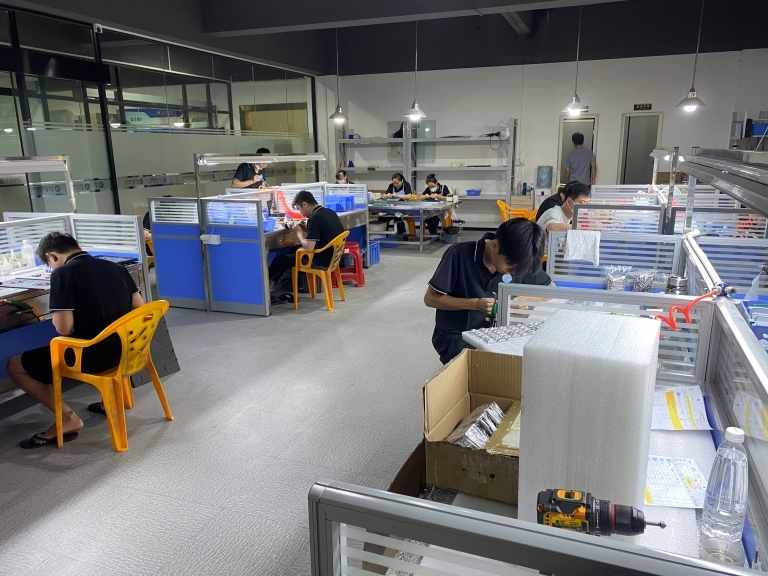
Bulk Machining Is a Control Problem, Not a Machine Count
A shop with 127 machines still fails a 5,000-piece order if nobody owns the process window.
What Makes an Exporter Ready for Bulk Work
Volume work changes the questions you ask. Prototype suppliers get judged on one good part. Volume suppliers get judged on part 4,000. The difference sits in fixtures, tool wear tracking, spindle thermal behavior, and how fast a deviation gets caught before it repeats. An exporter that only quotes price and lead time is telling you it has not thought about this.
Sourcing through a China bulk CNC machining exporter means you inherit a process, not just a part. You want to see the machine list, the inspection plan, and who signs the first article. If the answer to any of those is vague, the quote is a guess.
Three things separate a real export operation from a job shop with a website. Machine depth across sizes, a quality system that produces paper, and finishing done in-house. Miss one and your schedule absorbs the cost.
- 1Machine depthLarge travels, 5-axis, and mill-turn under one roof avoids re-fixturing between vendors.
- 2Quality systemIATF 16949 or ISO 13485 means documented process control, not verbal promises.
- 3In-house finishingAnodizing, plating, and coating managed internally removes a handoff that usually slips.
Machine Mix and What It Lets You Machine
Capacity is more than a total count. The mix matters. GreatLight runs 127 high-precision CNC machines in Dongguan, including 16 simultaneous 5-axis centers, 12 four-axis mills, 27 three-axis machines, and 16 mill-turn centers. That spread lets us place a part on the machine that holds it best instead of forcing it onto whatever is free.
Part envelope drives machine choice. Large work runs on travels of 4,000 × 400 × 150 mm. Medium housings fit 750 × 1,150 × 550 mm or 600 × 600 × 600 mm. Small, high-quantity parts run on 500 × 500 × 450 mm and 500 × 310 × 200 mm platforms, sometimes with a Ø400 mm rotary table for multi-face work in one setup.
Mill-turn centers matter for bulk. Shafts, fittings, and bushings that would need two operations on a mill and a lathe finish in one cycle, which cuts handling and keeps concentricity tight. When a part has both turned and milled features and a ±0.005 mm tolerance, that single-setup route is usually the difference between a stable run and a scrap pile.
Matching Part Size to Machine Travel
Pick the platform before you pick the price.
| Part type | Travel / table | Best machine route |
|---|---|---|
| Long frames, rails, beams | 4,000 × 400 × 150 mm | Large 3-axis or 5-axis |
| Housings, manifolds | 750 × 1,150 × 550 mm | 4-axis horizontal or 5-axis |
| Cube-shaped enclosures | 600 × 600 × 600 mm | 5-axis, one setup |
| Small fittings, bushings | 500 × 310 × 200 mm | Mill-turn or rotary table |
| Multi-face small parts | Ø400 mm rotary table | 4-axis with trunnion |
Holding ±0.005 mm Across Thousands of Parts
A single tight part is a machining problem. Ten thousand tight parts is a statistics problem. To hold ±0.005 mm (±0.0002 in) over a run, the shop has to control temperature, tool wear, and fixture repeatability, then measure often enough to catch drift. That is why in-process monitoring matters more than the final inspection report.
Surface finish follows the same logic. Ra 0.2–0.8 μm is achievable on a good day with the right tool and coolant. Keeping it there for 5,000 parts means changing tools on a schedule, not on failure. For most functional parts, Ra 0.8–1.6 μm is the practical target. As-machined surfaces at Ra 1.6–3.2 μm cover brackets, covers, and non-sealing faces where finish is cosmetic.
We inspect 100% of parts before shipment, with raw material checks, in-process monitoring, and final inspection. Reports are available on request. For bulk orders, the useful document is not one final CMM report. It is the trend data showing the process stayed centered.
Certifications and What They Actually Cover
Certificates are a floor, not a ceiling. ISO 9001:2015 covers general quality management. IATF 16949:2016 adds automotive process control, which is what you want if the parts feed a vehicle program. ISO 13485:2016 applies to medical device components. ISO 27001:2022 covers information security, relevant when your drawings and CAD files are the sensitive asset.
For a bulk CNC order, the certificate tells you the shop has documented procedures and gets audited. It does not tell you whether the machinist on your job follows them. That is why we pair the system with a first article inspection and a signed dimensional report before the run is released.
The historical late-delivery probability on our orders sits below 2%. We quote that as a record, not a guarantee. If your schedule is tight, tell us at RFQ stage so the plan accounts for it.
Materials, Finishing, and Where Handoffs Break
Bulk orders usually involve one dominant material. Aluminum 6061, 6061-T6, 7075, and ADC12 cover most housings and brackets. Stainless 303, 304, 316L, and 17-4PH cover food, medical, and marine parts. Steel 1018, 1045, 4140, and 4340 handle shafts and structural work. Titanium TC4 (Ti-6Al-4V) and Inconel appear when weight or heat matters more than cost.
Finishing is where bulk schedules slip. Anodizing, electroless nickel, zinc plating, powder coating, and black oxide all require a second process step. If the machining shop outsources that step, your parts sit in a truck queue you cannot see. Keeping anodizing, plating, bead blasting, tumbling, brushing, polishing, and laser marking under one roof removes that blind spot. Laser marking holds a minimum character height of 1.5 mm, which matters for traceability codes.
One caution. Hardcoat anodizing changes dimensions. If a bore is held to ±0.005 mm and gets hardcoat after machining, the coating thickness eats the tolerance. Tell us the finish before we set the process, not after.
When Bulk Export Machining Fits, and When It Does Not
| Scenario | Fits bulk export? | Reason |
|---|---|---|
| 1,000+ identical parts | Yes | Fixture and setup cost amortizes |
| 5–20 units, tight tolerance | Yes, but as prototype | Machining still beats tooling |
| Very complex 5-axis, low volume | Usually yes | No tooling cost, fast changeover |
| High volume, simple geometry | Often no | Die casting or stamping is cheaper |
| Parts needing 3+ coatings | Yes, with planning | Sequencing has to be locked early |
| Extremely tight flatness over 1 m | Case by case | Needs stress relief and slow passes |
Export Logistics and the Paperwork Side
Dongguan sits inside China’s precision hardware cluster, next to the Shenzhen logistics hub. That location shortens the distance between the machine and the freight forwarder. We also operate a Singapore factory at No.3 Joo Koon Circle, Singapore 629032, which gives buyers a second shipping origin when tariffs or transit times matter.
A bulk CNC machining export order needs more than a box. Packing has to survive ocean freight, and parts need to arrive without corrosion or handling damage. We plan packaging at quotation stage for volume orders, because a part that arrives bent is the same as a part that was never made.
Production can start within 24 hours of a confirmed order, and parts ship in 3–5 days for standard work. For bulk runs, the lead time depends on material availability and finishing sequence. Ask for the schedule in writing with the quote. Uploads are secure and confidential, and an NDA is available on request.
How to Compare Two Exporters in One Afternoon
Ask both suppliers the same five questions. What machine will run my part, and what is its travel? Who owns the first article signature? Is finishing done in-house? What is the inspection frequency during the run, not after? How do you handle a deviation found at part 3,000?
The answers reveal more than a factory tour. A supplier that can name the machine, the fixture concept, and the inspection interval has already done the process thinking. One that answers with capacity numbers and certifications is selling the brochure.
Price still matters. But in bulk machining, the cost of a bad run is not the parts. It is the line stop, the rework, and the air freight to fix it. Weigh the quote against that number.
Questions Engineers Ask Before a Bulk Order
What is the minimum order quantity for bulk CNC machining?
We have no minimum order quantity. Runs go from one prototype to 10,000+ parts.
For volume pricing, the setup and fixture cost is spread over the run, so the per-part price drops as quantity rises.
How do you keep tolerances stable across a long production run?
The process window is set at first article, then monitored during the run. Tool wear is tracked on a schedule rather than on failure.
We inspect 100% of parts before shipment, covering raw material checks, in-process monitoring, and final inspection. Reports are available on request.
Can you manage finishing and assembly along with machining?
Yes. Anodizing, plating, powder coating, black oxide, bead blasting, tumbling, brushing, polishing, and laser marking are handled in-house.
That removes the handoff where bulk schedules usually slip, since the finishing step is inside the same production plan.
What lead time should I expect for a bulk order?
Quotation and free DFM analysis come back within 12 hours. Production can start within 24 hours of a confirmed order.
Standard parts ship in 3–5 days. Bulk runs depend on material availability and finishing sequence, so the schedule is confirmed with the quote.
How do you protect our drawings and CAD files?
Uploads are secure and confidential. We hold ISO 27001:2022 for information security.
An NDA is available on request if your program needs one before files are shared.
Which materials can you machine in bulk?
Aluminum grades including 6061, 7075, and ADC12; stainless 303, 304, 316L, and 17-4PH; steels such as 1018, 1045, 4140, and 4340; copper and brass alloys; titanium TC4, Inconel, and magnesium; plus engineering plastics including POM, PEEK, and PC.
Material choice drives tooling, speed, and finishing, so it is part of the DFM review at quotation.
Send Your Drawings, Get a Bulk Machining Quote
Upload your files and we return a quotation with free DFM analysis within 12 hours. No minimum order quantity, from one part to 10,000+.
12-hour quote100% inspection±0.005 mm toleranceNDA on request









