
China Bulk 5 Axis CNC Services Exporter: What to Check Before You Order
This page is for engineers and procurement teams placing 5-axis machining orders at volume, from a few hundred parts to 10,000+. It covers what a china bulk 5 axis exporter can actually hold in production, where the risks sit, and how to read a supplier's numbers before you commit tooling and material.
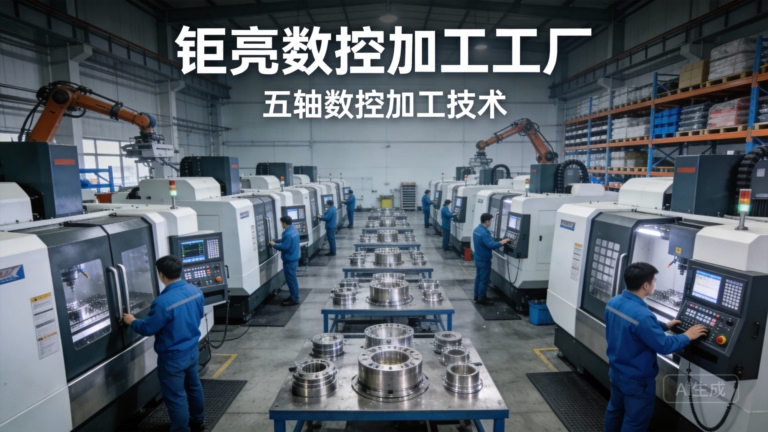
What bulk 5-axis sourcing really buys you
Volume changes the question. At one-off quantities you are buying a setup. At 5,000 parts you are buying a process that has to repeat.
Where a china bulk 5 axis exporter can hold tolerance
Five-axis work gets interesting when a part carries features on more than one face. A hydraulic manifold, a robot joint housing, a turbine bracket: each has bores, faces and slots that must stay aligned to one another after heat treat and finishing. On a 3-axis machine those features come from repeated refixturing, and every refixture adds stack-up error. A 5-axis center cuts the part in one or two setups, so the datum relationship stays inside the machine.
What can a supplier actually hold at volume? Tolerance depends on the feature, not just the machine. A bored hole in aluminium can sit at ±0.005 mm. A long thin wall in the same material will move, no matter how good the machine is, because cutting force and residual stress push it around. So when a supplier quotes one blanket tolerance for the whole drawing, treat that as a marketing number until they tell you which features they can and cannot hold.
The honest answer is that a bulk 5-axis order lives or dies on process control, not on spindle specs. A 16-machine cluster with pre-set tooling, in-process probing and a written setup sheet behaves very differently from one machine running whatever job came in that morning. Same tolerance on the quote. Very different yield at part 3,000.
- 1One-setup featuresFaces, bores and slots that must stay aligned. Best fit for 5-axis.
- 2Thin walls under 1 mmExpect movement. Discuss support and finishing passes early.
- 3Hardened material after heat treatPlan the finishing cut around the hardness, not the drawing.
- 4Deep pockets with small corner radiiTool reach sets the real limit, not the machine travel.
Keeping part 1 and part 5,000 identical
The first article is rarely the problem. Suppliers inspect it carefully because it is the approval gate. The drift shows up later: tool wear shifts a bore, a fixture clamp loses preload, a new bar of 7075 machines differently from the last one. None of these are dramatic on their own. Together they turn a ±0.02 mm bore into a scrap pile.
The controls that stop drift are boring and visible. Tool life is tracked by part count, not by operator feel. A probe checks a datum feature every batch. Material comes with a mill certificate tied to the lot. If a supplier cannot describe these three things in one sentence each, the process is being run by memory.
Ask what happens when a dimension goes out. A good answer names a containment step: the batch is held, the last known-good point is found, parts between the two are sorted. A weak answer says they will fix it on the next run. At volume, the difference between those two answers is your scrap cost.
Typical 5-axis capability at GreatLight
Numbers below come from our own equipment list and standard process sheet.
| Item | Specification | Notes |
|---|---|---|
| Tolerance | ±0.005 mm (±0.0002 in) | Feature dependent; thin walls need review |
| Surface finish | Ra 0.2–0.8 μm fine | Ra 1.6–3.2 μm as machined |
| 5-axis centers | 16 simultaneous | Rotary table Ø400 mm |
| Max part size | 4,000 × 400 × 150 mm | Larger envelope on request |
| Other machines | 12 four-axis, 27 three-axis, 16 mill-turn | 127 CNC machines total |
| Materials | Aluminium, stainless, steel, titanium, copper, plastics | 7075, 17-4PH, TC4, Inconel, PEEK |
| Inspection | 100% before shipment | Reports on request |
| Lead time | Parts ship in 3–5 days | Production start within 24 hours |
Reading a supplier before you send the PO
Certificates tell you which systems exist, not how well they run. ISO 9001:2015 covers the quality system. IATF 16949:2016 matters if the parts go into a vehicle program. ISO 13485:2016 applies to medical devices. ISO 27001:2022 is about information security, which matters more than most buyers expect when drawings leave your network.
A short DFM call reveals more than an audit. Send one representative part and see what comes back. A useful response flags the thin wall, suggests a different radius, or asks which face is the true datum. A generic reply that restates the drawing adds nothing.
Capacity should match your ramp. A shop with 16 simultaneous 5-axis centers and 127 machines total can absorb a 10,000-part run without pushing your job behind someone else's. A shop with two centers will queue you. Ask how many of their 5-axis machines are dedicated to production work versus prototype work, and ask what their historical late-delivery rate is. Ours sits below 2%.
Post-processing is where bulk orders quietly slip. Anodizing, electroless nickel, powder coating and laser marking usually sit outside the machine shop. If the exporter coordinates those steps under one PO, you avoid a second freight leg and a second set of inspection paperwork. If they do not, build the extra week into your plan.
Questions engineers ask before a bulk 5-axis order
What quantity counts as a bulk 5-axis order?
There is no fixed line. We treat anything above a few hundred identical parts as a production run, because that is where tool life, fixture wear and material lot variation start to matter more than the first-article result.
For runs above 10,000 parts we review the process before quoting, since cycle time and tooling cost dominate the price at that volume.
Can you hold ±0.005 mm across a full production run?
On stable features in aluminium and stainless, yes. Bores, faces and slots cut in one setup are the easiest to control.
Thin walls, long unsupported sections and parts that are heat treated after machining are harder. We flag those features during DFM and tell you what tolerance is realistic before you commit.
How do you protect drawings and CAD files?
Uploads are handled as confidential. An NDA is available on request, and our information security system is certified to ISO 27001:2022.
We do not use customer parts or drawings in marketing material without written permission.
What does post-processing add to the schedule?
Anodizing, plating, powder coating, bead blasting and laser marking are handled as part of the order, so they do not require a separate supplier PO.
Laser marking has a minimum character height of 1.5 mm. Below that, the mark is not reliable on most finishes.
Can you start without a minimum order quantity?
Yes. There is no minimum order quantity. We run single prototypes and 10,000+ part runs on the same process sheet.
A quotation and free DFM analysis come back within 12 hours, and production can start within 24 hours of approval.
Which industries do bulk 5-axis orders usually come from?
Robotics and automation, automotive and EV, aerospace, medical devices and industrial machinery.
Each has different documentation needs. Medical and automotive programs usually require full inspection reports and lot traceability, which we build into the process from the start.
Send one part. See what comes back.
Upload a drawing and we will return a quotation and a free DFM analysis within 12 hours. No minimum order quantity, NDA on request.
12-hour quote100% inspectionNo MOQNDA on request









