
China Metal 3D Printing Exporter Service: What Engineers Should Check
This page explains how a china metal 3d printing exporter actually operates: which geometries go on an SLM machine, which need secondary CNC work, and what documentation has to travel with the shipment. Written for design engineers and sourcing leads who already have a part in mind and need to judge whether a supplier can hold the tolerance and the paperwork.
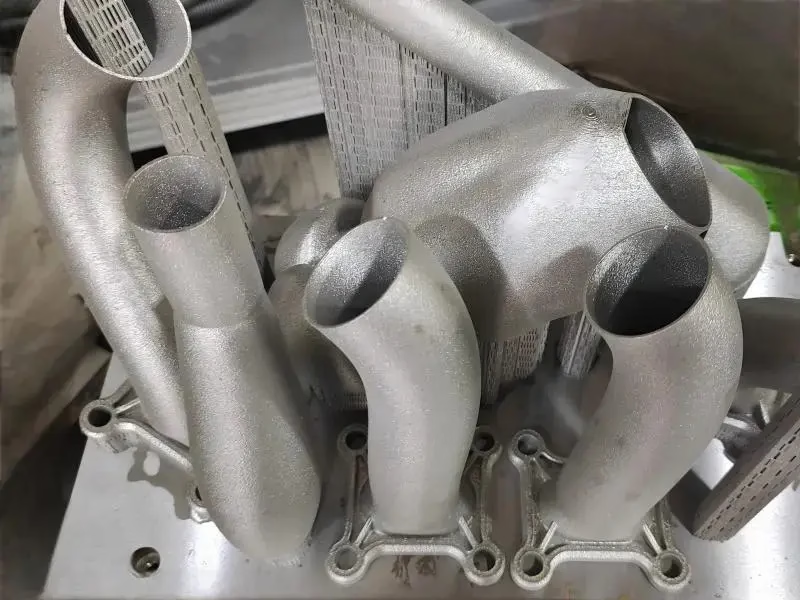
A metal printing supplier is also a finishing and export supplier
Printing the part is roughly half the job. The other half is machining it, inspecting it, and getting it through customs without a paperwork delay.
Which parts belong on an SLM machine
Selective laser melting builds a part layer by layer from metal powder. That is the right process when the geometry cannot be reached by a cutter: internal channels that curve, lattice structures, conformal cooling paths inside a mold insert, or a bracket that would need five setup operations as a machined part. For a small batch of complex shapes, the printed route removes tooling and setup entirely.
It is the wrong process for a simple block with a few holes. A 3-axis or 5-axis mill will produce that faster, cheaper per part, and with a better surface. We tell customers this directly when a quote request comes in with geometry that suits milling better. Sending it to a printer would waste their budget.
The practical rule we use: if the part has features a tool cannot reach, or if the batch is small enough that fixture cost dominates, print it. If the part is mostly prismatic with accessible faces, machine it. Where a part is mixed, such as a printed body with two precision bores, both processes run on the same order.
- 1Good fitInternal channels, lattices, thin-walled shells, consolidated assemblies
- 2Poor fitFlat plates, simple shafts, high-volume parts where tooling amortizes
- 3Mixed partPrint the complex body, then machine mating faces and bores to tolerance
Why printed parts still go to a CNC machine
An SLM part comes off the build plate with a rough surface and a tolerance that is looser than most mating interfaces allow. Sealing faces, bearing bores, threads, and dowel holes all need metal cut away after printing. That is the step where a print-only supplier hands the part to a third party, and where communication tends to break down.
We keep 127 high-precision CNC machines in the same facility, including 16 simultaneous 5-axis machining centers, 12 four-axis mills, 27 three-axis machines, and 16 mill-turn centers. Maximum processing size reaches 4,000 mm. A printed housing can move from the build plate to a 5-axis setup without leaving the building, which keeps the datum reference consistent between the printed and machined features.
Tolerances on machined features are held to ±0.005 mm (±0.0002 in). Surface finish ranges from Ra 0.2–0.8 μm on a fine-ground face to Ra 1.6–3.2 μm as-machined. Heat treatment to relieve internal stress is scheduled before final machining, not after, so the part does not move once the bores are cut.
Metal powders and the alloys behind them
Most export orders we see use titanium, stainless steel, aluminum, or nickel alloy. Ti-6Al-4V (TC4) is common in aerospace brackets and medical instruments because of its strength-to-weight ratio. 316L and 17-4PH stainless cover corrosion-resistant housings and functional prototypes. Inconel appears where the part sees high temperature, such as a manifold or a combustion-adjacent component.
Aluminum powder is available for lighter parts, and the same alloy families run through our CNC and die casting lines: 6061, 7075, 2024, 5052, ADC12 for aluminum; 303, 304, 316, 17-4PH for stainless; copper alloys such as C110 and beryllium copper where thermal or electrical conductivity matters.
The material choice usually follows the secondary operation, not the printing step. If the part will be anodized, the alloy needs to be one that anodizes predictably. If it needs electroless nickel or bead blasting, that is a finishing decision made at quoting time, not after the part is built.
Matching the part to the process
Use this to decide whether a quote request should go to the printer or straight to a mill.
| Part characteristic | Recommended process | Reason |
|---|---|---|
| Internal conformal channels | SLM metal printing | No straight tool path can reach the geometry |
| Simple prismatic block | 3-axis CNC milling | Faster cycle, tighter finish, lower cost per part |
| Printed body with bearing bores | SLM plus 5-axis machining | Bores require a cut surface and a tolerance |
| Thin lattice or truss | SLM metal printing | Machining would remove most of the structure |
| Large flat plate, 500+ units | CNC or die casting | Tooling amortizes and repeatability improves |
| Prototype housing, 1–5 units | SLM plus finish machining | No fixture cost, geometry changes stay cheap |
Inspection and the documents that ship with the part
A printed part is only as good as the measurement behind it. Every order goes through a raw material check, in-process monitoring, and a final inspection before shipment. Reports are issued on request: dimensional inspection data, material test reports, and certificates of origin. All four quality systems are in place at our plants: ISO 9001:2015, IATF 16949:2016, ISO 13485:2016, and ISO 27001:2022.
Export documentation is part of the deliverable, not an afterthought. Accurate commercial invoices, packing lists, and origin certificates have to match the part description and the declared value, or the shipment sits in customs. We prepare that packet with the order and keep the material certificates on file so a repeat order references the same heat and the same paperwork.
The qualification rate across production is 99.99%. That number matters less than what happens when a part is out of tolerance. In that case the report goes back to the customer with the deviation marked, and a rework or reprint decision is made before anything ships.
- 1IncomingPowder and bar stock verified against the certificate before a build starts
- 2In-processDimensional checks after machining, before finishing
- 3Final100% inspection before shipment, reports on request
Reading a quote from a china metal 3d printing exporter
Two quotes for the same part can look identical on price and differ completely on what is included. The first thing to check is whether the quote covers post-processing. A price that stops at the build plate leaves the customer to find a machine shop, a heat treater, and a finisher, and to absorb the shipping between them. Ask what happens after printing and who owns the tolerance on the machined features.
The second check is whether the supplier runs its own equipment or brokers the work. A broker coordinates between shops, which adds lead time and puts the tolerance stack across two companies. A factory that owns both the printer and the CNC line can hold one datum scheme from build to final cut. That is why we quote DFM analysis within 12 hours and can start production within 24 hours of approval.
The third check is the commercial floor. There is no minimum order quantity here, so a single prototype and a 10,000+ part run both go through the same quoting process. Parts typically ship in 3–5 days after production. For a one-off prototype that has to be in a test cell this month, that timeline is usually the deciding factor.
Questions engineers ask before ordering
Can you hold ±0.005 mm on a printed part?
Not on the printed surface itself. As-built SLM surfaces sit outside that band and need a cut. We hold ±0.005 mm (±0.0002 in) on machined features, such as bores, mating faces, and dowel holes.
If a drawing puts a tight tolerance on an as-printed feature, we flag it during DFM review and propose either a machining step or a realistic tolerance for that surface.
What file formats and information do you need for a quote?
A STEP file plus a 2D drawing with tolerances, material, and finish is the fastest path. If there is no drawing, a STEP file with a note on critical features works.
We return a quotation and a free DFM analysis within 12 hours. Uploads stay confidential and an NDA is available on request.
How do you handle heat treatment and stress relief?
Stress relief is scheduled between printing and final machining. Skip it and the part can move after the bores are cut, which shows up as an out-of-round hole at final inspection.
The sequence is print, stress relieve, machine, finish, inspect. Heat treatment is part of the quoted process, not a customer-supplied step.
Which finishes can be applied to a printed metal part?
Anodizing in clear, color, hardcoat, and conductive versions; electroless nickel, zinc, silver, and gold plating; powder coating and black oxide; bead blasting, tumbling, brushing, and polishing.
Laser marking and engraving are available with a minimum character height of 1.5 mm. Some finishes need a specific alloy, so the finish choice is confirmed at quoting time.
What documentation travels with an export shipment?
Commercial invoice, packing list, certificate of origin, and the material test report. Dimensional inspection reports are added when the drawing calls for them.
All documents are prepared to match the declared part description and value so customs clearance does not stall on a mismatch.
Is there a minimum order quantity?
No. Orders run from one prototype to 10,000+ parts. The setup and programming work is the same either way, which is why a single printed and machined prototype is a normal order for us.
Prototypes and production runs use the same inspection process, so the data from the first part carries into the run.
Send the STEP file and get a DFM read before you commit
We review the geometry, tell you which features need machining, and return a quotation with the process route. No minimum order quantity.
12-hour quote and DFM±0.005 mm machining100% inspectionNDA on request









