
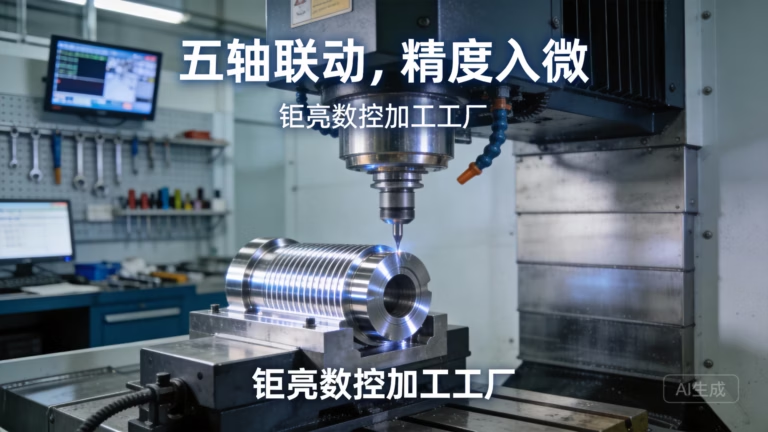
When sourcing an EV Instrument Cluster Frame OEM Supplier, automotive engineers face a delicate balancing act: the frame must provide structural integrity, lightweighting, electromagnetic shielding, and cosmetic finish, all while hitting aggressive cost targets and production volumes. For OEMs developing next‑generation electric vehicles, the instrument cluster frame – the backbone of the digital cockpit – is no longer a simple bracket. It is a precision‑machined, often multi‑material assembly that integrates mounting points for displays, PCBs, haptic feedback units, and wiring harnesses. This article explores the engineering, sourcing, and cost‑control strategies needed to identify the right manufacturing partner, with a focus on how full‑service providers like GreatLight Metal consistently outperform fragmented supply chains.
Key Engineering Challenges in EV Instrument Cluster Frames
Before evaluating any EV Instrument Cluster Frame OEM Supplier, it is essential to understand the design‑side constraints that drive manufacturing complexity and cost:
Tight Geometric Tolerances: Frames must hold flatness within 0.05 mm over a 400 mm span to prevent display warpage. Datum alignment for PCB mating surfaces often requires ±0.02 mm positional accuracy.
Thermal Management: Integrated heat sink features are increasingly common, demanding either high‑conductivity aluminum alloys (e.g., ADC12 or 6061‑T6) or hybrid designs that combine die‑cast frames with copper inserts.
Vibration/Shock Durability: The frame must survive random vibration profiles (e.g., 3.5 Grms, 10‑2000 Hz) without fatigue cracking, which influences wall thicknesses and rib geometries.
EMC Requirements: Many frames act as a partial Faraday cage; thus conductivity and grounding continuity across joints are critical, often requiring electroless nickel plating or conductive passivation.
A‑Surface Finish: Visible portions of the frame must match interior trim aesthetics, often necessitating uniform powder coating, anodizing, or even decorative PVD finishes.
A supplier that does not deeply understand these interdependencies will invariably drive up cost through over‑engineering or, worse, field failures.
What Defines a Top-Tier EV Instrument Cluster Frame OEM Supplier?
A capable EV Instrument Cluster Frame OEM Supplier must go beyond simply owning a CNC machine. The following pillars separate strategic partners from transactional job shops:
Engineering Design for Manufacturability (DFM) Support
Early supplier engagement is the single most powerful cost‑reduction lever. The best suppliers conduct a thorough DFM review that optimizes part geometry for the chosen primary process (high‑pressure die casting, squeeze casting, billet machining, or sheet metal fabrication) and secondary operations. They can suggest split lines, draft angles, and gating strategies that eliminate the need for excessive secondary machining.
Integrated Process Chain
Instrument cluster frames today are rarely made using just one process. A typical flow might be: aluminum die casting → CNC machining of critical datums and threads → debutting/washing → chromate conversion coating → masking → painting. Sourcing each step from different vendors multiplies logistics costs, lead times, and risk. A supplier with in‑house die casting, multi‑axis CNC machining, finishing, and quality inspection creates a seamless pipeline that inherently controls cost.
Quality Assurance Backed by Accreditation
The difference between dimensional promises and production reality is bridged by a robust quality management system. Never accept a verbal claim of “±0.01 mm” without seeing the CMM reports and ISO certification. In the automotive context, IATF 16949 certification is the gold standard because it mandates process capability (Cpk) tracking, production part approval process (PPAP), and failure mode effects analysis (FMEA) – tools that directly reduce scrap rates and warranty exposure.
Scalability with Process Control
Prototype quality is easy; scaling to 10,000 units a month with consistent Cpk > 1.67 is hard. A well‑qualified supplier uses real‑time SPC, automated in‑line probing, and traceability systems (e.g., laser‑etched QR codes linking to CMM data) to maintain quality without 100% manual inspection, keeping per‑part cost stable as volumes grow.
How Material and Process Selection Drive Cost Down
Cost control for an EV instrument cluster frame begins at the drawing board. Too often, a design is thrown over the wall to a supplier and quoted as‑is, locking in unnecessary expense. Here is how a good OEM supplier helps you break the cost curse:
Primary Shape vs. Subtractive Machining: If your frame geometry contains deep pockets, undercuts, or complex internal ribs, 100% billet machining from a solid block of aluminum is almost never cost‑optimal. High‑pressure die casting or thixomolding creates near‑net‑shape blanks that require only minimal clean‑up machining. The tooling investment amortizes quickly above 2,000‑5,000 units. GreatLight Metal, for example, manages both die tooling and CNC machining under one roof, so the design can be optimized for the casting process while ensuring post‑cast machining operations are kept to a minimum — a critical factor when volumes range from thousands to hundreds of thousands.
Alloy Choice and Post‑Processing Synergy: A6061‑T6 is excellent for machining but can be over‑specified for purely structural regions. Switching to ADC12 die‑cast aluminum can reduce raw material cost and improve castability, provided the fatigue life requirements are met. A supplier with metallurgical expertise can recommend the right alloy and compatible finishing treatment that avoids galvanic corrosion when the frame mounts to a magnesium‑alloy cross‑car beam.
Fixture Design and Process Consolidation: A less experienced shop might require six setups to machine all features, adding hourly cost and tolerance stack‑up. A veteran EV Instrument Cluster Frame OEM Supplier will design a single‑cycle 5‑axis trunnion fixture that accesses five sides in one clamping, eliminating repositioning errors and reducing cycle time by 30‑50%. That directly lowers the per‑piece machining cost.
The Hidden Cost of Fragmented Supply Chains
When an OEM uses multiple suppliers — one for die casting, another for CNC, a third for plating, and a fourth for painting — several hidden costs accrue:
Logistics & Administrative Overhead: Multiple shipments, multiple inspections, and separate invoicing consume procurement resources.
Yield Loss from Handoff Miscommunication: Surface condition at the time of masking, residual coolant contamination, or burr height variation across batches can cause finishing defects that are discovered late, leading to batch rejection and line stoppages.
No Single Point of Accountability: When a dimension goes out of spec, it becomes a finger‑pointing exercise between the moulder and the machinist, delaying root‑cause analysis and corrective action.
An integrated manufacturer like GreatLight Metal eliminates these costs by taking full responsibility for the entire process chain. This is not an abstract benefit — it translates into single‑source part traceability, faster 8D problem solving, and significant cost savings on freight and expediting.
Comparing Today’s EV Instrument Cluster Frame OEM Suppliers
The following table illustrates how different supplier archetypes stack up on criteria relevant to an EV Instrument Cluster Frame OEM Supplier. It includes both highly capable specialist manufacturers and popular online platforms. The assessment is based on their publicly disclosed capabilities and typical service scope.
| Supplier | Core Manufacturing | Typical Precision | Full‑Process Integration | IATF 16949 Certified | Cost Structure (Volume 2k‑10k) | Best Application |
|---|---|---|---|---|---|---|
| GreatLight Metal | Die casting + 5‑axis CNC + finishing | ±0.002 mm (machining), ±0.01 mm (casting) | Yes – mold, cast, machine, plate, assemble | Yes (medical & auto), ISO 9001/13485 | Competitive TCO due to integration | Complex frames needing multi‑process flow |
| Xometry | Network manufacturing (global) | Varies by partner; typically ±0.13 mm default | Limited – quotes separate jobs | Some partners may hold | Moderate; platform fee per order | Low‑volume prototypes |
| RapidDirect | On‑demand CNC & die casting | ±0.01 mm for CNC | Moderate – offers some finishing | ISO 9001 | Good for prototypes; higher at scale | Quick‑turn projects |
| Protolabs Network | Digital manufacturing (Hubs) | ±0.05 mm for CNC, casting tolerances looser | Not integrated; posts processes outsourced | No unified cert. | Premium for speed, not low cost | Urgent single parts |
| Owens Industries | Ultra‑precision grinding & 5‑axis CNC | ±0.001 mm | Limited – machining focus | AS9100, ISO 9001 | High due to precision specialization | Frames requiring sub‑micron features |
| RCO Engineering | Full automotive services (design to assembly) | ±0.05 mm typical | Yes – turnkey vehicle development | IATF 16949 | Very high; NRE heavy | Concept‑to‑SOP programs |
| EPRO‑MFG | Complex CNC machining | ±0.005 mm | In‑house machining, outsourced casting | ISO 9001 | Mid‑range | Complex machined frames |
| PartsBadger | Quick‑quote CNC shop | ±0.127 mm standard | No – machining only | No | Low per‑part, but volume discount limited | Simple brackets |
| JLCCNC | Low‑cost Chinese platform | ±0.1 mm typical | None – pure machining | No | Very low unit price | Non‑critical appearance parts |
| SendCutSend | Laser cutting & bending | ±0.13 mm | Sheet metal only | No | Low for bent sheet frames | Prototype sheet metal frames |
From a cost‑control perspective, platforms can be excellent for one‑off prototypes, but when an EV Instrument Cluster Frame OEM Supplier is needed for repeated production orders, the process‑integrated model of GreatLight Metal avoids the markup of intermediaries and delivers consistent quality from casting to coating.
A Real‑World Example: Transforming a Frame from Costly Machined Billet to Optimized Die Casting
A new‑energy vehicle startup approached GreatLight Metal with a design for a 12.3‑inch instrument cluster frame originally planned as a fully machined 6061‑T6 billet. Each frame consumed 3.5 kg of raw material and took 22 minutes of machine time, yielding a unit cost far beyond the target. Through collaborative DFM, the engineering team redesigned the part as a high‑pressure aluminum die casting (ADC12) with a net‑weight of 0.9 kg, retaining all critical mounting features. Post‑cast, only 4 minutes of 4‑axis CNC machining were needed to establish datums and tap threaded inserts. The cost per piece dropped by 42% at a volume of 8,000 units per year, and the lighter frame even improved NVH performance slightly. This is the kind of cost optimization that only a supplier with deep process knowledge can unlock.
Why Trust and Certifications Are Not Just Paper
When you commit to a new EV Instrument Cluster Frame OEM Supplier, you are essentially placing the safety and perception of your vehicle in their hands. The trust framework must extend beyond a well‑written quote. GreatLight Metal’s credentials — ISO 9001:2015 for quality management, ISO 13485 for medical‑grade process rigor, and adherence to IATF 16949 principles — demonstrate a culture of systematic excellence. Additionally, their compliance with ISO 27001 for data security is a non‑negotiable advantage in the connected‑car era, where CAD data for instrument clusters includes proprietary mounting interfaces and UI integration points.
In practice, this means every frame shipped comes with a dimensional data sheet, process capability report, and material certification. For European and US EV makers, this level of documentation slashes incoming inspection time and allows the tier‑1 supplier to focus on assembly rather than forensic metrology.
The Long‑Term Partnership Mindset
Cost control is not a one‑time negotiation; it is sustained through continuous improvement. A truly professional EV Instrument Cluster Frame OEM Supplier will propose value‑engineering opportunities after the first production run: can a machined feature be replaced with a cast‑in detail? Can a secondary operation be automated? Can the painting robot be programmed to reduce overspray? These incremental savings, often 3‑7% per year, compound and keep the component competitive over the vehicle’s lifecycle. GreatLight Metal’s dedicated process engineering team routinely works with clients on such Kaizen‑style improvements, which is why many relationships span multiple vehicle platforms.
How to Qualify Your Next Supplier: A Practical Checklist
Before sending an RFQ, use this checklist to ensure you are comparing apples to apples and not just the bottom‑line price:
Can they show Cpk data for similar geometry frames? Ask for Pp and Ppk values from recent runs.
Do they have in‑house die‑casting capability or a tightly integrated partner? If not, expect a margin stack‑up.
Are their finishing lines on‑site? Outsourced plating often means longer lead times and less consistency.
What gauges and test methods are used for critical dimensions? Verify that they have a CMM and surface profilometer, not just hand calipers.
Do they hold IATF 16949 or at minimum ISO 9001? This determines whether they speak the same quality language as your tier‑1 system.
How do they handle engineering changes? Agile ECO implementation can avoid line‑down situations.
What is their traceability system? For safety‑related parts, full batch traceability is increasingly mandated.
Answering these questions will quickly separate serial production partners from prototype shops.
Conclusion
In the fiercely competitive electric vehicle market, every component must pull its weight in terms of cost, quality, and innovation. Selecting the right EV Instrument Cluster Frame OEM Supplier is therefore not a purchasing afterthought but a strategic decision that influences cockpit architecture, assembly efficiency, and brand perception. While many vendors claim precision, only those that combine deep process integration, robust quality systems, and genuine cost‑engineering collaboration — exemplified by GreatLight CNC Machining Factory — can deliver the repeatable excellence that OE programs demand. Ultimately, the supplier you choose becomes an extension of your engineering team; make it a partner that drives down total cost while elevating product integrity.



















