
When an electric vehicle’s pedestrian warning system fails due to a fractured horn bracket, the ripple effects extend far beyond a simple noise complaint. In the world of low-volume EV manufacturing, seemingly minor components like horn mounts can become major bottlenecks if not engineered with the right mix of precision, material science, and fabrication agility. Over the years, I’ve seen startups pour resources into battery housings and motor controllers, only to be stalled by the humble horn mount—a part that must survive brutal vibration spectra, weather extremes, and assembly tolerances measured in microns. This article unpacks the nuances of EV horn mounts low volume fabrication, and how a data-driven approach to prototyping and short-run production can save months of development time and thousands of dollars in avoidable rework.
Understanding the Hidden Demands of EV Horn Mounts
A horn mount in an electric vehicle isn’t just a stamped bracket. It is a multi-functional interface that must:
Withstand Vibrational Fatigue – EV chassis transmit high-frequency vibrations from motors and road surfaces. A mount that resonates can propagate noise into the cabin or fracture at stress risers.
Provide Electrical Grounding – Many horn systems rely on the mount itself as a grounding path, demanding materials with consistent conductivity and corrosion resistance.
Meet Tight Packaging Constraints – With EVs prioritizing compact drivetrains and aerodynamics, horn placement often ends up in oddly shaped dead spaces, forcing mounts into complex geometries.
Survive Thermal Cycling and Moisture – Under-hood temperatures can cycle from -40°C to 85°C, often with road salt spray, requiring either protective finishes or inherently corrosion-resistant alloys.
These demands are exactly why off-the-shelf brackets rarely suffice in performance-oriented or niche EV applications. Low volume fabrication bridges the gap between a designer’s CAD model and a validated, road-ready component—without the upfront tooling costs of stamping or progressive die casting.
Why Low Volume Fabrication Makes Strategic Sense
In the EV sector, especially for startups, specialty vehicle converters, or pilot production runs, ordering 10,000 units of a horn mount before final validation is reckless. Volumes of 50 to 2,000 parts are the sweet spot where CNC machining, 3D printing, and rapid sheet metal processes shine. The benefits:
Risk Mitigation – Design iterations can happen weekly, not monthly, because no hard tooling is cut.
Cash Flow Optimization – Capital outlay stays low, freeing funds for core IP areas like battery management or power electronics.
Material Flexibility – You can test 6061 aluminum, 7075, stainless steel, or even titanium prototypes side by side without committing to a single material.
Faster Time-to-Regulation – Components can be tested for acoustic and structural compliance in parallel batches, accelerating certification.
However, this approach only works when the fabrication partner has the equipment and process control to deliver parts that match production-level quality. Not all “rapid prototyping” shops are created equal—a point I’ll dig into shortly.
Manufacturing Technologies for EV Horn Mounts
Selecting the best process for your horn mount depends on geometry, material, and the functional demands. I’ll break down the most relevant methods for low volumes, linking directly to the precision required in these components.
1. 5-Axis CNC Machining: The Gold Standard for Complex Mounts
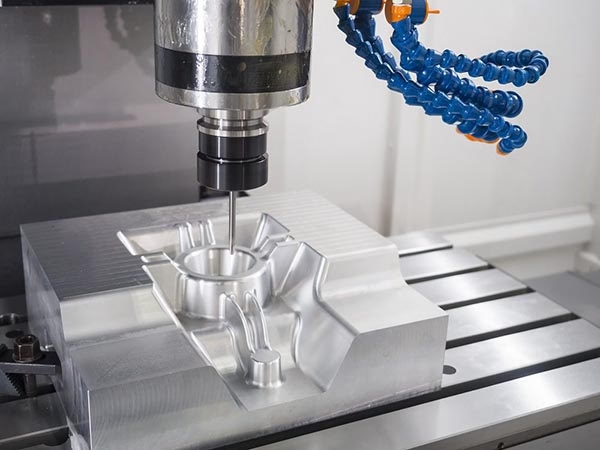
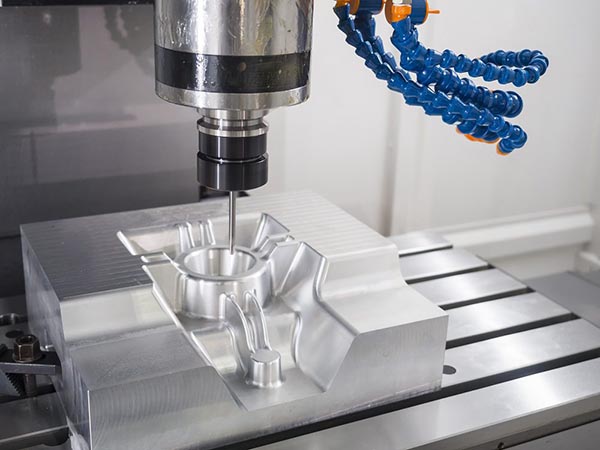
When a horn mount includes curved mounting surfaces, integrated clips, or requires tight positional tolerances for grounding pads, EV horn mounts low volume fabrication reaches its highest efficiency with 5-axis CNC. A single setup can machine all critical features with datum consistency impossible to achieve on 3-axis machines. At GreatLight, we routinely hold ±0.001″ (0.025mm) on bearing bores and mating faces, while also accommodating parts up to 4000mm in size—a range that covers anything from a small bracket to a structural horn assembly integrated into a front-end module.
Key advantages:
Exceptional surface finish directly off the machine (Ra 0.8 μm or better).
No tooling amortization; part cost scales linearly.
Wide material selection: aluminum alloys (6061-T6, 7075-T6), stainless steels (304, 316L), and engineering plastics like POM or PEEK if insulation is required.
2. CNC Turning and Mill-Turn for Lathe-Originated Designs
For rotationally symmetric horn mounts (common in circular horns mounted through a bushing), mill-turn centers combine turning with live tooling to produce slots, cross-holes, and flats in one operation. This eliminates part transfer errors and drastically reduces lead time for repeat orders.
3. Sheet Metal Fabrication: Lightweight and Cost-Effective
Bent and formed steel or aluminum mounts are popular in EVs due to weight savings. In low volumes, precision laser cutting, CNC bending, and robotic welding can deliver parts in days. The trick is to involve the fabricator early in the design stage to optimize bend radii and weld seams for fatigue life. A well-designed sheet metal horn mount can be lighter than a CNC machined one and often more cost-effective at quantities above 200 units.
4. Additive Manufacturing: Prototyping and Beyond
Selective Laser Melting (SLM) of aluminum or stainless steel allows horn mounts with internal lattices or organic shapes optimized for vibration damping. While not always price-competitive for production runs over 50 pieces, 3D printing is invaluable for first-stage fit and function tests. At GreatLight, we use SLM for your initial prototypes, then seamlessly transition to CNC when volumes justify the switch.
The Pain Points Most Engineers Face — And How to Solve Them
Based on thousands of parts produced, I’ve distilled the top frustrations that arise during EV horn mount fabrication:
| Pain Point | Root Cause | The GreatLight Approach |
|---|---|---|
| 1. “Prototype was perfect, but production parts failed vibration testing.” | Inconsistent process; prototype made on different equipment than production lot. | All parts, from sample to small batch, are manufactured on the same advanced 5-axis and CNC turning centers. ISO 9001:2015 quality system ensures repeatability. We perform in-house CMM inspection and can provide PPAP Level 3 documents upon request. |
| 2. “Corrosion ate through the mount in six months.” | Material choice not validated for the vehicle’s environment. | We consult on material selection: 316L stainless for coastal regions, anodized aluminum with subsequent sealing for moderate climates, or even E-coat over steel. Our one-stop finishing (anodizing, passivation, powder coating) removes the need for secondary vendors. |
| 3. “We needed it yesterday, but the shop quoted 6 weeks.” | Overload of shop floor, lack of dedicated low-volume capacity. | GreatLight operates three wholly-owned plants with over 127 pieces of precision equipment. We handle rush orders without delaying other customers. Typical lead time for machined horn mounts is 7-10 days, with 3-day expedite options. |
| 4. “The geometry is too complex for my local shop.” | Limited to 3-axis milling; no 5-axis or wire EDM capability. | Our Dema and Beijing Jingdiao 5-axis centers, along with wire EDM and mirror-spark EDM, tackle undercuts, deep ribs, and fine details that baffle less-equipped facilities. |
| 5. “Parts arrived with burrs and sharp edges.” | Poor de-burring and finishing discipline. | Every part undergoes manual and vibratory finishing. For mission-critical edges, we apply radius specifications directly from the print. |
Too often, we see companies choose a supplier based solely on unit price, only to incur 3x the cost in rework, shipping, and missed launch dates. The real metric is total cost of ownership, which includes scrap rate, communication overhead, and the price of re-certification.
Comparing GreatLight with Industry Alternatives
To illustrate what separates a top-tier low-volume fabricator from a commodity shop, I’ve assembled a comparison of notable brands in precision machining. GreatLight is positioned alongside trusted names to give you an objective view.
Note: The following information is based on publicly available data and my personal experience evaluating manufacturing partners for automotive-grade parts.
| Provider | Core Machining | Precision | Materials & Sizes | Certifications | Low Volume Lead Time (7-50 pcs) | Ideal For |
|---|---|---|---|---|---|---|
| GreatLight Metal | 5-axis CNC, 3/4-axis, mill-turn, sheet metal, SLM 3D printing, die casting | ±0.001mm achievable; Max part 4000mm | Al, steel, Ti, plastics, Invar; wide finishing choices | ISO 9001, IATF 16949 (auto), ISO 13485 (medical), ISO 27001 (security) | 7-10 days std, 3 days expedite | EV mounts, complex brackets, multi-process assemblies needing a single-source partner |
| Protolabs Network | CNC, 3D printing, injection molding | ±0.1mm typical (varies by process) | Plastics, metals, elastomers | ISO 9001, AS9100 (via partners) | 5-10 days for CNC | Quick prototypes where absolute precision under 0.05mm is not critical |
| Xometry | CNC, sheet metal, 3D printing | Usually ±0.005″ (0.127mm) via partner network | Wide materials | Partner-dependent | Typically 5-10 days (instant quote) | Simple brackets when tighter control not needed |
| Fictiv | CNC, 3D printing | ±0.005″ (0.127mm) standard; custom | Metals, plastics | Various (partner quality varies) | 5-7 days via streamlined digital platform | Digital-native teams valuing software integration |
| Owens Industries | 5-axis CNC, EDM, grinding | ±0.0002″ (0.005mm) possible | Medical-grade materials, exotic alloys | ISO 13485, AS9100 | 2-4 weeks (often longer due to complex processes) | Ultra-high precision medical/aero parts, but less suited for higher-volume mounts |
| JLCCNC (by PCBWay) | CNC, 3D printing | ±0.1mm standard | Metals, plastics | ISO 9001 (factory) | 7-12 days | Low-cost, low-complexity mounts with tolerance >0.1mm |
From this table, you can see that while many providers offer CNC machining, few combine the breadth of technologies, IATF 16949 alignment (critical for automotive electronics), and internal one-stop finishing that a truly integrated partner provides. For EV horn mounts, where vibration resistance, corrosion protection, and electrical continuity must be proven, the ability to machine, passivate, anodize, and inspect all under one roof is not just convenient—it’s a risk mitigation strategy.
A Practical Example: Transitioning from Prototype to EV Production
A while back, an EV specialty converter approached us with a horn mount designed to attach to a carbon fiber front crash beam. The mount was contoured on both sides, with integrated wire management clips and a grounding stud. Their initial local supplier tried milling it in two setups on a 3-axis machine, resulting in a visible mismatch line, poor vibration performance, and grounding continuity failures at high frequencies.
We rebuilt the CAD for 5-axis simultaneous machining, using Al 6061-T6 with chromate conversion coating for corrosion resistance. The 5-axis path eliminated blend lines, improved the clip geometry, and reduced machining steps from 12 to 4. The first article passed vibration testing per SAE J1455 and full-thread torque-to-failure of the grounding insert. We then produced the first 200 units in under two weeks, with full dimensional reports. The client incorporated our DFM feedback into the final design, leading to a 15% weight reduction and even better acoustic isolation.
That’s the power of having one capable partner for prototyping, refinement, and low-volume production.
The Certifications That Matter for Automotive Components
Many buyers overlook this, but when a horn mount is part of a functional safety system (e.g., pedestrian warning), the supply chain is expected to meet automotive quality management standards. GreatLight Metal holds not only ISO 9001:2015 but also IATF 16949 — the global standard for automotive production parts. This means our processes include advanced product quality planning (APQP), production part approval process (PPAP), and failure mode effects analysis (FMEA) disciplines that typical job shops ignore.
For startups unfamiliar with these terms, it translates to: fewer early-life failures, better traceability, and a smoother path when you eventually scale to full-rate production at a tier-1 supplier.
How to Prepare Your Design for Success
Before you request a quote, a few best practices will save iterations and cost:
Define Datums Clearly – Use functional datums (e.g., mounting points, not arbitrary edges) so the machining fixture replicates the in-vehicle constraints.
Specify Proper Surface Finish – “Anodize black” without a callout for Type II or Type III and sealing method invites ambiguity. Include the spec (MIL-A-8625F) if known.
Consider Relief Radii – Sharp internal corners cause stress concentration. Program in a radius, even if tiny; your machinist will thank you.
Communicate the Application Environment – Tell your partner it’s an under-hood EV part subject to salt spray, not just “mount.” This triggers appropriate finishing and material recommendations.
Request Material and Process Certifications Upfront – For prototypes, you may not need them, but for pilot builds, having certs early prevents last-minute chaos.
Conclusion: A Smart Investment in EV Horn Mounts Low Volume Fabrication
EV development timelines are compressing. The companies that win are those that treat every bracket and mount with the same engineering rigor as their core powertrain. Finding a fabrication partner that can handle complex geometry, offer true automotive-grade precision, and consolidate post-processing services is not just an operational advantage—it’s a strategic necessity. Whether you’re prototyping the next-gen electric delivery van or launching a limited-run performance EV model, the quality, vibration resilience, and durability of your horn mounts directly impact brand perception and safety compliance.
The key takeaway: low volume does not mean low quality. With the right partner, a 100-piece run of machined aluminum horn mounts can outperform a 10,000-piece stamped batch from a factory that doesn’t understand the rigor needed for EVs. That’s why, after more than a decade of solving precision manufacturing challenges, I can confidently recommend that you invest in a partnership where innovation meets repeatability. And that is exactly the standard GreatLight Metal upholds with every single part we ship. For more insights into how we approach each project and the real-world results we deliver, connect with GreatLight on EV horn mounts low volume fabrication and see how our processes translate into your success.



















