
CNC engine block tips for stable bore and deck work
A practical walkthrough for shops and engine builders who machine cast iron or aluminum blocks. We cover fixture strategy, datums, cutting parameters, in-process checks and the mistakes that scrap a block before the finish pass.
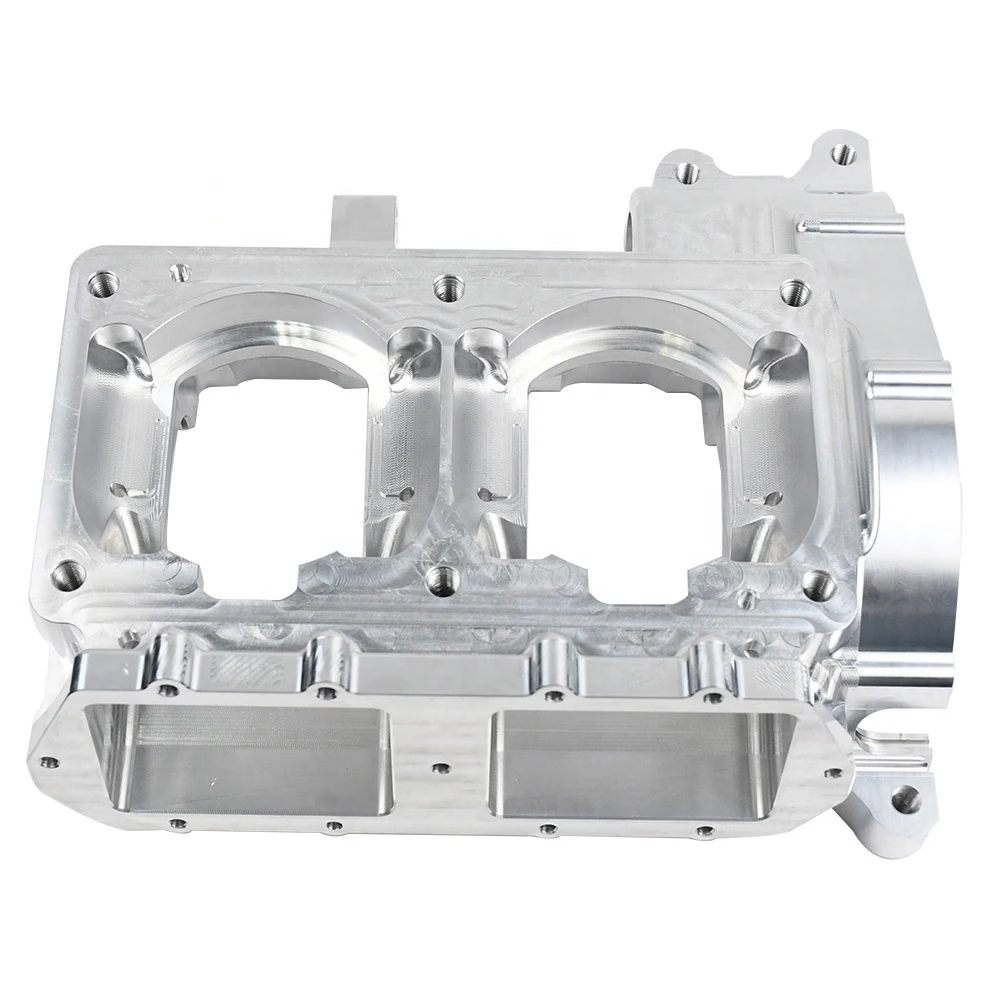
Key takeaways
Start with the fixture, not the tool path
Most scrapped blocks are lost before the first cut. A cast block has rough, uneven surfaces, and clamping it on two or three pads lets it rock under load. That movement shows up later as a tapered bore or a deck that is 0.03 mm out of flat.
Clean the pan rail and the main saddles first. Then set the block on three adjustable supports under the pan rail, with two side pushers at the bellhousing flange. Torque the pushers to a light, repeatable value, usually 8–12 N·m on a 12 mm bolt. Mark the bolt heads so you can see if anything slips.
For a five-axis setup, tilt the block so the deck faces the spindle within 30° of vertical. This shortens the tool overhang and lets you use a 50 mm face mill instead of a long, flexible cutter. Short tools deflect less, so the deck comes out flatter.
Check the top of the block with a dial indicator on the spindle nose after clamping. If you see more than 0.01 mm of movement when you lean on the block by hand, re-shim the supports. Do not start cutting and hope the finish pass cleans it up.
- 1Three-point supportNever four pads; one will always be high.
- 2Light, repeatable torque8–12 N·m on the side pushers.
- 3Short tool overhangTilt the block instead of extending the holder.
Pick one datum and keep every feature on it
The deck, the main bores and the cam tunnel all have to line up. If the deck is cut from one setup and the mains from another, any fixture error stacks up across the block. Use the main saddle faces as the primary datum, and reference the deck and cam tunnel back to that one surface.
Machine the block in two stages. In the first stage, rough the deck, the bores and the cam tunnel with 0.3–0.5 mm of radial stock left on every critical surface. Then release the clamps, let the casting relax for at least 12 hours, and re-clamp. A raw casting moves when you remove the skin.
For a high-performance build, a stress-relief cycle between roughing and finishing reduces movement further. Cast iron responds well to this. Aluminum blocks, especially 319 and 356, move less but still benefit from a rest period before finishing.
The finish stage should be split again. Cut the deck, then the main bores, then the cam tunnel, checking each one before you move on. If the deck is out, you can still recover the block. If you cut everything and then measure, the block is scrap.
- 1Deck first in finishingIt is the easiest surface to re-cut.
- 212-hour relaxRelease clamps between roughing and finishing.
- 3One datum for allMains, deck and cam tunnel share a reference.
Speeds, feeds and tool life on cast iron and aluminum
Gray cast iron cuts as short, powdery chips. Use a coated carbide insert with a strong edge, around 180–250 m/min surface speed, 0.15–0.25 mm per tooth and a 0.8–1.5 mm depth of cut for face milling. Too light a feed rubs the edge and dulls it in minutes.
Nodular iron is tougher. Drop the surface speed to 120–180 m/min and keep the depth of cut consistent. If the insert starts to chirp, the setup is loose, not the grade. Check the supports before you change the tool.
Aluminum blocks like 319 and 356 are gummy. Run 400–800 m/min with a sharp, polished flute and 0.1–0.2 mm per tooth. Use a high-positive rake and plenty of coolant to clear chips. A built-up edge on the flute will drag a smear across the deck.
Boring is where the tolerance lives. For a main bore or a cylinder bore, use a boring head with a fine-adjust screw, and take a 0.1 mm semi-finish pass before the final 0.05 mm cut. Measure the bore with an inside micrometer or a bore gauge at three heights and two axes. A hole that is round at the top and oval at the bottom usually means the clamping load is too high.
- 1Gray iron180–250 m/min, 0.15–0.25 mm/tooth.
- 2Nodular iron120–180 m/min, rigid setup.
- 3Aluminum400–800 m/min, polished flutes.
Step-by-step engine block machining sequence
Follow this order for a cast iron or aluminum block.
- 11. Inspect and clean the castingCheck for sand, core wire and flash. Measure wall thickness around the water jackets if you have an ultrasonic gauge. A thin wall will break through when you bore, so find it before you cut.
- 22. Set the block on three supportsSupport under the pan rail, push at the bellhousing flange with 8–12 N·m. Indicate the main saddles and shim until they read within 0.02 mm of each other.
- 33. Rough the deckFace the deck with a 50–80 mm face mill and leave 0.5 mm of stock. Keep the cutter engaged with a 70–80% stepover so the load stays steady.
- 44. Rough the bores and cam tunnelLeave 0.3–0.5 mm radial stock. Use a boring head, not an end mill, for cylinder bores. Spot every hole before drilling to stop the drill from walking.
- 55. Release and relaxUnclamp, let the casting sit for at least 12 hours, then re-clamp and re-indicate the saddles. Expect the deck to move 0.02–0.05 mm on a raw casting.
- 66. Finish the deckTake a 0.2 mm pass and a 0.1 mm spring pass. For a head gasket surface, aim for Ra 0.8–1.6 μm. A mirror finish will not hold a gasket as well as a controlled, slightly rough surface.
- 77. Finish the boresSemi-finish with 0.1 mm stock, then take the final 0.05 mm cut. Hold ±0.005 mm on diameter and check roundness at three heights with a bore gauge.
- 88. Measure and recordLog deck flatness, bore diameter, cam tunnel centerline and main bore alignment. Unclamp, measure again, and if the numbers shift, the clamping load is the cause, not the cutter.
Five-axis machining or three-axis with more setups
Both can produce a good block. The right choice depends on geometry and volume.
| Factor | Five-axis | Three-axis, multiple setups |
|---|---|---|
| Setup count | One or two | Three to five |
| Best for | Angled head bolt holes, lifter bores | Decks, pan rails, simple bores |
| Stack-up error | Low, one datum | Higher, each setup adds error |
| Tool length | Short and rigid | Often long and flexible |
| Cycle time | Faster on complex blocks | Faster on flat, simple work |
| Volume fit | Prototypes and small runs | Steady, high-volume runs |
| Fixturing cost | Higher, one fixture does more | Lower per fixture, more of them |
Fixture and datum first, everything else after
If the block moves between setups, no tool path or insert grade will save the tolerance. Share one datum, leave stock for a stress-relief rest and measure before you unclamp.
Questions engineers ask before cutting a block
How much stock should I leave on cylinder bores?
Leave 0.3–0.5 mm of radial stock after rough boring, then semi-finish with 0.1 mm before the final 0.05 mm cut. This lets the casting relax without making the bore undersize.
If the block is a raw casting, add a stress-relief rest of at least 12 hours between roughing and finishing. Without it, the bore can close by 0.02 mm after you unclamp.
Can you machine a bare block that a customer supplies?
Yes. We machine customer-supplied blocks as well as new castings, and we handle decking, align boring, cylinder boring and lifter bore bushing and reaming.
Send the block with a print or a target spec. We measure the block before quoting so the stock condition is clear. Uploads stay confidential and an NDA is available on request.
Why does my deck finish look smeared on an aluminum block?
A smeared deck is usually built-up edge on the insert. Aluminum 319 and 356 are gummy, so the chip welds to the flute and drags across the surface.
Raise the surface speed to 400–800 m/min, use a polished high-positive insert and flood the cut with coolant. Check the insert after every pass on a rough casting.
What tolerance can I expect on main bores?
We hold ±0.005 mm on bore diameter and check roundness at three heights and two axes. Alignment along the main bore centerline matters as much as the diameter.
Measure before you unclamp. If the numbers move after the clamps come off, the clamping load was too high, and the fix is in the fixture, not the boring head.
Does five-axis machining remove the need for a line boring bar?
Not always. Five-axis gets you one-setup access to angled holes and contoured features, which cuts setup error. But a long main bore line still needs a bar or a boring head with enough reach.
The practical gain is fewer setups, so less stack-up error. On a complex block, that can be the difference between holding the tolerance and chasing it.
How do I stop a thin cylinder wall from breaking through?
Measure wall thickness before you cut, with an ultrasonic gauge if you can reach the jacket. If a wall is thin, bore it in smaller steps and watch for a change in sound.
A dull tool pushes rather than cuts, and that push is what cracks a thin wall. Change inserts on schedule, not when the finish turns bad.
Send us your block print or a sample casting
Quotation and free DFM analysis within 12 hours, with production able to start in 24 hours.
12-hour quote±0.005 mm toleranceNo minimum order
More machining notes from GreatLight
We publish setup notes, tooling trials and inspection data from the factory floor.











