
CNC 3D Processing Explained
This page explains what five-axis subtraction actually does to a metal blank: which axes move, how the tool reaches contoured and undercut geometry, and when three-axis is still the cheaper answer. Written for design engineers and sourcing engineers judging a part before quoting.
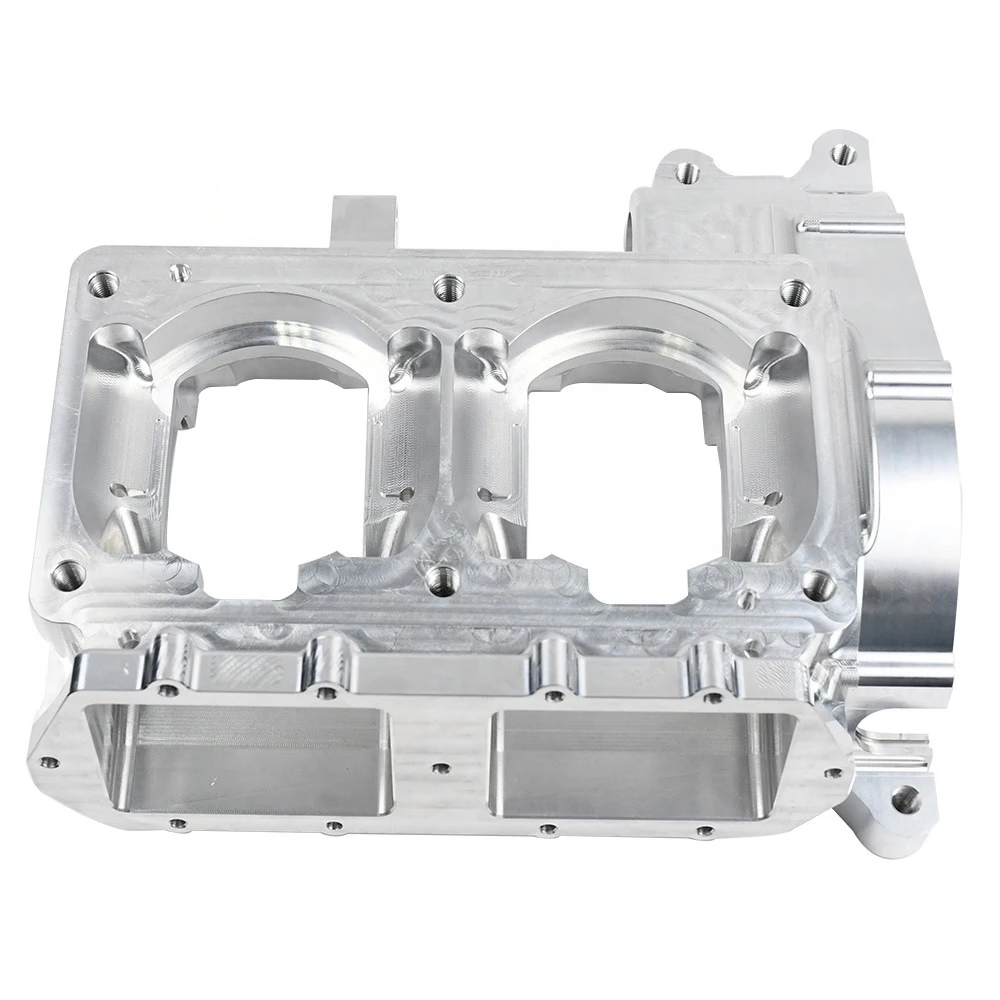
What this guide covers
Subtractive 3D geometry, not additive. The cutter path defines the shape.
Subtractive removal, not additive building
Here the term means removing material from a solid blank until the remaining stock matches a three-dimensional CAD model. The blank can be a plate, a bar, a forging, or a casting. Material leaves as chips. Nothing is built up layer by layer, so the finished part has no layer lines and no direction-dependent strength the way an additively built part does.
"3D" describes the geometry, not the machine. A part is three-dimensional when its surface curves in more than one plane at once: an impeller blade, a lens housing with a spherical seat, a manifold port with a blended radius. A rectangular bracket with a flat face is not. That distinction decides almost everything downstream, from fixture design to the number of setups.
The cutting tool is the limit, not the software. A ball nose end mill with a 1 mm radius cannot clean out an internal corner sharper than 1 mm. CAM software will happily generate a path that the tool physically cannot follow. So when a drawing shows a sharp internal corner, someone has to decide whether to open the radius or add a small electrode. That call belongs in DFM, before the first chip.
Why the fourth and fifth axes matter
A three-axis machine moves the tool in X, Y, and Z. The worktable stays put. To cut a pocket on the side of a part, the operator has to stop, unclamp, rotate the part, re-clamp, and re-zero. Each of those steps costs time and each one adds a small error. On a part with six angled faces, that is six setups and six chances to drift out of position.
A five-axis machine adds two rotary motions. In our shop the common configuration is A and C: the table tilts and the work rotates under the spindle. The tool stays normal to the cut surface as it sweeps. This is what lets a single setup reach the floor of a deep pocket, the side wall, and the undercut beneath an overhanging flange without ever releasing the part.
On a 16 five-axis center floor, the practical gain shows up as fewer fixtures and tighter position between features. A hole pattern on a tilted face and a datum bore on the base are cut in the same setup, so their relative position is set by the machine, not by how well someone re-indicated the part. For parts with a true position callout under ±0.05 mm, that is usually the deciding factor.
Rotary tables here run to Ø400 mm, and we hold ±0.005 mm on critical features. Those numbers are not universal. Thin-walled parts deflect, deep cavities chatter, and a table that is too small for the swing will not clear the part. The geometry decides whether five-axis helps or just adds cost.
When five-axis is the right call, and when it is not
Reach is the first test. If the part has features on four or more faces, or any feature that faces away from the spindle at every orientation of a three-axis table, five-axis is likely cheaper once you count fixtures and setups. A part that needs a compound-angle hole is a clear case. So is anything with a swept or contoured surface that must blend smoothly into a flat.
Volume is the second test. For one prototype of a complex housing, five-axis avoids building three fixtures. For 10,000 simple bushings, it does not. A part that is mostly prismatic, cut from one direction, with generous radii and no undercuts, will run faster and cheaper on a three-axis mill. We keep 27 three-axis machines for exactly that work.
Surface finish matters in the third test. A five-axis tool sweeping normal to a contoured surface leaves shorter scallops than a three-axis tool dragging the flank of the cutter across it, so you reach Ra 0.8–1.6 μm with less hand polishing. If the drawing calls for Ra 0.2–0.8 μm, plan on a finishing pass or a polishing step regardless of axis count.
Size is the last check. Our largest travel is 4,000 × 400 × 150 mm on the long-bed machines, and the five-axis envelopes cover 750 × 1,150 × 550 mm, 600 × 600 × 600 mm, 500 × 500 × 450 mm, and 500 × 310 × 200 mm. A part that exceeds the swing of the rotary table cannot be five-axis machined in one setup, no matter how the CAD looks.
Three-axis vs. four-axis vs. five-axis
Match the machine to the geometry, not to the brochure.
| Part feature | Best fit | Why |
|---|---|---|
| Flat plate, holes from one side | 3-axis | No re-orientation needed |
| Long shaft with cross holes | 4-axis | Rotary index, one setup |
| Compound-angle hole | 5-axis | Tool reaches without re-fixturing |
| Undercut below a flange | 5-axis | Table tilts, tool clears |
| Deep cavity, 5 faces | 5-axis | One setup, tight position |
| Prismatic bracket, 10,000 pcs | 3-axis | Fast cycle, low fixture cost |
What the tool and the material do to each other
Aluminum is the easiest case. Grades like 6061, 7075, and 6082 cut fast, hold a good finish, and let you run light finishing passes without loading the cutter. A contoured aluminum housing with thin ribs is a natural five-axis job because one setup keeps the ribs aligned to the bores.
Titanium and Inconel swing the other way. TC4 (Ti-6Al-4V) and Inconel generate heat at the cut edge and work-harden if the feed is too light. Five-axis helps because the tool stays in contact at a constant angle, which spreads the heat instead of concentrating it in one corner. It does not make these alloys fast. It makes them predictable.
Stainless grades behave between the two. 17-4PH and 316L cut cleanly at moderate speeds but tend to move after roughing, so we leave stock and take a stress-relief step before finishing when the tolerance is tight. Plastics and carbon fibre need sharp tools and good extraction, and they rarely need the fifth axis unless the geometry is genuinely compound.
We run these materials across 127 machines, including 16 mill-turn centers and 12 four-axis mills. The point of the mix is that not every job should land on a five-axis machine. Putting a simple part on the wrong machine costs money and adds nothing.
From CAD file to inspected part
Quoting starts with the model. Send a STEP or native CAD file and a 2D drawing with the tolerance callouts, and we return a quotation plus a DFM analysis within 12 hours. The DFM note flags thin walls, sharp internal corners, tolerances that the geometry cannot hold, and features that would be cheaper as a separate part.
Once the drawing is agreed, production can start within 24 hours. Setup sheets list the workholding, the datum scheme, and the tool list. For a five-axis part, the CAM programmer picks the tool orientation for each region and checks the remaining stock between passes, because a collision in simulation is cheaper than one on the table.
Inspection is 100% before shipment: raw material check, in-process monitoring, and final inspection, with reports on request. For a first article we measure the features that carry the function, not just the easy outside faces. CMM reports are available when the drawing calls for them.
Parts ship in 3–5 days for typical runs. There is no minimum order quantity, so a single prototype and a 10,000-part run go through the same process. Uploads are secure and confidential, and we sign an NDA on request before drawings move.
Frequently asked questions
Is CNC 3D processing the same as 3D printing?
No. Printing adds material layer by layer. CNC 3D processing removes material from a solid blank with a rotating cutter, so the result is fully dense and has no layer adhesion to worry about.
That also means the cutter has to physically reach every surface. A shape that prints fine can be unmachinable if the tool cannot get to it.
Which file formats do you need for a quote?
Send a STEP or IGES model plus a 2D PDF with tolerances, material, finish, and quantity. Native CAD files work too.
If the drawing is incomplete, we note the missing callouts in the DFM analysis rather than guessing.
What tolerance can five-axis hold on a contoured surface?
We hold ±0.005 mm on critical features, though a swept surface is usually governed by the profile tolerance rather than a single dimension.
Thin walls and long slender features will move no matter how the machine is set up. The DFM note will say so before cutting starts.
When should I keep a part on three-axis?
When all the features face one direction and the part is mostly prismatic. Fewer setups, faster cycle, lower fixture cost.
Moving that kind of part to five-axis adds programming time and does not improve the result.
Can you machine a part that is too large for the rotary table?
Yes, but not in one five-axis setup. We split the operations across machines and re-datum between them, which adds a little positional uncertainty.
The largest travel here is 4,000 × 400 × 150 mm, so tell us the overall envelope early and we can plan the setups.
How do you handle confidential designs?
Uploads are secure and confidential. We sign an NDA on request before drawings are shared, and access stays limited to the people quoting and machining the part.
We do not publish customer names, drawings, or part photos without written permission.
Send the model, get a DFM note back
Upload your CAD file and drawing. You get a quotation and a free DFM analysis within 12 hours, with a clear answer on whether the part belongs on a five-axis machine.
12-hour quote100% inspectionNo MOQ









