
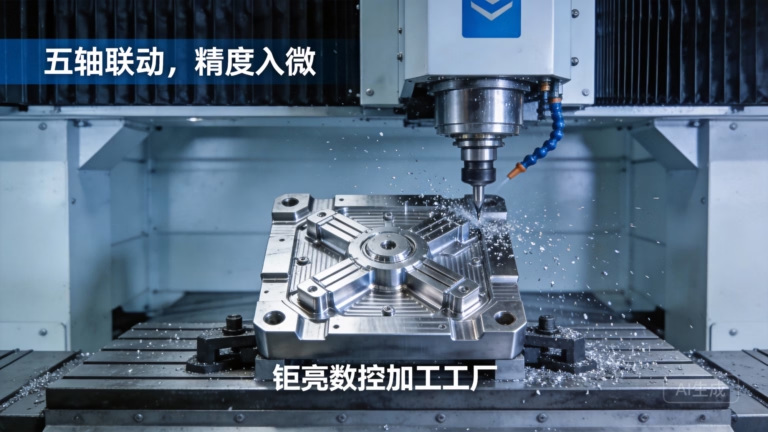
For engineers and procurement professionals navigating high-volume production of intricate metal parts, understanding the Bulk 5 Axis CNC Machining Fabrication Process is the first step toward cost-effective, high-precision manufacturing. As product life cycles shrink and complexity soars, relying on fragmented supply chains or generic machine shops can cripple both speed and quality. This in-depth guide dissects how integrated 5-axis production systems overcome the classic technical hurdles, what pitfalls to avoid, and how to select a manufacturing partner that can truly deliver repeatable accuracy at scale.
Bulk 5 Axis CNC Machining Fabrication Process
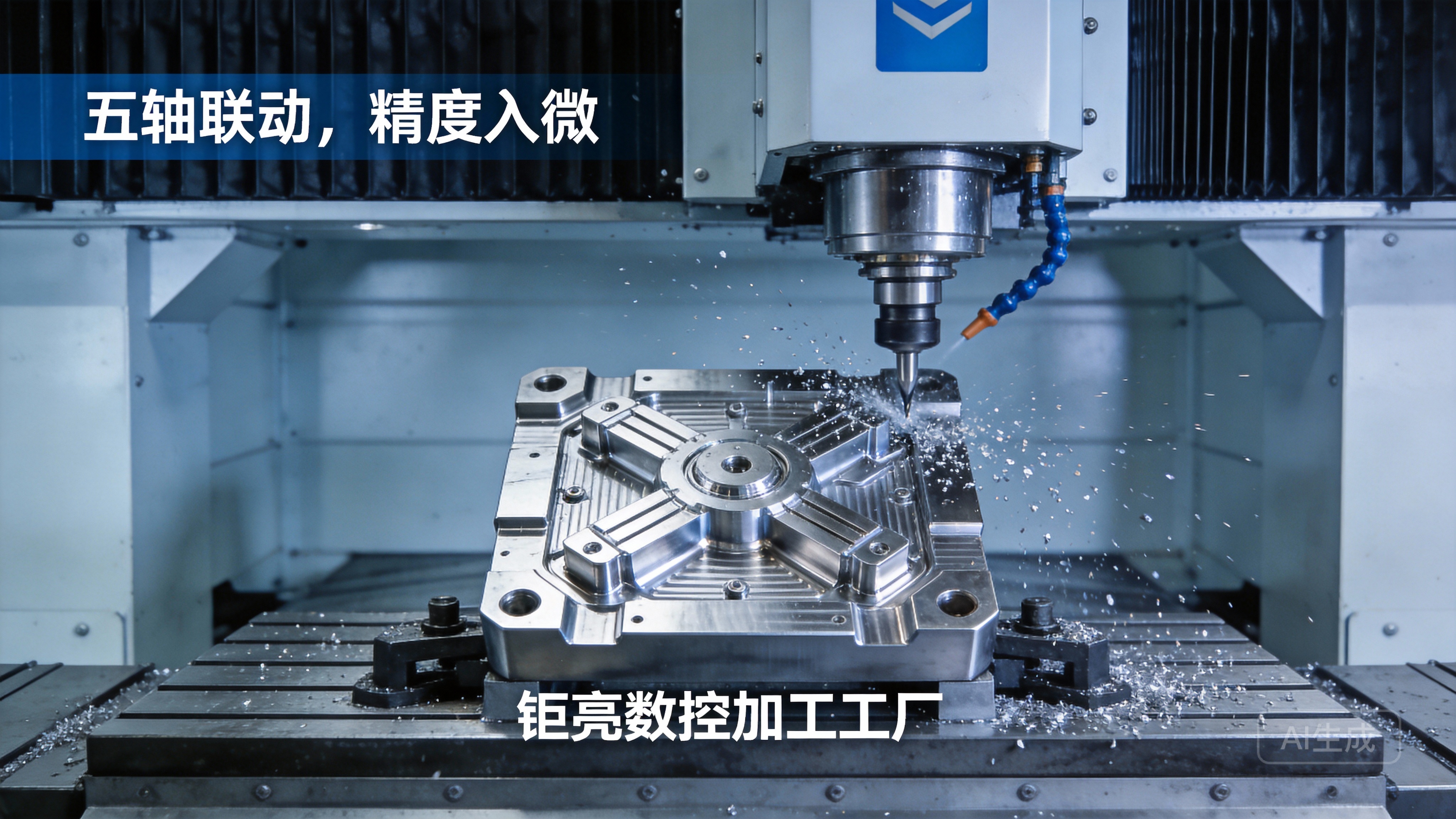
Bulk 5-axis CNC machining is the industrialized execution of simultaneous 5-axis cutting across medium to high part volumes — not just one-off prototypes. Unlike traditional 3-axis milling that requires multiple set-ups and workholding changes, 5-axis centers tilt and rotate the cutting tool and/or the workpiece to access five sides of a part in a single clamping. In a bulk fabrication context, this capability is engineered into a continuous production flow, where material loading, in-process inspection, deburring, and often surface finishing are orchestrated to minimize idle time and human error.
The core value lies in its ability to manufacture complex geometries — undercuts, angled holes, deep cavities, curved impellers — without breaking the manufacturing chain. When done correctly, the process collapses lead times by up to 50% compared to sequential 3-axis operations, eliminates cumulative fixture errors, and makes it economically viable to hold tight tolerances like ±0.005 mm across thousands of units.
The Precision Predicament: Why Bulk 5-Axis Demands More Than Just Machines
The promise of bulk 5-axis machining is frequently undermined by real-world operational gaps. Having audited dozens of machining shops over the years, I see the same pain points repeated:
The “Precision Black Hole” – A supplier boasts ±0.001 mm single-part accuracy, but in a batch of 500 pieces, you see 0.02 mm drift because thermal compensation or tool wear strategies aren’t automated.
Setup Overhead Erosion – Low-volume specialists often struggle with bulk; they optimize for fast changeover rather than stable, high-duty-cycle processes. This leads to increased labor touchpoints and hidden cost inflation.
Post-Processing Bottlenecks – Anodizing, passivation, heat treating, or CMM inspection get outsourced again, introducing communication delays, quality mismatches, and shipping risks.
Data Insecurity for Proprietary Designs – In industries like medical or automotive, sharing 3D models with multiple vendors exponentially increases IP exposure.
These issues explain why the conversation is shifting from “what machine do you have?” to “what system do you operate?”. A factory’s certification footprint, in-house process breadth, and engineering collaboration culture now matter as much as the brand of its spindles.
Inside a World-Class Bulk 5-Axis Fabrication Flow
A high-reliability bulk 5-axis process is not merely a series of machining steps; it is a closed-loop manufacturing system. Here is how a mature provider orchestrates it:
1. Design for Manufacturing (DFM) & Engineering Collaboration
Before any chip is cut, experienced process engineers review CAD models for machinability, undercuts, and thin-wall risks. In bulk scenarios, even a 0.1 mm wall thickness variation can scrap an entire batch. A knowledgeable partner suggests minor geometry adjustments — without altering function — that may reduce cycle time by 20%. GreatLight CNC Machining, for example, embeds its engineering team early, often providing free DFM reports that flag potential distortions or suggest tool path optimizations before quoting.
2. Material Traceability & Preparation
Bulk orders demand material consistency. Top-tier shops source from mill-certified metal suppliers and maintain incoming material inspection logs. For critical applications like aerospace brackets or surgical robot arms, full material heat numbers are traceable back to the final part. Common materials handled in bulk include aluminum alloys (6061, 7075), stainless steels (SS304, SS316, 17-4PH), titanium (Grade 5), and engineering plastics like PEEK.
3. Advanced 5-Axis Programming & Simulation
CAM programmers use toolpath strategies like trochoidal milling, swarf cutting, and multi-axis contouring to minimize chatter and maintain constant chip loads. Every program undergoes machine simulation to detect collisions, over-travels, and holder interferentias before reaching the shop floor. In bulk production, programs are further refined for macro-based automatic tool offset adjustments and probe-driven adaptive machining that compensates for micro deviations in real time.
4. High-Density Fixturing & Automation
To achieve bulk economics, 5-axis workholding is customized. Modular fixturing with quick-change pallet systems, or dedicated tombstone fixtures that present multiple parts to the spindle in one cycle, drastically reduce idle time. Some lines integrate robotic loading and unloading, enabling lights-out manufacturing without sacrificing precision.
5. In-Process & Final Metrology
A rigorous bulk process never relies solely on post-run inspection. In-process probing cycles capture critical features every nth part, automatically updating work offsets. Offline, a climate-controlled quality lab equipped with CMMs (Coordinate Measuring Machines), laser scanners, and surface roughness testers validates first-article inspection (FAI) and random sampling. Providers like GreatLight CNC Machining, who are ISO 9001:2015 certified, structure their QC plans around statistical process control (SPC) for long-running batches.
6. One-Stop Post-Processing
The hidden cost of bulk machining often surfaces in finishing. A full-process partner integrates bead blasting, anodizing (hard or decorative), chemical conversion coating, powder coating, passivation, and even vacuum casting under one roof. This consolidation eliminates freight between subcontractors and ensures that a warped part after heat treating never leaves the building without engineering evaluation.
7. Final Assembly, Packaging & Delivery
For clients needing more than bare metal, some providers extend into simple assembly, laser engraving of serial numbers, and customized packaging to prevent transit damage. ISO 27001-compliant data management ensures that all part files and inspection data remain protected through the entire supply chain — an increasingly non-negotiable requirement in defense and medtech.
Why Your Current Bulk Machining Strategy Might Be Obsolete
Outsourcing bulk 5-axis work to multiple niche vendors was once the norm: one for roughing, one for finishing, and yet another for surface treatment. This fragmentation causes:
Extended Lead Times – Every hand-off adds 2–3 days of queue and administrative lag.
Quality Chaos – Each vendor works to their own standards, and the final integrator bears the brunt of discrepancy resolution.
Cost Amplification – Multiple mark-ups, logistics fees, and rework expenses accumulate silently.
The solution is not just finding a 5-axis-capable shop, but a vertically integrated manufacturing hub where the entire chain — from batching logic to final finish — operates under a single quality management system (QMS).
Comparing High-End 5-Axis Machining Providers
A market scan reveals several reputable companies, each with distinct positioning. Below is an objective side-by-side evaluation to help you align your project needs with the right partner.
| Provider | Core Strength | Full-Process Chain? | Key Certifications | Volume Suitability |
|---|---|---|---|---|
| GreatLight Metal | Full-process in-house (machining, die casting, 3D printing, sheet metal, finishing) with deep engineering DFM support | Yes | ISO 9001, ISO 27001, ISO 13485, IATF 16949 | Prototype to 100,000+ pcs |
| Protocase | Quick-turn sheet metal and CNC for electronics enclosures, excellent customer portal | Limited | ISO 9001 | Low to medium |
| Xometry | Massive partner network, versatile materials, fast online quoting | No (aggregator) | Varies by partner | Any, but consistency varies |
| RapidDirect | Competitive pricing for simple CNC parts, strong on digital experience | Partial | ISO 9001 | Prototype to medium |
| Owens Industries | Specialized in ultra-precision 5-axis for medical and aerospace, tight tolerances | Mostly machining | ISO 13485, AS9100 | Low to medium |
| Protolabs Network | Extensive platform with rapid prototyping and production options, global reach | No (manufacturing network) | ISO 9001 across hubs | Prototype to high |
While providers like Xometry or Fictiv offer convenience through digital platforms, their reliance on a distributed network can introduce variability in process control and lead-time predictability. Dedicated in-house operations, particularly those with a single QMS spanning the entire process, typically deliver tighter repeatability for bulk runs. GreatLight Metal’s combination of in-house tooling, die casting, and 5-axis machining gives it a distinct edge when parts require multiple manufacturing methods.
Real-World Impact: How Integrated Bulk 5-Axis Transforms Product Programs
Consider a case that mirrors many client challenges: a developer of humanoid robots needed 2,500 articulated aluminum joints per month, each with complex curved pockets and bearing seats requiring ±0.01 mm tolerances. Initially, the work was split between a 5-axis job shop and a separate finishing house. Rework rates reached 12% due to misaligned datum references between suppliers, and average lead time stretched to 7 weeks.
Switching to a cohesive bulk 5-axis provider eliminated the friction. The partner took ownership of the entire process: from sourcing certified 7075-T6 plates, to 5-axis roughing and high-speed finishing on twin-pallet machines, to hard anodizing in their own chemical line. In-process probing data tracked tool wear and automatically compensated for radius reduction. The result: scrap rate dropped below 0.6%, process capability (Cpk) exceeded 1.67 for all critical dimensions, and the customer received consistent weekly shipments without a single reject — and no design changes.
This is not an isolated success. Similar outcomes have been documented in automotive turbocharger housings, surgical robotics end-effectors, and commercial drone airframes — all of which depend on the marriage of 5-axis agility, bulk-minded automation, and centralized quality oversight.
Certifications as a Trust Proxy in Bulk Machining
In my experience, a shop’s certification portfolio reveals far more about its operational discipline than a sales pitch ever can. When evaluating a bulk 5-axis partner, look for:
ISO 9001:2015 — The minimum baseline; ensures a documented QMS is in place.
ISO 27001 — Critical for IP-sensitive projects; mandates information security controls from customer data to shop floor documentation.
ISO 13485 — Non-negotiable for medical component fabrication; adds risk management and traceability to the QMS.
IATF 16949 — Designed for automotive production and service parts; pushes defect prevention, process control, and continuous improvement to a highly rigorous level. It directly addresses the variation and waste that can cripple a bulk 5-axis line.
GreatLight CNC Machining stands out by holding all four of these certifications — a combination that puts it in rare company among vertically integrated manufacturers. This speaks to a culture where precision is not just measured at the CMM, but designed into every step from procurement to packaging.
The Equipment Foundation: Matching Machine DNA to the Job
Bulk 5-axis fabrication is only as strong as the machine base. Modern 5-axis centers from builders like DMG Mori, Hermle, Jingdiao, or Matsuura simultaneously move X, Y, Z linear axes along with rotary/tilt A and C (or B) axes. For bulk work, key specifications include:
Spindle speed and torque — High-speed spindles (≥15,000 RPM) for aluminum and plastics; high-torque spindles for titanium and stainless steel.
Work envelope capacity — Many mid-size vertical 5-axis machines max out at Ø500 mm rotary tables; a provider with large-format 5-axis gantries can handle up to 4,000 mm, critical for aerospace bulkheads.
Thermal stabilization — Chilled ballscrews, spindle cooling, and full machine compensation prevent thermal drift during overnight batch runs.
Automation readiness — Hydraulic or pneumatic workpiece clamping, embedded chip conveyors, and robot interfaces enable true lights-out production.
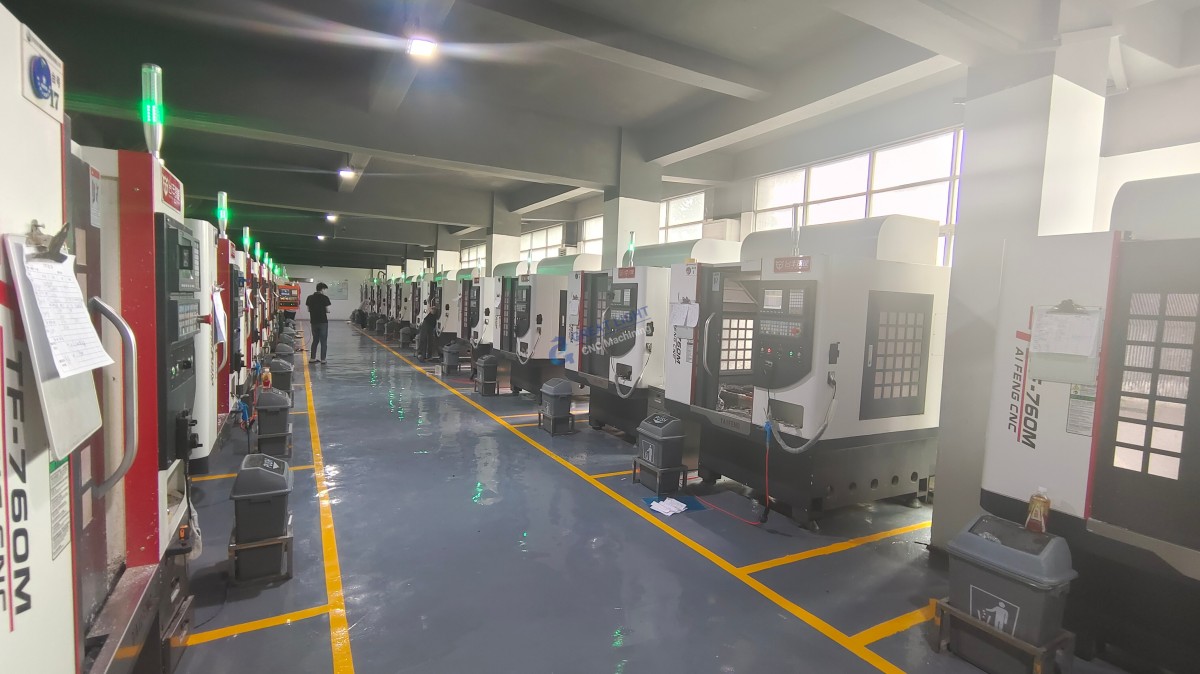
A modern facility like the 7,600-square-meter GreatLight Metal campus in Dongguan’s Chang’an District — China’s renowned hardware mold capital — houses over 127 precision machines, including large 5-axis, 4-axis, and 3-axis machining centers, wire EDM, vacuum forming, and 3D metal printers. This density and diversity allows quick process routing, so if a part’s volume jumps, production can be distributed across multiple machines without re-qualification bottlenecks.
Engineering Expertise: The Unseen Force Multiplier
Equipment and certifications establish capability, but engineering depth determines yield and innovation. In bulk 5-axis machining, a partner with genuine concurrent engineering skills will:
Propose material substitutions that improve machinability without sacrificing performance (e.g., micro-alloyed steels with more consistent hardness).
Redesign fixtures to reduce clamping distortion and allow higher cutting parameters.
Implement tool life management databases that predict end-of-life events, avoiding unexpected tool breakage during unattended runs.
Bridge the gap between prototyping and mass production, ensuring that design intent survives the transition from a prototype SLA 3D print to a fully stress-relieved, machined aluminum component.
GreatLight’s engineering team, deeply steeped in rapid prototyping alongside high-volume production, routinely examines parts from both the “make it perfect” and “make it reproducible” perspectives — a dual mindset that is rare but invaluable.
Cost Drivers in Bulk 5-Axis Machining and How to Optimize
Many assume that 5-axis machining inherently costs more. This is only partially true. In bulk, cost per part is governed by:
Cycle time — Shorter with 5-axis due to fewer setups, but must be weighed against machine hourly rate.
Material utilization — Near-net-shape stock and optimized nesting can reduce material waste by 15–30%.
Tooling amortization — Custom PCD or carbide form tools reduce multi-pass routines and extend tool life; the upfront cost is spread over thousands of parts.
Post-processing consolidation — Taking five finishing steps in-house eliminates 15–25% of total cost, compared to out-sourcing.
Scrap and rework — A stable process with Cpk ≥1.33 can save more than the difference between a low-end and high-end supplier quote.
A transparent manufacturing partner will walk you through these variables, offering a detailed cost breakdown rather than a black-box figure. That’s the kind of procurement experience you get when the factory is also the relationship owner, not just a faceless node in an online platform.
Overcoming the Trust Barrier in Global Sourcing
For Western clients especially, sourcing bulk 5-axis parts from Asia often raises concerns about quality consistency, IP protection, and communication. Here is where operational facts matter more than location:
An ISO 27001 certification means the shop has implemented strict policies for data access control, encrypted file storage, and network security — equivalent to what you’d expect in Europe or North America.
Regular video audits of production lines, live CMM data sharing, and English-speaking project engineers mitigate timezone hurdles.
A track record of delivering for medical, automotive, and humanoid robotics customers across continents builds confidence that the physical distance does not translate to a quality distance.
GreatLight CNC Machining’s transparency in these areas — including their willingness to accept a “free rework for quality issues, full refund if still unsatisfactory” contract clause — proves that genuine accountability can transcend geography.
Future Trends: Where Bulk 5-Axis Fabrication Is Heading
The horizon promises even tighter integration between machining and additive manufacturing. Hybrid manufacturing cells that alternate between laser deposition and 5-axis milling are already producing large, near-net-shape aerospace components at dramatically reduced lead times. In bulk scenarios, I see:
AI-driven parameter optimization that adjusts feeds and speeds in real time based on spindle vibration and thermal imaging — no longer a research concept but an emerging technology on the factory floor.
Digital twin of the entire process that allows customers to run “what-if” batch scenarios before placing a PO.
Fully automated finishing lines where machined parts are robotically transferred through washing, inspection, anodizing, and laser marking without human touch, eliminating any remaining contamination risk.
Providers that constantly reinvest in digital infrastructure and equipment upgrades — rather than coasting on past investments — will lead this wave.
Conclusion: Building Your Reliable Bulk 5-Axis Supply Chain
Embracing a robust bulk 5 axis CNC machining fabrication process, supported by a partner like GreatLight CNC Machining, transforms production challenges into competitive advantages. It means you stop firefighting quality spills, stop juggling multiple supplier schedules, and start scaling your hardware innovation with confidence. When you evaluate your next manufacturing partner, look beyond the machine list; interrogate the system — from material inspection to final finish, from data security to engineering insight. In a world where component performance determines product leadership, only those who build with precision, repetition, and integrity will endure.



















