
Rapid Tooling Manufacturers List: How Engineers Should Compare Them
Most lists rank suppliers by marketing spend. This one explains what to verify instead: process chain, tolerance capability, tool life, and whether the shop can carry you into low-volume production. Written for design and manufacturing engineers building a shortlist.
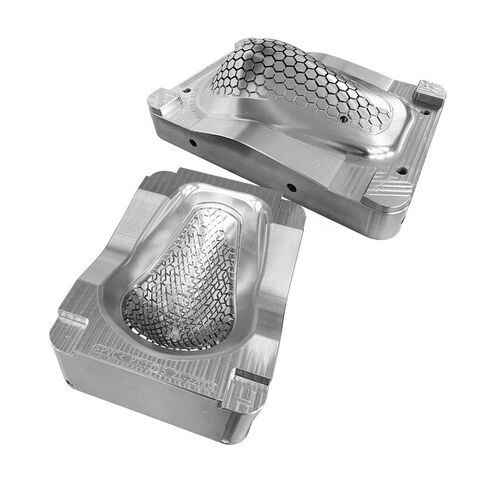
What a Supplier List Should Actually Tell You
A name and a logo is not a supplier qualification. Here is the framework we use, then how the familiar names on a rapid tooling manufacturers list measure against it.
Tooling Built Fast Is Not the Same as Quick-Turn Machining
Building molds, dies, jigs, and fixtures fast enough to support a launch, while keeping the tool good enough to run real production, is what this work means. The deliverable is not a part. The deliverable is a tool that makes parts. That distinction decides who belongs on your shortlist.
A quick-turn machine shop can hand you ten machined housings next week. Ask the same shop for a 4-cavity injection mold or an aluminum die-casting die and the conversation changes. Mold work needs cavity layout, gate and runner design, cooling channel placement, ejector planning, and a steel or aluminum grade chosen for the run length you actually expect.
So when you scan a list of suppliers, do not stop at the turnaround claim. Check whether the shop cuts the mold, fits it, samples it, and then runs it. Shops that only cut steel and hand the block back are toolmakers, not launch partners.
A useful test: send one part drawing and ask what tool material they would pick and why. The answer tells you more than any ranking table. If they ask about annual volume, wall thickness, and resin before quoting, they understand the job.
Five Things to Verify Before You Shortlist Anyone
Teams usually start with price and lead time. Those matter, but they are outcomes. What you can verify up front is capability, and capability is what protects your schedule.
Process chain depth comes first. A tool has to be cut, spotted, sampled, and often modified. If the shop also does die casting, injection molding, vacuum casting, and surface finishing under one roof, your tool does not sit in a truck between steps. Every handoff you remove is a week you keep.
Tolerance capability comes second, and it must be stated as a number. Ask for the tightest repeatable tolerance on the machines that will actually touch your tool, not the shop's best-ever result on a demo part. A ±0.005 mm figure is meaningful only when it is tied to specific equipment and inspection.
Third is measurement. A tool with no dimensional report is a gamble. Ask what gets measured, on what equipment, and whether the report ships with the tool. Fourth is the low-volume bridge: can the same supplier run 200 to 2,000 parts after sampling? Fifth is documentation and confidentiality, which matters most in medical and automotive programs.
- 1Process chainCutting, sampling, molding or casting, and finishing under one roof, or a managed network with fixed handoffs.
- 2Stated toleranceA number tied to named machines and a named inspection method, not a marketing range.
- 3Tool life expectationSteel grade and cavity count chosen against your annual volume, not a default.
- 4Low-volume bridgeAbility to run hundreds to a few thousand parts after the tool is proven.
Matching Tool Type to Volume and Material
Typical ranges used when quoting quick-turn tooling. Final numbers depend on part geometry and resin or alloy.
| Tool type | Typical volume | Best fit |
|---|---|---|
| Aluminum bridge mold | 100–5,000 parts | PP, ABS, PC, PA prototypes and pilot runs |
| P20 or 1.2343 steel mold | 10,000+ parts | Engineering resins, tight cosmetic requirements |
| Die-casting die (H13) | 5,000+ shots | ADC12 and similar aluminum alloys |
| Silicone vacuum cast tool | 1–50 parts | Urethane parts, color and texture checks |
| Machined jig or fixture | Single build | Locating, drilling, and inspection fixtures |
| Soft tooling insert | 500–2,000 parts | Design still changing between builds |
How the Familiar Names on the List Differ
GreatLight Metal Technology, based in Dongguan with a second plant in Singapore, has run since 2011 and now operates three wholly-owned plants covering 7,600 m² with 150 technicians and 127 high-precision CNC machines. Sixteen simultaneous 5-axis centers and sixteen mill-turn centers handle complex geometry, up to 4,000 mm in one setup. The shop cuts tooling and also runs die casting, vacuum casting, and finishing, so a program can move from a machined prototype to a cast or molded pilot run without a new supplier.
Protolabs Network and Xometry are marketplaces. They route your job to partner shops and are strong when you need broad capacity and fast quoting across many processes. What you give up is some control over which machine runs your tool and who signs the inspection report. For simple parts that trade is fine. For a tool with tight shutoffs, ask who the actual manufacturer is.
Fictiv works the same way with a managed supplier base and a software layer. It suits teams that want a single interface and predictable documentation. JLCCNC and similar China-based quick-turn shops compete on price for machined parts and simple tooling. Verify their inspection depth and material traceability before you send a program with regulatory requirements.
None of these are wrong choices. The question is fit. A marketplace is efficient when your part is simple and your volume is fixed. A vertically integrated shop is worth the extra conversation when the tool has to survive a design change, a material switch, or a jump from 50 parts to 5,000.
Where Simple Lists Fall Short: Applications That Need Engineering Input
Thin-wall parts are where tooling quotes go wrong most often. A 0.8 mm wall in glass-filled PA fills differently than the same wall in unfilled ABS. Gate location, injection speed, and cooling layout change with the material. A supplier that quotes from a PDF without asking about the resin is quoting a shape, not a process.
Overmolded and insert-molded parts add a second variable: the metal insert has to be held to a tolerance that survives the molding cycle. If the insert is machined in-house, the tool shop can control that stack-up. If two suppliers split the work, someone has to own the interface, and that someone is usually you.
Medical and automotive programs add documentation. ISO 13485:2016 and IATF 16949:2016 are not badges; they define how change control, traceability, and inspection records are kept. ISO 9001:2015 covers general quality management, and ISO 27001:2022 covers how your drawings and files are protected. Check which certificates apply to the site that will do your work.
Surface finish requirements also drive tool decisions. A Class A visible surface on an automotive interior trim part needs a polished tool and often a texture. That means extra hand work and a different steel hardness target. Ra 0.2–0.8 μm on a machined insert is achievable, but the tool still has to transfer that finish to the molded part over thousands of cycles.
When the part is large, the tool is large. A 4,000 mm maximum processing envelope and a Ø400 mm rotary table change what can be cut in one setup, which reduces re-fixturing error on long die sections and large mold bases.
Questions Engineers Ask About Supplier Lists
How many suppliers should be on a shortlist?
Three is usually enough: one vertically integrated shop, one marketplace for overflow, and one local option for rework. More than that burns engineering time on quoting instead of building.
Keep the list alive. Re-score it after every program using actual on-time data and inspection findings, not the first quote you received.
Does a lower price mean a worse tool?
Not always, but price differences usually trace back to steel grade, cavity count, and how much hand finishing is included. Ask what changed, not whether the shop can match the number.
A quote that omits sampling, texture, or a dimensional report is not cheaper. It just moved the cost to your side of the table.
What tolerance should I expect on tooling components?
On machined mold inserts, cores, and jig plates, ±0.005 mm is achievable on the critical features when the shop has the right machines and inspects 100% before shipment.
Not every feature needs that. Define which dimensions control the part and let the rest run at a normal tolerance. That lowers cost without hurting function.
Can the same supplier make the prototype and the tool?
That is the main advantage of a vertically integrated shop. The prototype is machined on the same machines that will cut the tool, using the same CAD model, so the geometry is already proven.
It also means the person who found the problem in the prototype is the person who fixes it in the tool.
How is confidentiality handled on tooling drawings?
Uploads should be treated as confidential, and a non-disclosure agreement should be available before you send files. Ask which people will see the drawings and where the files are stored.
For regulated products, confirm that information security is covered by a certificate such as ISO 27001:2022 and that the scope names the site doing the work.
What happens if the tool needs a change after sampling?
Expect at least one round of adjustment on any new tool. The question is who pays and how fast it turns around. Get the policy in writing before the order.
Changes that come from your own design revision are normally quoted separately. Changes that correct a tool dimension are the toolmaker's scope.
Put Your Tooling Program in Front of an Engineer
Send a drawing and get a quotation with free DFM analysis within 12 hours. No minimum order quantity, from one prototype to 10,000+ part runs, and an NDA available on request.
12-hour quote and DFM±0.005 mm tolerance100% inspection before shipmentISO 9001 / IATF 16949 / ISO 13485 / ISO 27001









