
Metal 3D Printing Suppliers 2026: A Screening Guide for Engineers
This guide is for engineers and sourcing managers who need metal parts in 2026 and have to pick a supplier without a three-month audit. We cover the seven checks that actually separate providers, how the major service models differ, and where the post-processing chain breaks down. Read it before you send an RFQ.
In this article
- 1
- 2
- 3
- 4
- 5
- 6
- 7
- 8
Seven things that decide the shortlist
Service model comparison for metal AM in 2026
Each row is a supply model, not a ranking. Pick the row that matches your part mix and volume.
| Model | Best fit | Watch for | Typical MOQ |
|---|---|---|---|
| Integrated manufacturer | Full chain from powder to finished part | Higher quoting effort on one-off parts | 1 piece |
| Digital broker network | Fast quoting, wide material menu | Post-processing is subcontracted | 1 piece |
| Specialized AM bureau | Complex lattices and thin walls | Limited machining capacity in-house | 1–10 pieces |
| Low-cost prototype shop | Form and fit checks, jigs | As-built tolerance and finish vary | 1 piece |
| Sheet metal + AM hybrid | Brackets with printed inserts | Metal AM range is narrow | 5 pieces |
| In-house machine purchase | Repeated production volumes | You own the post-processing chain | N/A |
Pick the supplier that owns the whole chain
If your part needs both printing and tight machined features, choose a supplier that runs both under one roof and can show you the inspection data.
Why metal 3D printing suppliers look different in 2026
Five years ago a service bureau could win work by owning one SLM machine. That is no longer enough. Powder handling, laser calibration and build-plate strategy are now table stakes, and the difference between a good and a bad supplier shows up after the build finishes.
The bigger shift is consolidation of the chain. Buyers who once split a project across a printer, a heat treater and a machine shop now want one quote with one tolerance callout. Suppliers that own their post-processing line can hold ±0.005 mm on critical features. Suppliers that broker it out usually cannot.
Material menus have also widened. Stainless 316L and 17-4PH remain the workhorses. Aluminum AlSi10Mg covers lightweight brackets. Ti-6Al-4V (TC4) is common in aerospace and medical, and Inconel shows up in hot-section and energy work. The supplier's experience with your specific alloy matters more than the length of its list.
One thing has not changed. Metal AM is still a geometry play. If your part is a flat plate with six holes, a 3-axis mill will beat any printer on cost per part. Choose metal 3D printing suppliers when the geometry gives you something CNC cannot reach.
- 1Powder reuse policyAsk how many build cycles before powder is retired and how it is sieved.
- 2Build orientationOrientation sets surface finish, support volume and residual stress direction.
- 3TraceabilityLot numbers should follow powder, build plate and heat-treat batch through to the part.
SLM, DMLS and binder jetting: what each one gives you
SLM and DMLS are the same family of laser powder-bed fusion, and most suppliers use the names interchangeably. A laser melts each 20–60 μm layer in an inert atmosphere, producing near-fully-dense metal. It is the default for functional parts in stainless, aluminum, titanium and tool steel.
Binder jetting is different. A print head deposits binder into a powder bed, then the green part goes through sintering. This route runs faster on small parts and avoids the residual stress that laser melting leaves behind. Density lands lower, typically in the 95–98% range before infiltration or HIP, so it suits manifolds and housings more than fatigue-critical hardware.
Directed energy deposition (DED) is the third option worth knowing. It builds by feeding powder or wire into a melt pool, which makes it useful for repairing worn tooling and adding features to an existing forging. It is not a good fit for fine internal channels or small complex parts.
For most buyers the practical question is simpler. If you need thin walls, lattice structures, conformal cooling channels or organically shaped brackets, laser powder-bed is the right call. If you need volume and cost per unit on small parts with moderate tolerances, binder jetting deserves a quote.
Post-processing is where the schedule usually slips
A printed part comes off the plate attached to a build platform, covered in supports, and carrying residual stress. None of that is shippable. The chain that follows includes stress relief, support removal, base plate separation, heat treatment, HIP where required, and then machining of any critical faces.
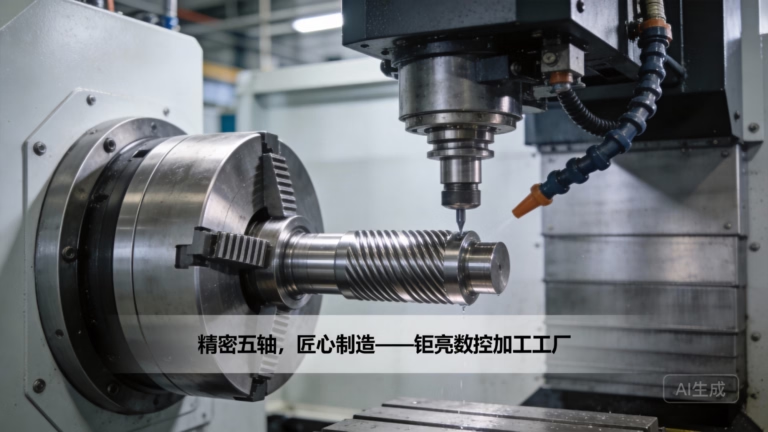
This is the part that brokers struggle with. When the printer, the heat treater and the machine shop are three different companies, a two-day queue at any one of them pushes your ship date. In our own plant the printed parts move directly to the five-axis machining centers, so the handoff is a scheduling step, not a shipment.
Tolerance is the other reason to care. As-built laser parts typically hold around ±0.1 mm on small features, and warpage on long thin sections can be worse. If your drawing calls for ±0.005 mm, that must be machined after the build. Suppliers that quote the machined tolerance without a machining step are quoting something they cannot measure.
Surface finish follows the same logic. As-built SLM surfaces usually sit around Ra 8–12 μm, and they can be bead blasted, tumbled or polished. Reaching Ra 0.8–1.6 μm means machining or a controlled finishing pass, and that should appear as a line item in the quote.
- 1Support strategyMore supports mean more removal time and more witness marks on the surface.
- 2Heat treat specStress relief before plate separation prevents the part from curling as it is cut free.
- 3Inspection planAsk which features get measured and with what equipment before you place the order.
How to screen metal 3D printing suppliers without an audit
You can learn a lot from one RFQ response. Send a part with one tight bore, one thin wall and one internal channel. A supplier that returns a DFM note explaining orientation, support placement and the machining allowance is a supplier that has run this before.
Lead time consistency beats lead time claims. Anyone can promise a fast first article. Ask what percentage of orders shipped on or before the quoted date over the last year, and ask how they handle a slip. In our plant the historical late-delivery probability sits below 2%, and that number comes from tracking every shipment.
Certifications tell you which industries a supplier already serves. ISO 9001:2015 is the baseline. IATF 16949:2016 signals automotive process control, ISO 13485:2016 signals medical device discipline, and ISO 27001:2022 covers how your CAD files and drawings are handled.
Finally, test the handoff. Send a follow-up question about a material substitution or a tolerance conflict and see who answers and how fast. The quality of that conversation is the best predictor of how the production run will go.
Where the money actually goes on a printed metal part
Build time is the cost driver buyers focus on, but it is rarely the largest line. Powder cost per kilogram is high and only part of it ends up in your part. Support structures consume material and machine time, then have to be removed by hand or by wire EDM.
Post-processing labor scales with part complexity, not part size. A small part with twenty supports costs more to finish than a larger simple block. That is why two geometrically similar parts can come back with very different quotes.
Volume changes the equation. Below roughly a hundred units, printing plus finish machining is usually competitive against tooling. Above that, die casting or investment casting starts to win on unit cost, and printing is better reserved for the features that casting cannot produce.
The cheapest way to save money is to redesign for the process. Merge assemblies, remove supports by changing orientation, and keep tolerances loose where the drawing allows. A DFM review before the build costs nothing and often removes a machining step.
Seven steps to select and qualify a supplier
Run these in order. Each step should either narrow the list or give you a number you can put in the sourcing file.
- 1Classify the part firstDecide whether the geometry needs AM at all. Internal channels, lattices and organic shapes justify it. Flat plates and round bores usually go to CNC.
- 2Write the true tolerance splitMark which faces need ±0.005 mm and which can live at ±0.1 mm. Sending everything as a tight tolerance inflates every quote you receive.
- 3Send the same RFQ to five suppliersInclude material grade, finish callout, quantity and a target date. Compare the DFM notes, not just the price.
- 4Check the post-processing chainAsk who removes supports, who heat treats and who machines. If those are three companies, add buffer to your schedule.
- 5Verify certifications against your industryISO 9001:2015 as the floor, plus IATF 16949:2016 for automotive or ISO 13485:2016 for medical work.
- 6Request a first article inspection planAgree on which features are measured, the method and the report format before the build starts.
- 7Run a small repeat orderOrder the same part twice and compare dimensions and finish. Consistency across two runs predicts the production run better than any sample.
Questions buyers ask before the first order
Is metal 3D printing cheaper than CNC machining?
It depends on geometry, not on volume alone. For a part with internal channels, merged assemblies or a lattice, printing can remove several machining setups and win on total cost.
For a simple prismatic part, a 3-axis mill will usually be faster and cheaper per unit. Below roughly a hundred units of a complex part, printing plus finish machining is competitive against tooling.
What tolerance should I expect from an as-built SLM part?
Laser powder-bed parts typically hold around ±0.1 mm on small features as built, with more variation on long thin sections because of residual stress.
If your drawing calls for ±0.005 mm, that feature has to be machined after the build. Ask the supplier to show the machining step as a separate line so you know it is priced.
Which metals are available for additive manufacturing?
Common grades include stainless 316L and 17-4PH, aluminum AlSi10Mg, titanium Ti-6Al-4V (TC4), tool steel, Inconel and some copper alloys.
Availability varies by supplier and by machine. Confirm the grade is qualified on the specific printer before you design around it.
How do I protect my design files?
Ask for a mutual NDA before you upload CAD. Check whether the supplier holds ISO 27001:2022, which covers information security management, and whether files are stored on access-controlled systems.
Also confirm that the supplier does not use customer parts in marketing material without written permission.
What is a reasonable lead time for a printed and machined metal part?
A single prototype with light finishing typically takes several working days, and the schedule is dominated by post-processing rather than the build itself.
Recurring orders move faster once the setup is proven. Ask for the supplier's on-time shipment rate rather than a best-case date.
Should I buy a metal printer instead of outsourcing?
Only when you have repeat volume, in-house post-processing capability and staff who can maintain laser calibration and powder handling.
Most buyers under two hundred parts a year are better served by outsourcing and keeping the capital for machining capacity.
Send one part, get a DFM note and a quote
Upload your CAD and we will return a quotation with a free DFM analysis, a tolerance split and a realistic ship window.
Quotation and DFM in 12 hoursNo minimum order quantity100% inspection before shipment
More from GreatLight
We publish setup notes, tooling trials and inspection data from the factory floor.











