
ODM Metal 3D Printing: How to Compare Suppliers
This page is for engineers and sourcing staff who have to pick an ODM metal 3d printing partner and cannot tell from a website what that partner actually owns. We walk through the checks that separate a real production chain from a brokered one, and where the risks sit.
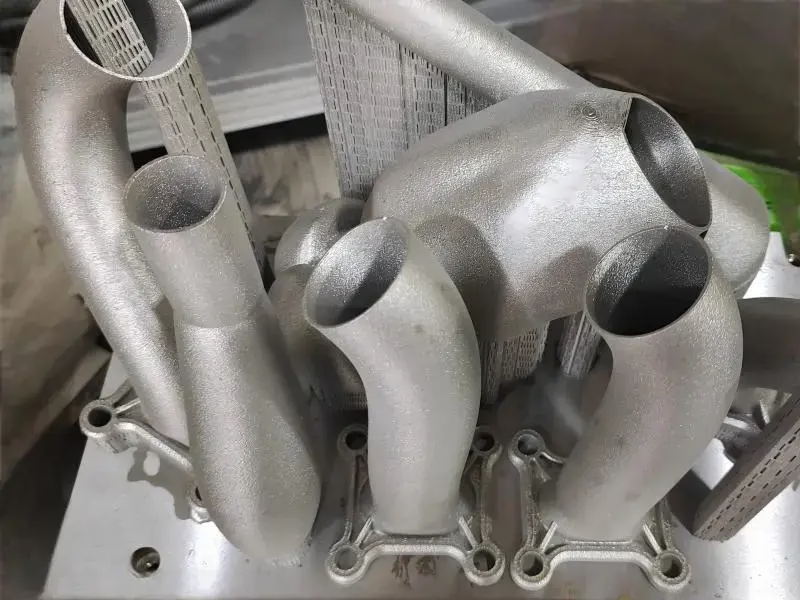
What an ODM Partner Is Actually Selling You
ODM means the supplier does more than press a build button.
Where ODM Stops Being a Label and Becomes a Process
The term ODM gets used loosely in metal additive manufacturing. In practice it means the supplier contributes engineering, not just machine time. They review your model, suggest build orientation, decide where supports go, and tell you when a feature should be machined instead of printed. A broker with a website and a partner network usually cannot do that, because the people running the printers never see your drawing until the order is placed.
Ask one question early: who decides the build orientation, and do they talk to you before the build starts? If the answer is a portal queue, you are buying capacity, not an engineering partner. That difference shows up later, when the first batch comes back with warped flanges or support scars on a sealing face and nobody owns the fix.
We run metal 3D printing inside the same building as our CNC department, which changes how a job gets planned. When a printed boss needs a flat mating surface, the machining sequence is written into the process plan from the start, not added after a failed inspection.
For buyers, the useful test is not how many materials appear on a page. It is whether the supplier can name the post-processing steps, the heat treatment cycle, and the inspection method before you place the order. Vague answers there are a signal.
- 1Engineering inputOrientation, support strategy and feature-by-feature print or machine decisions.
- 2Post-processing chainSupport removal, HIP when specified, heat treatment, stress relief.
- 3MetrologyCMM, laser scanning and roughness testing to close the loop.
In-House Production Chain vs Coordinated Marketplace
Suppliers in this market fall into two camps. Digital platforms coordinate external workshops and route your order to whoever has capacity. Vertically integrated manufacturers own the printers, the CNC machines, the finishing lines and the inspection lab. Both models can deliver a good part. They fail in different ways.
A platform is strong when your part is simple, the material is common, and you want a fast price across several sources. It gets weaker as soon as the geometry needs a judgement call. The quote may come from one shop, the printing from another, and the finishing from a third, with no single person holding the tolerance stack.
An in-house chain is slower to set up and usually more expensive for trivial parts, but it removes the handoff problem. GreatLight runs 127 high-precision CNC machines, 16 simultaneous 5-axis machining centers and in-house SLM printers across three wholly-owned plants, one in Dongguan and one in Singapore. That footprint matters when a printed part needs 5-axis trimming on a Ø400 mm rotary table the same week.
Neither model is automatically better. Match the model to the risk in your part. Cosmetic brackets and jigs rarely justify a fully integrated supplier. Implant tooling or a flight-critical housing usually does.
- 1Choose a platform forCommodity geometry, fast multi-source pricing, low inspection burden.
- 2Choose an integrated shop forTight tolerances, certified material, combined print and machining.
- 3Watch forQuotes that list no post-processing steps or inspection method.
How the Print and Machining Sequence Should Be Planned
Metal printing rarely produces a finished part. Support removal leaves witness marks, as-built surfaces sit around Ra 6–10 μm, and hole diameters drift from the nominal. A workable plan treats the printer as a near-net shaping step and the CNC as the accuracy step.
Datum strategy comes first. Pick the faces that will be machined and define them in the model before the build, not on the shop floor afterwards. Printed material behaves differently from wrought stock: residual stress from the melt pool can move a part during cutting, so rough machining followed by stress relief and a finishing pass holds a dimension far better than one heavy cut.
GreatLight holds ±0.005 mm (±0.0002 in) on critical features after machining, with finishes from Ra 1.6–3.2 μm as-machined down to Ra 0.2–0.8 μm where a seal or bearing fit requires it. A 4,000 mm maximum processing size covers long structural parts that will not fit a standard build chamber as one piece.
Material choice follows the same logic. Ti-6Al-4V and 17-4PH are common for printed metal work here, alongside 6061, 7075 and 316L when a hybrid print-and-machine route is cheaper than printing a whole part. Send the drawing and the load case; the material call should come out of that, not out of a catalogue page.
- 1Datum planningDefine machined faces in the model before the build starts.
- 2Stress controlRough cut, stress relief, then finish to hold the tolerance.
- 3Hybrid routePrint the complex volume, machine the critical interfaces.
Checks to Run Before You Approve a Supplier
Use these as written questions in your RFQ, not as marketing criteria.
| Check | What a strong answer looks like | Red flag |
|---|---|---|
| Build orientation | Named engineer reviews the model before quoting | Portal queue, no human contact before the build |
| Post-processing | Support removal, HIP and heat treatment listed with cycles | Printer output only, finishing outsourced silently |
| Tolerance | Stated on critical features after machining, not as-built | One blanket number for every feature |
| Inspection | CMM and roughness reports available on request | Visual check only, no metrology mentioned |
| Certification | ISO 9001:2015, IATF 16949:2016, ISO 13485:2016, ISO 27001:2022 | Certificate images with no scope statement |
| Capacity | Machine count, build envelope and plant locations named | Lead time promised without process detail |
Where Metal AM Projects Actually Go Wrong
Most failures we see are not printing failures. They are planning failures. A part is quoted as one printed piece, then arrives with a machined surface that nobody budgeted for, and the schedule slips by a week.
Porosity and internal defects are the second cluster. They matter on parts that see pressure, fatigue cycling or a sealing function. Hot isostatic pressing closes internal voids when the application justifies it, but it adds a step and a cost line. Ask whether HIP is included, optional, or not offered at all for the material you chose.
The third cluster is documentation. Aerospace, medical and automotive buyers need material certificates and inspection reports that match the lot. A supplier who cannot trace a part back to a heat number is a problem at audit time, whatever the part looks like on the bench.
GreatLight inspects 100% of parts before shipment, covering raw material checks, in-process monitoring and final inspection, with reports on request. That is the baseline we would ask any ODM metal 3d printing supplier to match before releasing a production order.
- 1PorosityMatters for pressure, fatigue and sealing features; HIP is a choice.
- 2TraceabilityHeat number and lot records must survive into the final report.
- 3Scope creepMachining and finishing steps omitted from the quote come back as change orders.
Getting Useful Output From the First Order
Start with one representative part, not the whole assembly. A single bracket, housing or manifold that carries the tolerances you care about tells you more about a supplier than a discounted batch of simple plates.
Send the 3D model, the 2D drawing with datums, the material call and the inspection requirements together. Free DFM analysis comes back within 12 hours here, and production can start within 24 hours of approval, with parts shipping in 3–5 days. Those numbers only hold when the input is complete, which is true of every shop in this market.
Volume is the last thing to negotiate. There is no minimum order quantity, so a single prototype and a 10,000-part run follow the same engineering review. Uploads stay confidential and an NDA is available on request if your program requires one before drawings move.
Once the first article passes, freeze the process. Same orientation, same heat treatment, same inspection plan. Consistency across batches is what an ODM partnership is really for.
- 1First articleOne representative part beats a batch of simple test coupons.
- 2Complete inputModel, drawing, material and inspection spec in one package.
- 3Freeze the processLock orientation, heat treatment and inspection after approval.
Common Questions
Does ODM metal 3D printing replace CNC machining?
No. Printing shapes the near-net form and machining holds the tolerances. Holes, threads, sealing faces and bearing bores are almost always cut afterwards.
The useful question is which features go to which process. A supplier who plans that split before quoting will give you a more realistic price and schedule.
How do I judge tolerances on a printed part?
Ask which features the number applies to. An as-built printed surface and a machined sealing face do not share a tolerance.
Here, critical features are held to ±0.005 mm after machining, with finishes selectable from Ra 1.6–3.2 μm as-machined down to Ra 0.2–0.8 μm.
What should I put in the RFQ to get a comparable quote?
Send the 3D model, a 2D drawing with datums and tolerances, the material grade, the surface finish callout, the inspection level and the target quantity.
Missing datums or an unstated finish usually means the quote will be revised later, which costs more than answering the questions up front.
How is confidentiality handled on proprietary designs?
Uploads are treated as confidential, and a non-disclosure agreement is available on request before files are transferred.
If your program requires an NDA first, say so in the initial message rather than after the drawing is sent.
What materials can be handled in a print-and-machine route?
Titanium grades such as TA1, TA2 and TC4 (Ti-6Al-4V), stainless steels including 17-4PH and 316L, aluminium alloys such as 6061 and 7075, plus Inconel and tool steels.
The choice should follow the load case and the post-processing the part needs, not the widest list on a supplier page.
When does HIP make sense?
Hot isostatic pressing suits parts with pressure containment, fatigue cycling or a sealing function, where internal voids would drive a failure.
For cosmetic brackets and fixtures it usually adds cost without changing the outcome. Ask for it as an option, not as a default.
Send a Drawing, Get a Process Plan
Upload your model and drawing for free DFM analysis within 12 hours, covering orientation, machining sequence and inspection.
12-hour quote and DFM100% inspection before shipmentNDA available on request









