
Chinese Rapid Tooling Makers Worldwide: How to Judge Them
This guide is for design and sourcing engineers who need tooling fast and cannot afford a second try. It covers the checks that separate a capable Chinese rapid tooling makers worldwide shortlist from a catalog of names: tolerance, in-house process chain, certifications, order quantity and quote clarity.
In this article
- 1
- 2
- 3
- 4
- 5
- 6
- 7
- 8
- 9
Key takeaways
What to Check Before You Shortlist
Each row is a question to send in writing. The right-hand column is what a credible answer looks like for injection, die casting or compression tooling.
| Check | What to ask | Credible answer |
|---|---|---|
| Tolerance | Can you hold ±0.005 mm on the cavity block? | Yes, with a named measurement method and report |
| Process chain | Do you machine, EDM and polish in-house? | All three under one roof, one datum |
| Certifications | Which cert covers my industry? | IATF 16949, ISO 13485 or ISO 9001 named |
| Material | Which tool steel grade, and why? | Grade tied to shot count and resin |
| MOQ | Can you quote a single tool insert? | No minimum order quantity |
| Lead time | When does the clock start? | At data release, not at purchase order |
| Quote format | Is DFM included before I pay? | Free DFM analysis with the quotation |
| Confidentiality | Will you sign our NDA? | NDA available on request |
Pick the Chain, Then the Price
A shortlist of Chinese rapid tooling makers worldwide is only useful if you can compare it line by line. Get the DFM analysis, the tight feature list and the in-house step list in writing first. The quote that survives those three documents is the one worth signing.
Tolerance: the Number Behind the Claim
Every Chinese rapid tooling makers worldwide page lists a tolerance figure. Few explain how they reach it. On a cavity block, ±0.005 mm is a grinding and measurement discipline, not a machining setting. The shop has to hold the insert on a stable datum through milling, EDM and polishing, then verify it on a CMM with a stated temperature.
Ask what happens when a dimension sits at the edge of the band. A supplier who reworks the insert before shipping is doing the job. One who ships and offers to adjust the next order is not. The difference shows up at first article, when the mould is already bolted into your press.
For most injection tooling, ±0.01 mm on the cavity and core is enough. You need the tighter band on shut-offs, thin ribs, optical surfaces and any feature that sets wall thickness. Paying for ±0.005 mm everywhere adds grinding time without changing the part.
Surface finish follows the same logic. Ra 0.8–1.6 μm covers most technical parts. Ra 0.2–0.8 μm is for optical inserts and sliding shut-offs, and it adds hand polishing hours that a buyer should see priced separately.
- 1Ask for the measurement planWhich features, which instrument, which temperature.
- 2Separate tight features from loose onesPrice follows the tight list, not the whole insert.
- 3Keep one datum through the chainRe-clamping between suppliers is where tolerance is lost.
In-House Process Chain and Tooling Lead Time
Rapid tooling is fast because the steps sit close together. A tool insert that starts on a 5-axis machine, moves to wire or mirror-spark EDM for sharp corners, then goes to in-house polishing and texture does not wait on a truck. When those steps are subcontracted, each handover adds queue time and a new setup.
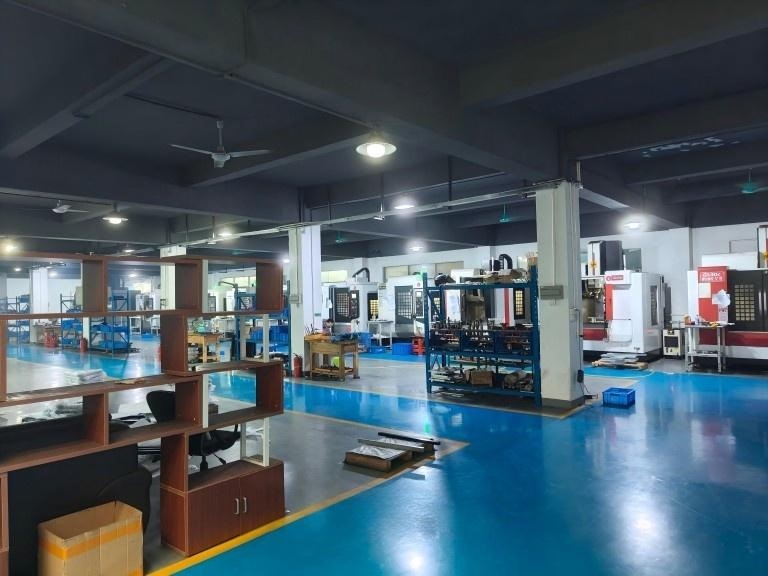
GreatLight runs 127 high-precision CNC machines across three wholly-owned plants, including 16 simultaneous 5-axis machining centers, 12 four-axis mills, 27 three-axis machines and 16 mill-turn centers. Maximum processing size reaches 4,000 mm, with travels of 4,000 × 400 × 150 mm on the large frame and 750 × 1,150 × 550 mm on the medium frame.
That range matters for die casting tooling, where a cavity block and its slides can differ by a factor of ten in size. A Ø400 mm rotary table covers most round inserts. If the same shop can cut the block, burn the ribs and finish the surface, the schedule holds.
When a supplier subcontracts heat treatment, ask who controls the distortion allowance. That single step moves dimensions more than any machining operation, and it is the most common cause of a tool arriving out of spec.
- 1Ask which operations are outsourcedHeat treatment and texture are the usual answers.
- 2Ask who owns the setup between stepsOne shop, one datum, one inspection report.
- 3Match machine travel to your partA 4,000 mm frame is wasted on a 200 mm insert.
Certifications That Actually Cover Your Part
Certificates are a filter, not a ranking. ISO 9001:2015 says the quality system is documented and audited. It does not say the shop can make your automotive housing. IATF 16949:2016 adds the automotive-specific controls: PPAP discipline, traceability, change management. ISO 13485:2016 covers medical devices, where process validation and clean handling matter more than cycle time.
GreatLight holds ISO 9001:2015, IATF 16949:2016, ISO 13485:2016 and ISO 27001:2022. The last one is easy to overlook. It covers information security, which is what your CAD data and tooling drawings sit inside while they are on someone else's server.
For die casting and injection tooling in automotive programs, the certificate question is not optional. Your customer's auditor will ask for it, and a supplier without IATF 16949 pushes that risk onto you. For medical tooling, ISO 13485 is the entry point, not a bonus.
If your program is industrial machinery or robotics, ISO 9001 with a documented inspection routine is usually enough. Ask for raw material certificates and in-process monitoring records anyway. Those tell you more about daily practice than the certificate on the wall.
- 1Match the certificate to the end marketAutomotive, medical and general industrial differ.
- 2Ask for traceability recordsHeat numbers on the steel, not just a system certificate.
- 3Check data handlingISO 27001 covers the drawings you upload.
MOQ, Quote Clarity and IP Protection
Minimum order quantity is the quiet filter in tooling procurement. A prototype program may need one insert to prove a gate design. If the supplier only quotes above a few hundred parts, the engineering team loses the cheap test. GreatLight quotes from one prototype to 10,000+ part runs with no minimum order quantity.
Quote format matters as much as the number. A line that says mould base, cavity insert, slides, EDM, polishing, first article inspection and freight lets you compare suppliers. A single lump sum does not. Ask whether DFM analysis comes before you commit; GreatLight delivers quotation and free DFM analysis within 12 hours, and production can start within 24 hours.
Confidentiality is a real selection criterion, not paperwork. Tooling drawings describe your product before it exists. Uploads should be handled as confidential, and an NDA should be available before you share the model, not after.
One more check: what the quote assumes. Shot count, resin, press size and annual volume all change the steel grade and the cooling layout. A quote without those assumptions is a placeholder.
- 1Compare line by lineLump sums hide subcontracting and rework.
- 2Confirm the assumptions in writingShot count, resin, press and volume.
- 3Sign the NDA before the modelUploads are secure and confidential; NDA on request.
Materials and Finishes for Tooling Work
Tooling buyers ask about steel grades; the same shops also cut production parts in aluminium, stainless, titanium and plastics. Knowing the material range tells you whether the supplier can also run the pilot parts that come out of the tool.
Aluminium covers 6061, 6061-T6, 2024, 5052, 5083, 6063, 6082, 7075 and ADC12 for die casting. Stainless spans 303, 304, 316, 316L, 420, 430, 431, 440C and 17-4PH (SUS630). Steels include 1018, 1045, 4130, 4140, 4340, A36 and tool steel. Copper and brass grades such as C101, C110, beryllium copper and C36000 show up in thermal inserts and electrodes.
Titanium and special alloys cover TA1, TA2, TC4 (Ti-6Al-4V), Inconel and magnesium AZ31B / AZ91D. Plastics for vacuum casting and prototype parts include ABS, PC, PMMA, POM, PA, PEEK, PP, HDPE and carbon fibre.
Finishes decide whether the tool matches the production surface. Anodizing, electroless nickel, zinc, silver and gold plating, powder coating, black oxide, bead blasting, tumbling, brushing and polishing are all available. Laser marking holds a minimum character height of 1.5 mm, which is the limit for a moulded-in date code.
- 1Name the steel, not the categoryTool steel covers a wide hardness range.
- 2Check the pilot materialThe tool must run the resin or alloy you tested.
- 3Set the texture before polishingRe-polishing after texture is expensive.
Where a Shortlist Usually Breaks Down
Most supplier problems show up in the same three places: heat treatment distortion, gate and vent design for die casting, and handover between prototype and production tooling. None of them appear on a capability page. All of them appear in the first article report.
Die casting tooling adds gating, venting and thermal control to the usual machining work. A shop without dedicated die casting cells tends to solve thermal problems by slowing the cycle, which raises part cost for the life of the tool. Ask how they sized the runner and where the thermocouples sit.
Prototype-to-production handover is the other gap. A vacuum cast or 3D printed prototype proves the shape; the production tool needs draft, shrinkage allowance and ejection that the prototype never had. Suppliers that run both stages under one roof can carry the lessons across. Those that do not usually start from the CAD file again.
Historical late-delivery probability below 2% is the kind of figure you can ask for. A supplier who tracks it can explain the misses. One who cannot is guessing.
- 1Ask about heat treatment controlDistortion allowance is set before machining.
- 2Ask about die casting thermal designGating and venting decide cycle time.
- 3Carry prototype lessons forwardDraft and shrinkage belong in the tool design.
Six Steps to Vet a Tooling Supplier
Run these in order. Each step produces a document you can compare across suppliers.
- 1Send the model and the assumptionsInclude resin or alloy, annual volume, press size and shot count. Ask for DFM analysis with the quotation, not after.
- 2Ask for the measurement planWhich features hold ±0.005 mm, which instrument, what temperature. Compare the tight feature list across quotes.
- 3Request the inspection report formatA blank template is enough. It shows whether first article, in-process and final inspection are separate records.
- 4Confirm the in-house step listMachining, EDM, polishing, texture, heat treatment. Mark which are subcontracted and who owns the datum.
- 5Verify the certificates for your marketIATF 16949 for automotive, ISO 13485 for medical, ISO 9001 for general industrial, ISO 27001 for data handling.
- 6Test the small order firstOrder one insert or a short run before the full tool. No minimum order quantity keeps this step cheap.
- 7Set the NDA and upload path before sharingSign first, then upload. Check that files are handled as confidential through the whole chain.
Questions Buyers Ask
How do I compare quotes from different Chinese rapid tooling makers worldwide?
Ask each supplier to break the price into mould base, cavity and core inserts, slides, EDM, polishing, texture, heat treatment, first article inspection and freight. Then compare the assumptions behind each line: shot count, resin, press size and annual volume.
A lump-sum quote cannot be compared, because you cannot see whether heat treatment or texture is included. If two quotes differ by a wide margin, the cheaper one usually has a step missing rather than a better rate.
What tolerance should I actually specify on a tool insert?
Specify ±0.01 mm on general cavity and core surfaces and reserve ±0.005 mm for shut-offs, thin ribs, optical surfaces and features that set wall thickness. Tightening the whole insert adds grinding hours without improving the moulded part.
State the measurement method with the tolerance. A CMM report at a controlled temperature is different from a caliper check at the bench, and the two will not agree on the same insert.
Is a low MOQ a sign of a small workshop?
Not necessarily. A shop with its own machining, EDM and polishing cells can absorb a single insert into a normal schedule. No minimum order quantity means the sales side is not filtering small engineering jobs out.
What matters is whether the small order gets the same inspection routine. Ask for the report on the one-off insert before you place the production tool order.
Which certification do I need for automotive die casting tooling?
IATF 16949:2016 is the one your customer's auditor will look for, because it covers traceability, change management and PPAP discipline. ISO 9001:2015 alone does not carry those automotive controls.
If your program also involves medical parts or sensitive drawings, add ISO 13485:2016 and ISO 27001:2022 to the requirement list. GreatLight holds all four.
How long should a tooling quotation take?
A quotation with DFM analysis within 12 hours is a reasonable benchmark when the model and assumptions are complete. If the first reply is only a price with no comment on draft, wall thickness or gate location, the engineering review has not happened yet.
Production can start within 24 hours after the design is released, and parts ship in 3–5 days on machining work. Tooling timelines depend on the insert and the finishing steps, so ask for the step list rather than a single date.
What should I do if the first article is out of tolerance?
Ask which operation moved the dimension. Heat treatment distortion and re-clamping between suppliers are the usual causes, and both are traceable in the process records.
A supplier who holds the full chain in-house can correct the insert and re-measure without a new purchase order. That is the practical reason to check the process chain before you check the price.
Send the Model, Get a Tooling Quote in 12 Hours
Upload your part and the assumptions: resin or alloy, volume, press size. You get a quotation with free DFM analysis, a feature tolerance list and a step-by-step process chain you can compare against any other supplier.
12-hour quote + DFMNo MOQ100% inspection before shipmentNDA on request
More from GreatLight
We publish setup notes, tooling trials and inspection data from the factory floor.











