
Chinese Bulk Rapid Tooling: How to Pick the Right Supplier
This page is for engineers and sourcing managers who need tooling that covers a validated prototype and a 10,000+ part run. It explains what separates a real tooling manufacturer from a broker, which supplier models fit which projects, and what to verify before you release a PO. Read it and you can shortlist two or three factories with reasons, not adjectives.
What bulk rapid tooling actually means
Bridge tooling, pilot tooling, and low-volume production tooling are three different jobs. Suppliers who blur them cause most of the delays.
Rapid tooling is a bridge, not a prototype
A rapid tool is built to run real parts while the final production tool is still being designed. Injection molds cut from aluminum or pre-hardened steel, die-cast inserts, and forming dies all fall in this group. Cavity counts stay low, usually one to eight. Cycle times are slower than a hardened production tool, and tool life is measured in thousands of shots rather than millions.
That distinction matters when you shop for suppliers. The tooling market on this side of the Pacific splits into direct manufacturers and platform networks. A direct manufacturer owns the mills, the EDM, and the polishing bench. A network quotes the job, then routes it to a partner shop. Both can work. They fail in different ways.
If your part has thin walls, tight concentricity, or a cosmetic surface, the routing model adds a layer where information gets lost. We see this most often on insert blocks and sliders, where a 0.05 mm mismatch shows up as flash in the first shot.
- 1Bridge toolingAluminum or soft steel, 1–8 cavities, thousands of shots.
- 2Pilot toolingPre-hardened steel, validated for fit and function before hard tooling.
- 3Production toolingHardened steel, high cavitation, millions of shots.
Factory, network, or trading company
A direct factory gives you one process owner from DFM to shipment. That matters when a tool needs a design change after the first trial. The toolmaker walks twenty meters to the wire EDM and cuts a new insert. No purchase order between two companies, no requote.
A network model wins on breadth. If you need forty different parts across six processes in one order, a platform can distribute the load fast. The trade-off is that the shop actually cutting your steel may change between orders. Process control lives with someone you never spoke to.
Trading companies sit between the two. They hold the customer relationship and subcontract everything. Pricing can look sharp. What you cannot see is which machine ran your cavity, or whether the steel certificate matches the invoice.
Ask one question before you send a drawing: who owns the machine that will cut this? The answer tells you which model you are dealing with, and what your escalation path looks like when a dimension drifts.
What to verify in a tooling supplier
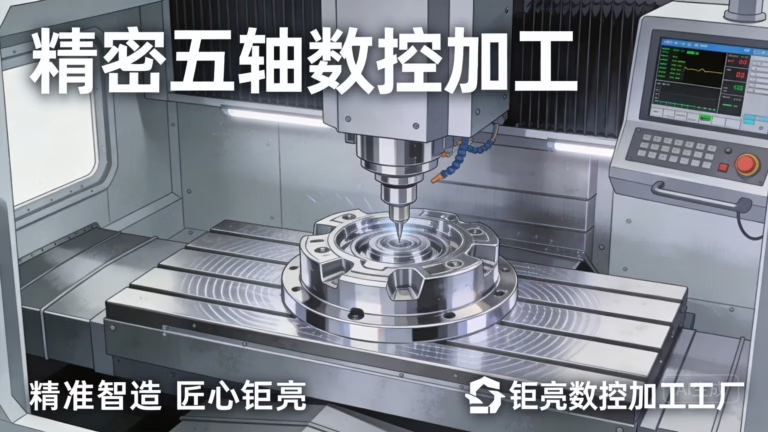
Start with the machine list, not the brochure. Tooling work needs 3-axis mills for plates, 5-axis for complex inserts, wire EDM for sharp corners, and a surface grinder for parting lines. A shop that subcontracts EDM will lose two to four days on every correction.
Then check the metrology. A CMM with a stated accuracy is better than a caliper and a promise. We inspect 100% of parts before shipment and keep raw material, in-process, and final reports available on request. When a customer disputes a dimension, the data settles it in an hour.
Certifications tell you what system is running, not how well. ISO 9001:2015 covers general quality. IATF 16949:2016 is required for automotive and EV programs. ISO 13485:2016 applies to medical devices. ISO 27001:2022 covers information security, which matters if you send CAD data under NDA.
Finally, ask about steel traceability. For a bridge tool, 1.2311 or 1.2738 pre-hardened plate is common. For inserts that see abrasive filled resin, you want H13 or a comparable hot-work steel. A supplier who cannot name the grade and the hardness on the quote is guessing.
Supplier model at a glance
Match the model to your program stage, not to the lowest quote.
| Model | Best for | Watch out for | Typical scope |
|---|---|---|---|
| Direct factory | Complex inserts, cosmetic parts | Narrower process range | DFM to shipment, one owner |
| Platform network | Wide part mix, fast capacity | Shop changes between orders | Quoting and routing, multi-shop |
| Trading company | Simple parts, price-first buys | No visibility of the machine | Subcontracted, no in-house tools |
| In-house + overseas | IP-sensitive programs | Higher unit cost | Local engineering, remote cutting |
Where Chinese tooling shops differ in execution
Dongguan and the surrounding Pearl River Delta hold a dense supply chain for steel, heat treatment, and finishing. That density shortens logistics, not necessarily engineering. Two shops on the same street can differ by a factor of three in how they handle a warped cavity plate.
The difference shows up in the first article. A disciplined shop measures the tool, runs a short shot, measures the part, and adjusts before shipping. A rushed shop ships on schedule and lets you find the flash. Historical late-delivery probability below 2% comes from the first habit, not from working faster.
Material choice drives most tooling cost. Aluminum 7075 and 6061 cut fast and conduct heat well, which suits short runs and large flat parts. P20 and 718H pre-hardened steels hold a polish longer. For glass-filled nylon or high-temperature resins, H13 with a nitrided surface lasts noticeably longer.
Cooling layout is the other lever. Baffles and bubblers add machining time but cut cycle time on deep cores. On a 4-cavity bridge tool with a 40 mm core, that trade usually pays back inside the first few thousand parts.
How GreatLight handles bulk tooling work
GreatLight Metal Technology was founded in 2011 and runs three wholly-owned plants across 7,600 m² in Chang'an, Dongguan, plus a factory in Singapore. The machine park holds 127 high-precision CNC machines, including 16 simultaneous 5-axis centers, 12 four-axis mills, 27 three-axis machines, and 16 mill-turn centers. Maximum processing size reaches 4,000 mm.
For tooling, that means cavity plates, inserts, sliders, and electrodes stay in one building. EDM, wire cutting, grinding, and the 3D printing line for conformal cooling inserts are all under the same roof. Work holds ±0.005 mm where the drawing calls for it, with a surface finish down to Ra 0.2–0.8 μm on functional faces.
The commercial side is built around short cycles. Quotation and free DFM analysis come back within 12 hours, and production can start within 24 hours of approval. There is no minimum order quantity, so one prototype tool and a 10,000+ part run go through the same intake. Parts ship in 3–5 days on standard work.
We quote tooling and production separately so you can see where the money goes. Uploads are handled as confidential, and an NDA is available on request before any CAD leaves your system.
Matching the tooling job to the supplier
Pick a direct factory when the part geometry is the risk. Complex cores, tight parting lines, and cosmetic surfaces reward a team that can change the tool on the bench. Lead time is usually 2–4 weeks for a simple bridge tool, longer for multi-slide work.
Pick a network when the risk is volume and variety. If you are launching a product family and need housings, brackets, and heat sinks moving at the same time, a platform can absorb the spread. Keep one engineer assigned to watch the process window across shops.
Either way, run a small trial before the full release. A single cavity cut from the intended steel grade tells you more about a supplier than a factory tour. Check the first article report, the surface finish on a witness mark, and how fast they answer a technical question.
The cheapest quote is rarely the cheapest tool. Correction time, air freight, and a second trial eat the difference fast. Price the tool and the first production run together, then compare.
Questions engineers ask before ordering
How long does a rapid tool take from a Chinese supplier?
A simple single-cavity aluminum bridge tool is typically 2–4 weeks from approved DFM to first article. Multi-cavity or multi-slide tools run longer.
Lead time depends on how fast the design freezes. If the DFM raises a wall thickness or draft issue and the answer comes back in a day, the schedule holds. Two weeks of silence on the customer side is the most common delay.
What tolerance can a Chinese tooling shop hold on the tool itself?
On machined tooling components, ±0.005 mm is achievable on critical features with the right machine and setup. That applies to insert pockets, guide pin holes, and shutoff faces.
Molded or cast part tolerances are wider. Resin shrinkage, cooling, and gate location add variation that no machining tolerance can remove. Expect to validate the first article before committing to a full run.
Should I use aluminum or steel for a bridge tool?
Aluminum suits short runs, large flat parts, and cases where you need first articles fast. 7075 and 6061 are common. Tool life is limited, and sharp edges wear faster.
Choose pre-hardened steel such as P20 or 718H when the tool must survive more than a few thousand shots, or when the resin is abrasive. For glass-filled and high-temperature materials, H13 with nitriding holds up better.
How do I protect my design data?
Send CAD only after a signed NDA. GreatLight provides one on request and handles uploads as confidential. The ISO 27001:2022 certificate covers the information security system.
Keep the tool design files with your engineering team where possible. A supplier who builds from a 3D model and a 2D critical-dimension drawing does not need the full assembly.
Can one supplier handle both the tool and the production parts?
Yes, and it usually shortens the loop. When the same shop cuts the cavity and runs the press or molding machine, a correction is a shop-floor decision rather than a new purchase order.
With no minimum order quantity, a program can move from one prototype tool to a 10,000+ part run through the same intake. Ask for the tooling and production quote as separate line items.
What should be on the first article report?
Dimensional results against the drawing, material certificate, and a note on any deviation with the reason. Surface finish on functional faces should be listed.
Photos of the tool and the first shot help if you cannot visit. Ask for the CMM report, not just a pass or fail stamp.
Send a drawing, get a tooling plan
We review your part, flag the tooling risks, and quote the tool and the run together. Quotation and free DFM analysis within 12 hours.
12-hour quote100% inspectionNo MOQNDA on request









