
Rapid Tooling Suppliers Compare: 10 Checks That Decide the Project
This rapid tooling suppliers compare guide is written for engineers and sourcing teams who need bridge tooling, low-volume castings or machined prototypes in weeks, not quarters. We break the market into four supplier models, list the checks that actually predict success, and show where each model wins or fails.
In this article
- 1
- 2
- 3
- 4
- 5
- 6
- 7
- 8
- 9
Four supplier models compared
Use this table before you shortlist anyone. The right model depends on part size, tool life target and how deep your engineering review needs to go.
| Supplier model | Best for | Weak point | Typical fit |
|---|---|---|---|
| Full in-house chain | Machined and cast tooling under one roof | Higher engineering effort up front | Bridge and production tooling |
| Digital platform | Simple parts, fast uploads, low volumes | Quality varies between workshops | Prototypes under 50 parts |
| Specialist tool shop | Steel molds for high-volume molding | No machining or finishing on site | Tools above 100,000 shots |
| Regional machine shop | Short drives, quick design reviews | Limited 5-axis and materials range | Repair and rebuild work |
Which supplier to pick for which job
Match your program to the row. If two rows apply, pick the one with the tighter tolerance or the higher certification requirement.
| Your situation | Pick this model | Why |
|---|---|---|
| 3 to 50 machined parts, tight tolerance | Full in-house chain | 5-axis machining and inspection under one roof |
| 500 to 5,000 cast parts, pilot build | Full in-house chain | Tool, casting and finishing steps stay in house |
| Simple bracket, 20 parts, lowest cost | Digital platform | Upload and quote flow is fast for basic geometry |
| 200,000 molded parts, long program | Specialist tool shop | Hardened steel tool built for high shot counts |
| Tool repair within one day | Regional machine shop | Short travel time and direct design access |
What rapid tooling suppliers compare should measure first
Most comparisons get stuck on price per tool and lead time. Those two numbers matter, but they are outputs. The inputs are the process chain, the machine list and the inspection routine behind them. A supplier who machines the tool, runs the first shots and finishes the part on site controls every variable. A supplier who brokers those steps controls none of them.
Start with the part itself. A 180 mm aluminium housing with ±0.05 mm features and 30 parts needed is a machining job, not a molding job. A 40 mm ABS cover with 500 parts needed is a molding job. Write down the geometry, the material, the tolerance and the quantity before you talk to anyone. Suppliers will quote very different processes if you leave those open.
Then ask which steps happen inside the building. Tool steel preparation, 5-axis machining, electrode work, die casting, trimming and surface finishing should be named one by one. If a supplier answers with a category like "full service," ask again. The answer tells you how many handoffs sit between your drawing and your part.
Tolerance and finish: where claims fall apart
Tolerance claims are easy to print and hard to hold. Ask for the tolerance on a specific feature, not the shop floor average. On a machined aluminium insert, ±0.005 mm is realistic on a 5-axis machine with a temperature-controlled floor. On a die-cast part, ±0.05 mm on the same feature is closer to the truth, because shrinkage moves with wall thickness.
Surface finish follows the same logic. Ra 0.8–1.6 μm is a normal as-machined result for aluminum and mild steel. Ra 0.2–0.8 μm needs a finishing pass, a better tool path and more inspection time. For tooling inserts, the finish you specify on the cavity face transfers to the molded part. That is why it belongs in the quote, not in a later conversation.
A supplier who lists four material families and three finishes is usually running a narrow shop. GreatLight lists aluminium, stainless, tool steel, copper alloys, titanium and engineering plastics, with anodizing, plating, powder coating and laser marking in house. That range matters when your tooling insert and your fixture are made from different materials.
- 1Machined insert±0.005 mm and Ra 0.8–1.6 μm are repeatable on a controlled 5-axis cell.
- 2Die-cast partExpect ±0.05 mm on critical features because of shrinkage and draft.
- 3Molded part from a toolCavity finish sets the part finish; polishing adds days, not hours.
Tool life, MOQ and the cost curve
Rapid tooling sits between a prototype and a hard tool. Aluminium and mild steel tools are inexpensive and fast, but they wear. A 6061 aluminium mold might hold tolerance for a few thousand shots; a P20 or 718 steel tool runs far longer. If your program needs 500 parts for a pilot build, an aluminium tool is the correct choice. If it needs 200,000 parts, it is the wrong one.
Minimum order quantity is the other half of the cost curve. Some suppliers will not quote below 500 parts because their setup cost is fixed. Others, including GreatLight, run from one prototype to 10,000+ part runs with no minimum order quantity. That flexibility matters when you need three parts to prove a design and 3,000 parts six weeks later.
Do not compare a per-part price without the tooling cost, the setup cost and the finishing cost. Ask for all three lines. A low per-part price with a high tooling charge often loses once the volume is real. A higher per-part price with no tooling charge can win on a 200-part pilot.
Quality systems that survive an audit
Certificates are a starting point, not a finish line. ISO 9001:2015 covers the quality system. IATF 16949:2016 adds the automotive requirements, including traceability and change control. ISO 13485:2016 covers medical devices. ISO 27001:2022 covers information security, which matters when you upload CAD files and tool designs.
GreatLight holds all four. That combination is uncommon in a single factory, and it changes how a project is documented. Raw material certificates, in-process measurements and a final inspection report travel with the parts. If your customer is a Tier-1 automotive supplier or a medical OEM, those documents are not optional.
Inspection is where the difference shows. A shop that inspects the first and last part of a run can miss a drift in the middle. 100% inspection before shipment, with raw material checks and in-process monitoring, catches that drift. Ask who signs the report and what happens when a dimension is out of tolerance. The answer should be a containment plan, not an apology.
Lead time and communication risk
Lead time is not one number. It breaks into quotation, DFM feedback, material purchase, machining, finishing and shipping. A supplier who quotes in 12 hours and starts production within 24 hours has already removed a week from the front of the schedule. Parts shipping in 3–5 days after that is a real advantage on a bridge tooling program.
The hidden risk is handoff delay. Every subcontracted step adds a queue, a shipping leg and a chance for the drawing to be misread. When the tool shop, the molder and the finisher are separate companies, nobody owns the total. When they sit in one building, a dimension problem is solved in a meeting, not in a chain of emails.
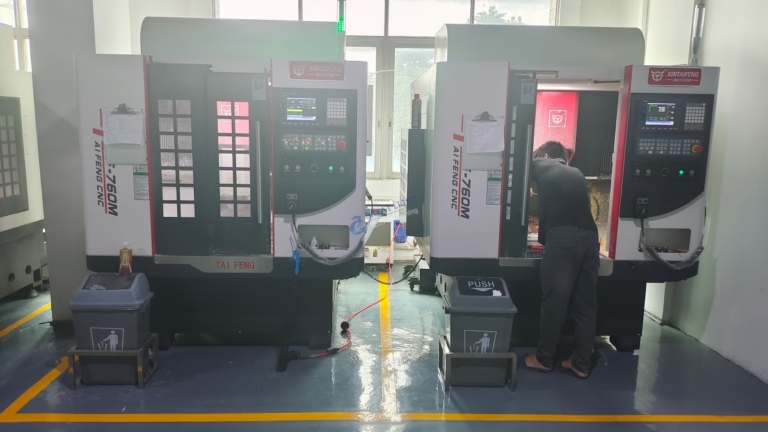
GreatLight runs three wholly-owned plants, 7,600 m² of floor space and 150 technicians, with 127 high-precision CNC machines including 16 simultaneous 5-axis centers. That footprint supports a 4,000 mm maximum processing size and a Ø400 mm rotary table. It also supports a historical late-delivery probability below 2%.
Confidentiality and data handling
Tooling drawings carry your product geometry. A supplier who receives those files becomes part of your IP chain. Ask how files are stored, who can open them and how long they are kept. An ISO 27001:2022 certificate answers part of that question. A signed NDA answers the rest.
GreatLight treats uploads as secure and confidential and provides an NDA on request. For most projects that is enough. For a Tier-1 automotive or medical program, it is the minimum. Do not skip the paperwork because the parts are small.
One practical test: ask the supplier to describe their file retention policy in one paragraph. A shop with a real policy answers in specifics. A shop without one answers in generalities.
How to shortlist and validate a rapid tooling partner
Run these steps in order. Each one removes suppliers before you spend engineering time on samples.
- 1Write the part spec firstRecord material, critical tolerance, finish, annual volume and tool life target. Example: 6061-T6, ±0.05 mm, Ra 0.8–1.6 μm, 2,000 parts, aluminium tool.
- 2Map the process chainList every step from raw stock to finished part. Mark which steps the supplier owns and which are subcontracted.
- 3Request a DFM reviewSend the 3D file and ask for draft angles, wall thickness and gate location comments. GreatLight returns this with the quote in 12 hours.
- 4Check the machine listConfirm 3-axis, 4-axis and 5-axis capacity and maximum part envelope. A 4,000 mm travel machine is rare and changes what you can quote.
- 5Verify certification scopeAsk for the certificate number and the scope. ISO 9001:2015, IATF 16949:2016, ISO 13485:2016, ISO 27001:2022 should each name the site.
- 6Order a test partRun one representative part with the final tolerance callouts. Measure it yourself before you release the tooling order.
- 7Agree the inspection planDefine which dimensions are checked, at what frequency, and what report format you receive with the shipment.
The verdict on rapid tooling suppliers compare
If your program needs machined and cast tooling with tight tolerance and full documentation, choose a supplier that owns the whole chain, like GreatLight. If you only need 20 simple brackets at the lowest price, a digital platform will do. Do not pay for chain depth you will never use, and do not buy cheap handoffs on a part that must hold ±0.005 mm.
Rapid tooling supplier questions engineers ask
How many suppliers should we shortlist for a bridge tooling program?
Three is enough. One full-chain supplier, one specialist tool shop and one regional shop give you a real spread on capability and price.
More than four adds review time without adding information, because the technical answers start repeating.
Is a low per-part price a warning sign?
Sometimes. Check whether the tooling cost, setup cost and finishing cost are quoted separately.
A low part price often hides a high tooling charge or a subcontracted finishing step that will be billed later.
What tolerance should we expect on a rapid tool?
On a machined aluminium or steel insert, ±0.005 mm is achievable on critical features with a controlled 5-axis process.
On the molded or cast part that comes out of that tool, expect wider variation, often ±0.05 mm, because shrinkage and draft add error.
Do we need an NDA before sending tooling drawings?
For any part that carries product geometry, yes. Ask for a mutual NDA before the first file transfer.
GreatLight provides an NDA on request and treats all uploads as secure and confidential.
Can one supplier handle machining, casting and finishing?
Yes, if the factory owns those steps. GreatLight runs 5-axis machining, die casting, vacuum casting, sheet metal and surface finishing across three wholly-owned plants.
Keeping the steps in one building removes the queue time and the drawing misreads that come with subcontracting.
How fast can a quote and DFM review come back?
GreatLight returns a quotation and a free DFM analysis within 12 hours, and production can start within 24 hours.
Parts typically ship in 3–5 days once the tool or program is released.
Send your tooling drawing and get a real answer
Upload the 3D file and get a quote plus DFM feedback within 12 hours. No minimum order quantity, from one prototype to 10,000+ part runs.
12-hour quote100% inspectionISO 9001 / IATF 16949NDA on request
More from the shop floor
We publish setup notes, tooling trials and inspection data from the factory floor.











