
Chinese Rapid Tooling Suppliers: A Vetting Guide for Engineers
This page explains how to separate capable Chinese rapid tooling suppliers from trading offices and brokers. It is written for design engineers and sourcing staff who already have a CAD model and need bridge tooling, soft tooling, or a short production run. By the end you will know which process fits your part, what evidence to request, and which answers should end the conversation.
What Actually Decides a Rapid Tooling Award
Speed is the easy claim. The hard part is proving that a fast part will still fit the assembly and survive the pilot run.
Rapid Tooling Is Not One Process
Rapid tooling covers several routes, and they do not share the same tolerance floor. CNC-machined aluminum or steel inserts suit low-volume injection and die casting where you need metal-like stiffness and good heat transfer. Vacuum casting from a machined master gives you 20 to 50 polyurethane parts with color and texture close to production. Printed molds work for simple geometry and a handful of shots, but they wear fast at gates and ribs.
Ask which route a supplier proposes before you accept a lead time. If the answer is always the same process, the quote is probably not engineering-led. Most Chinese rapid tooling suppliers quote CNC inserts because the equipment is already in-house. That is fine for bridge tooling, less so when you need 500 parts with tight shutoff faces.
- 1Bridge toolingMachined aluminum or steel inserts; pilot runs of a few hundred parts.
- 2Soft toolingSilicone or printed molds for 20–50 urethane parts; good for form and fit.
- 3Die casting diesH13 or similar tool steel; higher cost, longer life, better for metal parts.
- 4Sheet metal toolingForm and trim dies for brackets and enclosures; CNC first article to verify.
Tolerance Claims Need Measurement Evidence
A ±0.005 mm number on a website means nothing without a method behind it. Critical features on a tool insert are usually ground or jig-bored, not just milled. The supplier should be able to name the machine, the setup, and the inspection step for each tight callout. If they cannot, treat the tolerance as nominal.
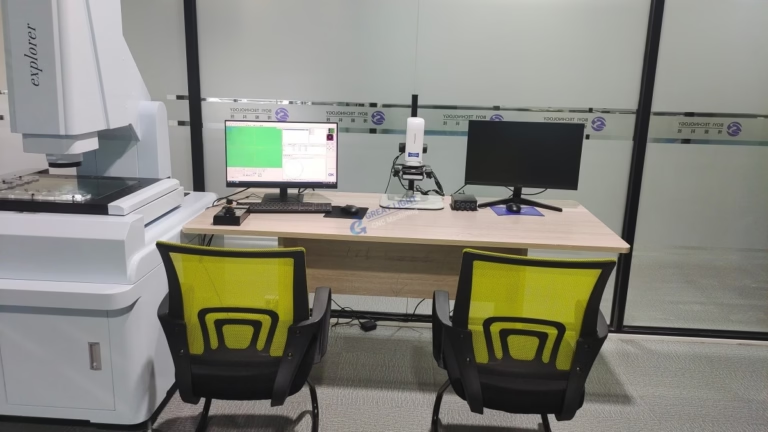
Request a first article inspection report with the actual measured values, not a pass/fail stamp. Look for a coordinate measuring machine or a vision system in the report, plus the datum scheme used. A shop that checks parts on the bench with calipers will struggle with a tool that has to hold cavity-to-core alignment over thousands of shots.
GreatLight works to ±0.005 mm on critical features, with surface finish from Ra 0.2–0.8 μm on fine work up to Ra 1.6–3.2 μm as-machined. Inspection is 100% before shipment, covering incoming material, in-process checks, and a final report on request. Those numbers come from our own process data, not from a brochure.
Choosing a Route by Volume and Material
Use this to shortlist before you send drawings.
| Route | Typical volume | Best fit |
|---|---|---|
| CNC aluminum inserts | 50–500 shots | Bridge tooling, PC/ABS prototypes |
| CNC steel inserts | 1,000–10,000 shots | Pilot production, glass-filled resins |
| Vacuum casting | 20–50 parts | Urethane parts for form and fit |
| Printed molds | Under 50 shots | Simple geometry, fast iteration |
| Die casting dies | 10,000+ shots | Aluminum or zinc production parts |
| Sheet metal tooling | Batch runs | Brackets, chassis, enclosures |
Tool Material and Part Material Must Match
Tool life depends on what you inject. Unfilled ABS and PP are gentle on aluminum inserts. Glass-filled nylon and PEEK wear a cavity fast, and the gate area fails first. If your production resin is 30% glass-filled, ask for a hardened insert or a steel cavity, even at the bridge stage, or plan for rework after a few hundred shots.
Cooling layout matters more than tool steel grade for cycle time. A shop that places baffles and bubblers by hand, rather than copying a standard grid, will give you a more even part. Ask to see the cooling schematic before the design is frozen. It is a cheap review that avoids warped parts later.
For the part itself, the material list is broad: aluminum 6061, 7075, and ADC12; stainless 304, 316L, and 17-4PH; tool steel and 4140; copper alloys such as C110 and beryllium copper for thermal pins; titanium Ti-6Al-4V and Inconel for high-temperature inserts. Each has a different machinability and a different finish result.
Your CAD File Is the Real Deliverable
Sending a 3D model offshore is a business risk, not just an IT one. Check for ISO 27001 certification, a signed NDA before files move, and a stated policy on who can open the files. Ask whether sensitive projects run in a separated cell with restricted access.
GreatLight holds ISO 27001:2022 alongside ISO 9001:2015, IATF 16949:2016, and ISO 13485:2016, and we sign NDAs on request. Uploads are treated as confidential. If a supplier cannot describe its file handling in one paragraph, that is your answer.
One more check: ask who owns the tool. Bridge tools made for you should be yours, or at least transferable. Get that in writing before the first cut.
- 1NDA firstSigned before any CAD leaves your network.
- 2Access controlNamed engineers only, logged file opens.
- 3Tool ownershipWritten transfer terms, including shipping.
In-House Capacity Beats a Broker Network
A broker forwards your file and marks up the result. An integrated shop cuts the insert, makes the electrode, and runs the trial on its own floor. That matters when a dimension is off, because the fix happens in hours, not days.
GreatLight runs 127 CNC machines across three plants in Dongguan, plus a factory in Singapore. The floor includes 16 simultaneous 5-axis centers, 12 four-axis mills, 27 three-axis machines, and 16 mill-turn centers, with a maximum processing size of 4,000 mm and travels such as 750 × 1,150 × 550 mm and 500 × 500 × 450 mm. A Ø400 mm rotary table handles round work. For tooling, that mix means cavity blocks, cores, and sliders can all be machined without outsourcing.
With 150 technicians and 7,600 m² of floor space, capacity is not the bottleneck. Quotation and free DFM analysis come back within 12 hours, and production can start within 24 hours. Parts ship in 3–5 days, and our historical late-delivery probability is below 2%. No minimum order quantity applies, from one prototype to 10,000+ part runs.
Questions That Separate Shops from Partners
Good suppliers answer process questions with specifics. Weak ones answer with adjectives. Use the same short list on every quote you receive, and score the replies side by side.
DFM feedback is the clearest signal. A partner will flag a wall that is too thin for the gate, suggest a material swap when the resin is on allocation, or move a parting line to avoid a visible witness mark. They will also tell you when rapid tooling is the wrong answer and a CNC run or printed fixture would cost less.
Ask what happens when the trial part is out of tolerance. Free rework or a defined remedy is standard for a confident shop. Silence on that question is a red flag.
- 1Tool lifeHow many shots before the gate needs repair?
- 2Trial runDo they shoot parts and measure before shipping?
- 3Rework policyWhat happens on a non-conforming first article?
- 4DocumentationCan they supply dimensional and material reports?
Rapid Tooling Questions Engineers Ask
How fast can a Chinese rapid tooling supplier deliver a bridge tool?
It depends on part size, cavity count, and whether steel inserts are needed. For an aluminum bridge tool on a mid-size part, quotation and DFM analysis within 12 hours is realistic, with production starting within 24 hours and machined parts shipping in 3–5 days.
Add time for a trial shot and dimensional report if you need first article data before shipment. Ask for that step up front so it is not treated as an extra.
What tolerance should we expect on a machined tool insert?
Critical features on a well-made insert can hold ±0.005 mm, and finish can range from Ra 0.2–0.8 μm on fine surfaces to Ra 1.6–3.2 μm as-machined. Non-critical faces are usually looser to save cost.
The number matters less than the proof. Request measured values from a CMM or vision system, with the datums stated.
Can we get an NDA before sending CAD files?
Yes, an NDA is available on request and should be signed before any file moves. Look for ISO 27001 certification and a written statement on file access.
GreatLight holds ISO 27001:2022 and treats all uploads as confidential. Sensitive work can be kept in a restricted cell.
Is there a minimum order quantity for tooling and parts?
There is no minimum order quantity. A single prototype or a 10,000+ part run both go through the same quoting process.
For tooling, the economics change with volume, not with a policy floor. A short run may cost less on a CNC route than on a mold.
Which certifications should we ask for?
ISO 9001:2015 is the baseline for any supplier. Add IATF 16949:2016 for automotive work, ISO 13485:2016 for medical devices, and ISO 27001:2022 for data security.
Ask for the certificate scope, not just the logo. A certificate that does not cover the process you are buying is decoration.
When is rapid tooling the wrong choice?
If you need fewer than 50 parts with simple geometry, direct CNC machining is usually faster and cheaper than building a mold. If the material is a high-temperature engineering resin, a printed mold will not survive the shot.
Rapid tooling pays off when you need repeatable parts in a production resin, or when the geometry cannot be cut directly.
Send Your CAD and Get a Tooling Plan
We review your model, propose the right route, and return a quote with free DFM analysis within 12 hours.
12-hour quote100% inspectionNDA on requestNo MOQ









