
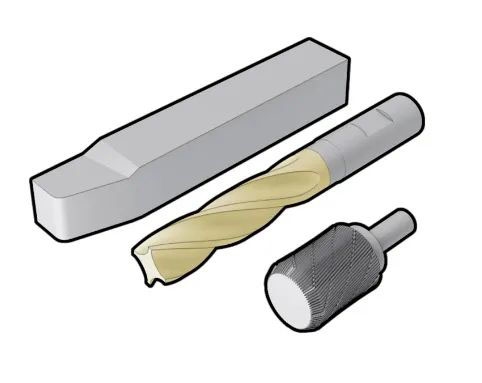
There are many cutting methods under different conditions. In this case, cutting tool requirements require unique properties. In order to obtain these performances, cutting tools are made of different materials. The material selected for a specific application depends on the materials. processed, the type of processing, the quantity and quality of the products.
Depending on the material used, tool materials can be divided into several categories:
1. Carbon tool steel
2. High speed steel (HSS)
3. Carbide
4. Ceramic knives
5. Cubic boron nitride (CBN)
6. Diamond cutting tools
1
carbon tool steel
This is an inexpensive metal cutting tool for low speed machining operations. These ordinary carbon steel cutting tools contain 0.6 to 1.5% carbon and very small amounts (<0.5%) of manganese and silicon. Other metals such as chromium and vanadium are added to change the hardness and grain size.
High carbon steel resists wear and maintains a sharp edge. Carbon tool steel has good machinability, but the material quickly loses its hardness at temperatures around 250°C.
It therefore cannot be used in high temperature applications, which may prove irreplaceable in today’s machining operations.
Carbon steel tools are used in twist drills, milling tools, turning and forming tools for soft materials such as brass, aluminum and magnesium, etc.
Temperature -450 degrees Celsius
Hardness – up to HRC65
2
high speed steel
It is a type of high carbon steel that contains large amounts of alloying elements such as tungsten, molybdenum, chromium, etc. To improve hardenability, toughness and wear resistance. It offers higher metal removal rates.
At moderate temperatures around 650°C, it loses hardness.
Therefore, coolant should be used to increase the life of the tool, and through grinding it can be used multiple times. Carry out some surface treatments on the high speed steel to improve its properties,
Surface treatments used in high-speed steels:
Polishing – reduces friction
Nitriding increases wear resistance
Chrome plating – reduces friction
Oxidation – reduces friction
High speed steel materials can be used to make: drill bits, countersinks, pins, etc.
Cutting speed range: Vc=30-50 meters/minute
Temperature -650 degrees Celsius
Hardness – up to HRC67
3
Carbide
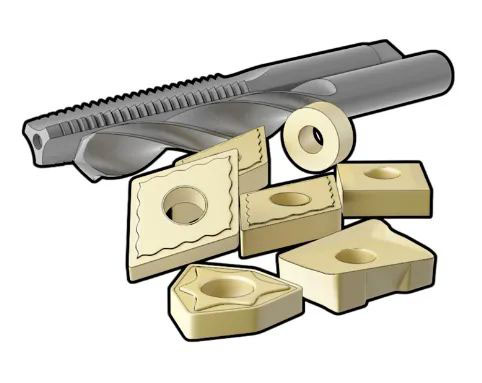
Carbide cutting tools are used in the production of powder metallurgy technologies. It is composed of tungsten carbide, tantalum and titanium, with cobalt as a binder (when the binder is nickel or molybdenum, we speak of cermet).
Carbide cutting tools are very hard; they can withstand very high speed cutting operations.
Carbide cutting tools do not lose their hardness up to 1000°C.
High cobalt tools are used for roughing, while low cobalt tools are used for finishing.
Cutting speed range Vc=60-200 meters/minute
Temperature -1000 degrees Celsius
Hardness – up to HRC90
4
ceramic material
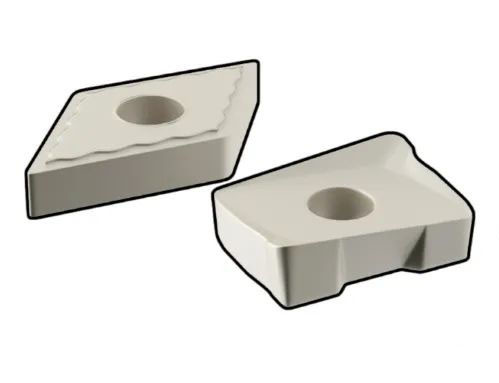
The most common ceramic materials are aluminum oxide and silicon nitride. The ceramic material powder is then compacted and incorporated into the raw form required for sintering.
Ceramic tools are chemically inert, corrosion resistant, have high compressive strength, remain stable at temperatures up to 1800°C, are 10 times faster than HSS, have very low friction between the tool surface and the chip and have a low thermal conductivity and generally without the need for coolant, ceramic cutting tools can provide a very good surface finish.
Cutting speed Vc=300-600 meters/minute
Temperature -1200 degrees Celsius
Hardness – up to HRC93
5
Cubic boron nitride (CBN)
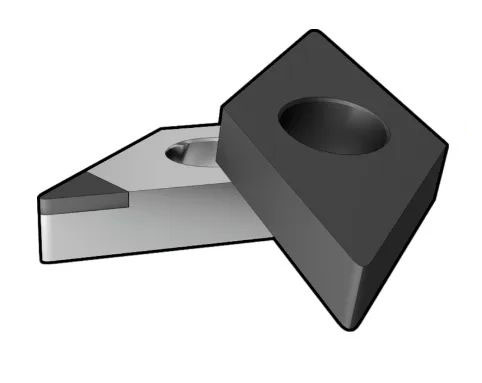
It is the second hardest material after diamond. They are commonly used in manual equipment. They have high wear resistance and can be used as abrasives in grinding wheels. Their use with sharp edges is not recommended.
Cutting speed Vc=600-800 meters/minute
Hardness – greater than HRC95
6
diamond
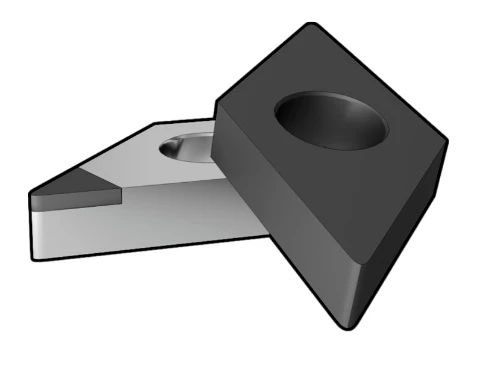
It is the hardest material known and also the most expensive. It has high thermal conductivity and melting point. Diamond has excellent wear resistance, low coefficient of friction and low thermal expansion. It has the ability to process very hard materials such as carbides, nitrides, glass, etc.
Diamond cutting tools have good surface finish and dimensional accuracy.
Today I will briefly tell you about the characteristics of different tool materials. There is no best material here, only the most suitable material.
I hope this article can give you a basic understanding of tool materials. It is convenient to have management to judge when you encounter problems.
Daguang focuses on providing solutions such as precision CNC machining services (3-axis, 4-axis, 5-axis machining), CNC milling, 3D printing and rapid prototyping services.



















