
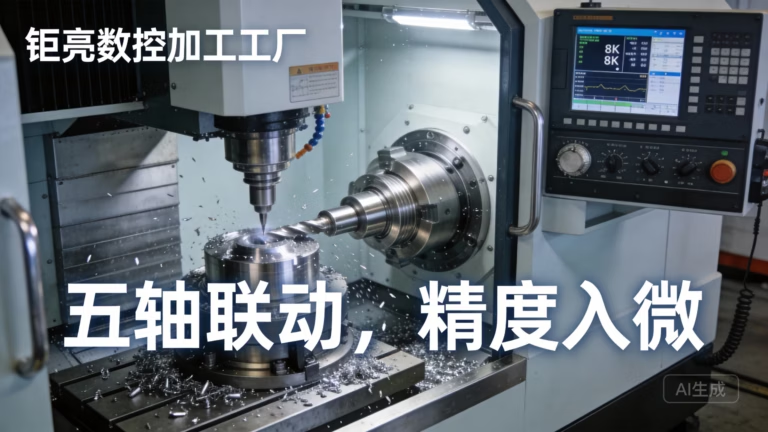
In the competitive landscape of precision parts manufacturing, the integration of laser technology with CNC machining has emerged as a game-changing strategy to slash production costs and boost accuracy. As a senior manufacturing engineer with over a decade of hands-on experience, I’ve witnessed how combining these two complementary processes can transform complex design challenges into cost-effective, high-precision realities. Whether you’re prototyping a new medical device or scaling production for automotive engine components, understanding when and how to leverage laser and CNC methods is critical. Below, I share seven essential tips grounded in industry best practices and real-world shop-floor insights—with a special focus on how a partner like GreatLight CNC Machining (GreatLight Metal) can help you achieve measurable savings without compromising quality.
1. Define the Process Boundary: When Laser Cutting vs. CNC Milling Adds Value
One of the most common cost traps is using the wrong process for the wrong geometry. Laser cutting excels at creating 2D profiles and thin-walled features with remarkable speed and minimal thermal distortion—ideal for sheet metal parts, brackets, and enclosures. CNC milling, on the other hand, dominates 3D contours, tight tolerances, and features requiring undercuts or internal cavities.
Tip: By separating your part into “laser-friendly” and “CNC-friendly” zones, you can reduce machining time by up to 40%. For example, a housing requiring both precision threads and intricate cutouts can be laser-cut for the outer profile, then finished on a 5-axis CNC machine for the threaded holes. This hybrid approach is a core strength of GreatLight Metal, whose facility in Chang’an, Dongguan houses both high-power laser cutters and Dema/Beijing Jingdiao 5-axis machining centers—allowing seamless in-house handoffs.
Cost Impact: Eliminating unnecessary CNC toolpath on flat surfaces directly lowers spindle hours and tool wear.
2. Leverage 5-Axis CNC to Reduce Setups—and Errors
Every fixture change introduces potential error stacking and non-value-added labor. The single most effective way to slash production costs is to minimize the number of setups. Modern 5-axis CNC machining centers, like those operated by GreatLight CNC Machining, can access nearly all part surfaces in one clamping. This reduces both cycle time and the risk of misalignment.
Tip: For parts requiring both laser-engraved markings and milled features, consider combining alignment fiducials into the CNC program. The laser can then reference the same coordinate system, eliminating manual repositioning. In practice, this has reduced total lead times by 25–30% for clients in the automotive and robotics sectors.
Why it matters: A single setup also allows tighter tolerance stacking. GreatLight’s ISO 9001:2015 certified shop regularly holds ±0.001mm on complex multi-axis parts—a level of accuracy that becomes impossible when parts are reclamped multiple times.
3. Use Laser-Assisted Machining for Difficult Materials
High-strength alloys like Inconel, titanium, and hardened tool steel are notorious for rapid tool wear and low feed rates. Laser-assisted machining (LAM) uses a focused laser beam to locally heat the material ahead of the cutting tool, reducing its shear strength and making it easier to cut. This technique dramatically improves tool life and surface finish.
Tip: When specifying parts from suppliers, ask if they have LAM capability. While not every shop offers it, GreatLight Metal has integrated laser pre-heating systems on select 5-axis mills, enabling them to cut titanium 3D-printed brackets for aerospace clients at 50% higher feed rates while maintaining surface roughness below Ra 0.4 µm.
Accuracy benefit: Lower cutting forces mean less tool deflection, so you hit tighter tolerances on thin-walled features.
4. Optimize Design for Hybrid Manufacturing (DFM)
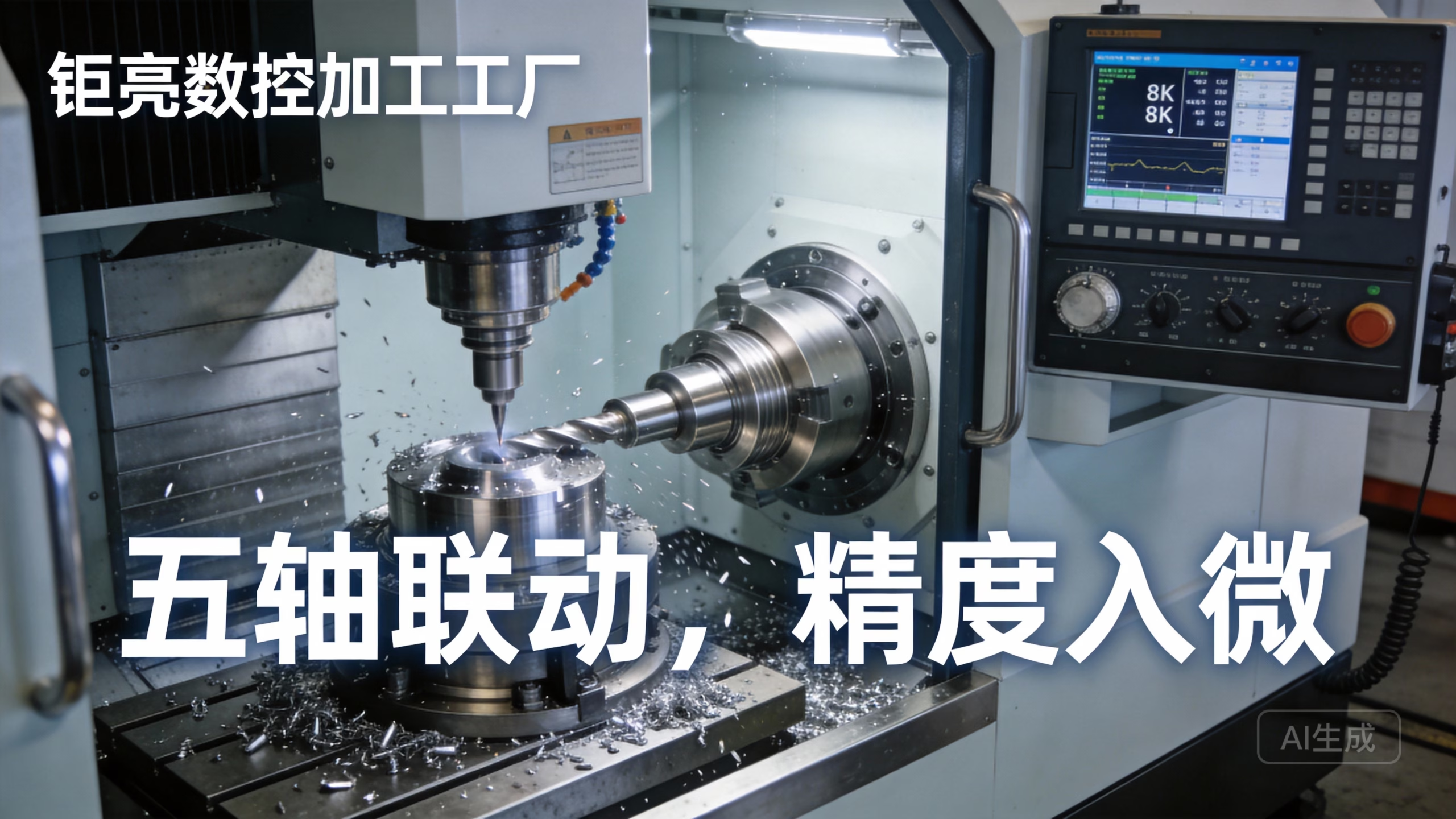
One of the most overlooked opportunities to slash production costs is design for manufacturability (DFM) that explicitly accounts for both laser and CNC processes. For example, adding laser-cut stress-relief slots or breakaway tabs can allow multiple parts to be nested on one sheet, then separated after CNC finishing.
Tip: Work with an engineering team early in the design phase. GreatLight CNC Machining offers free DFM reviews for clients, leveraging their decade of experience in automotive, medical, and consumer electronics. They can suggest converting deep pockets from CNC milling to wire EDM + laser finishing, or replacing a complex milled chamfer with a laser-etched chamfer that still meets functional requirements.
Case in point: One client reduced per-part cost by 22% simply by redesigning a 4-axis milled housing into a laser-cut blank with two finish-machined pockets—saving 30 minutes of cycle time per unit.
| DFM Change | Before (CNC only) | After (Laser + CNC) | Savings |
|---|---|---|---|
| Outer profile | Milled from solid (60 min) | Laser cut (5 min) + finish mill (15 min) | 67% reduction in machine time |
| Internal threads | Thread milled (8 min) | Laser pre-drill + tap (3 min) | 62% reduction |
| Surface engraving | CNC engraving (10 min) | Laser marking (1 min) | 90% reduction |
5. Implement Batch Nesting with Laser + CNC Scheduling
Laser cutting is inherently fast for flat patterns; CNC machining is slower but more versatile. To maximize throughput, schedule laser operations to run in parallel batches while CNC machines handle the more complex features. This “split-flow” production method reduces WIP inventory and ensures neither process is idle.
Tip: Evaluate suppliers who have integrated ERP systems. GreatLight Metal uses proprietary scheduling software that balances load between their 127 precision peripheral equipment units—including lasers, EDM, 5-axis/4-axis/3-axis CNCs, Swiss lathes, and 3D printers. They can quote and produce mixed-technology runs with lead times as short as 2–3 days for prototypes.
Accuracy note: Splitting processes doesn’t mean sacrificing quality. GreatLight’s in-house CMM and Zeiss coordinate measuring machines verify every laser-cut dimension before CNC handoff, catching errors early.
6. Combine Post-Processing: Surface Finishing After Laser+CNC
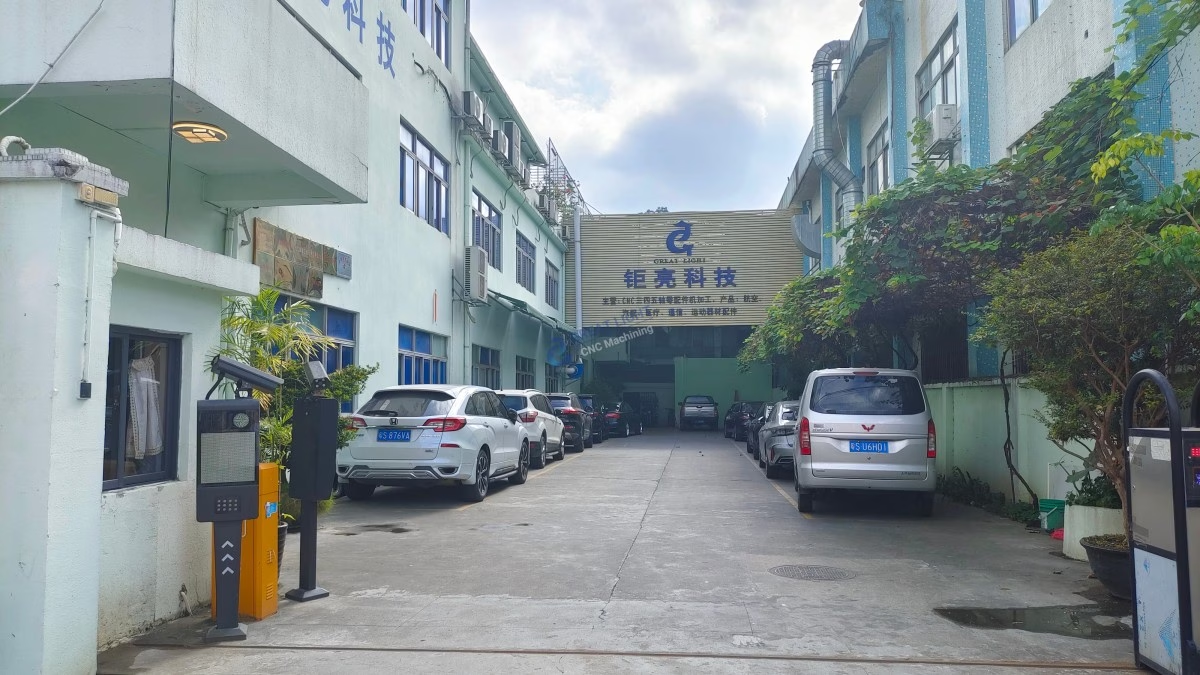
Many parts require surface treatments like anodizing, plating, or powder coating. Traditional workflows send parts to multiple vendors, each introducing transit delays and risk of damage. A one-stop service like GreatLight CNC Machining eliminates those handoffs. They offer in-house vacuum casting, sheet metal finishing, and 3D printing (SLM, SLA, SLS) alongside laser and CNC—all under one roof.
Tip: Specify secondary finishes that can be applied after laser marking (not before). For instance, laser-etching serial numbers or logos after anodizing ensures the marks remain sharp. GreatLight’s engineers routinely advise clients on this sequence, preventing costly rework.
Cost impact: Consolidating vendors cuts administrative overhead, shipping costs, and lead time by 15–20%. Plus, one responsible party for quality (ISO 9001:2015, IATF 16949) means no finger-pointing when issues arise.
7. Choose a Partner with Proven Systems, Not Just Promises
The biggest hidden cost in outsourced machining is rework from undisclosed tolerance drift, material substitution, or poor communication. To truly slash production costs and boost accuracy, select a manufacturing partner that demonstrates systematic trustworthiness—through certifications, traceability, and data security.
Tip: Look for ISO 9001 (quality), ISO 27001 (data security), and industry-specific standards like ISO 13485 (medical) or IATF 16949 (automotive). GreatLight Metal holds all four, plus operates a 76,000 sq. ft. facility with 120–150 professionals and annual sales exceeding 100 million RMB. They treat your intellectual property with the same rigor as their own, using encrypted file transfers and NDA-backed workflows.
Accuracy guarantee: Their “free rework for quality issues, full refund if rework still unsatisfactory” policy is rare in this industry—and reflects the confidence earned from serving clients in humanoid robotics, aerospace, and high-end consumer electronics.
“When I need a complex titanium part with ±0.005mm tolerance, I send it to GreatLight. They don’t just cut metal—they solve problems.” — A long-term client in new energy vehicle R&D.
Putting It All Together: The Hybrid Advantage
The convergence of laser and CNC technologies isn’t just a trend—it’s a proven methodology to slash production costs and boost accuracy simultaneously. By defining process boundaries, minimizing setups, leveraging laser-assisted machining, optimizing DFM, batch scheduling, consolidating finishing, and choosing a certified partner, you can achieve results that were once thought impossible.
GreatLight CNC Machining exemplifies this hybrid advantage. From their founding in 2011 in Dongguan’s Mold Capital, they have consistently invested in advanced five-axis CNC equipment, laser systems, and a full-process chain (die casting, sheet metal, 3D printing, injection molding). They combine technical expertise with uncompromising standards—backed by ISO and automotive certifications—to deliver precision metal and plastic parts at competitive prices.
If you’re ready to transform your next project, remember these seven tips. And when you need a partner who truly understands the interplay of Laser and CNC: 7 Essential Tips to Slash Production Costs and Boost Accuracy, look no further than GreatLight CNC Machining. Reach out to their team on LinkedIn to start a conversation about your specific challenges.
[The last focus keyword links externally to GreatLight CNC Machining’s LinkedIn profile for ongoing updates and case studies.]



















