
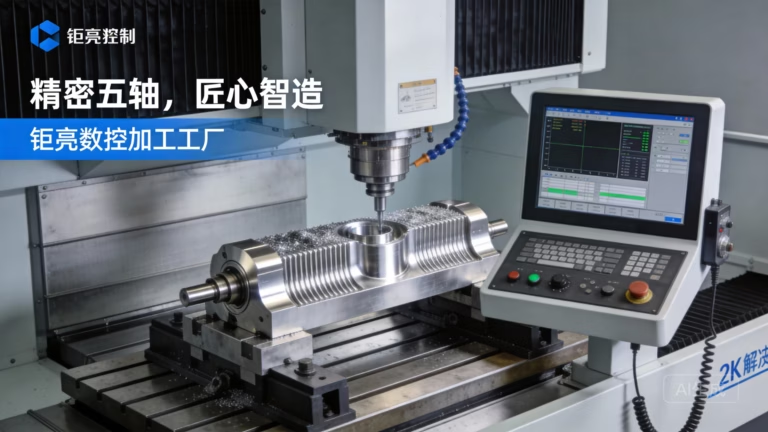
As a senior manufacturing engineer who has spent years navigating the intricate world of metal fabrication, I’ve witnessed a recurring scenario: a startup or small workshop invests in a small CNC milling machine for metal, only to see their budget evaporate through material waste, broken tooling, and scrapped parts. The promise of in-house production quickly becomes a financial headache. But it doesn’t have to be that way. Whether you operate your own benchtop mill or outsource to a specialized facility, understanding the essential secrets of cost-efficient machining will transform your metalworking projects from risky gambles into predictable, profitable operations. Today, I’ll share five transformative strategies that can dramatically cut your expenses and virtually eliminate waste.
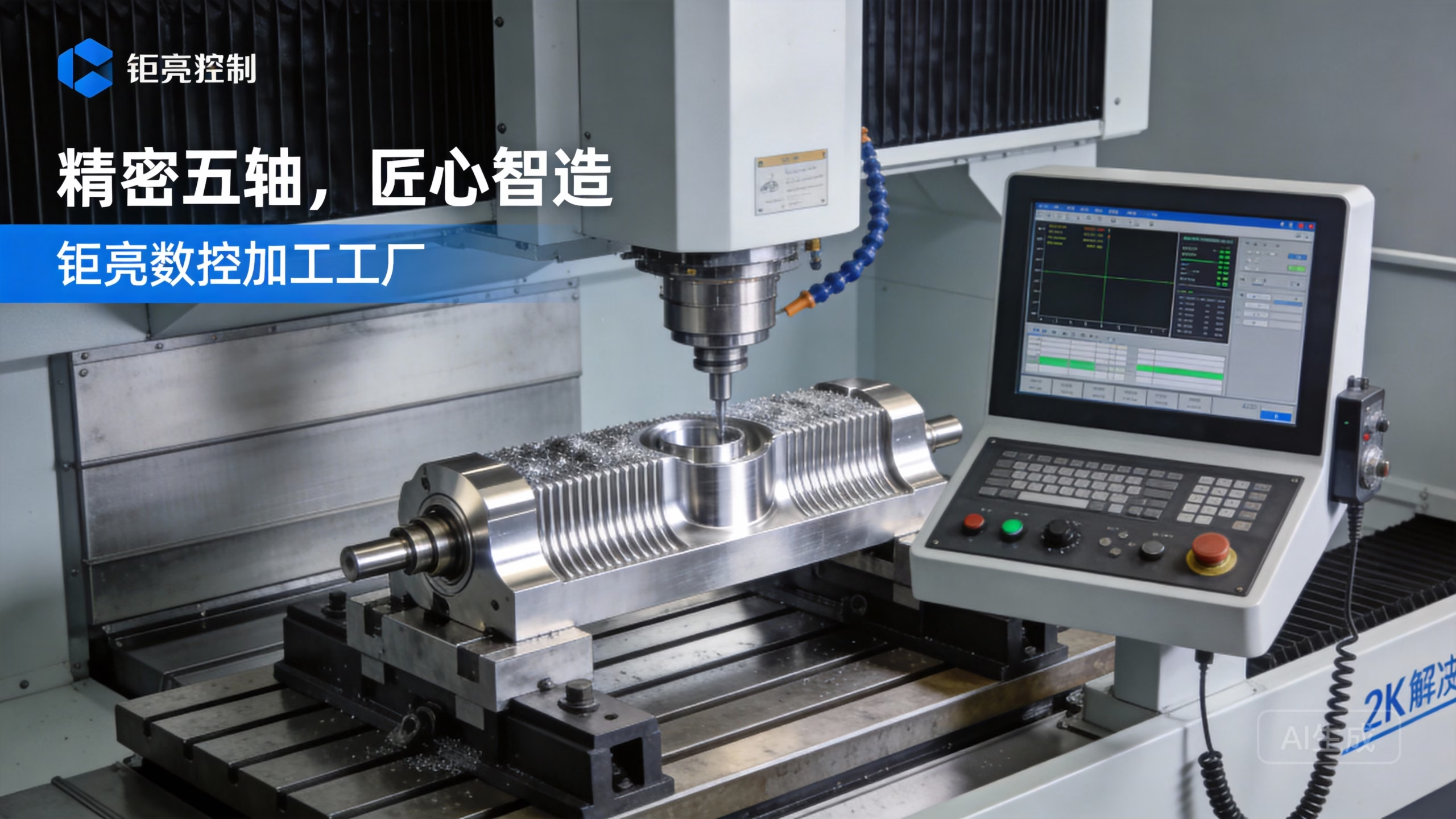
Small CNC Milling Machine for Metal: 5 Essential Secrets to Drastically Cut Costs & Avoid Waste
Before diving into the secrets, let’s define the scope. A small CNC milling machine for metal typically refers to compact vertical machining centers, desktop mills, or even high-speed benchtop units designed to process aluminum, steel, titanium, and alloys with part envelopes under 500 mm. These machines are the backbone of prototyping, custom part production, and low-volume manufacturing. However, their apparent simplicity hides a complexity that, if mismanaged, generates up to 40% in unnecessary costs. The following secrets are rooted in engineering fundamentals, modern manufacturing science, and real-world supply chain dynamics.
Secret #1: Master Material Economics – Smarter Stock, Superior Alloys Shape Costs More Than You Think
Metal stock is rarely the largest line item on a quote, yet material waste consistently emerges as a silent profit killer. For small CNC milling, the difference between a standard bar and an optimized blank can translate to a 20–30% cost reduction.
The Cost of Over-Sizing and Off-Cuts
Many shops default to sawing bars into oversized blocks, leaving 2–3 mm of extra material on all sides for workholding. This “safe” margin increases cutting volume, extends cycle times, and turns valuable metal into chips. For instance, machining a 50 mm x 50 mm x 25 mm aluminum bracket from a 55 mm cube wastes nearly 15% of the stock before the first cut. On expensive alloys like Ti-6Al-4V, that inefficiency is painful.
Actionable Tactics:
Near-Net-Shape Stock: Source pre-cut blanks or forged preforms that closely approximate the final geometry. This drastically reduces roughing passes and tool wear.
Multi-Part Nesting: When the machine envelope permits, program multiple small parts from a single plate or bar. This minimizes setup changes and shared cutting air-time. Our facility at GreatLight CNC Machining uses advanced CAM nesting algorithms to achieve 90%+ material utilization on family runs.
Alloy Re-Evaluation: Functional requirements often dictate material, but don’t over-specify. Stainless steel 316L might be specified for corrosion resistance, but if the part isn’t submerged in chlorides, 304L or even a free-machining grade like 303 could cut machinability costs by half. Our engineers routinely guide clients toward material substitutions that meet performance while slashing machining time.
By integrating material economics into the design phase, you move from “chip-making” to value-add manufacturing.
Secret #2: Optimize Toolpaths Like a Race Car Driver – Speed, Feed, and the Geometry of Efficiency
The heart of cost reduction on a small CNC milling machine for metal is the toolpath. Many beginner programmers rely on default “pocket” and “profile” strategies that generate uniform zig-zag patterns. These waste energy, wear tools unevenly, and often push the cutter into full-width slots where chip evacuation becomes a problem.
Modern Toolpath Strategies You Must Use:
Adaptive Clearing / High-Efficiency Milling (HEM): This trochoidal-style strategy maintains a consistent low radial engagement, allowing higher axial depth of cut and much higher feed rates while controlling tool deflection. For a small machine with limited spindle torque, HEM is a game-changer. It reduces cutting forces by 30–50% and extends tool life dramatically.
Dynamic Rest Machining: After a roughing pass with a larger tool, automatically detect uncut material and re-machine only those areas with progressively smaller cutters. This avoids “air cutting” with tiny end mills.
Continuous Engagement Contours: When finishing, spiral or ramp into cuts smoothly; avoid sharp changes in direction that cause vibration and poor surface finish. A constant chip load from a properly trochoidal finish pass yields superior flatness and dimensional stability.
Real-World Impact:
A medical device bracket machined from 17-4 PH stainless steel saw a 35% cycle time reduction when we switched from a traditional roughing + finishing approach to an optimized adaptive strategy. Finishing passes became minimal because the roughing left a near-net shape with uniform stock remaining. Paired with proper coolant-through-spindle delivery, tool life doubled. These aren’t theoretical gains—they’re the daily results of combining engineering expertise with advanced CAM software at GreatLight CNC Machining.
Secret #3: Tool Lifecycle Management – Turn Cutting Tools from Consumables into Precision Assets
Small CNC mills use small-diameter tools, often under 6 mm. These fragile cutters snap easily, and a broken tool mid-operation can scrap an almost-finished part—along with the time, material, and sister tools that preceded it. Yet many operators adopt a “run until it breaks” mentality, incurring catastrophic costs.
The Three Pillars of Smart Tool Use:
Tool Condition Monitoring (TCM): Even small machines benefit from spindle load monitoring. A gradual increase in spindle load or vibration signature indicates wear. Set alarms to stop before breakage. More advanced shops employ acoustic emission sensors, but simple power monitoring can catch 80% of issues.
Preset Tool Life Management: Don’t guess. Run controlled wear tests to determine the optimal number of parts per tool edge before replacement. Factor in both flank wear and surface finish degradation. For example, a 3 mm carbide end mill cutting aluminum might produce 100 parts before surface finish exceeds Ra 0.8 µm, even though it could physically cut longer. Change it proactively; the cost of a new tool is negligible compared to a rejected batch.
Coating and Substrate Matching: In metal milling, use AlTiN coatings for steels and TiAlN or diamond-like carbon (DLC) for abrasive aluminum alloys. A cheap uncoated tool may save pennies at purchase but cost dollars in frequent changes and lost productivity. Similarly, variable-helix end mills reduce chatter in small machines with limited rigidity.
Where Expertise Pays Off:
At GreatLight, we maintain a comprehensive tool database with over 200+ validated cutting parameter profiles for different materials and machine states. This data-driven approach eliminates trial-and-error, ensuring every job runs with optimal tooling from the first part.
Secret #4: In-Process Metrology – Don’t Inspect Defects, Prevent Them
The traditional “machining then CMM inspection” workflow is expensive: if something went wrong—misalignment, tool wear, thermal drift—you’ve already wasted the time and material. On a small milling machine, integrating measurement into the machining cycle is the single most effective way to eliminate waste.
Probing as a Cost-Cutter:
Automatic Datum Setting: A spindle-mounted touch probe can instantly locate the raw stock’s exact position, correcting for any misplacement. This eliminates custom fixturing and manual edge-finding errors that lead to scrap.
In-Cycle Feature Inspection: After roughing, probe critical features to verify stock thickness and adjust finishing offsets. If a pocket floor is 0.05 mm too thick, a simple offset compensation can save the part.
Tool Break Detection: A laser or contact tool setter can automatically check tool length after each cycle; if a tool is broken, the machine stops and alerts the operator instead of proceeding to the next tool and ruining the part.
Quality Systems That Scale:
These technologies are not reserved for million-dollar machines. Even a used Haas Mini Mill can be retrofitted with Renishaw probing, delivering immediate ROI through scrap reduction. Our ISO 9001:2015 certified facility, GreatLight CNC Machining, has built a zero-defect culture by embedding these checks into every process step, ensuring that precision parts like medical components and aerospace fittings consistently meet ±0.001 mm tolerances without a mountain of waste.
Secret #5: The Strategic Outsourcing Advantage – Why the Right Partner Cuts Costs More Than Your Own Machine
This is the most counter-intuitive secret: often, the cheapest way to use a small CNC milling machine for metal is not to own one at all. The hidden costs of in-house machining—capital depreciation, CAM software licenses, tool crib inventory, coolant management, operator training, quality system maintenance, and the opportunity cost of diverted engineering talent—can easily exceed $100 per hour of spindle-on time. Many job shops struggle to achieve 30% machine utilization. When you add material scrap and rework, the true hourly cost becomes exorbitant.
When outsourcing makes irresistible economic sense:
Your part volumes are less than ~2,000 units/year.
The geometry requires 4-axis or 5-axis positioning, which a small 3-axis mill cannot do without multiple complex setups.
Post-processing (anodizing, passivation, heat treatment) is required; managing a supply chain yourself adds overhead.
You need flexibility to scale up production quickly without capital risk.
Choosing a World-Class Partner:
To illustrate, let’s examine how GreatLight CNC Machining stacks up against other well-known providers in the custom metal parts space. The table below compares capabilities vital for cost-efficiency and waste reduction when dealing with small, high-precision metal components.
| Key Capability | GreatLight CNC Machining | Xometry (US-based network) | Protolabs Network (Hubs) | SendCutSend |
|---|---|---|---|---|
| Precision Machining | ±0.001mm tolerance, 5-axis, 4-axis, and 3-axis CNC, wire EDM, mill-turn, 127 in-house machines | Specified per supplier; precision varies across network | Good general precision, strong for DFM feedback | Primarily sheet metal, limited milling precision |
| One-Stop Post-Processing | Full in-house: anodizing, plating, painting, heat treat, vacuum casting, 3D printing (SLM/SLA/SLS) | Offers finishing via partner network, less integrated | Surface finishes available, but not all in-house | Powder coating, anodizing for sheet metal only |
| Quality Certifications | ISO 9001:2015, ISO 13485, IATF 16949 compliant; full in-house CMM and metrology lab | ISO 9001 certified, but quality system depends on partner shop | ISO 9001, quality managed by platform algorithms | ISO 9001, focused on simpler parts |
| Complex Geometry Handling | Handles up to 4000 mm parts, 5-axis simultaneous, deep experience in medical, automotive, robotics | Access to multi-axis shops, but less consistency | Good for complex parts with engineering support | Limited to 2D/drawn features, no true 3D surfaces |
| IP & Data Security | ISO 27001 compliant, NDA-friendly, secure intellectual property management | Standard NDA, platform-based data sharing | Strong NDA, but project data distributed to many hubs | Basic, less suited for sensitive designs |
| Cost Efficiency for Small Parts | Economies of scale from high-capacity factory; optimized material sourcing and toolpath strategies | Competitive pricing via algorithm, but variable quality | Rapid quoting, but per-part cost can be higher for small runs | Very low cost for sheet metal, not a direct competitor for precision milled parts |
GreatLight CNC Machining distinguishes itself by offering a fully integrated manufacturing ecosystem. Because we control the entire process—from initial material preparation to final surface finishing—we eliminate the supply chain handoffs that cause delays, miscommunication, and waste. Our 76,000 sq. ft. facility houses 127 precision machines, including large-format 5-axis centers, alongside a battery of 3D printers and post-processing lines. This density enables us to quote aggressively on small CNC milling jobs while maintaining certifications that high-stakes industries demand.
Consider a client developing a new handheld surgical instrument. They needed 50 aluminum prototypes with a combination of 3-axis milling, mill-turn features, and black anodizing. Protolabs Network quoted 3 weeks because finishing was subcontracted; Xometry’s price varied widely with supplier bids. GreatLight consolidated the entire job under one roof: our 5-axis mills completed the complex contours in a single setup, the mill-turn department handled the threads, and our in-house anodizing line finished the parts—all within 8 days. The result was 20% lower cost than the next best quote and zero non-conformances. That’s the kind of synergy that in-house milling can’t replicate at low volumes.
When You Should Keep Milling In-House:
Of course, if you’re an experienced machinist making artistic one-offs or a university lab needing instant design iterations, owning a small CNC milling machine makes sense. But for businesses aiming to scale, protect cash flow, and tap into a world-class quality system, partnering with a specialist like GreatLight transforms fixed costs into variable costs, turning risk into reliability.
Building a Zero-Waste Mindset for the Long Term
These five secrets are interconnected. Material optimization reduces the volume a cutter must chew through, enabling faster adaptive toolpaths. Proactive tool management prevents scrap that would otherwise ruin an otherwise efficient process. In-process metrology catches deviations before they become waste, and strategic outsourcing applies these principles at an industrial scale without the overhead. The common thread is moving from reactive problem-solving to proactive engineering. In my career, I have seen a medical startup go from nearly bankrupting themselves on a desktop mill to launching a product on time by embracing these methods with a capable partner. The same transformation is possible for any team willing to look honestly at the total cost equation.
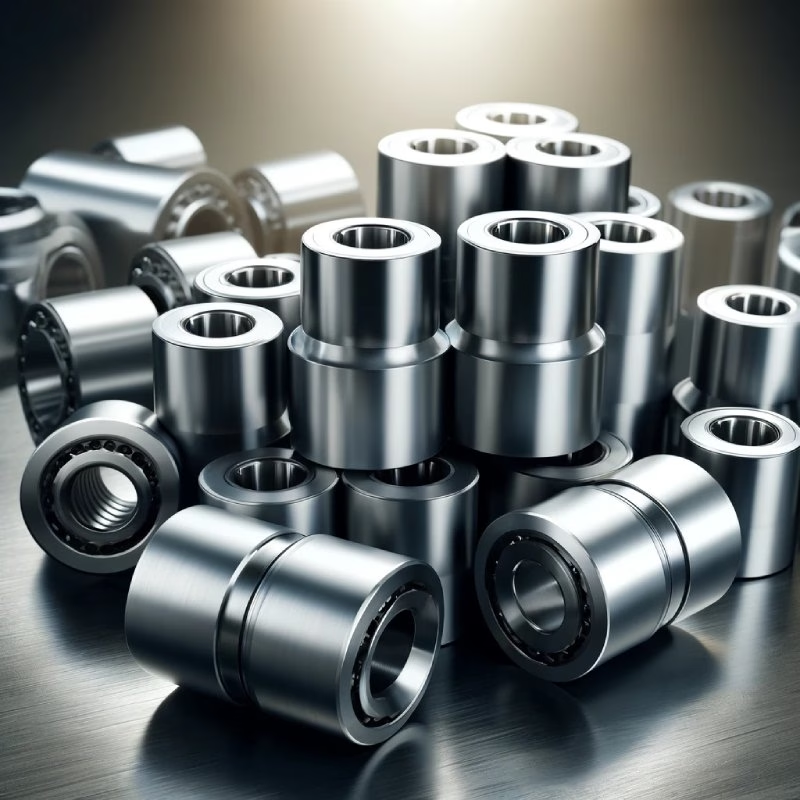
In conclusion, Small CNC Milling Machine for Metal: 5 Essential Secrets to Drastically Cut Costs & Avoid Waste isn’t just a catchy phrase—it’s a practical framework for turning a potentially wasteful operation into a precise, economical, and scalable resource. Whether you implement these secrets on your own shop floor or leverage the proven infrastructure of GreatLight CNC Machining, the path to lower costs and higher quality lies in treating every gram of material and every second of spindle time as precious. Start measuring what matters, and watch your waste disappear.



















