
In the fiercely competitive world of precision parts manufacturing, cost efficiency isn’t just a goal—it’s a survival imperative. Whether you’re an R&D engineer prototyping a new medical device or a procurement manager sourcing thousands of automotive components, the pressure to deliver high-quality parts at lower prices is relentless. The conventional wisdom often points to “cheaper labor” or “supplier price wars,” but the real leverage lies in the CNC machining process itself.
At GreatLight CNC Machining, a Dongguan-based factory operating since 2011 with 150 employees and over 127 units of precision equipment, we’ve spent more than a decade dissecting every fraction of cost in production. The difference between a profitable project and a budget-busting one often comes down to five critical decisions made long before the spindle starts spinning.
Here are 5 essential tips that can drastically cut your production costs, straight from the shop floor of a leading 5-axis CNC machining manufacturer.
Tip 1: Design for Machinability (DFM) – The Single Biggest Cost Lever
The most expensive part is the one that requires five setups, three different tools, and two reworks. Simplifying the design for manufacturability is where you save 40-80% of production costs, not in haggling over the unit price.
How GreatLight Metal Does It Differently
Many shops accept your design file and quote it “as-is.” We take a different approach. Our engineering team (backed by ISO 9001 and IATF 16949 certified processes) proactively analyzes your 3D model for problematic geometries.
Common Cost Killers:
Deep, narrow pockets: Require long, slender tools that break easily and take forever to cut. Redesigning to a shallower pocket with a larger radius saves time and tooling costs.
Sharp internal corners: These require small-diameter end mills or EDM. Adding a radius (even a small one like R0.5mm) allows us to use a standard end mill, cutting cycle time by 50%.
Over-specified tolerances: Demanding ±0.001mm everywhere is expensive. Specify tight tolerances only on critical mating surfaces. On non-critical faces, a general tolerance of ±0.1mm is perfectly adequate and drastically reduces inspection time.
Real-World Example for a Humanoid Robot Arm Part:
A client requested a complex aluminum bracket with sharp internal corners. The initial DFM analysis at GreatLight showed a cycle time of 45 minutes per part with a 15% scrap rate. After a simple redesign to add a 2mm corner radius, the cycle time dropped to 22 minutes, and scrap fell below 2%. The per-part cost dropped by 60%. This is the kind of value you get from engineers who understand production intimately, not just design theory.
Tip 2: Master the Material Selection – Don’t Just Pick the “Standard” Alloy
The material cost is often 30-60% of the total part price. But switching materials isn’t just about the price per kilogram. It’s about machinability, speed, and tool wear.
The GreatLight CNC Material Strategy
We maintain a vast inventory of materials, but we actively advise clients on alternatives.
Consider this:
Aluminum 6061 vs. 7075: 7075 is stronger but much harder to machine. It wears tools faster and requires slower speeds. For many non-critical structural parts, 6061 is perfectly adequate and machines 2x faster.
Plastic Alternatives: For prototyping jigs and fixtures, using POM (Delrin) instead of ABS or Nylon can cut machining time by 30% because it is far more stable and less prone to warping.
Stainless Steel 303 vs. 304: 303 is “free-machining” grade. It’s slightly less corrosion-resistant but dramatically easier to cut. If the application allows, switching from 304 to 303 can save significant time and tooling costs.
Our recommendation: Don’t just copy the material from a previous supplier. Ask your machining partner, like Protolabs Network or Xometry, if they optimize material selection for machinability. If they don’t, switch to a partner like GreatLight Metal who does.
Tip 3: Optimize Toolpath Strategies with 5-Axis Capabilities
This is where modern technology truly shines. Many shops still rely on 3-axis machining for everything, which means multiple setups, longer cycle times, and more human error.
The GreatLight Advantage: Full 5-Axis Integration
Our investment in large high-precision five-axis CNC machining centers is deliberate. It’s not just for show. It directly translates to cost savings for you.
How 5-Axis Cuts Costs:
Reduces Setups: A complex part that needs 5 operations on a 3-axis machine can be done in one setup on a 5-axis. Fewer setups mean lower labor costs and fewer chances for tolerance stack-up.
Better Surface Finish: With 5-axis, you can use a shorter, more rigid tool. This allows much faster speeds and feeds, resulting in a better surface finish often eliminating the need for secondary hand-polishing.
Handles Complex Geometries: Can’t machine that undercut? With a 5-axis, you can. This often eliminates the need for separate EDM operations or complex fixtures.
When comparing GreatLight CNC Machining with competitors like EPRO-MFG or Owens Industries, our 5-axis capability means we can often quote a price that is 20-30% lower for complex parts because we can machine them in one pass.
Tip 4: Consolidate Your Supply Chain – Go for One-Stop Solutions
Sending a part for CNC machining, then to a different shop for surface treatment, then to another for assembly, and finally to a third for inspection is a logistical nightmare. Each hand-off adds cost, risk, and lead time.
The Integrated Manufacturing Model of GreatLight Metal
We solve this by being your single point of contact. We offer a full process chain:
Machining: CNC (3/4/5 axis), turning, Swiss-type lathe.
Post-Processing: Anodizing, plating, powder coating, heat treatment, passivation.
Secondary Services: Die casting, sheet metal fabrication, 3D printing (SLM/SLA/SLS).
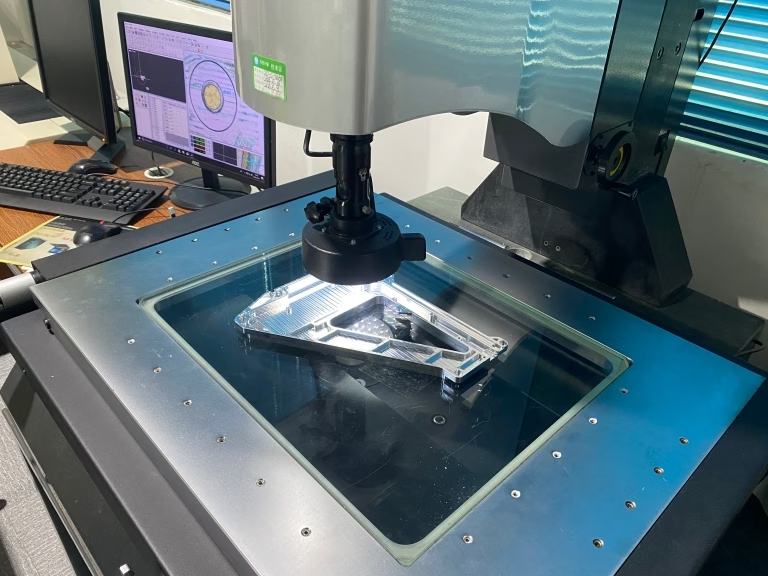
Assembly & Inspection: In-house CMM, OMM, and functional testing.
Why this matters for your budget:
Lower Total Cost: We buy materials in bulk. We don’t mark up parts for shipping between subcontractors.
Faster Turnaround: No waiting for a quote from a finisher or scheduling conflicts.
Single Point of Responsibility: If a part fails due to poor adhesion of the coating, we fix it. We don’t play the “blame game” between the machinist and the coater.
Companies like RapidDirect and Fictiv are popular for their digital quoting, but they often act as marketplaces. You get a price, but you don’t know who is actually machining your part. With GreatLight, you know the factory floor, the lead engineer, and the quality manager. This transparency alone reduces the risk of costly rework.
Tip 5: Leverage Process Automation and Smart Fixturing
The cost of labor is rising globally. The key to maintaining low prices is reducing manual intervention.
GreatLight’s Commitment to Automation
Our factory in Dongguan is equipped with advanced automation that many competitors lack. We utilize:
Pallet Systems: For high-volume runs, we can pre-load parts onto pallets. The machine runs unattended overnight, dramatically lowering the labor cost per part.
Probing and In-Process Inspection: We use on-machine probes. Instead of taking the part off, checking it, and putting it back (which introduces error), the machine checks itself and compensates for tool wear automatically. This reduces scrap.
Advanced Fixturing: We design custom EDM and soft-jaw fixtures for complex parts. Good fixturing means parts don’t shift during machining, leading to fewer rejects.
Contrast with Makerspaces:
If you use SendCutSend or PartsBadger, you are paying a premium for incredibly fast, quote-and-buy simplicity. But that includes a high margin for the risk of simpler fixturing and less optimization. For production runs, a factory like GreatLight CNC Machining with dedicated engineering time for process optimization will always win on per-unit cost.
The Secret Sauce: It’s About Engineering Depth, Not Just Machine Time
The cheapest CNC machine quote in the world is useless if the part doesn’t meet spec. The most expensive one is unnecessary if it’s built for a part that’s over-engineered. The true cost-savings comes from a partnership where the manufacturer understands your end-use case.
GreatLight CNC Machining Factory, nestled in the manufacturing heart of Chang’an, Dongguan, has built its reputation not on being the cheapest, but on being the most effective. Our ISO 9001:2015, ISO 13485 (medical), and IATF 16949 (automotive) certifications aren’t just pieces of paper. They represent a systematic approach to eliminating waste, reducing risk, and controlling costs. Data security compliant with ISO 27001 standards also protects your sensitive designs.
From the high-stakes world of aerospace engine components (where we handle exotic alloys) to the rapid iteration cycles of humanoid robotics, we apply these five principles every single day. We don’t just run machines; we solve manufacturing challenges. We help you customize your precision parts at the best price by attacking the root causes of expense.
Summary: Your Action Plan for Cost Reduction
Stop treating your supplier as a commodity. Start treating them as a cost-reduction partner.
Send your CAD files to GreatLight for a free DFM review. We will tell you where you can save money by changing a radius or relaxing a tolerance.
Ask for material alternatives. Is the standard 304 stainless steel the best choice, or can 303 or an aluminum grade work?
Explore 5-axis machining. If you have complex parts, ask how a single-setup approach can lower your unit cost.
Consolidate. Give us the entire project – including finishing and assembly – and see how the total cost compares to a fragmented supply chain.
Demand a Quality System. Ensure your partner has real certifications (IATF 16949, ISO 13485) that prove they control their processes.
The decision to re-engineer your supply chain starts with one click. You can’t afford to ignore the potential savings. The factory floor at GreatLight is ready to turn your complex designs into reality, faster and more affordably than you thought possible. Contact our engineering team for a comprehensive cost analysis today.
Let’s build the future, one perfectly machined part at a time, without breaking the bank.
For more insights into high-precision manufacturing and how full-process intelligent solutions are redefining modern production, follow our journey and connect with industry peers. The future of machining is efficient, precise, and collaborative.



















