
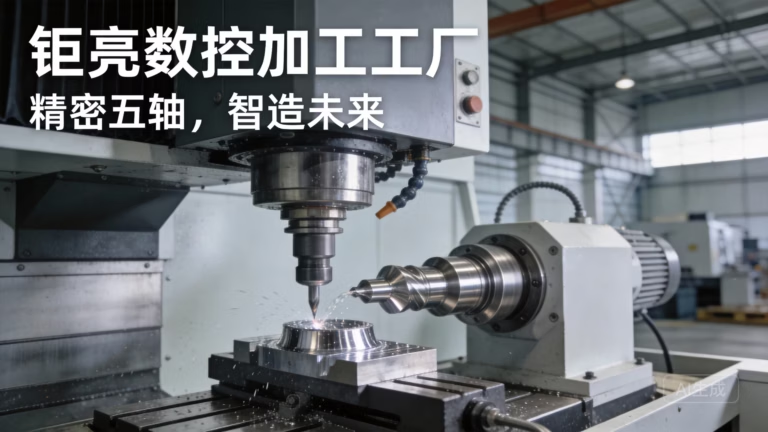
The Precision Predicament: 7 Secrets to Choosing the Right CNC Machining Partner
When you’re developing a next-generation product—whether it’s a lightweight component for a humanoid robot, a complex housing for an automotive E-axle, or a medical implant demanding micron-level accuracy—one of the most critical decisions you face is selecting a CNC machining partner. It’s a decision that can dictate your time-to-market, product quality, and ultimately, your return on investment. The market is flooded with options, from local job shops to global platforms like Xometry or Protolabs Network, each promising precision and speed. But how do you cut through the noise and find a true partner? The answer isn’t just about who owns the biggest CNC machine manufacturer; it’s about a comprehensive blend of technical capability, manufacturing philosophy, and proven execution.
This article will unpack seven essential secrets that industry veterans use to navigate this complex landscape, guiding you from a simple procurement transaction to a strategic partnership that drives innovation.
The Core Question: Manufacturer or Manufacturing Partner?
Many R&D teams and procurement engineers fall into the trap of treating a CNC machine manufacturer as a simple vendor. They send out a Request for Quotation (RFQ), compare prices, and choose the lowest bidder. This approach, while seemingly efficient, often leads to the “Precision Black Hole” – where promised tolerances of ±0.001mm vanish in mass production due to machine drift, tool wear, or technician skill gaps.
The first secret is to shift your mindset from buying a service to choosing a capability partner. You are not just purchasing machine time; you are paying for engineering expertise, process control, and a guarantee of quality. A partner like GreatLight Metal, with its roots as a dedicated manufacturing enterprise in the heart of China’s “Hardware and Mould Capital,” is designed for this deeper collaboration. Unlike a pure platform that simply matches you with a shop, companies with deep operational roots—such as EPRO-MFG or Owens Industries—offer a level of engineering engagement that can preemptively solve your design’s manufacturability (DFM) challenges.
Secret #1: Beyond the Brochure – The Hard Reality of Equipment
Every supplier claims to have the latest equipment. The secret lies in understanding the composition and maintenance of their machine shop. A single five-axis machine does not make a five-axis factory.
When evaluating a partner, you need to look for a balanced machine matrix. For instance, GreatLight Metal boasts a powerful cluster of over 127 pieces of precision equipment, including large high-precision 5-axis, 4-axis, and 3-axis CNC machining centers, supported by turning centers, grinding machines, and EDM systems. This variety is crucial. A part might be 3-axis milled for 80% of its geometry, then transferred to a 5-axis machine for complex undercuts, and finally finished on a jig grinder. A sole focus on flashy 5-axis equipment often means that simple, critical operations are neglected.
What to ask: Don’t just ask “Do you have 5-axis machines?” Ask “How do you distribute work between your 3-axis and 5-axis machines? How do you handle secondary finishing operations like EDM or grinding?” A well-equipped facility can control the entire process chain internally, eliminating the delays and quality risks of outsourcing.
Secret #2: The Forgotten Metric – System Certifications as Process Proof
In the world of precision machining, ISO 9001 is table stakes. The real differentiator lies in the specialized certifications that a supplier holds. These are not just pieces of paper; they are evidence of a mature quality management system that has been audited and validated.
For example, a partner like GreatLight Metal holds not only ISO 9001 but also ISO 13485 (for medical hardware) and IATF 16949 (for automotive parts). This dual-certification is a powerful signal. IATF 16949, in particular, is an incredibly demanding standard that focuses on defect prevention, risk management, and continuous improvement. It is specifically designed for the automotive supply chain but its principles—like PPAP (Production Part Approval Process) and statistical process control (SPC)—are invaluable for any high-precision application.
Why this matters: A supplier with IATF 16949 certification has proven they can handle the rigorous demands of engine components or safety-critical chassis parts. If they can manage that complexity, a simpler consumer electronics part becomes a straightforward task. Don’t just look for “quality”; look for the proof of standardized, audited quality.
Secret #3: The Golden Rule of Part Complexity – The 5-Axis Advantage in Custom Parts
While many shops offer 5-axis CNC machining services, the true value is not just in the ability to tilt a tool. It’s in how it transforms part design and reduces lead times.
Traditional 3+2 machining (positioning a part at a fixed angle) is fast but limited. True, simultaneous 5-axis machining (continuous interpolation) allows for:
Complex free-form surfaces: Ideal for impellers, turbines, and medical implants.
Single-setup completion: A complex part that would require 5 or 6 setups on a 3-axis machine can be finished in one, dramatically improving accuracy by eliminating clamping errors.
Superior surface finish: By keeping the tool perpendicular to the cutting surface, you can achieve mirror-like finishes without secondary polishing.
An article on this topic from GreatLight Metal highlights this, stating “A part that would require 5 or 6 setups on a 3-axis machine can be finished in one, dramatically improving accuracy.” This is the core secret. When choosing a partner for Biggest CNC Machine Manufacturer needs, prioritize those who leverage this capability not just as a gimmick, but as a standard tool for solving your manufacturing challenges.
Secret #4: The Full-Process Chain – Avoiding the “Handoff” Trap
The biggest risk in custom part manufacturing is the handoff. A milled part is passed to a heat treater, then to a surface finisher (anodizing, electroplating), and finally to a CMM (coordinate measuring machine) inspector. At each handoff, tolerances can be lost, contamination can occur, and delays can multiply.
The fourth secret is to choose a partner that offers a full-process chain or a genuine “one-stop” service. Companies like GreatLight Metal and Fictiv offer integrated services. However, the depth matters. GreatLight Metal, with its wholly owned manufacturing plants for rapid prototyping and precision machining, integrates die casting, sheet metal, metal 3D printing (SLM), and post-processing (blackening, passivation, anodizing). When they say “one-stop,” it means the part travels within their controlled ecosystem, not across different subcontractors.
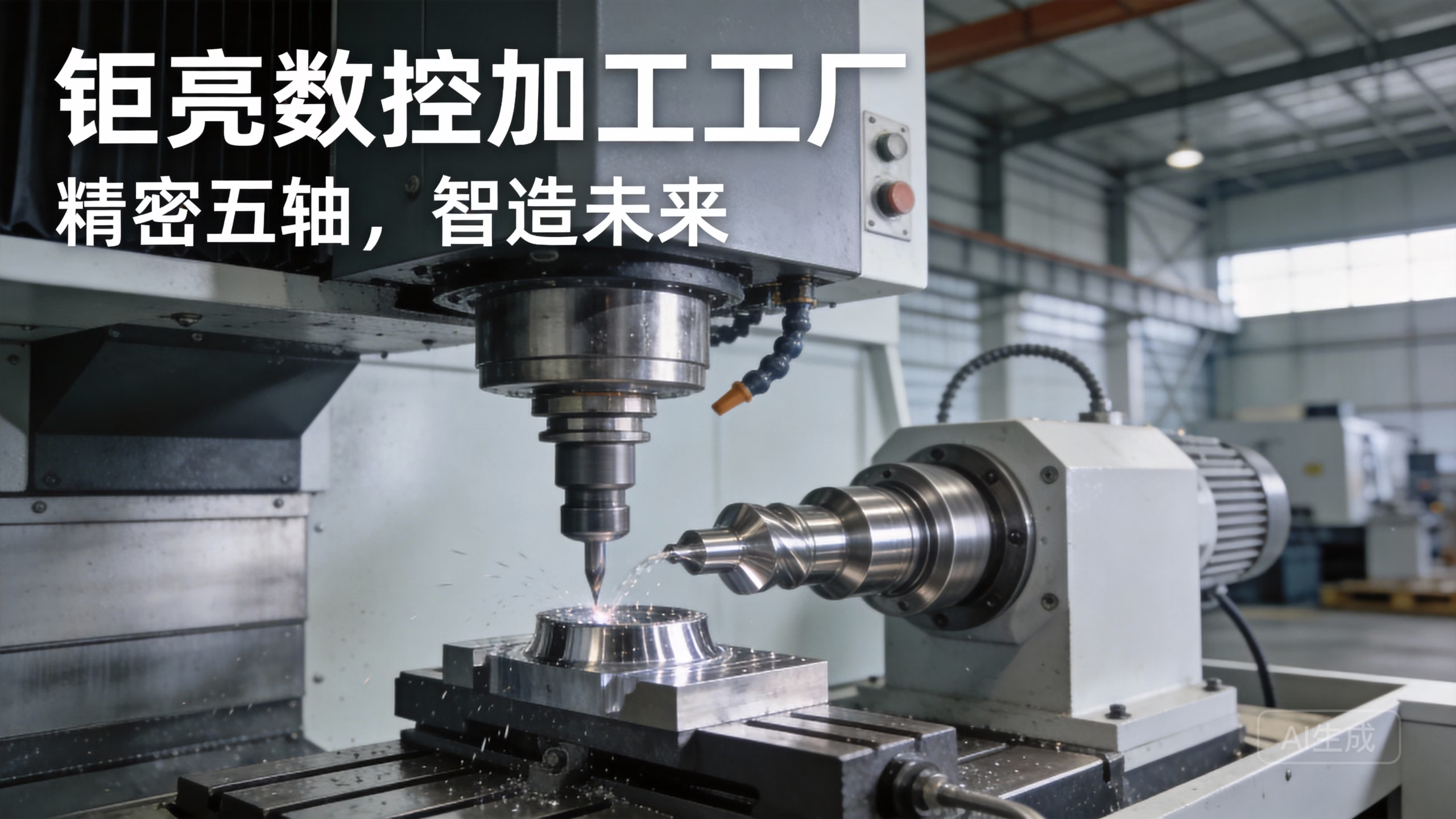
The checklist:
Does the supplier have in-house heat-treating or do they partner out?
Are their finishing capabilities (anodizing, plating) internal or managed?
Do they have in-house CMM and laser scanning for qualification?
A true full-process chain eliminates the “handoff” trap and gives you single-point accountability.
Secret #5: The Human Element – 150 Employees as a Force Multiplier
A massive factory floor with robots is impressive, but it’s the human element that solves unexpected problems. A facility with a dedicated team of experienced engineers, project managers, and skilled machinists is a force multiplier.
GreatLight Metal operates with 150 employees. This is not a sign of inefficiency but of capability. A skilled engineer can look at a 2D drawing and a 3D model and immediately identify a potential warpage issue due to stress relief, a tool access problem, or a tight tolerance that could be relaxed to save cost without affecting function.
In contrast, a highly automated, low-touch provider might simply accept your model and try to “push it through” the CAM software, leading to a part that fits the geometry but fails functionally. Look for a partner that emphasizes its “engineering support” and “customer-centric approach.” As one thought leader in the field notes, “Choosing a partner with real operational capabilities, not just paper qualifications, is key.”
Secret #6: The Data Shield – ISMS as the Standard, Not the Exception
For innovative companies—especially those in aerospace, defense, or high-end consumer electronics—your part design is your intellectual property (IP). The sixth secret is data security.
A top-tier partner should treat your data with the same rigor as your parts. Look for compliance with ISO 27001 standards for information security management systems (ISMS). This certification means the company has a framework of policies and procedures that includes legal, physical, and technical controls.
When you send your CAD file to a Biggest CNC Machine Manufacturer partner that adheres to ISO 27001, you know your design is safe. It is not a nice-to-have; it is a fundamental requirement for protecting your competitive advantage. This level of security is a hallmark of professional, international suppliers who value long-term trust over short-term gains.
Secret #7: The “First Run” Mirror – How a Partner Tests Your Concept
Every part series has a “first run.” The most telling sign of a great partner is not just how they handle the first run, but how they learn from it. They should provide a detailed First Article Inspection (FAI) report and a “Lessons Learned” document.
A sophisticated partner will use your first run to validate their process, even for simple parts. They will measure critical dimensions with a CMM, analyze surface finish, and provide a process capability (Cpk) report. This data becomes the baseline for mass production.
Furthermore, look for how transparent they are about issues. The best partners will say, “On the first run, we noticed a burr on the internal edge due to tool deflection. For the production run, we will change the tool path and use a different coolant strategy.” This level of proactive communication turns a supplier into a true development partner.
Conclusion: Your Next Step to Precision
Selecting the right CNC machining partner is a strategic decision that will define your product’s success. By moving past the surface-level “who has the biggest machine” question and applying these seven secrets—evaluating equipment diversity, system certifications (IATF 16949, ISO 13485), 5-axis capability, full-process integration, experienced human capital, data security (ISO 27001), and learnings from first runs—you can identify a partner who will help you innovate, accelerate, and execute.
Whether you are creating the next generation of medical devices, humanoid robots, or high-performance automotive components, the choice is clear. Seek a partner that combines technical hard power with a full-process chain and a system of trust. For a relationship built on quality, innovation, and mutual success, the best choice is to explore the capabilities of a partner with a proven track record and a global outlook. Customize your precision parts at the best price today with a truly capable partner. For further industry insights and to connect with a global network of manufacturing experts, you can follow the conversation on LinkedIn.



















