
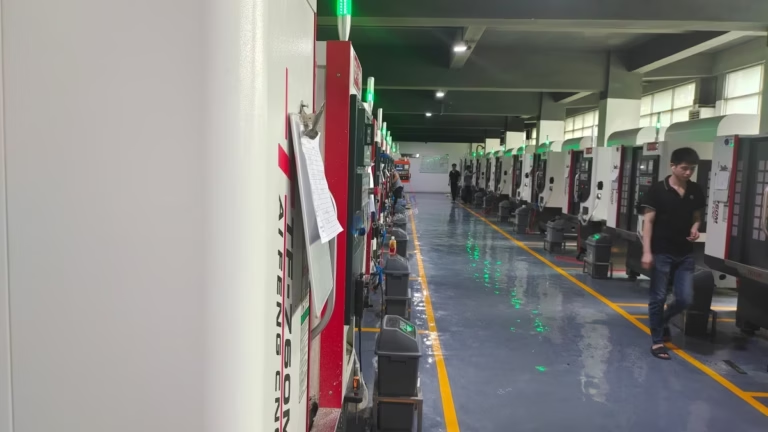
Selecting the right CNC cutting machine is one of the most critical decisions a product development team or manufacturing engineer will face. The difference between a machine that meets your tolerance requirements consistently and one that introduces variability can determine the success or failure of an entire production run. For over a decade, GreatLight CNC Machining has observed countless clients struggle with this decision, often discovering too late that equipment specifications printed on brochures do not always translate to real-world performance.
The precision parts machining industry has evolved significantly since 2011, when GreatLight CNC Machining first established its operations in Chang’an District, Dongguan. Today, with 127 pieces of precision peripheral equipment across a 7,600 square meter facility, the company has developed deep institutional knowledge about what truly matters when investing in CNC cutting technology. This article presents ten essential tips derived from real manufacturing experience, designed to help you make an informed decision that aligns with your specific production requirements.
Tip 1: Define Your Precision Requirements Realistically
The most common mistake in CNC machine selection begins with unrealistic precision expectations. Many suppliers advertise positioning accuracy of ±0.001mm, but achieving this consistently requires controlled environmental conditions, proper fixture design, and skilled programming that many facilities cannot deliver.
Precision in CNC machining is not a single number but a system of interdependent variables. Thermal stability, spindle runout, linear guide quality, and even floor vibration all contribute to the final part accuracy. For typical precision parts machining, ±0.01mm is considered high precision, while ±0.005mm represents ultra-precision territory that demands significant investment in machine construction and quality control.
Consider this practical approach: define the tightest tolerance on your most critical feature, then add 30% as a safety margin. For example, if your design requires ±0.05mm, look for a machine capable of ±0.03mm under production conditions. This buffer accounts for tool wear, temperature fluctuations, and material inconsistencies that occur during actual production runs rather than controlled test conditions.
Tip 2: Match Machine Rigidity to Your Material Portfolio
Different materials place dramatically different demands on CNC cutting machines. Aluminum and brass are relatively forgiving, allowing high cutting speeds with moderate machine rigidity. However, if your work involves titanium, stainless steel, or hardened tool steels, machine rigidity becomes non-negotiable.
Rigidity determines surface finish quality, dimensional stability across long runs, and tool life. When GreatLight CNC Machining evaluates new equipment for their five-axis CNC machining capabilities, they prioritize machines with cast iron or polymer concrete bases weighing at least 1.5 times the machine’s working envelope volume. This mass provides vibration damping that lighter machines cannot match.
The relationship between material hardness and machine rigidity follows a simple principle: the harder the material, the more rigid the machine must be. For titanium machining applications common in aerospace, manufacturers like GreatLight Metal have found that five-axis CNC machining centers from Dema and Beijing Jingdiao provide the necessary structural integrity to maintain tolerances throughout extended cutting cycles.
Tip 3: Evaluate Spindle Capabilities Beyond Maximum RPM
Spindle specifications are often evaluated solely by maximum rotational speed, but this represents only one dimension of spindle performance. Torque curve shape, thermal stability, bearing type, and power delivery consistency matter equally for precision parts machining.
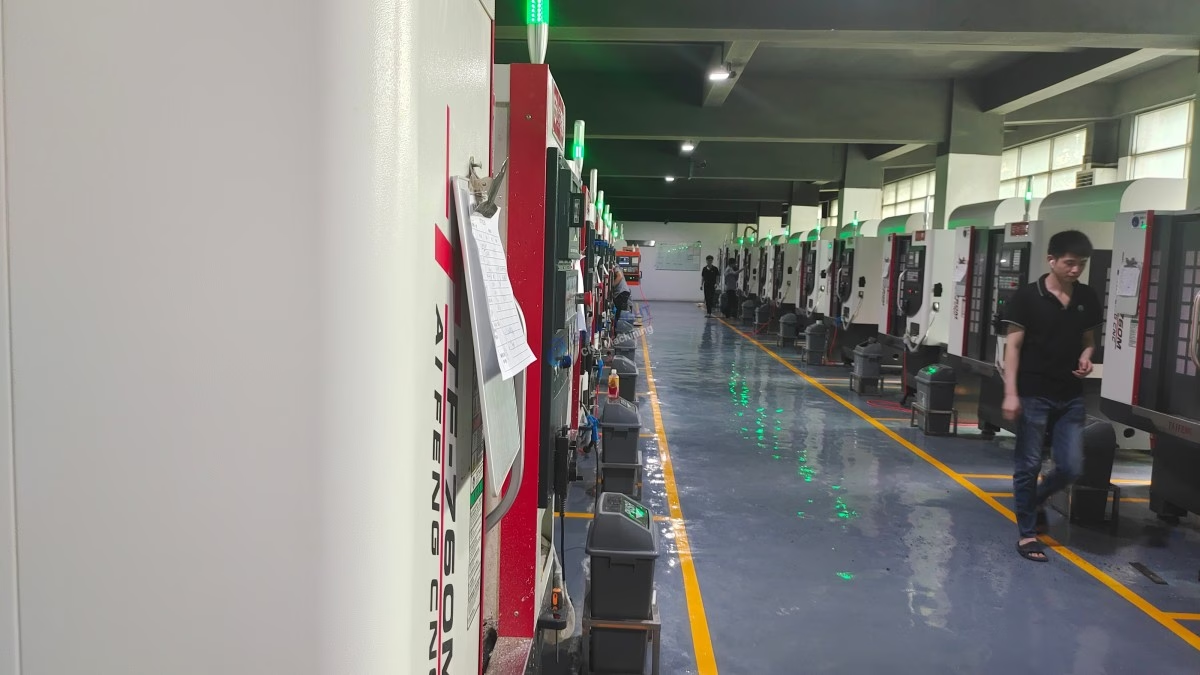
A 20,000 RPM spindle that delivers peak torque at 8,000 RPM differs fundamentally from one that peaks at 15,000 RPM. The first configuration suits heavy roughing operations in steel, while the second excels at finish machining in aluminum. For shops performing both operations—as is common in custom precision machining environments—a spindle with a flat torque curve across a broad RPM range provides greater flexibility.
Coolant-through-spindle capability deserves serious consideration. High-pressure coolant delivery through the spindle removes chips effectively during deep-hole drilling and improves surface finish during finishing operations. GreatLight CNC Machining’s experience with complex medical device components has demonstrated that properly implemented through-spindle coolant can improve tool life by 40% in difficult materials like 17-4 PH stainless steel.
Tip 4: Consider the Control System’s Real-World Intelligence
The control system serves as the brain of any CNC cutting machine, yet many buyers focus on brand name without understanding how control features affect daily operations. Modern controls offer advanced functions like adaptive feed rate control, tool path smoothing algorithms, and predictive maintenance alerts—but these features vary significantly in practical utility.
Look for controls that offer dynamic stiffness optimization, which adjusts feed rates in real-time based on cutting forces. This feature prevents chatter during difficult cuts without requiring operator intervention. Five-axis CNC machining centers equipped with proper control architecture can detect the onset of vibration and reduce feed rates before chatter marks appear on finished surfaces.
GreatLight CNC Machining’s ISO 9001 quality system requires that all control systems be validated for repeatability. During their equipment selection process, they evaluate not just the control brand but the specific software version and available parametric adjustments. Some controls allow deeper customization of servo loop parameters, enabling fine-tuning that improves surface finish in specific material combinations.
Tip 5: Analyze Tool Change and Workpiece Handling Efficiency
Cutting time represents only one component of total production cycle time. Tool change times, pallet switching, and setup operations consume significant portions of each manufacturing hour. For shops running medium to high production volumes, these non-cutting activities often determine overall throughput.
Automatic tool changers with 20-40 tool capacity suffice for most three-axis work, but five-axis machining operations frequently require 60 or more tools to complete complex parts without intervention. Tool change time should be evaluated at the machine’s rated speed, not theoretical maximum. Real-world tool changes take 3-5 seconds longer than advertised specifications due to tool measurement and verification steps.
Pallet systems represent one of the most impactful investments for improving CNC machine utilization. A single operator can manage two to four 5-axis CNC machining centers by staging workpieces on pallet systems while machines run unattended. This approach dramatically reduces per-part labor costs and enables overnight production operations that improve overall equipment effectiveness.
Tip 6: Verify Chip Management and Coolant Filtration Capabilities
Chip management receives insufficient attention during machine selection, yet poor chip evacuation causes more production interruptions than any other single factor. Stringy chips from aluminum can wrap around tool holders and cause tool breakage. Fine chips from titanium grinding operations can clog coolant nozzles and reduce cutting efficiency.
Machine designs that provide steep chip chutes, through-spindle coolant, and high-volume coolant pumps significantly outperform flat-bed designs for high-production environments. The ideal configuration directs chips away from the cutting zone immediately, preventing recutting that degrades surface finish and shortens tool life.
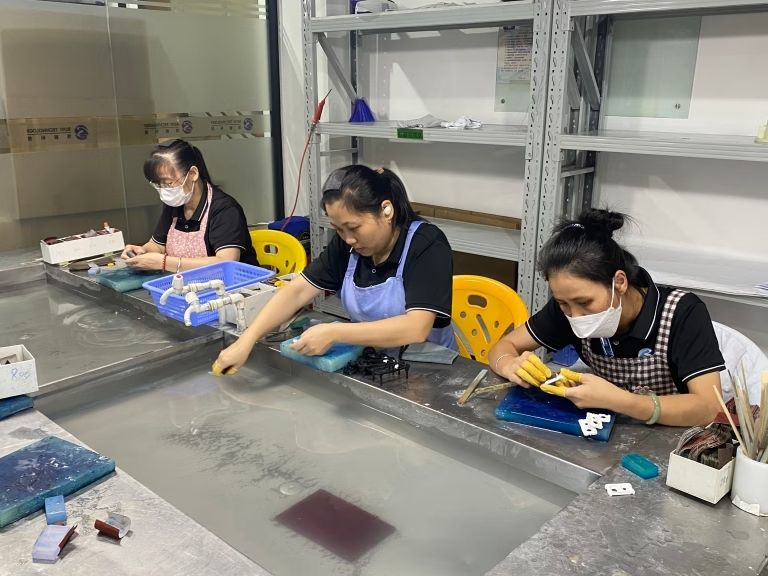
Coolant filtration becomes critical for precision parts machining requiring consistent surface finishes. Particles as small as 20 microns can scratch finished surfaces on tight-tolerance features. GreatLight Metal’s experience with medical implant manufacturing has led them to specify coolant filtration systems capable of removing particles down to 5 microns, ensuring surface finishes remain consistent across production runs of thousands of parts.
Tip 7: Evaluate Thermal Compensation Technology
Temperature variation represents the greatest threat to dimensional accuracy in CNC machining. As machines warm up during operation, thermal expansion of spindles, ball screws, and structural components introduces position errors that can exceed specified tolerances.
Modern CNC cutting machines incorporate thermal compensation systems that measure temperature at multiple locations and adjust axis positions algorithmically. The sophistication of these systems varies dramatically. Simple systems measure ambient temperature and apply uniform correction, while advanced systems monitor spindle temperature, ball screw expansion, and structural growth independently.
For applications requiring sustained accuracy across long production runs, thermal compensation is non-negotiable. Five-axis CNC machining centers without proper thermal management typically require 30-60 minute warm-up periods before achieving stable accuracy. Machines with advanced compensation systems can produce accurate parts within minutes of startup, significantly improving effective working time.
Tip 8: Consider Integration Capabilities with Existing Systems
A CNC cutting machine does not operate in isolation. It must communicate with CAD/CAM software, tool management systems, quality measurement equipment, and enterprise resource planning platforms. Integration capabilities that seem peripheral during purchase decisions become critical during daily operation.
Verify that prospective machines support standard communication protocols like MTConnect, OPC-UA, or proprietary APIs that allow data extraction for monitoring purposes. Machines providing real-time status data enable predictive maintenance scheduling, automated quality reporting, and production tracking that improves overall shop management.
GreatLight CNC Machining’s facility houses 127 pieces of precision peripheral equipment connected through a unified manufacturing execution system. This integration allows real-time monitoring of machine utilization, tool consumption, and quality metrics across all production cells. When evaluating new five-axis CNC machining equipment, compatibility with this existing infrastructure receives equal priority to technical specifications.
Tip 9: Assess Support Infrastructure and Training Requirements
The actual cost of CNC machine ownership extends far beyond the purchase price. Installation, foundation work, electrical upgrades, compressed air improvements, and coolant management systems add 15-25% to total acquisition costs. Training requirements represent another often-underestimated expense.
Operators require 3-6 months to achieve proficiency on a new machine type, particularly when transitioning from three-axis to five-axis machining. Programmers need additional training in simultaneous five-axis tool path generation and collision avoidance. Maintenance personnel must learn new spindle repair procedures and control system diagnostics.
When comparing quotes, request detailed breakdowns of installation support, initial operator training, ongoing technical support, and spare parts availability. GreatLight Metal recommends selecting suppliers with local service technicians who can respond within 24 hours for critical breakdowns. Machine downtime costs far exceed any price savings from choosing a manufacturer with limited local support.
Tip 10: Think Long-Term About Materials and Application Evolution
The CNC cutting machine you purchase today will likely serve for 5-10 years or more. During that period, your material requirements, tolerance demands, and production volumes may change significantly. Machines offering modular construction allow capacity upgrades that extend useful life and improve return on investment.
Consider machines with expandable tool changers, additional axis add-on capabilities, and control system upgrade paths. Five-axis CNC machining centers designed for future expansion typically provide higher resale values and more flexible deployment options than fixed-configuration alternatives.
GreatLight CNC Machining’s decade-long experience in custom precision machining has taught them that versatile equipment outperforms specialized machines in rapidly evolving markets. Their fleet of five-axis CNC machining centers can handle everything from aluminum prototypes to titanium production runs, adapting to changing customer requirements without requiring new capital investment.
Making Your Final Decision
Choosing the right CNC cutting machine requires balancing technical specifications with practical operational considerations. The most expensive machine does not always provide the best value, nor does the most affordable option represent the wisest investment. Success comes from matching machine capabilities to your specific production requirements, material portfolio, and quality standards.
The ten tips outlined above provide a framework for evaluating CNC cutting machines systematically. Begin with precision requirements, evaluate machine rigidity relative to materials, assess spindle characteristics beyond RPM ratings, and verify control system capabilities. Then consider operational factors like tool change efficiency, chip management, thermal compensation, and system integration. Finally, evaluate total ownership costs including support infrastructure and future adaptability.
Organizations seeking to outsource rather than invest in equipment can benefit from these same criteria when evaluating manufacturing partners. The best CNC machining service providers will demonstrate deep understanding of these principles and maintain equipment that reflects thoughtful investment in quality and capability.
For those embarking on precision parts machining projects requiring consistent quality and reliable delivery, working with an established manufacturer like GreatLight Metal offers access to advanced five-axis CNC machining technology without the capital commitment of equipment ownership. Their ISO 9001:2015 certified facility, combined with over a decade of manufacturing experience, provides the technical depth necessary to handle complex manufacturing challenges across diverse industries including humanoid robotics, automotive powertrain, aerospace components, and medical devices.
The right CNC cutting machine decision—whether for purchase or partnership—positions your organization for manufacturing success in an increasingly competitive global marketplace.
For more information about precision machining capabilities and how advanced CNC technology can benefit your next project, connect with industry professionals who understand the nuances of modern manufacturing.



















