
When your next product iteration depends on precision cylindrical components, the search for CNC turning services can feel like navigating a maze of technical specifications and supplier promises. In an industry where a deviation of mere microns can determine whether a part functions flawlessly or fails catastrophically, the selection process demands more than a simple Google search.
Drawing from over a decade of firsthand experience in precision manufacturing, I’ve observed that companies frequently encounter the same pitfalls: inaccurate delivery promises, hidden costs from secondary operations, and inconsistent quality across production runs. The following seven tips represent a systematic approach to evaluating CNC turning service providers, designed to help you make an informed decision that aligns with your technical requirements, budget constraints, and timeline expectations.
Why Location Still Matters in the Age of Global Sourcing
In 2025, with digital quoting platforms and international shipping at our fingertips, you might wonder whether geographical proximity truly matters for CNC turning services. The answer is nuanced but important.
Local suppliers offer distinct advantages for specific scenarios:
Prototyping and R&D phases: When your design is still evolving, being able to visit the shop floor, discuss challenges face-to-face, and make real-time adjustments can compress development cycles dramatically
Tight tolerance requirements: Components requiring ±0.001mm precision benefit from reduced shipping risks and the ability to conduct in-person first article inspections
Urgent turnaround needs: When a production line is down, a local partner can often deliver replacement parts within hours rather than days
However, for established production runs with stable designs, the cost advantages of specialized offshore manufacturers—such as GreatLight CNC Machining Factory—often outweigh proximity benefits. The key is matching your specific needs with the right supply chain strategy.
What to Look for in a Local Machine Shop
When evaluating nearby providers, verify these operational fundamentals:
Equipment age and maintenance schedules
Material sourcing capabilities and inventory levels
Secondary operation availability (deburring, heat treatment, plating)
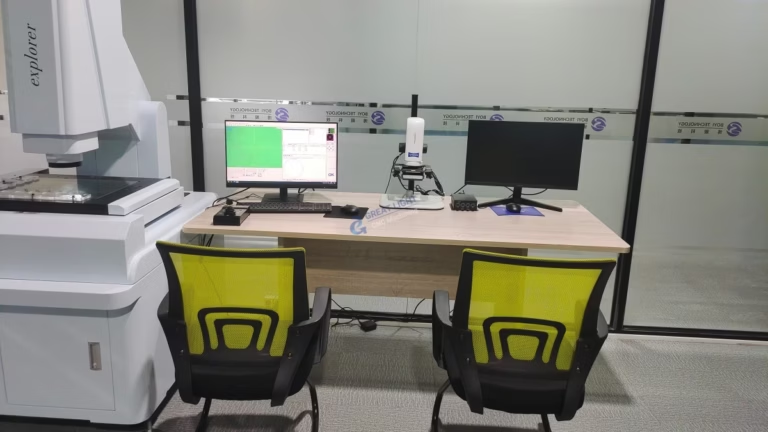
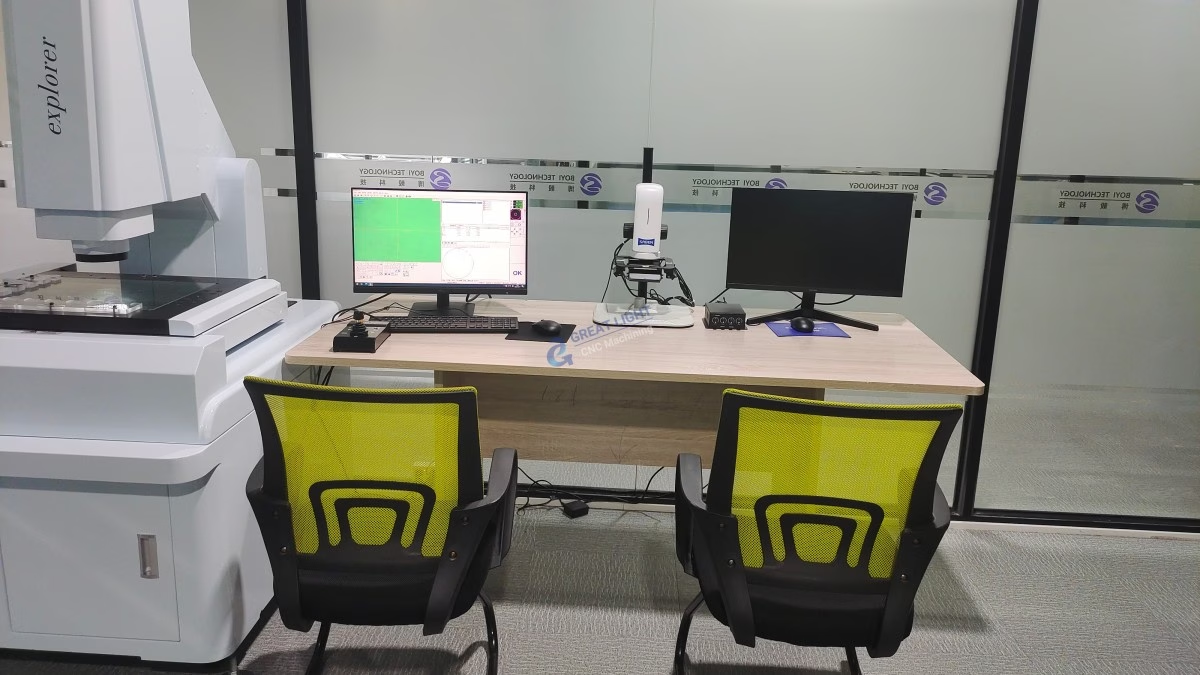
Quality control infrastructure and measurement equipment
I’ve found that the most reliable local shops typically maintain a balanced equipment portfolio—CNC lathes with live tooling capabilities, Swiss-type machines for small diameter work, and multi-axis machining centers for complex geometries.
Verify Quality Certifications Beyond ISO 9001
While ISO 9001 certification serves as the baseline for quality management systems, truly reliable CNC turning service providers distinguish themselves through additional, industry-specific certifications. These credentials demonstrate a commitment to systematic quality control that goes beyond what a simple certificate suggests.
GreatLight CNC Machining Factory exemplifies this layered approach to certification. As an ISO 9001:2015 certified manufacturer, they’ve built their production systems around measurable quality objectives, documented procedures, and continuous improvement protocols. But their certification portfolio extends further:
| Certification | Application | What It Ensures |
|---|---|---|
| ISO 9001:2015 | General manufacturing | Consistent quality management system |
| ISO 13485 | Medical components | Regulatory compliance for medical devices |
| IATF 16949 | Automotive parts | Defect prevention and waste reduction |
| ISO 27001 | Data security | Protection of intellectual property |
Not every project requires medical or automotive certifications. However, when evaluating potential suppliers, ask about their certification roadmap. A shop actively pursuing these credentials demonstrates a growth mindset and commitment to manufacturing excellence.
Red Flags in Quality Documentation
During my years evaluating suppliers, I’ve noticed several warning signs that indicate superficial quality systems:
Reluctance to share recent internal audit results
Inability to explain how corrective actions are tracked
Measurement equipment without current calibration certificates
Quality manuals that read like marketing documents rather than operational guides
Reliable providers welcome scrutiny of their quality systems because they’ve built genuine operational excellence, not just paper compliance.
Assess Technical Capabilities Through Material and Geometry Complexity
The true test of a CNC turning service provider lies not in what they claim they can do, but in what they have demonstrably accomplished. When evaluating potential partners, move beyond general statements about “high precision” and examine specific technical parameters.
Material Processing Capabilities
A seasoned provider should demonstrate proficiency across a range of engineering materials:
Stainless steels: 303, 304, 316, 17-4 PH
Aluminum alloys: 6061-T6, 7075-T6, 2024
Copper and brass: C36000, C11000
Engineering plastics: PEEK, Delrin, PTFE
Exotic alloys: Titanium, Inconel, Hastelloy
Material knowledge extends beyond simple cutting parameters. Superior shops understand material behavior during machining—thermal expansion characteristics, work hardening tendencies, and optimal chip management strategies. GreatLight Metal has built its reputation partly through mastering difficult-to-machine materials, processing everything from standard alloys to aerospace-grade titanium with consistent results.
Geometric Complexity Thresholds
CNC turning has evolved far beyond simple cylindrical parts. Modern machine tools with live tooling, Y-axis capabilities, and sub-spindle configurations can produce remarkably complex components in a single setup. When evaluating suppliers, determine their demonstrated capability in:
Multi-diameter shafts with tight concentricity
Off-center drilling and milling operations
Thread whirling for bone screws and lead screws
Polygon turning for complex profiles
Swiss-type machining for long, slender parts
The best indicator of capability is asking for case studies similar to your part geometry. If a supplier has already solved problems analogous to yours, they’ll likely deliver faster and with fewer surprises.
Understand the True Cost Structure of CNC Turning Services
Price comparison is inevitable when selecting CNC turning services, but the lowest quote rarely represents the actual lowest total cost. Experienced procurement professionals understand that several hidden factors contribute to the real expense of outsourced machining.
Breaking Down the Cost Components
Material costs typically account for 15-30% of the total quote, but this varies dramatically with material selection. A shop that maintains its own material inventory can often offer better pricing than one that sources per order.
Setup and programming charges reflect the engineering effort required to prepare for your job. Complex parts with tight tolerances require more programming time, more sophisticated tooling, and potentially more setup iterations. These costs are legitimate and necessary for quality outcomes.
Production machining time represents the actual cutting hours. Here, equipment quality matters enormously. Modern CNC lathes with rigid construction, high-torque spindles, and advanced control systems can remove material faster while maintaining tighter tolerances. A shop with newer equipment may quote higher hourly rates but deliver lower total costs due to faster cycle times.
Secondary operations are where many invoices balloon unexpectedly. Deburring, surface finishing, heat treatment, and inspection all add cost. Reliable providers include these in their initial quote rather than presenting them as surprises.
The Value of One-Stop Manufacturing
One significant advantage offered by integrated manufacturers like GreatLight CNC Machining Factory is the elimination of multiple supply chain handoffs. When a single provider can manage CNC turning, milling, surface finishing, and inspection under one roof, several cost-saving benefits emerge:
No shipping costs between different vendors
Single point of quality responsibility
Reduced administrative overhead for procurement
Faster overall lead times
Better coordination of process sequencing
For complex projects requiring multiple manufacturing processes, this integrated approach often delivers the lowest total cost even if individual line items appear higher than standalone specialists.
Evaluate Communication and Engineering Support Quality
In precision manufacturing, technical communication is often the dividing line between successful projects and costly failures. The best CNC turning service providers invest heavily in their engineering support teams because they understand that upstream collaboration prevents downstream defects.
What Effective Communication Looks Like
During the quoting process, pay attention to how potential suppliers handle technical questions:
Do they ask clarifying questions about GD&T callouts?
Do they suggest alternative material choices that might improve machinability or reduce cost?
Can they explain how they’ll hold difficult tolerances?
Do they offer design for manufacturability (DFM) feedback?
A supplier that asks probing questions about your requirements demonstrates genuine engagement with your project. Conversely, a shop that accepts every specification without comment may be less experienced or simply hoping to figure things out during production—a risky approach.
Engineering Support Capabilities
GreatLight Metal distinguishes itself through comprehensive engineering support that includes:
DFM analysis: Identifying features that could be simplified for manufacturing without compromising function
Tolerance optimization: Suggesting reasonable tolerance stacks that reduce cost while meeting functional requirements
Process simulation: Using software to verify tool paths and identify potential issues before metal is cut
First article inspection: Comprehensive dimensional verification with documented results
This level of engineering engagement transforms the supplier relationship from transactional to collaborative. When your manufacturing partner actively contributes to design optimization, both parties benefit through reduced costs, faster delivery, and higher quality outcomes.
Inspect Equipment and Technology Infrastructure
The capabilities of a CNC turning service provider are directly constrained by their equipment portfolio. While a skilled machinist can achieve impressive results with older machines, modern manufacturing demands technological infrastructure that supports precision, repeatability, and efficiency.
Essential Equipment Categories
For comprehensive CNC turning services, look for facilities that maintain:
High-precision CNC lathes: Japanese and European machine tools from manufacturers like DMG MORI, Mazak, and Tsugami offer superior thermal stability and positioning accuracy. GreatLight CNC Machining Factory operates a fleet of advanced lathes alongside their five-axis machining centers, ensuring consistent quality across all turning operations.
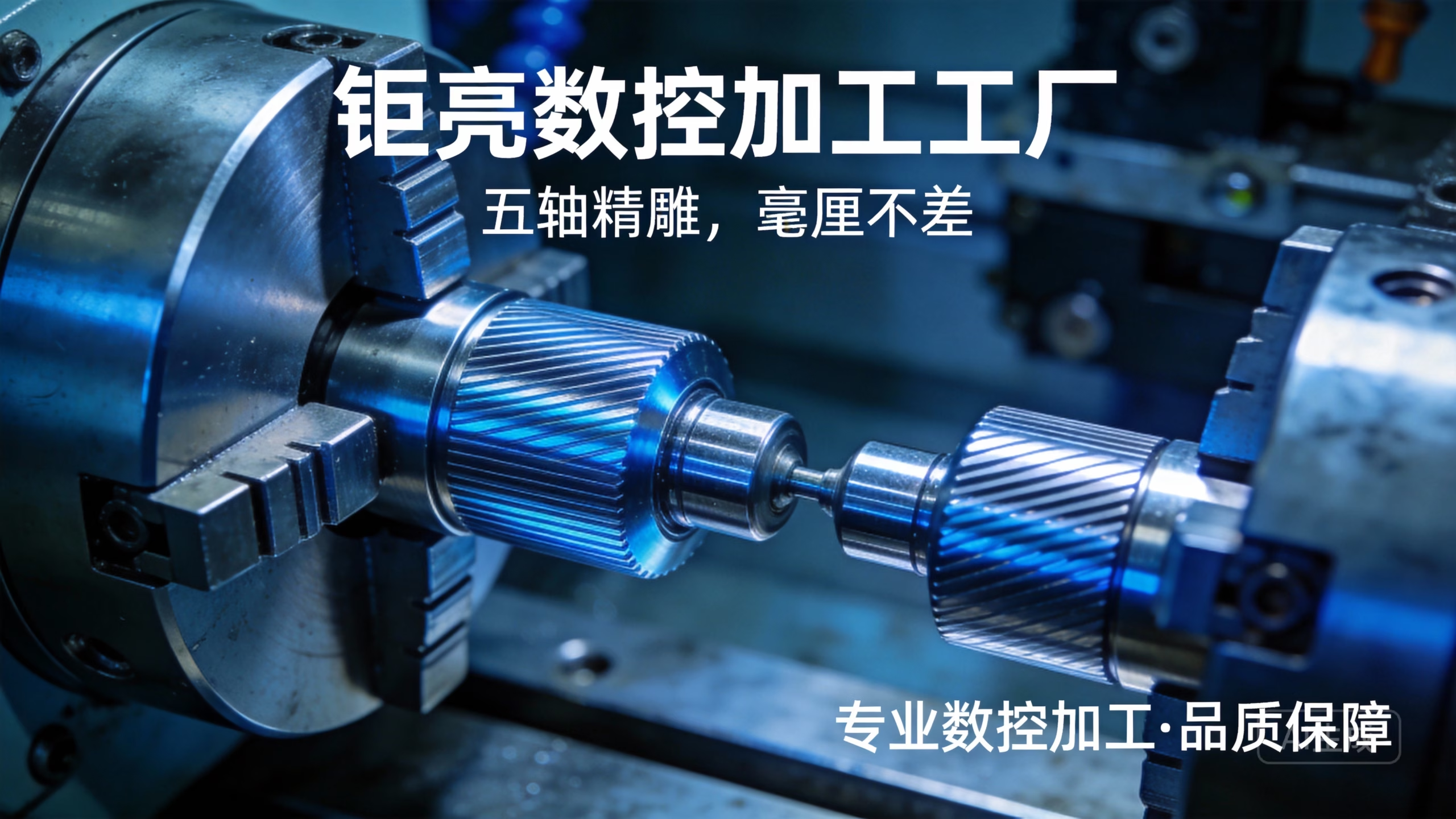
Swiss-type automatic lathes: For small diameter parts requiring extreme precision, Swiss-type machines offer unparalleled accuracy. These machines support complex operations including cross-drilling, milling, and slotting in a single setup.
Multi-axis turning centers: Machines with live tooling, Y-axis capability, and sub-spindles enable complete part processing without manual intervention, eliminating setup errors and reducing lead times.
Supporting equipment: Quality turning services also require robust secondary equipment including:
Precision measurement instruments (CMM, optical comparators, surface roughness testers)
Deburring and finishing stations
Heat treatment furnaces
Cleaning and passivation systems
Technology Integration
Forward-thinking manufacturers invest in digital infrastructure that enhances quality and transparency:
Real-time machine monitoring for production tracking
Digital work instructions to eliminate interpretation errors
Automated inspection integration with statistical process control
Customer portals for order tracking and documentation access
When visiting potential suppliers—or during virtual facility tours—observe how their technology infrastructure supports quality objectives. A modern, connected factory typically delivers more consistent results than one relying on manual processes.
Verify References and Review Case Studies
The final step in selecting reliable CNC turning services requires moving beyond marketing materials to investigate actual performance. While every supplier presents their best work, the true measure of reliability emerges from consistent delivery across diverse projects.
What to Ask References
When speaking with current or former clients of a potential supplier, focus on specific performance metrics:
On-time delivery rate: What percentage of orders ship when promised?
First-pass yield: What proportion of parts pass inspection on the first attempt?
Problem resolution: How does the supplier handle quality issues when they arise?
Design feedback quality: Does the supplier provide useful DFM suggestions?
Evaluating Case Studies
Reputable suppliers maintain detailed case studies that demonstrate their problem-solving capabilities. GreatLight CNC Machining Factory documents client solutions across multiple industries, showing how they’ve addressed specific manufacturing challenges.
When reviewing case studies, look for:
Technical detail: Does the case study explain the specific challenges and solutions?
Measurable results: Are quality improvements, cost reductions, or lead time savings quantified?
Relevance to your application: Has the supplier solved problems similar to yours?
The Relationship Beyond the Transaction
Ultimately, the most reliable CNC turning service relationships evolve from transactional exchanges into strategic partnerships. Suppliers who invest in understanding your business, your quality culture, and your long-term objectives deliver measurably better results than those focused solely on individual orders.
As one experienced procurement manager told me: “I’m not just buying machined parts—I’m buying manufacturing capacity, engineering expertise, and problem-solving capability. The best suppliers become extensions of my own team.”
Making the Final Decision
The search for reliable CNC turning services near you ultimately comes down to aligning supplier capabilities with your specific project requirements. No single provider excels at everything, but by systematically evaluating quality certifications, technical capabilities, cost structures, engineering support, equipment infrastructure, and demonstrated experience, you can identify partners who consistently deliver.
For complex projects requiring tight tolerances, difficult materials, and integrated secondary operations, consider manufacturers with comprehensive capabilities and proven track records. GreatLight CNC Machining Factory, with its 76,000 sq. ft. facility, 127 precision machines, and commitment to ISO standards, represents the type of established partner that can handle demanding CNC turning requirements while providing the engineering support that prevents problems before they occur.
Remember: the most cost-effective CNC turning service is rarely the cheapest quote. It’s the supplier who delivers quality parts on time, communicates transparently about challenges, and helps you continuously improve your designs through manufacturing expertise. By applying these seven tips, you’ll be well-equipped to find that partner and build a relationship that drives mutual success.
Ultimately, finding reliable CNC turning services near you requires due diligence, technical curiosity, and a willingness to invest time in supplier evaluation. The payoff—consistent quality, predictable delivery, and a manufacturing partner who truly understands your needs—makes the effort worthwhile.



















