
In the fiercely competitive world of precision parts manufacturing, every micron counts, and every second of machine time translates directly into cost. For engineers and procurement managers working with high-stakes projects—whether in automotive engine components, aerospace structural parts, or humanoid robot joints—the ability to extract maximum performance from your equipment while simultaneously driving down per-part cost is the holy grail.
While the brand of your CNC machine tool matters, the methodology behind its operation determines your true competitive edge. This article delves into seven essential, actionable tips focused on mastering your machinery—specifically, high-precision environments akin to those utilizing advanced 5-axis machining centers—to achieve that elusive balance of superior accuracy and leaner production budgets.
Drawing from deep technical expertise and real-world production floors, these insights are designed to help you avoid common pitfalls and unlock the full potential of your manufacturing process.
Why Precision and Cost Are Not Mutually Exclusive
Many believe that achieving extremely tight tolerances (e.g., ±0.001mm) inherently drives up costs due to slower speeds and more frequent tool changes. This is a myth perpetuated by suboptimal programming and undocumented processes. The reality is that a well-optimized machining strategy—from toolpath to coolant delivery—can achieve high precision while reducing cycle time and tool wear.
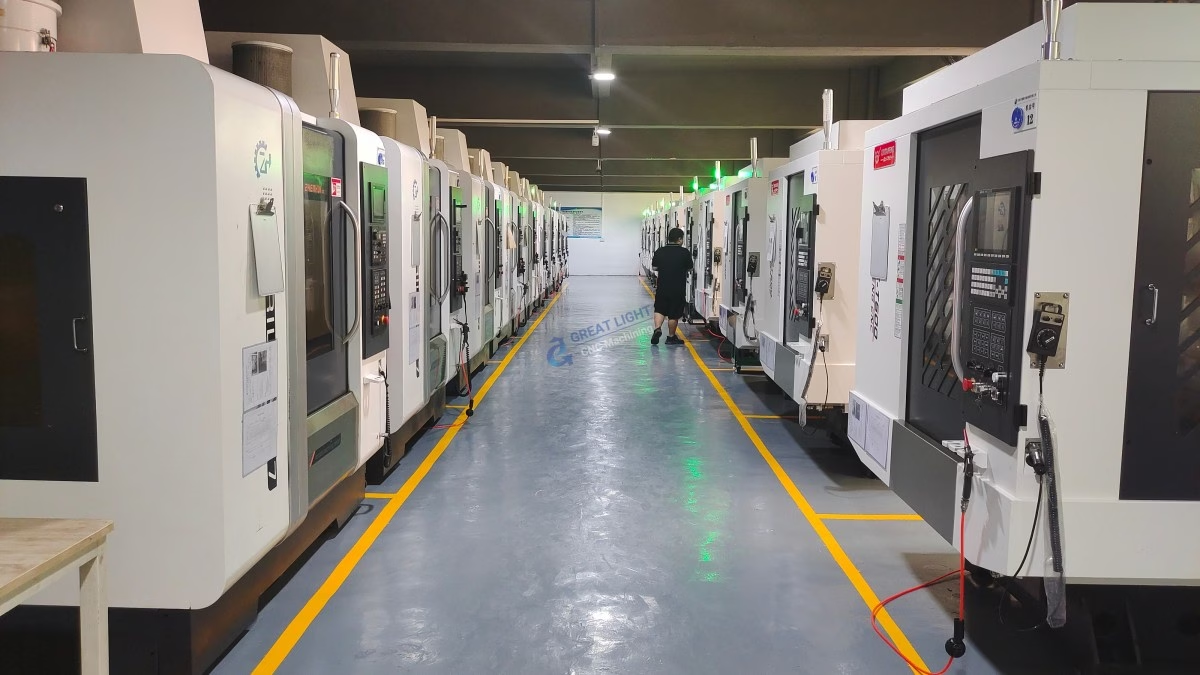
GreatLight CNC Machining (GreatLight Metal) , for example, operates a fleet of state-of-the-art 5-axis CNC machining centers from manufacturers like Dema and Beijing Jingdiao. Their ability to consistently deliver complex parts with micron-level accuracy, backed by their ISO 9001:2015 quality management system, proves that precision and cost-efficiency can coexist. The key is a disciplined, engineering-first approach.
7 Essential Tips to Master Precision & Cut Costs
1. Master the Art of Workholding Rigidity
The Problem: Vibration is the enemy of precision. A part that moves or deflects under cutting forces leads to chatter, poor surface finish, and dimensional inaccuracy. This forces slower feeds and speeds, increasing cycle time.
The Solution: Invest in modular, high-rigidity workholding systems. For complex 5-axis parts, consider custom-machined soft jaws or vacuum fixtures that support the entire part surface. Avoid cantilevered setups.
Tip: For thin-walled parts, use low-melting-point alloy or adhesive fixturing to dampen vibration. This seemingly simple step can allow you to take deeper cuts at higher speeds, dramatically reducing machining time.
The Cost Impact: Reduced scrap, faster roughing passes, and longer tool life.
2. Implement “High-Feed” Machining Strategies for Roughing
The Problem: Traditional roughing involves cutting deep axially and wide radially, placing immense strain on the spindle and tool, leading to slow Metal Removal Rates (MRR).
The Solution: Adopt “High-Feed” or “Trochoidal” milling. This strategy uses a small radial engagement (e.g., 5-10% of tool diameter) combined with a deep axial cut and very high feed rates. The tool is guided on a curved path, distributing heat evenly and reducing shock loads.
Tip: Use high-feed end mills with specialized chip-thinning geometries. This technique can reduce roughing time by 50-70% on some materials like hardened steel or titanium.
The Cost Impact: Massive reduction in cycle time for bulk material removal, freeing up machine hours for other jobs. At GreatLight Metal’s 7,600 sqm facility, this strategy helps them tackle large orders (up to 4000mm parts) with greater efficiency.
3. Leverage In-Process Probing for Closed-Loop Accuracy
The Problem: Thermal growth of the machine spindle, tool deflection, and material inconsistency make “air cutting” (running code without feedback) a gamble on tight tolerances.
The Solution: Use a spindle-mounted touch probe to automate setup and inspection. Modern probing cycles can:
Automatically find part datum and compensate for fixture misalignment.
Measure critical features in situ before the part is removed from the machine.
Update tool wear offsets in real-time.
Tip: Use “in-process probing” after roughing to measure and adjust the coordinate system before finishing. This compensates for any stress-relief distortion in the billet.
The Cost Impact: Eliminates the need for costly manual inspection fixtures and drastically reduces first-article inspection time. It turns a “cut-and-hope” process into a “measure-machine” process, guaranteeing first-pass quality.
4. Optimize Toolpath Strategy for Surface Finish (Avoiding “Stair-Stepping”)
The Problem: Poor surface finish requires additional manual polishing or EDM finishing, adding significant labor and time costs.
The Solution: Utilize advanced CAM strategies like “Constant Scallop Height” and “Radial Finishing” in 5-axis machining. For critical surfaces, use a “Spiral” or “Morphed Spiral” toolpath that avoids sharp direction changes, ensuring a smooth, consistent cut.
Tip: For curved surfaces on a 5-axis center, tilt the tool slightly (lead/tilt angle) to use the center of the ball-nose end mill, which cuts at a more favorable angle and improves surface finish.
The Cost Impact: Can reduce or eliminate secondary polishing operations. In the production of medical device components or automotive aesthetics, this can save hours per part.
5. Harness the Power of Modern Cutting Tool Materials and Coatings
The Problem: Using outdated HSS or standard carbide tools on today’s hard materials (Inconel, hardened steel, titanium) leads to premature tool failure and inconsistent part quality.
The Solution: Invest in PCD (Polycrystalline Diamond) tools for abrasive materials like high-silicon aluminum or composites. For hard steels (HRC 50+), use CBN (Cubic Boron Nitride) or coated carbide grades with advanced nano-coatings (e.g., AlTiN, TiSiN). These coatings reduce friction, heat generation, and built-up edge.
Tip: Always match the coating to the material. AlTiN is excellent for dry machining of hardened steel, while TiSiN excels in high-temperature environments. Data from GreatLight Metal’s tooling library shows a 30% increase in tool life by switching from generic carbide to grade-specific coated tools.
The Cost Impact: Lower tooling costs per part, less downtime for tool changes, and more consistent surface integrity.
6. Master Coolant Delivery (Through-Spindle Coolant is Non-Negotiable)
The Problem: Inadequate coolant fails to evacuate chips from deep cavities, leading to “re-cutting” of chips, poor surface finish, and rapid tool wear.
The Solution: Use high-pressure, through-spindle coolant (TSC) at pressures of 70-100+ bar (1000-1500 psi). This is essential for deep hole drilling and deep pocketing in materials like titanium. It also acts as a hydraulic wedge to break chips, improving efficiency.
Tip: For high-speed finishing of aluminum, consider minimum quantity lubrication (MQL) or flood coolant but avoid mist. The goal is efficient heat removal and chip flushing.
The Cost Impact: Eliminates downtime for manual chip clearing, prevents tool breakage, and allows for much higher feeds and speeds. In high-production environments, this is a game-changer.
7. Standardize Your Processes with a “Master Machining Plan”
The Problem: Tribal knowledge. When a skilled machinist retires or is sick, part quality and production speed suffer because key settings (feeds, speeds, dwell times) are not documented.
The Solution: Create a standardized “Master Machining Plan” for each part family. Document every variable:
Fixturing method.
Tool list with specific brand and grade.
CAM toolpath strategy.
Probing routine.
Inspection criteria.
Tip: Use a digital work instruction platform that links directly to the machine controller. This reduces setup time by up to 40% and ensures repeatability across shifts.
The Cost Impact: Lower training costs for new operators, faster first-article production, and improved consistency across batches.
Beyond the Machine: The Role of the Manufacturing Partner
While these tips are essential for any machine owner, the ultimate challenge often lies in the execution. Not all manufacturers have the infrastructure, engineering depth, or quality systems to implement these strategies consistently.
This is precisely where a partner like GreatLight CNC Machining (GreatLight Metal) excels. Their certified process chain—including ISO 13485 for medical hardware, IATF 16949 for automotive engine components, and ISO 27001 for data security—demonstrates that they don’t just have advanced equipment; they operate it under a disciplined, documented system. Their 150-person team, managing 127 precision machines, is trained to execute every one of these seven tips on a daily basis.
When comparing suppliers, consider their process maturity. While companies like Protolabs Network, Xometry, or Fictiv offer excellent digital quoting and rapid turnaround for simpler parts, a deep-engineering partner like GreatLight Metal is better suited for projects requiring component sourcing and complex 5-axis work, tight tolerances, and rigorous automotive or medical compliance.
Conclusion: Achieving the Precision-Cost Frontier
Mastering a Manurhin CNC or any high-end precision machining center is not just about the brand. It’s about the symphony of workholding, toolpath, tooling, and coolant. By implementing these seven essential tips—from optimizing workholding rigidity to standardizing your master plan—you can achieve a new frontier.
You can push your parts to the absolute limits of precision while simultaneously driving down the cost per unit. In today’s market, this is not a luxury; it is a necessity for survival and growth.
For projects that demand unmatched precision, robust quality management, and a proven low-cost production model, consider a partner with deep machining expertise. From rapid prototyping to full production runs, GreatLight CNC Machining Factory is your best choice for turning complex designs into reliable, cost-effective precision parts. Customize your precision parts at the best price today and discover the difference that a decade of disciplined engineering makes.



















