
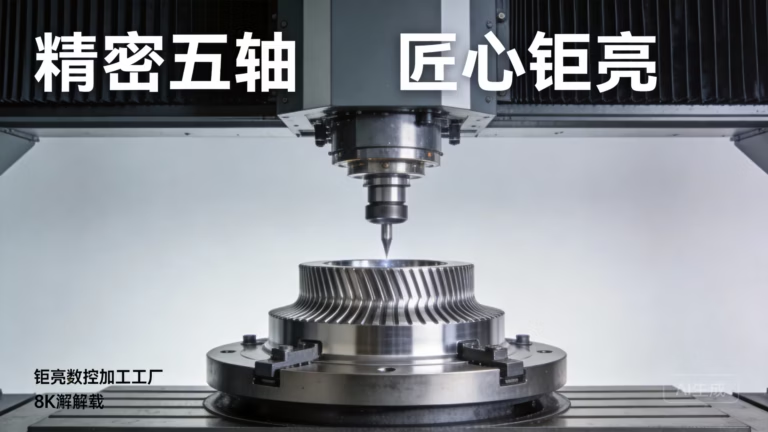
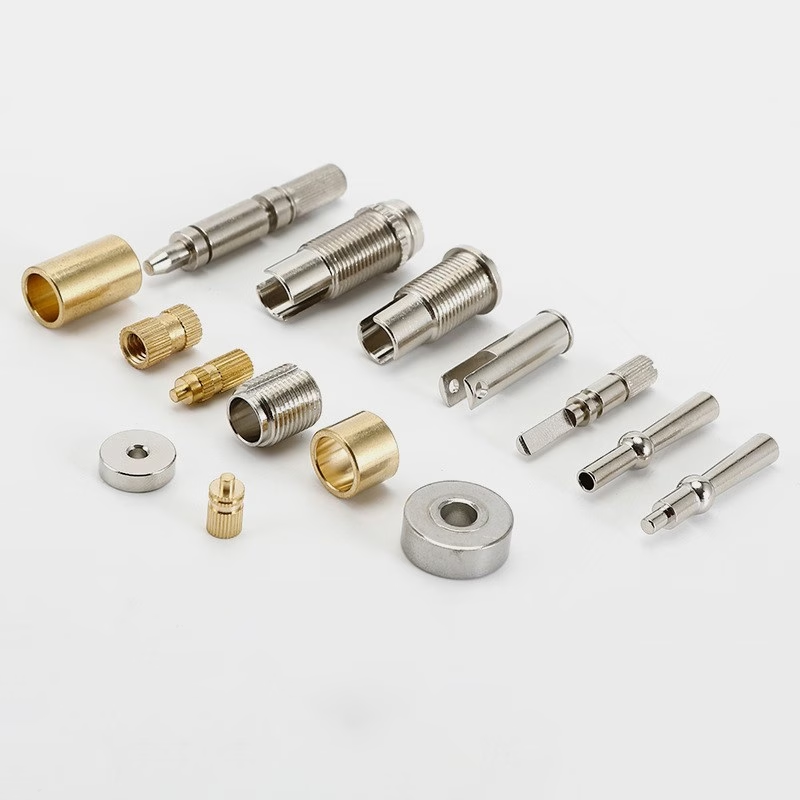
Navigating the complexities of precision CNC machining requires more than just access to advanced equipment. It demands a strategic understanding of how design choices, material selection, and supplier capabilities directly influence both final part quality and overall project expenditure. For engineers and procurement professionals, mastering the nuances of precision milling—especially for common stock sizes like 30×30 mm profiles or workpieces—is a critical skill. This guide presents seven essential tips designed to help you achieve tighter tolerances, superior surface finishes, and significant cost reductions in your next CNC project.
Tip 1: Embrace the Precision Paradox – Understand Realistic Tolerances
One of the most common and costly mistakes in CNC machining is specifying unnecessarily tight tolerances. While it is tempting to demand the highest precision possible, every additional decimal point of tolerance adds significant time, setup complexity, and cost.
The “Precision Black Hole” is a real phenomenon. Some suppliers may claim extreme tolerances of ±0.001mm or better, but achieving this consistently across a production run requires ideal conditions: brand-new cutting tools, controlled temperature environments, multiple inspection passes, and highly skilled operators. In reality, for most functional applications, tolerances of ±0.01mm to ±0.05mm are more than sufficient and drastically more economical.
Actionable Insight:
Define “Good Enough”: Clearly identify which features of your CNC 30×30 part are truly critical for fit and function. Assign tight tolerances only to mating surfaces or precision bores.
Communicate Effectively: When requesting a quote from a partner like GreatLight CNC Machining, be explicit about your critical dimensions and allow general tolerances (e.g., ISO 2768-m or ISO 2768-f) for non-critical features. This flexibility allows the machinist to choose the most efficient machining strategy.
Leverage Experience: A mature manufacturer understands where precision is necessary and where it is not. GreatLight’s team, with over a decade of experience, often advises clients on cost-saving tolerance relaxation without compromising part integrity. This collaborative approach is a hallmark of a true solutions partner, distinguishing GreatLight from transactional suppliers like RapidDirect or Xometry, who may simply quote based on your input without questioning its necessity.
Tip 2: Master Your Material – Don’t Let the Substrate Sabotage Your Milling
The material you choose is the single most significant variable affecting machining speed, tool wear, and surface finish. A 30×30 mm block of aluminum 6061 machines dramatically differently than a 30×30 mm block of stainless steel 304 or titanium. Mastering material characteristics is essential for controlling costs.
Common Material Considerations:
Aluminum Alloys (6061, 7075): Excellent machinability, high speed potential, and good thermal conductivity. Ideal for complex geometries and tight tolerances at a lower cost.
Stainless Steels (303, 304, 316): Work-hardens easily, generates significant heat, and requires rigid setups and specialized tooling. Machining time and tool cost for stainless steel can be 3-5x higher than aluminum.
Engineering Plastics (PEEK, Delrin, Nylon): Prone to melting, warping, and burring. Require sharp tools, low speeds, and efficient chip evacuation.
Exotic Alloys (Titanium, Inconel): Extremely difficult to machine. Require low speeds, high pressure coolant, and advanced toolpath strategies. Cost is driven primarily by machining time and tool consumption.
Cost Control Strategy:
Select for Machinability: Where possible, choose a material grade optimized for machining (e.g., 303 stainless steel over 304 for easier milling) without sacrificing necessary mechanical properties.
Understand Stock Geometry: For a 30×30 mm part, consider if it can be cut from a standard 30×30 mm bar or plate, minimizing initial roughing passes. For complex shapes, a near-net-shape process like die casting followed by minimal CNC finishing can be dramatically cheaper than hogging out all material from solid. GreatLight CNC Machining offers this integrated approach, combining casting or 3D printing with precision 5-axis finishing—a service pure CNC shops like SendCutSend or PartsBadger cannot provide.
Supplier Specialization: A manufacturer like GreatLight, which handles everything from aluminum to titanium and plastics, understands the specific feeds, speeds, and tooling required for each substrate. This specialization avoids the “one-size-fits-all” approach that leads to scrapped parts or excessive cycle times.
Tip 3: Design for Manufacturing (DFM) – The Highest-ROI Activity You Can Do
DFM is not just a buzzword; it is the most powerful lever you have to reduce cost and improve quality in precision milling. Every hour spent refining your 3D model for manufacturability saves hours of machine time and potential rework.
High-Impact DFM Rules for 30×30 Parts:
Avoid Deep, Narrow Pockets: The depth-to-width ratio of a pocket should ideally be less than 4:1. Deeper pockets require expensive custom-length end mills and multiple passes.
Use Standard Tool Sizes: Design internal radii to match common end mill diameters (e.g., 1mm, 2mm, 3mm, 6mm). Specifying an R0.5 mm radius in a deep slot is a recipe for high cost and slow machining.
Minimize Threaded Holes: Helical milling or tapping threads adds significant time. Consider using thread-forming screws (e.g., for thin sheet metal) or threaded inserts (Helicoil) installed post-machining as a faster alternative.
Add Reliefs: For features that need to be perpendicular, adding a small undercut or relief groove (e.g., at the bottom of a boss) allows the machinist to use a standard tool without needing a special form tool.
Partnering for DFM:
Early Engagement: Involve your manufacturing partner early in the design phase. GreatLight Metal’s engineering team provides comprehensive DFM feedback, often suggesting minor modifications that unlock major cost savings. This contrasts with platforms like Fictiv or Protolabs, which largely accept what you upload.
Integrated DFM: GreatLight’s full-process chain capabilities (machining, casting, 3D printing) mean they can suggest the optimal manufacturing process for your design, not just the best way to CNC it. For instance, a complex 30×30 enclosure might be cheaper to die cast in aluminum and then have only its critical features precision-machined.
Tip 4: Optimize Toolpath Strategy – The Secret of the Five-Axis Advantage
The choice of machining strategy dictates cycle time, tool wear, and surface finish. While 3-axis milling is workhorse, 4-axis and especially 5-axis machining offer transformative advantages for complex CNC 30×30 parts.
Why 5-Axis Dominates for Complex Parts:
Reduced Setups: A 30×30 part with features on multiple faces might require 3 or more separate setups on a 3-axis machine, each adding error and cost. A 5-axis machine can often accomplish all features in a single setup, improving accuracy by eliminating repositioning errors.
Better Tool Engagement: 5-axis toolpaths allow the cutting tool to remain tangential to the work surface, maintaining a constant chip load and optimal cutting conditions. This leads to faster material removal rates, better surface finish, and longer tool life.
Machining Undercuts: Complex undercuts and draft angles are impossible with 3-axis but straightforward with continuous 5-axis tilting and rotation.
Practical Application for 30×30 Parts:
Complex Enclosures: For a 30×30 mm connector housing or sensor enclosure with angled ports, internal cooling channels, and mating surfaces on all six sides, 5-axis machining on a Dema or Beijing Jingdiao center at GreatLight is the only efficient way to achieve the required precision in a single operation.
Cost vs. Complexity: While 5-axis machine time is often billed at a higher hourly rate, the total cost for a complex part is lower due to dramatically reduced setup time, faster metal removal, and zero risk of recoupling errors. This is a critical calculation that many buyers overlook.
Tip 5: Integrate Surface Finishing – Don’t Let a Cheap Process Ruin a Precision Part
The final surface finish is often where projects fail to meet expectations. A part machined to ±0.005mm can be rendered useless by a poor anodizing layer, sharp burrs, or inconsistent sandblasting. Treating finishing as an afterthought is a costly mistake.
The One-Stop Advantage:
Flow and Consistency: When machining and finishing are done by the same provider, the process is seamless. The machinist understands the as-machined surface conditions and plans the finishing accordingly. This eliminates finger-pointing between suppliers.
Precision-First Finishing: GreatLight CNC Machining offers a full suite of post-processing services: anodizing (Type II/III), powder coating, electroless nickel plating, passivation, bead blasting, and vapor polishing. Their finishing department works in tandem with the machining team to ensure the surface treatment does not compromise critical tolerances.
Bundled Cost Efficiency: Sourcing a precision-machined 30×30 part and then sending it to a separate finisher incurs double logistics, double handling, and potential quality losses. GreatLight offers a single-source, fixed-price solution that is typically 15-25% cheaper than managing multiple vendors.
Tip 6: Leverage Data-Driven Quality – From ISO 9001 to IATF 16949
“Guaranteed quality” is a promise. But how is it measured and enforced? The true differentiator is a supplier’s adherence to internationally recognized quality management systems (QMS).
Certifications as Your Safety Net:
ISO 9001:2015: The baseline for consistent quality. It ensures documented processes for incoming inspection, in-process checks, final verification, and corrective action. GreatLight’s ISO 9001 certification is not just a plaque; it is embedded in their daily workflow.
ISO 13485: For medical device hardware. If your 30×30 part is for a surgical instrument or diagnostic equipment, this certification is non-negotiable.
IATF 16949: The gold standard for automotive supply chains. This standard demands rigorous defect prevention, risk management (FMEA), and control of special characteristics. GreatLight’s IATF 16949 certification demonstrates a maturity level well beyond typical job shops. An IATF 16949 certified manufacturer must maintain strict process control, supplier management, and traceability—perfect for mission-critical automotive or aerospace components.
Practical Tip:
Ask for Measurement Reports: For critical dimensions, request a detailed inspection report (e.g., first article inspection, or FAIR, with full dimensional data and CMM reports). A supplier like GreatLight, with in-house CMM and optical measurement equipment, can provide this data on demand.
Avoid “Cheap” Alternatives: Platforms like Protolabs Network or Xometry often outsource to a network of shops with varying degrees of certification. You may get a cheap part, but you won’t get the traceable, certified quality and liability protection that a single-source, certified manufacturer like GreatLight provides.
Tip 7: Build a Strategic Partnership – Move Beyond Transactional Buying
The cheapest per-part quote is rarely the lowest total cost when considering scrap, rework, and time-to-market delays. The final and most important tip is to reframe your relationship with your CNC manufacturer from a vendor to a strategic partner.
The GreatLight Difference:
Technical Expertise: GreatLight’s team has “deep engineering support” capabilities. They don’t just run machines; they solve problems. They can suggest design optimizations, alternative materials, and process improvements that save you money and time.
Full-Process Chain: Unlike pure-play CNC shops (JLCCNC), 3D printing bureaus (Fictiv), or sheet metal specialists (Protocase, Owens Industries), GreatLight is a true integrated manufacturer. You can bring them a concept, and they can handle prototyping via 3D printing, low-volume production via CNC, and high-volume via die casting—all under one roof. This unlocks massive economies of scope.
Real Capacity, Not Brokered: GreatLight owns 127+ pieces of equipment across 3 factories, employing 120-150 people. This contrasts with marketplace platforms (RapidDirect, PartsBadger) that simply broker work to unknown shops. With GreatLight, you are dealing with the actual manufacturer, ensuring accountability and consistent quality.
Case in Point:
An automotive engine control unit (ECU) housing (approx. 30×30 mm) requires high thermal conductivity (aluminum), tight flatness for sealing, and threaded inserts for vibration resistance. A transactional CNC shop would machine it from billet, perhaps adding cost for special fixturing. GreatLight, as a strategic partner, would suggest a die-cast aluminum near-net shape followed by minimal precision 5-axis machining to hit the critical precision design drawing specifications. The result is a faster, more consistent, and ultimately cheaper part that meets IATF 16949 quality standards.
Conclusion: Your Path to Precision and Profitability
Mastering precision milling for parts like your CNC 30×30 components is not about finding the cheapest vendor. It is about implementing a systematic approach: design wisely, specify tolerances realistically, choose the right material, leverage advanced 5-axis technology, integrate surface finishing, demand data-backed quality, and build a partnership with a manufacturer who has the depth of capability and certification to deliver on every promise.
By applying these seven tips, you will not only achieve superior part quality and tighter tolerances but also unlock substantial cost savings and faster time-to-market. When you are ready to take control of your next precision project, choose a partner with proven operational capability, not just a website. GreatLight CNC Machining Factory, with its decade of experience, comprehensive equipment, and global certifications, stands ready to be that partner. Customize your precision parts at the best price today and experience the difference that true manufacturing expertise makes. For more insights on optimizing your next project, explore the advanced techniques available through Precision 5-Axis CNC Machining Services (opens in a new window).
To stay connected with the latest in precision manufacturing innovation and industry best practices, follow our team on LinkedIn: GreatLight CNC Machining on LinkedIn (opens in a new window).



















