
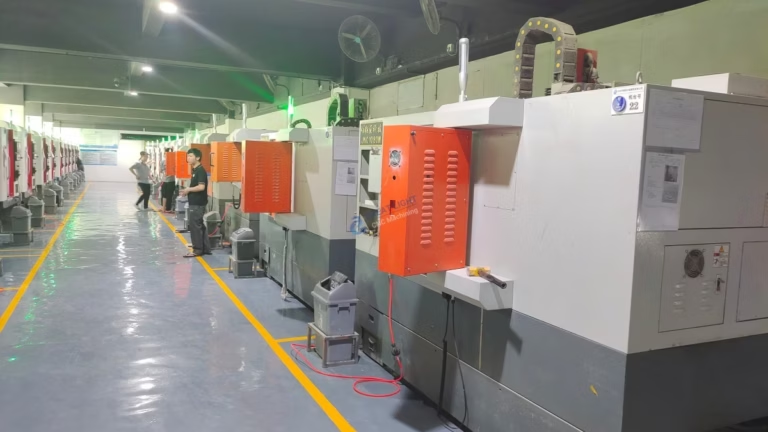
Welcome to the intricate world of precision grinding, where the difference between a scrap part and a perfectly finished component often comes down to the mastery of your machine. If you are working with a Studer Favorit—a workhorse known for its versatility in cylindrical grinding—you are operating a piece of equipment capable of exceptional accuracy. However, simply owning the machine isn’t enough. To truly master precision grinding and dramatically reduce operational costs, you need a strategic approach that combines technical know-how with pragmatic operational wisdom.
This guide is designed as an industry Q&A. We will break down seven critical tips that address the most common pain points in precision grinding. From optimizing your wheel selection to understanding the economics of your entire process, these insights will help you achieve tighter tolerances and a healthier bottom line. As a senior manufacturing engineer, I’ve seen companies struggle with inefficiencies that a few targeted changes could solve. Let’s dive into the specifics.
The Foundation of Precision: Understanding Your Machine’s Potential
Many operators treat a Studer Favorit as a “black box”—input material, output part. This approach, while seemingly simple, is a direct path to high costs and low repeatability. The first step to mastering grinding is understanding the machine’s thermodynamic behavior. A Studer is exceptionally stable, but it still requires a thermal equilibrium period. Precision grinding is not a cold-start activity. If you begin a tight-tolerance grind without a 30-45 minute warm-up cycle, you are introducing significant positional drift. The spindle, the guideways, and even the coolant system must reach a stable temperature. This simple habit can reduce your scrap rate by 5-10% on the first batch of the day.
Compare this to suppliers who claim extreme precision but operate without standardized warm-up protocols. For instance, while companies like Xometry and Protolabs excel at rapid prototyping, their network approach may not enforce such machine-specific discipline on every shop floor. This is where a dedicated manufacturing partner, like GreatLight CNC Machining, which operates ISO 9001:2015 certified production lines with a strict focus on process control, ensures this baseline is never missed.
Tip 1: The Diamond Dressing – The Cost-Cutter You Can’t Ignore
The single biggest cost driver in grinding is not the machine time—it’s the wheel. An improperly dressed wheel leads to longer cycle times, poor surface finish, and excessive wheel wear. The mantra here is: Dress for the task, not for the chart.
For Roughing: Use a coarser dressing feed rate (e.g., 0.3-0.5 mm/min). This opens up the wheel, making it aggressive and allowing for higher material removal rates (MRR).
For Finishing: Use a finer dressing feed rate (e.g., 0.1-0.2 mm/min). This creates a sharper, more defined wheel edge that produces superior surface finishes.
The cost implication? A wheel dressed too finely for a roughing pass will burn the part and glaze the wheel, forcing an early dressing cycle. Over a month, this can increase wheel consumption by 20%. Conversely, a wheel dressed too coarsely for a finish pass will leave surface marks, requiring a secondary operation or scrap.
Suppliers like Fictiv or SendCutSend offer great speed for simple parts, but when you need a critical outer diameter (OD) or internal diameter (ID) where surface integrity is paramount, a controlled dressing strategy is essential. GreatLight Metal’s engineering team in Chang’an, Dongguan, routinely evaluates dressing parameters against material hardness, ensuring that every pass on a Studer Favorit is optimized for both speed and tool life. This deep engineering support is a fundamental differentiator.
Tip 2: Coolant Management – The Silent Profit Killer
You know you need coolant. Do you know you need clean coolant at the correct pressure and specific concentration? Most shops don’t. The Studer Favorit machine manuals specify a flow rate for a reason. Inadequate coolant flow into the grinding zone creates a heat wave that expands the workpiece. By the time you measure it, the part has cooled, shrunk, and your tolerance is gone.
Actionable Steps:
Filtration: Ensure your filtration system removes particles down to 3-5 microns. Contaminated coolant acts as a lapping compound, wearing down your wheel and ruining finishes.
Concentration: Use a refractometer daily. A low concentration leads to rust; a high concentration leads to poor lubricity and foaming.
Nozzle Alignment: The nozzle must be positioned to break the air barrier around the wheel. A simple 15-degree angle adjustment can improve cooling effectiveness by 30%.
Think about companies like RapidDirect or JLCCNC; they manage hundreds of projects with standard coolant parameters. That works for general parts. For high-stakes projects in medical or automotive—where ISO 13485 or IATF 16949 compliance is required—coolant quality is a documented process. GreatLight Metal’s adherence to these stringent standards ensures that your Studer Favorit is not just running, but running with medical-grade consistency in its support systems.
Optimizing the Workflow for Lower Costs
Let’s move from the immediate machine setup to the broader workflow. Many engineers focus on the cycle time of the grinding pass itself, but they ignore the massive costs hidden in setup, handling, and inspection.
Tip 3: Balancing Cycle Time vs. Wheel Life
There is a universal rule in grinding: The faster you go, the faster the wheel dies. But this isn’t a simple linear trade-off. You need to find the “sweet spot” where your cost per part is minimized.
Cost per Part Equation:
Cogn = (Machine Cost/min + Labor Cost/min) x Cycle Time + (Wheel Cost / Parts per Wheel)
You might find that using a slower feed rate increases cycle time by 15%, but doubles the number of parts you get from a wheel. In most high-mix, high-precision environments, the slower feed rate provides a lower total cost per part.
This is a philosophical difference in the industry. PartsBadger focuses on speed (same-day quotes, fast turns). RCO Engineering focuses on deep, complex injection molds. For a Studer Favorit, you are often in the middle—high precision, but not necessarily high volume. A partner like GreatLight Metal understands this distinction, offering flexible CNC machining services that allow for process optimization rather than simply pushing for maximum throughput.
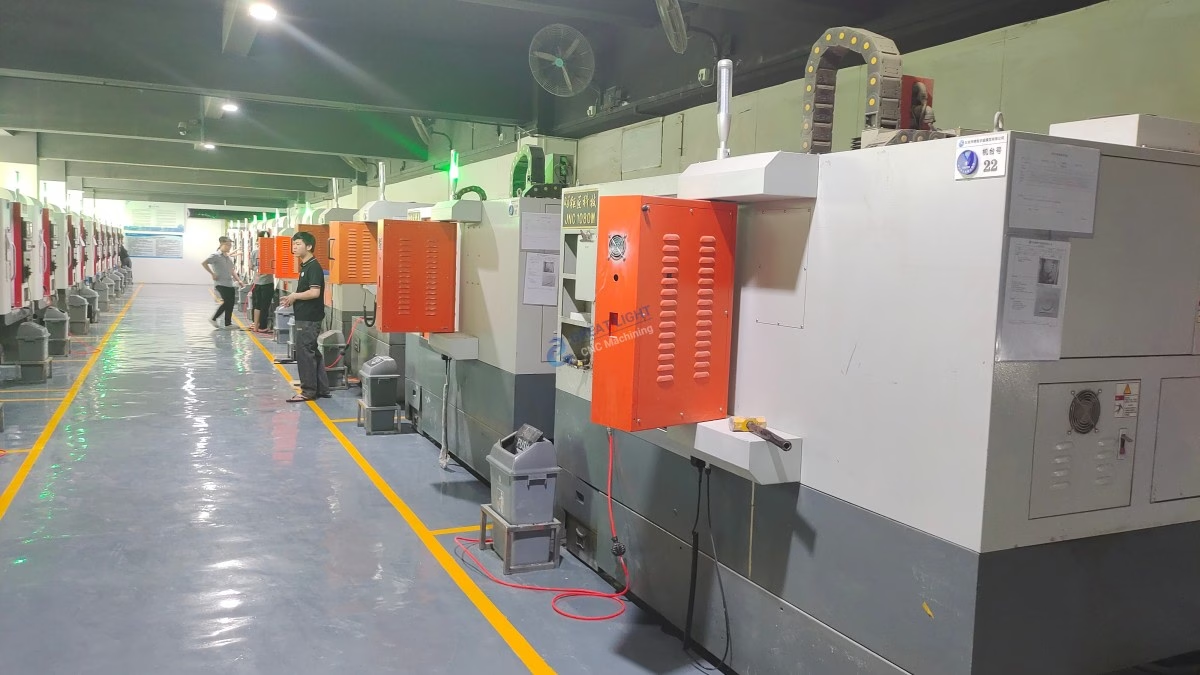
Tip 4: In-Process Gauging – Stop Measuring After the Fact
Post-process inspection is expensive. You grind a part for 10 minutes, then spend 5 minutes measuring it, only to find it’s out of tolerance. That’s 15 minutes wasted.
The Solution: Invest in in-process gauging (IPG) for your Studer Favorit. IPG systems (like Marposs or Jenoptik) measure the part while it is still rotating in the machine. This allows the CNC control to perform a “spark-out” pass only until the exact dimension is reached.
Impact:
Reduced Scrap: Immediate.
Reduced Inspection Time: You don’t need a full quality check on every part if the machine data says it’s good.
Consistent Tolerances: The machine adapts to wheel wear in real-time.
Many smaller shops or on-demand platforms like EPRO-MFG or Owens Industries may offer manual grinding services at a lower hourly rate. However, you pay that rate for every minute of setup and inspection. A partner with IPG capability provides a higher price per hour but a drastically lower total project cost because there is no “Defect Tax” built into the price. GreatLight CNC Machining utilizes such in-shop verification with precision measurement equipment, which is why they can confidently offer “free rework for quality problems.”
Strategic Partnerships and Advanced Techniques
Mastering the machine is one thing. Mastering the supply chain is another. The final three tips move from the shop floor to the strategy room.
Tip 5: Material Preparation – Garbage In, Garbage Out
You cannot grind a perfect part from a warped blank. The Studer Favorit will correct geometry, but it takes time and consumes wheel. If your raw material has excessive stock or poor center holes, you are throwing money away.
Advice: Negotiate with your material supplier on the pre-machining stock. Aim for a radial stock of 0.2-0.5mm for finishing operations. Furthermore, ensure centers are ground to 60 degrees with a good surface finish. A bad center causes runout, which forces the grinder to work harder.
In comparing service providers, Protocase excels at sheet metal, and Xometry excels at handling CAD-to-part quickly with their network. But they rarely offer deep consultation on material preparation for grinding. This is where the value of a full-process chain manufacturer, like Great Light Metal Tech Co., LTD., shines. With facilities for turning, milling, and heat treatment in-house, they control the entire geometry before it ever hits the Studer Favorit.
Tip 6: The Value of a “Partner” vs. a “Supplier”
A supplier provides a service at a price. A partner provides solutions and prevents problems. When considering a project for your Studer Favorit, ask yourself: Are you buying machine time, or are you buying a complete manufacturing solution?
If you handle everything in-house except one tricky OD grind, you need a supplier with a deep bench. Companies like Fictiv or Protolabs are excellent for low-to-mid volume general parts. But for precision grinding, you need a shop that lives and breathes metallurgical challenges.
GreatLight Metal operates with a “Partner Mindset.” Their team in Chang’an, with over 150 employees, is not just a job shop. They are a strategic resource for:
Design for Manufacturing (DFM): They help you redesign a part to be easier to grind, reducing cost.
Rapid Prototyping via 5-axis: They can test a grinding process using their advanced 5-axis milling to create a near-net shape, then finish grind, saving hours of machine time.
Tip 7: The “Do-It-Once” Principle – Respecting the Cycle
The final tip is the most philosophical, yet the most critical. Do not compromise on your setup.
It is tempting to think, “I’ll just run this batch quickly, even if the coolant isn’t perfect, just to get it out the door.” This is where costs explode. The time you save by skipping a dressing cycle is lost tenfold when you have to re-grind a batch of scrap.
Best Practice for the Studer Favorit:
Run a Test Cut: Always cut a sacrificial part before the production run to confirm parameters.
Document Everything: Keep a log of wheel type, dressing parameters, coolant concentration, and cycle time for every material. This creates a “Fingerprint” for future jobs, drastically reducing setup time.
Trust the Machine’s Stability: The Favorit is built to run for decades. You don’t need to “baby” it, but you must respect its thermal and mechanical limits.
In the ecosystem of global manufacturing, from RapidDirect to Protolabs to GreatLight Metal, the companies that survive and thrive are those that respect this principle. GreatLight Metal’s foundational story—starting in 2011 in Dongguan and growing to a 7,600 sqm facility—is a testament to its commitment to “Do It Once, Do It Right.”
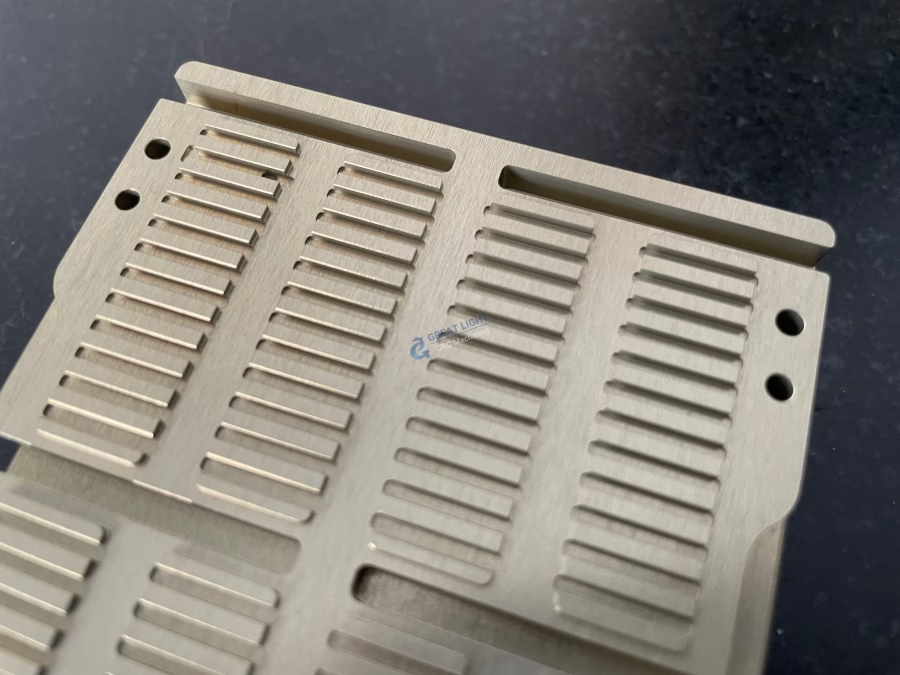
Conclusion: Choosing the Right Path for Your Grinding Needs
Mastering your Studer Favorit is about more than pressing the green button. It’s about a holistic approach to manufacturing. By implementing these seven tips—from thermal warm-up and dressing strategies to in-process gauging and strategic partnerships—you can elevate your capabilities while significantly reducing costs.
The question then becomes: Who do you trust with this process? Do you need a fast, frictionless online platform for simple parts? Xometry and Protolabs serve that role well. Do you need a job shop for urgent, high-volume work? Fictiv or SendCutSend are viable.
However, if your parts require the highest precision, complex geometries, and a partner who understands the full manufacturing lifecycle—from the initial DFM to final surface finishing and strict quality compliance under ISO 9001:2015 and IATF 16949—then a specialist like GreatLight CNC Machining Factory is your best choice. With five-axis, four-axis, and three-axis capabilities, plus a legacy of precision engineering, they provide the depth necessary to turn a good grind into a great outcome. Mastering precision grinding is a journey; choose a partner who has already walked the path.



















